



The labor savings from prefab horse stall kits are often overlooked when estimators see the lower initial price of a weld-it-yourself system. This miscalculation shifts unpredictable expenses, like certified welder rates and inefficient freight, directly to the job site, consistently eroding project margins.
This analysis moves beyond sticker price to compare total landed cost. We benchmark systems on their freight efficiency—comparing 12-set container loads to high-density Steel Pallet Flat-Pack systems—and the integrity of the ISO 1461 galvanized coating after installation.

Weld-It-Yourself vs. Bolt-Together: What is the Real Cost?
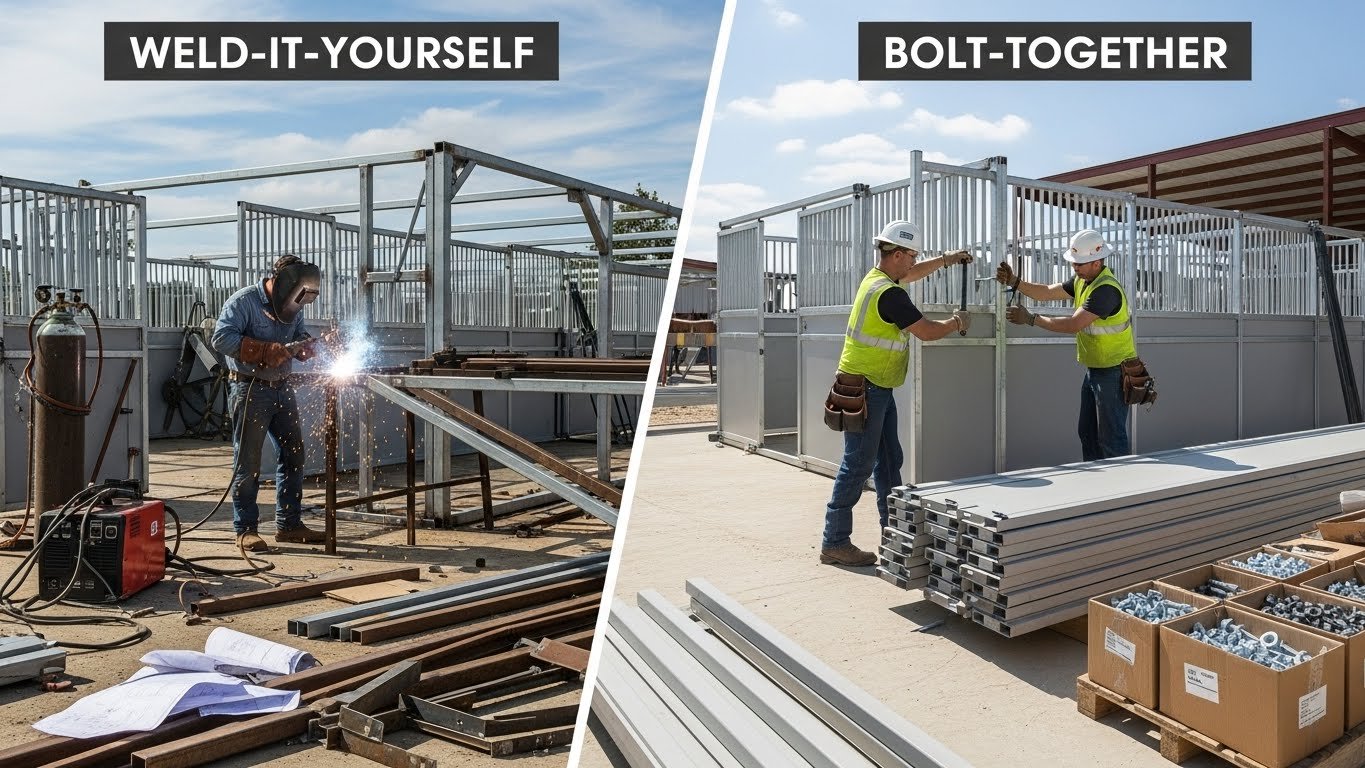
The initial price of a weld-it-yourself kit is misleading. The real cost is hidden in freight, where flat-pack systems save distributors over 60% on shipping.
| Cost Component | Fully Welded System | DB Stable Flat-Pack System |
|---|---|---|
| Initial Product Cost | Appears Lower | Higher (Precision Engineered) |
| On-Site Labor | High & Unpredictable (Requires Certified Welder) | Low & Predictable (General Carpentry) |
| Freight Cost (Per Stall) | Extremely High (12-15 sets per 40HQ container) | 60%+ Lower (30-45 sets per 40HQ container) |
| Total Landed Cost | Often Higher | Consistently Lower |
Analyzing Upfront Costs: Fabrication, Labor, and Materials
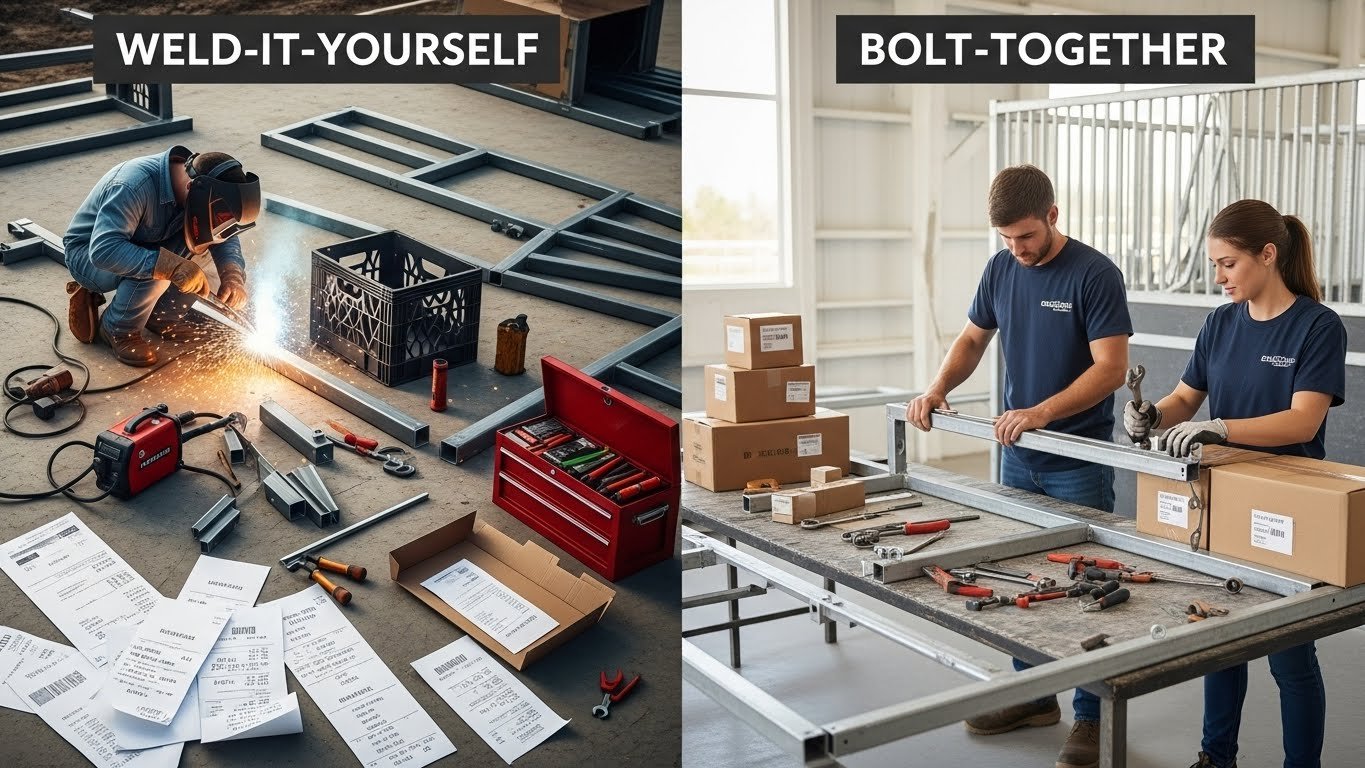
A weld-it-yourself project looks cheap on paper but shifts massive costs to the job site. You become responsible for sourcing certified, insured welders—a variable that introduces unpredictable expenses and timeline risks. A simple weld repair or adjustment can blow the budget.
Bolt-together systems require a higher initial investment in materials because every component is precision-manufactured and pre-drilled in a factory. This controlled factory environment, however, makes fabrication faster and more efficient than manual on-site welding, which helps offset the material expense. The result is a predictable, fixed cost for the product itself.
The Logistics Factor: How Flat-Pack Kits Reduce Freight Costs
Logistics is where the cost difference becomes undeniable. Fully welded stable panels are bulky and inefficient to ship. A standard 40HQ container can only fit 12 to 15 fully assembled sets, making the per-unit freight cost astronomical.
Our Steel Pallet Flat-Pack system changes this equation entirely. By packing components densely, we can load 30 to 45 stable sets into the same 40HQ container. This efficiency directly cuts freight costs by over 60%. For distributors and large-scale contractors, this is not a small saving—it’s direct profit protection. The lower landed cost gives you a significant competitive advantage in your local market.
Why is “Site Labor” the Biggest Hidden Cost in 2026?
Site labor costs spiral due to overlooked burden rates and indirect expenses. A flat-pack, bolt-together system replaces this unpredictability with cost certainty.
Unpacking the Burden Rate and Indirect Labor Costs
Initial project estimates rarely capture the full cost of on-site labor. The base wage is just the tip of the iceberg. The real financial drains come from stacked percentages that contractors often miscalculate or ignore, leading to eroded profit margins.
- Burden Rate: Every worker’s hourly rate carries an additional 35-45% load from payroll taxes, insurance, and paid time off.
- Indirect Expenses: Site mobilization, supervision, and potential rework can add another 20-30% to total labor spending. These costs are rarely tracked accurately.
- Overtime Pressure: A tight labor market means budgeting for 10-15% of total project hours at overtime rates. Unplanned overtime can single-handedly eliminate a project’s profitability.
How a Flat-Pack System Mitigates On-Site Labor Risks
A factory-engineered system shifts labor from the unpredictable job site to a controlled manufacturing environment. This provides cost certainty by minimizing the variables that drive up on-site expenses.
Our system uses a complete bolt-together Installation Kit, which includes pre-cut infill planks and all necessary 304 stainless steel hardware. This design eliminates any need for on-site welding or custom fabrication, removing the requirement for expensive certified tradespeople.
The Steel Pallet Flat-Pack design simplifies logistics and assembly. A small crew with general skills can complete installations efficiently. This standardized approach creates predictable installation times, protecting project budgets from the volatility of overtime and untracked labor costs.
Durable, Compliant Horse Stables for Any Climate
Can a 2-Man Crew Install 10 DB Stalls in One Day?
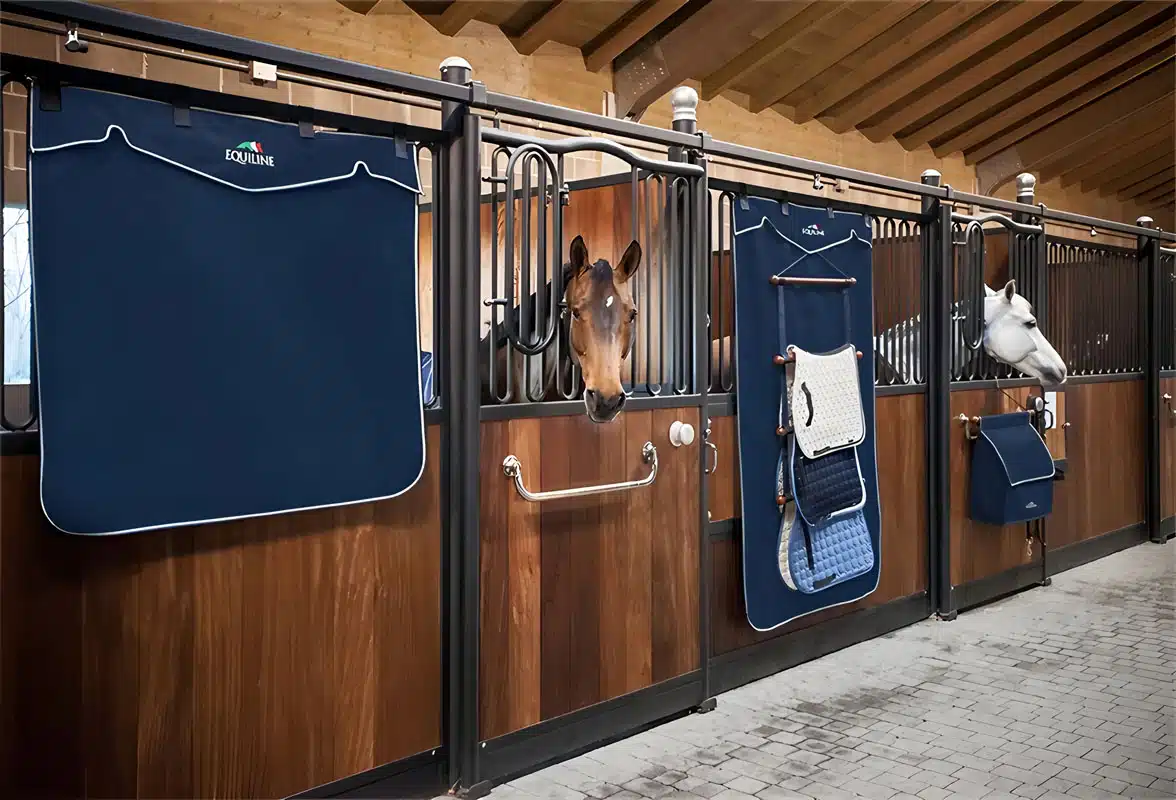
Yes, an experienced two-person crew can install 10 stalls in a full 10-hour day. Success depends on a prepared site and an efficient, bolt-together kit system.
Calculating the Standard Installation Timeline
Industry benchmarks show that a typical two-person crew needs about one hour to assemble and install a single pre-fabricated stall front. Based on this rate, installing 10 stalls requires about 10 hours of focused labor. This timeline assumes the work area is clear, level, and ready for assembly, without factoring in initial site prep or unpacking time.
How the DB Flat-Pack System Accelerates the Process
The goal is achievable because the DB system is engineered to eliminate common on-site delays. The design turns a custom fabrication job into a repeatable assembly process.
- The entire system uses a bolt-together design, which eliminates the need for slow and specialized on-site welding.
- Each stall arrives on a steel pallet as a complete kit, including pre-cut infill planks and a full 304 Stainless Steel hardware set.
- This level of pre-fabrication removes guesswork and minimizes on-site variables, allowing an efficient crew to work like an assembly line.
Does Welding On-Site Ruin the Galvanized Coating?
Yes, on-site welding burns away the protective zinc, creating an immediate rust point. The only way to ensure complete protection is to weld the steel *before* galvanizing.
The Heat-Affected Zone: How Welding Creates a Failure Point
The intense heat from a welding arc vaporizes the zinc coating in the area surrounding the weld. This creates a “heat-affected zone” of bare steel, immediately exposed to moisture and oxygen. Rust starts right there. While some try to patch this failure point with repair sprays, it’s just a surface fix. It cannot replicate the metallurgical bond of a proper hot-dip galvanizing process.
The ‘Hot-Dip After Fabrication’ Solution
Our manufacturing process avoids this problem entirely. We fabricate and fully weld all components from raw Q235B structural steel first. Only after all welding is complete is the entire stall panel submerged in molten zinc. This creates a seamless, uncompromised protective layer compliant with ISO 1461 that covers every weld, corner, and edge. Our bolt-together assembly preserves this factory finish, eliminating the need for any destructive on-site welding.
Which Kit Type Yields Higher Profit for Contractors?
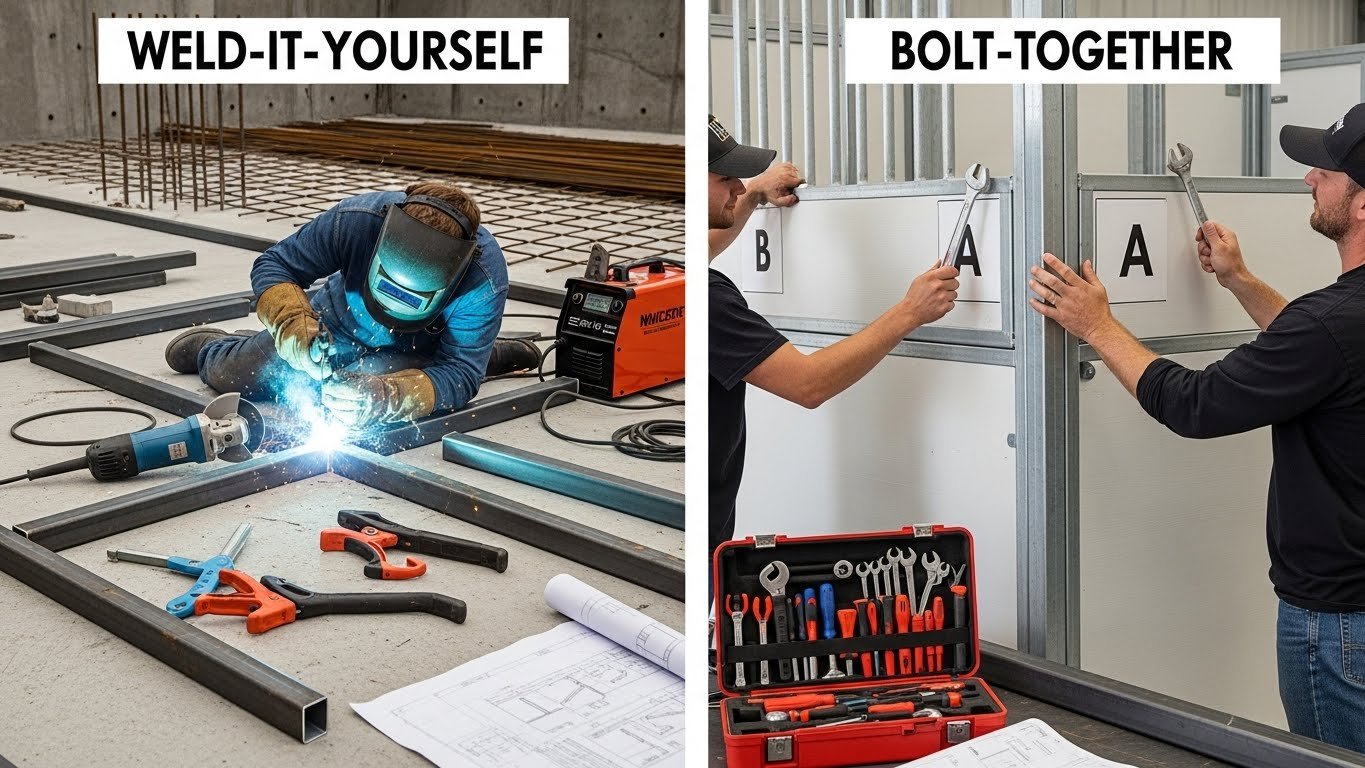
Bolt-together kits yield higher profits. They slash freight costs by over 60% and eliminate on-site welding, letting contractors finish jobs faster and protect their margins.
The Hidden Costs: On-Site Labor vs. Inbound Freight
A contractor’s profit margin on any stable project is dictated by two variables: hours spent on assembly and the cost to get materials to the site. Traditional, fully-welded stable construction attacks margins from both sides. It demands expensive on-site labor for time-consuming measuring, cutting, and welding. Research shows prefabricated systems can cut build time by up to 40%, letting a contractor complete more projects in a season.
Shipping bulky, pre-welded stall panels is also notoriously inefficient. Freight costs can consume a massive portion of a project’s budget before a single post is set. This logistical expense is a major hidden cost that directly erodes profitability.
How Flat-Pack Design Protects Contractor Margins
A modern flat-pack system is engineered to solve both the logistics and labor problems. The DB Stable Flat-Pack System allows 30-45 stable sets to be loaded into a single 40HQ container. This is a huge jump from the 12-15 sets possible with welded panels. This shipping density provides what we call ‘Profit Protection’ by slashing the per-stall freight cost for our B2B clients.
The bolt-together design also eliminates any need for on-site welding. This not only preserves the integrity of the hot-dip galvanized coating but also allows a small, efficient crew to perform the installation. The contractor saves money on specialized labor and completes the project faster, moving on to the next job with healthier margins.
Final Thoughts
A weld-it-yourself kit’s low initial price is a trap for your budget. The true landed cost is driven by freight and unpredictable on-site labor, where our flat-pack system delivers a decisive financial advantage. This isn’t just about a better product; it’s about protecting your profit margins.
Don’t guess on logistics costs—verify them. Request a formal quote with a landed cost analysis for your port. Contact our team to discuss your project requirements and see the engineering difference firsthand.
Frequently Asked Questions
Do you sell horse stalls directly to individual barn owners?
As a dedicated B2B OEM/ODM manufacturer, our business model focuses exclusively on supporting distributors and large-scale project contractors. We do not retail directly to individual end-users, which helps protect the local markets of our distribution partners.
What does ‘Hot-Dip Galvanization After Fabrication’ mean for rust protection?
This is our core quality standard. It means we construct the entire stable panel from raw steel first, and then the fully welded structure is submerged in molten zinc. This process, compliant with ISO 1461, completely coats all surfaces, including the critical weld joints, providing decades of rust protection far superior to competitors who weld pre-galvanized tubes.
How does your flat-pack system reduce shipping costs for distributors?
Our flat-pack design allows us to load 30-45 stable sets into a single 40HQ container. In contrast, traditional fully-welded stalls often fit only 12-15 sets. This high-density loading can reduce sea freight costs by more than 60%, directly protecting the profit margins of our B2B clients.
Which infill material is better: HDPE or Bamboo?
The best choice depends on your project’s needs. Our UV-stabilized HDPE offers a true ‘zero maintenance’ solution that absorbs impacts, ideal for busy commercial facilities. Our high-density strand-woven bamboo is three times harder than oak, providing exceptional durability and a premium aesthetic for high-end equestrian centers.
Are your steel frames suitable for harsh winter climates?
Yes. For regions with severe winters, we recommend our Q345B steel option. This low-alloy, high-strength steel features superior low-temperature impact toughness, ensuring the frame remains resilient against horse kicks and prevents brittle fractures in freezing conditions.
Do I need a certified welder to install a DB Stable kit?
No. Our bolt-together stable systems are engineered for assembly without any welding. All components connect using the provided high-strength 304 stainless steel hardware, making installation straightforward for a two-person crew with basic tools.
Is a kit stall structurally weaker than a custom-welded stall?
Not when engineered correctly. Our systems use heavy-gauge Q235B or optional Q345B steel with precise, robust connection points to ensure structural integrity. The design focuses on distributing force effectively, providing safety and durability comparable to welded stalls.
Will the bolted connections loosen from horse kicks or vibration?
Our systems are designed to maintain tightness. We use high-quality locking hardware and connectors that maintain clamping force under normal conditions. As with any barn hardware, we recommend periodic checks during routine maintenance to ensure everything remains secure.
Can I disassemble and move the stables in the future?
Yes. A key advantage of our modular system is its portability. The stables can be disassembled, transported, and reassembled in a new location, offering excellent long-term flexibility for your facility.
How does your flat-pack shipping save distributors money?
Traditional pre-welded stalls are bulky, limiting a 40HQ container to about 12-15 sets. Our flat-pack design allows 30-45 sets to fit in the same space. This high loading capacity can reduce per-unit freight costs by over 60%, directly protecting your profit margins.
What is meant by ‘Hot-Dip Galvanization After Fabrication’?
This is our core quality standard. We fully weld all the black steel components first, then immerse the entire completed panel into a molten zinc bath. This process coats every edge, weld, and corner inside and out, offering far superior rust protection compared to competitors who weld pre-galvanized tubes.

 English
  Spanish
  French
  Arabic
  German
0 Comments