



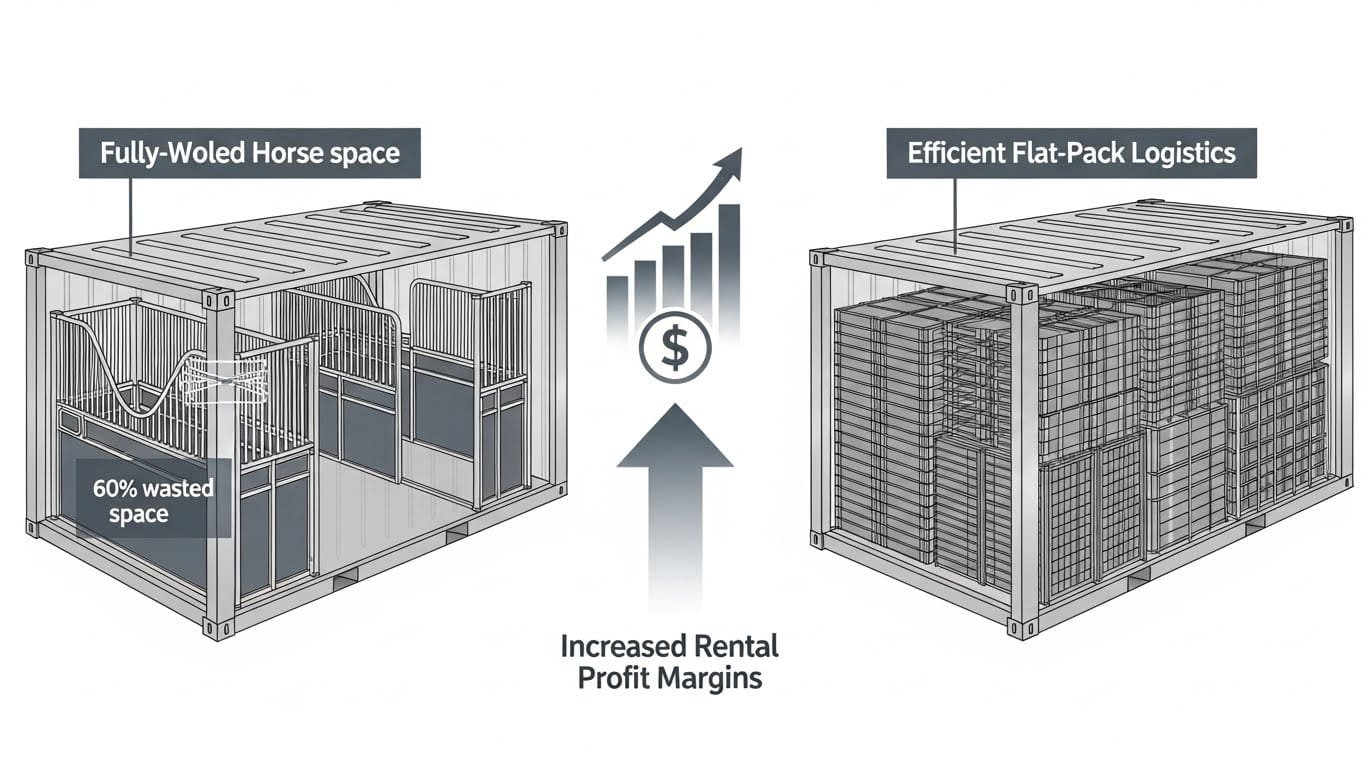
Effective flat-pack logistics for shipping horse stalls is the primary defense against disappearing profit margins. Fully-welded stalls waste over 60% of container space, converting your capital into sunk freight costs before a single unit is rented or sold.
This analysis benchmarks suppliers on the critical metric of container loading efficiency—the difference between 15 and 45 sets per 40HQ. We evaluate the impact of steel pallet packaging and flexible MOQs to help you secure a scalable supply chain.
Why Should You Avoid Cheap Portable Panels?
Cheap panels use thin, pre-galvanized steel that rusts at the welds and bends under pressure. This leads to costly replacements and serious safety risks for horses.
The Hidden Costs of Thin Steel and Poor Coatings
The biggest failure point on budget-friendly panels is rust. Manufacturers cut costs by welding pre-galvanized tubes, which burns off the zinc coating at every joint. These exposed weld points become immediate rust zones, compromising the entire structure. The steel itself is another problem. Many cheap panels use tubing thinner than the industry-safe minimum of 2.0mm wall thickness. This thin steel can easily bend or break from a horse’s kick or even just from leaning, creating a dangerous and unreliable enclosure.
The Lifetime Standard: Hot-Dip Galvanization After Fabrication
The correct manufacturing process involves welding the entire panel first from raw black steel and then fully immersing it in molten zinc. This “hot-dip after fabrication” method completely seals every surface, including all the welds and joints. This process ensures a robust and uniform protective layer that prevents corrosion for decades.
- Governing Standard: The process must conform to BS EN ISO 1461.
- Protective Coating: This achieves a zinc coating of over 70 microns on all tubing, fully protecting the underlying steel.

Top 10 Features to Look for in Portable Stalls
Prioritize stalls with hot-dip galvanized steel frames after fabrication, kick-proof HDPE infill, and designs that minimize shipping costs. These features directly impact safety, longevity, and your bottom line.
When sourcing portable horse stalls, looking past the sales pitch to the engineering specifics is essential. The right features ensure animal safety, reduce long-term maintenance costs, and even protect your freight margins. A stall is a system where every component, from the steel gauge to the connector design, plays a critical role in performance and stability.
| Feature | Key Benefit | Why It Matters for B2B Buyers |
|---|---|---|
| 1. Frame Material & Gauge | Structural Integrity | Demand Q235B or Q345B steel with a minimum 14-gauge (2.0mm) wall thickness. Thinner tubing (<2.0mm) will dent and fail under pressure, leading to costly replacements and safety liabilities. |
| 2. Rust Protection Process | Longevity & Safety | “Hot-Dip Galvanization After Fabrication” is non-negotiable. This process coats welds and cuts, preventing rust. Cheaper pre-galvanized tubing rusts at the weld points within months. Insist on ISO 1461 compliance. |
| 3. Kick-Proof Infill | Animal Safety & Zero Maintenance | HDPE (High-Density Polyethylene) boards absorb impact without cracking and require zero maintenance. Plywood splinters and rots from moisture. High-density bamboo is another premium, durable option. |
| 4. Smart Connector Design | Stability & Security | Snug-fitting connectors are critical to prevent panels from shifting or rattling. Loose connections compromise the entire structure. All hardware, including bolts and screws, should be 304 stainless steel to avoid corrosion. |
| 5. “Cast-Proof” Gaps | Injury Prevention | The gap between the bottom of the stall wall and the ground should be minimal (approx. 50mm). This prevents a horse from getting a hoof or leg trapped when rolling. It’s a small detail that avoids major veterinary bills. |
| 6. Effective Ventilation | Respiratory Health | An open-top grill design promotes “stack effect ventilation,” allowing warm, ammonia-laden air to rise and exit while fresh air is drawn in from below. This is crucial for maintaining a healthy environment. |
| 7. Weather Resistance | Durability in All Climates | Materials must withstand local conditions. This means UV-stabilized HDPE for sunny climates like Australia and Q345B steel with superior low-temperature toughness for freezing European winters. |
| 8. Smooth Edges & Welds | Handler & Horse Safety | All surfaces a horse can touch must be free of sharp edges, weld spatter, or protruding bolts. This is a direct result of quality control during manufacturing and a key indicator of a professional supplier. |
| 9. Modular Assembly | Flexibility & Scalability | The system should allow for easy setup and reconfiguration. A good modular design enables you to adapt layouts for different events or expand your facility without being locked into a fixed configuration. |
| 10. Flat-Pack Shipping | Profit Protection | This is a critical commercial feature. Flat-pack systems on steel pallets can fit 30-45 sets in a 40HQ container, while fully-welded stalls fit only 12-15. This drastically cuts per-unit shipping costs, protecting your import margins. |

Does “Pre-Galvanized” Mean Rust-Proof? (Spoiler: No)
Pre-galvanized steel isn’t rust-proof. Its coating is applied before cutting and welding, leaving raw edges and joints vulnerable to immediate corrosion and structural failure.
The Weak Points of Pre-Galvanized Steel
Pre-galvanized material is a common cost-cutting measure, but it introduces critical points of failure. The process involves coating steel sheets or tubes *before* they are fabricated. This means every cut edge is exposed, raw steel. Welding also burns away the thin zinc layer at every joint. These unprotected areas are where rust begins, compromising the entire structure, especially in damp or abrasive stable environments.
The DB Stable Standard: Hot-Dip Galvanization After Fabrication
We reject pre-galvanized materials entirely. Our standard is **Hot-Dip Galvanization After Fabrication**. First, we fully weld the entire stable panel from raw black steel. Then, we submerge the completed structure in a bath of molten zinc. This process creates a thick, comprehensive coating that protects every surface, corner, edge, and weld.
- Standard: Conforms to BS EN ISO 1461.
- Coating Thickness: Averages over 70 microns (μm) on all tubing.
This method provides both a physical barrier and sacrificial protection, ensuring the structure resists corrosion for decades, not just a few seasons. It is the only way to build a genuinely long-lasting steel stable.

Why Should You Demand HDPE over Plywood?
HDPE provides a zero-maintenance, waterproof solution that won’t rot or splinter. Plywood fails under moisture, creating constant replacement costs and safety hazards for horses.
The Failure Point of Plywood: Moisture and Maintenance
Plywood’s fundamental weakness is water absorption. In a stable environment, it’s constantly exposed to urine, humidity, and water used for cleaning. The wood acts like a sponge, causing it to swell, warp, and eventually rot from the inside out. This isn’t just an aesthetic problem; it’s a recurring operational cost. You get locked into a cycle of sealing, painting, and replacing panels.
Damp, splintering wood also becomes a breeding ground for bacteria and mold. This creates an unhygienic and unsafe environment that directly compromises horse health and welfare.
The HDPE Solution: Zero Maintenance and Impact Absorption
HDPE is engineered to solve plywood’s failures. Our 28mm-32mm UV-stabilized planks are completely non-porous. They cannot absorb moisture, so they will never rot, warp, or swell. This delivers a genuine ‘Zero Maintenance’ infill solution that never needs painting or sealing for its entire lifespan.
The material is also designed for impact absorption, which is why we back it with a ‘Kick-Proof Guarantee’. It prevents dangerous splinters from kicks or impacts, ensuring a safe and hygienic surface that withstands the toughest stable conditions for years.

How Important is the Connector Design?
Connector design is vital for safety and durability. Quality hardware withstands powerful impacts, prevents panel misalignment, and simplifies assembly, directly impacting the stable’s long-term value.
Why Weak Connectors Compromise the Entire System
Connectors and hardware bear the brunt of mechanical stress from horses kicking or leaning against panels. If the hardware is poorly designed, it leads directly to panel misalignment, sagging doors, and serious safety hazards. The quality of these connection points also dictates how easily the stables can be assembled initially or reconfigured later.
Using 304 Stainless Steel for Lasting Integrity
Our entire hardware kit—every anchor bolt, screw, and connector—is made from 304 Stainless Steel. This isn’t a minor detail; it’s a core feature that prevents rust streaks and stops structural failure at the most critical joining points. We also use robust, hot-dip galvanized pins to provide a secure and durable link between panels, ensuring the whole system holds together under pressure.
Durable, Climate-Proof Stables Shipped Worldwide
Final Thoughts
While pre-galvanized panels offer a lower initial price, the ISO 1461 hot-dip after fabrication standard is the only way to protect your inventory from rust claims and safety liabilities. This engineering choice directly defends your profit margins and reputation as a quality supplier. Your long-term success depends on it.
Don’t take our word for it—verify the engineering yourself. We recommend a small trial order to confirm our galvanization quality and precision fitment firsthand. Contact our team to get a detailed quote and discuss your specific distributor requirements.
Frequently Asked Questions
How many stable sets can fit in one shipping container?
Our flat-pack system is designed for logistics efficiency. A standard 40HQ container can hold between 30 to 45 complete stable sets, which is significantly more than the 12-15 sets typical for fully-welded stalls. This design helps our distributors save over 60% on freight costs per unit.
Are your stalls galvanized before or after welding?
We perform hot-dip galvanization *after* all fabrication and welding is complete. This process ensures that every surface, including the welds themselves, is fully coated according to the ISO 1461 standard. This method provides far superior rust protection compared to welding pre-galvanized tubes.
What are the infill material options for the walls?
We offer two premium infill options. The first is UV-stabilized HDPE (28mm-32mm), which is a zero-maintenance solution that absorbs impact. The second is high-density strand-woven bamboo (28mm-38mm), a material three times harder than oak and naturally resistant to mold and rot.
Are these stalls suitable for regions with very cold winters?
Yes. For cold climates, we recommend upgrading to Q345B steel. This material maintains superior impact toughness at low temperatures, preventing the risk of brittle fractures from horse kicks in winter. It is a common choice for our partners in Europe and North America.
What is your Minimum Order Quantity (MOQ) for distributors?
We offer flexible tiers to support our partners. A trial order can be as small as 3-5 sets. A project order typically fills a 20GP container (about 10-15 sets), and a full distributor order is based on a 40HQ container (30-45 sets) to achieve the best shipping value.
How can I confirm the steel is truly hot-dip galvanized?
Hot-dip galvanized steel has a distinct matte gray finish, sometimes with a spangled pattern. Unlike paint, this coating is metallurgically bonded. Our process is strict: we weld the raw steel first, then dip the entire component. This follows the BS EN ISO 1461 standard, guaranteeing a zinc coating over 70 microns thick for genuine, long-term rust prevention.
Are there any sharp edges on the panels or doors?
No. Every edge is smooth to prevent injury. Our engineering process is built around high animal welfare, including a ‘Cast-Proof’ design with minimal bottom gaps to stop a horse’s leg from getting stuck when rolling. Safety for both horses and handlers is a primary design requirement.
What is the warranty on your stable systems?
Our stable systems are backed by a comprehensive structural warranty. The hot-dip galvanized steel framework is warrantied against rust-through for 10 years under normal operating conditions. All moving components, such as door hardware and swivel feeders, are covered for 1 year against manufacturing defects. This warranty reflects our commitment to high-quality materials and engineering standards.
Does the system include all necessary hardware for installation?
Yes, every system ships as a complete flat-pack kit on a steel pallet. This includes all required 304 Stainless Steel hardware like anchor bolts and connectors. We also provide a cold galvanizing touch-up spray to fix any minor scratches that might happen during assembly, ensuring full rust protection.

 English
  Spanish
  French
  Arabic
  German
0 Comments