


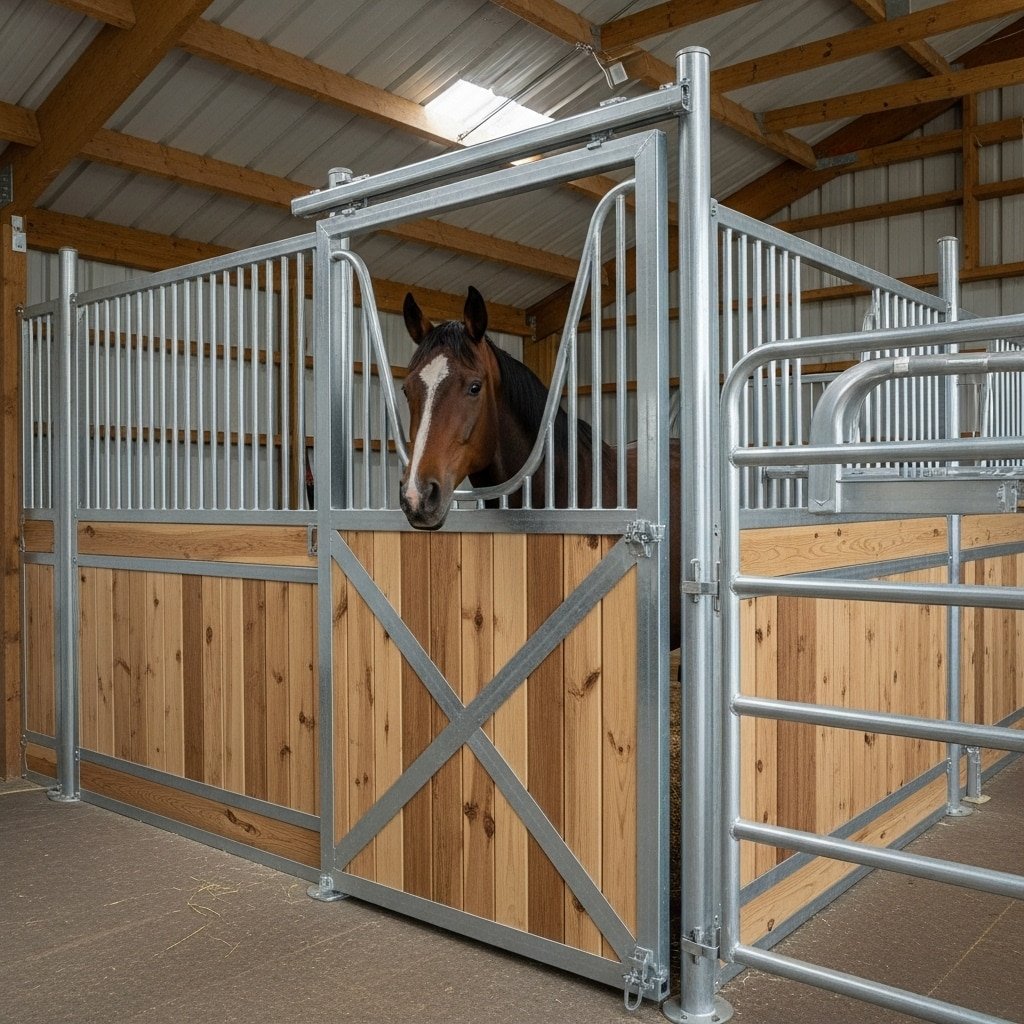
Correctly installing stall fronts in an existing barn is more than a simple retrofit; it’s a critical safety upgrade that addresses hidden liabilities. A common DIY mistake is focusing only on the frame, ignoring hazards like improper bar spacing or gaps under doors that lead directly to vet bills and animal injury.
This guide provides the technical steps for a professional-grade installation. We focus on securing hot-dip galvanized steel frames and ensuring your setup meets modern safety benchmarks, including the ‘cast-proof’ 50mm bottom gap that prevents a horse from getting trapped when rolling.

Is Your Old Barn a Safety Trap for Modern Horses?
Yes, old barns are a liability. Outdated designs with splintering wood, wide bar gaps, and sharp edges cause injuries that modern, engineered stalls are built to prevent.
Common Hazards in Traditional Stall Designs
Many older barns weren’t designed with today’s equine safety standards in mind. They were built for utility, not for the nuances of horse behavior. This leaves a legacy of hidden dangers that can lead to costly vet bills or worse.
- Cuts and Abrasions: Splintering wood planks, rough welds, and protruding bolts are common. A simple rub against a wall can turn into a nasty cut.
- Trapped Limbs: Gaps between stall bars are often too wide—sometimes 3-4 inches. This is a classic trap for a horse that kicks, rears, or rolls, allowing a hoof or leg to get stuck.
- Toxic Materials: Old lumber was often treated with chemicals that are toxic if chewed. Horses that crib or chew on stall walls can ingest these substances over time.
- Respiratory Issues: Solid-wall designs without proper top grills create stagnant air. Poor ventilation traps ammonia and dust, leading directly to respiratory problems.
Solving Old Problems with Modern Engineered Materials
You don’t fix these structural flaws with patch-up jobs. The solution is to use materials and designs that eliminate the risks from the start. This is about engineering safety into the core product, not adding it as an afterthought.
- Eliminating Splinters and Chewing: Instead of wood, we use non-toxic, impact-absorbing HDPE or high-density bamboo infills. HDPE offers zero maintenance, and our bamboo is three times harder than oak, making it resistant to chewing and rot.
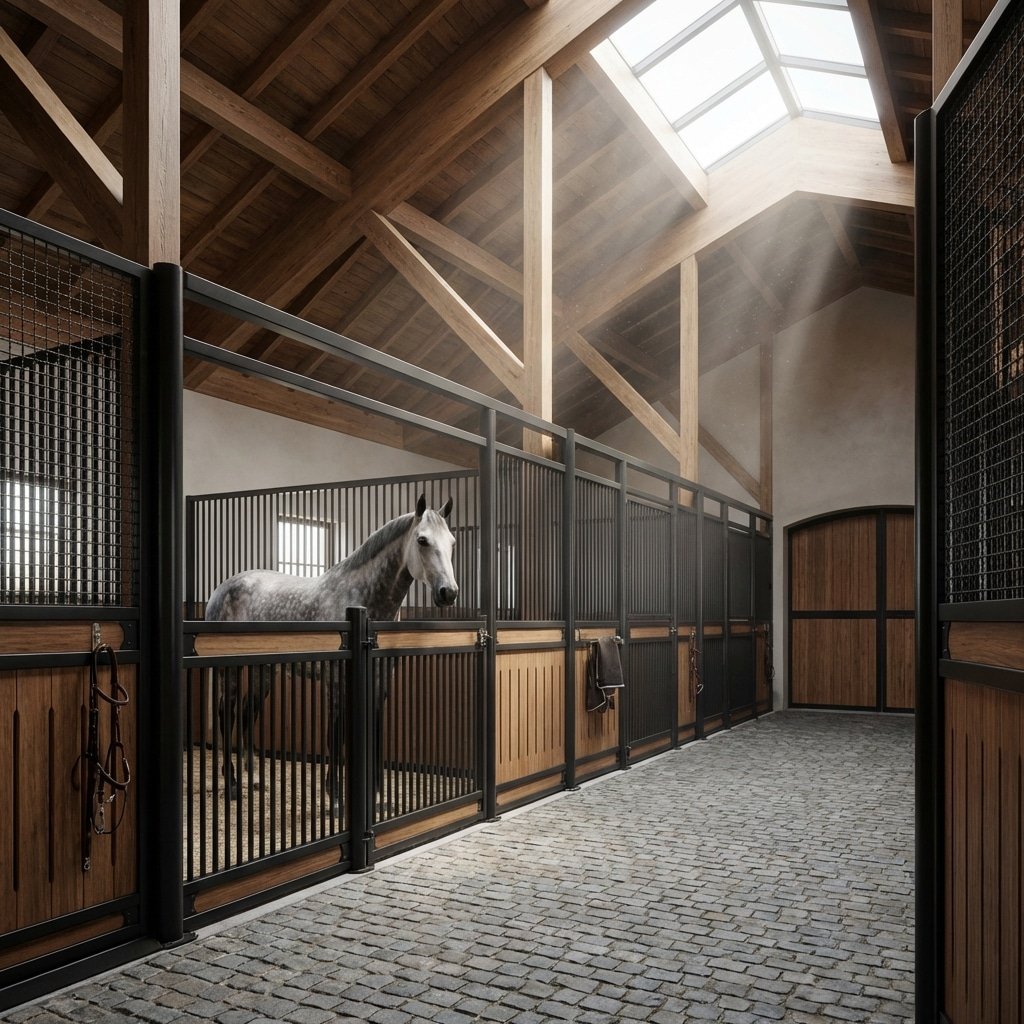
- The Cast-Proof Design: Our stalls feature minimal bottom gaps. This design specifically prevents a horse’s legs from getting stuck under the partition when rolling, a common and dangerous situation known as being “cast.”
- A Kick-Proof Framework: The frame is built from Q235B structural steel, with an option for Q345B for cold climates. This high-strength steel is engineered to absorb impacts from kicks without failing or creating sharp breakages.
- Smooth, Rust-Proof Welds: We use a process called ‘Hot-Dip Galvanization After Fabrication.’ The entire steel panel is welded first, then dipped in molten zinc. This coats every surface and smooths every weld, eliminating sharp edges and guaranteeing rust protection that meets ISO 1461 standards.

Best 10 Safety Features to Retrofit in 2026
Key 2026 stable retrofits focus on impact absorption, anti-casting designs, and fail-safe doors. The best systems use high-density polyethylene (HDPE) and robust hot-dip galvanized steel frames.
Upgrading an older barn isn’t about aesthetics; it’s about mitigating liability and protecting valuable animals. Many facilities built even 15 years ago fail to meet modern safety expectations, creating hazards from kick-through walls, trapping gaps, and poorly designed hardware. The following retrofits address the most common failure points we see in the field.
| Safety Retrofit | Key Specification & Rationale |
|---|---|
| 1. Kick-Resistant Wall Infill | Replace old wood planks that splinter. Use 28mm+ UV-stabilized HDPE for zero maintenance and impact absorption, or high-density bamboo for extreme durability. This is a core part of any “kick-proof” system. |
| 2. Smooth, Snag-Free Finishes | Eliminate all protruding bolts, sharp weld spots, and corners. Frames should be hot-dip galvanized *after* fabrication to ensure a smooth, uniform coating that covers welds and prevents injuries. |
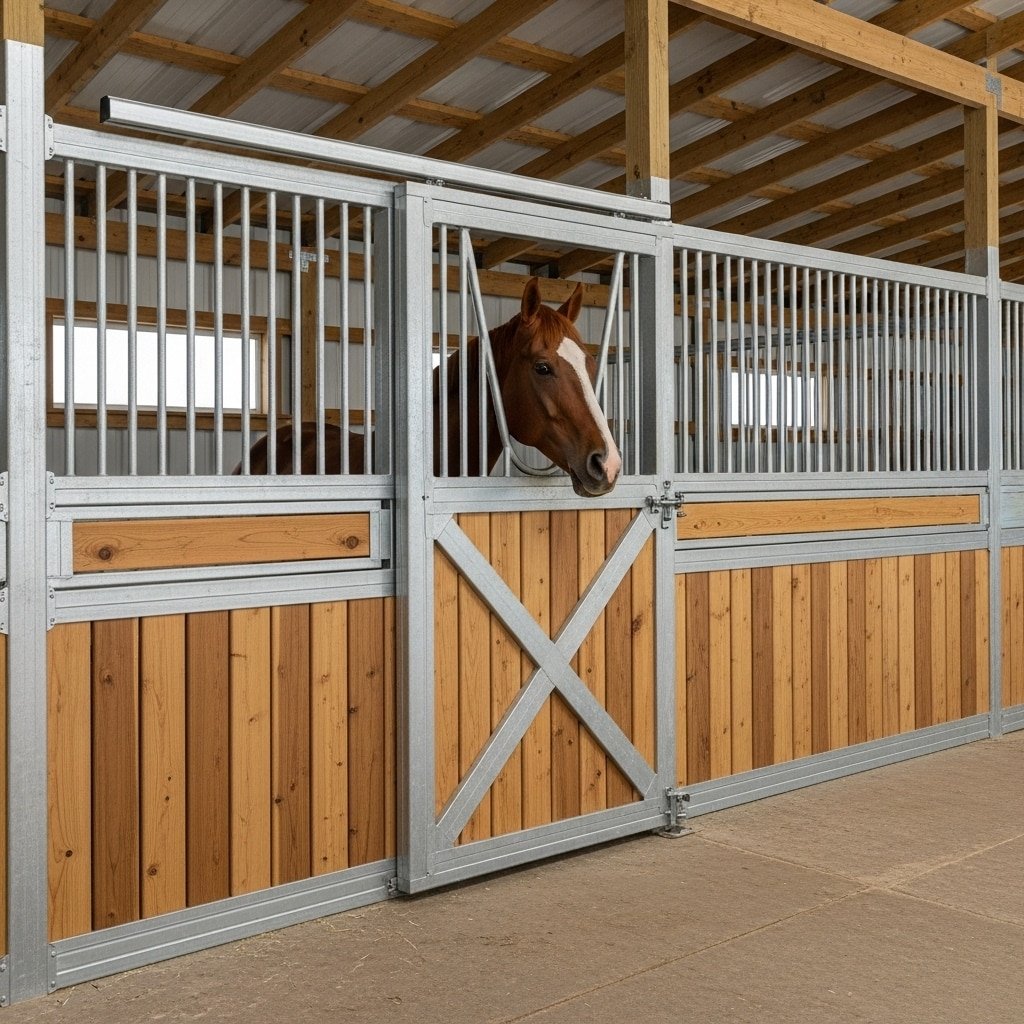
| 3. Modernized Bar & Grill Spacing | Old 3-4 inch gaps are a major trapping hazard. The current safety standard is a 2-inch gap between bars on upper sections and 1.5 inches on lower sections to prevent a hoof from getting caught. |
| 4. Sliding Stall Doors | Replace inward-swinging doors. Sliding doors are safer, save valuable aisle space, and remove the risk of a horse getting trapped behind a partially open door. |
| 5. “Cast-Proof” Bottom Gaps | The gap under stall doors and partitions must be minimal. A gap of around 50mm (2 inches) is large enough for drainage but too small for a horse to get a leg stuck underneath when rolling. |
| 6. Horse-Proof Latches | Install latches designed for one-handed human operation but are difficult for a horse to manipulate. Snag-free designs without sharp edges also prevent injuries to handlers’ fingers. |
| 7. Interlocking Rubber Stall Mats | Loose mats curl and create trip hazards. A system of interlocking rubber mats over a compacted stone base provides a stable, non-slip, and cushioned surface that won’t shift. |
| 8. Raised Ceilings & Ventilation | Ceilings should be at least 9 feet high. Open-top stall grills are not just for visibility; they create a “stack effect” that pulls ammonia and dust up and away from the horse’s breathing zone. |
| 9. Fortified Steel Frame | Ensure the underlying structure is sound. Modern systems use Q235B or Q345B structural steel with a minimum wall thickness of 2.0mm to withstand impacts without deforming. |
| 10. Protected Electrical Fixtures | Encase all lighting and wiring in durable, sealed covers. Fixtures must be installed high enough to be out of a horse’s reach to prevent electrocution or fire hazards. |
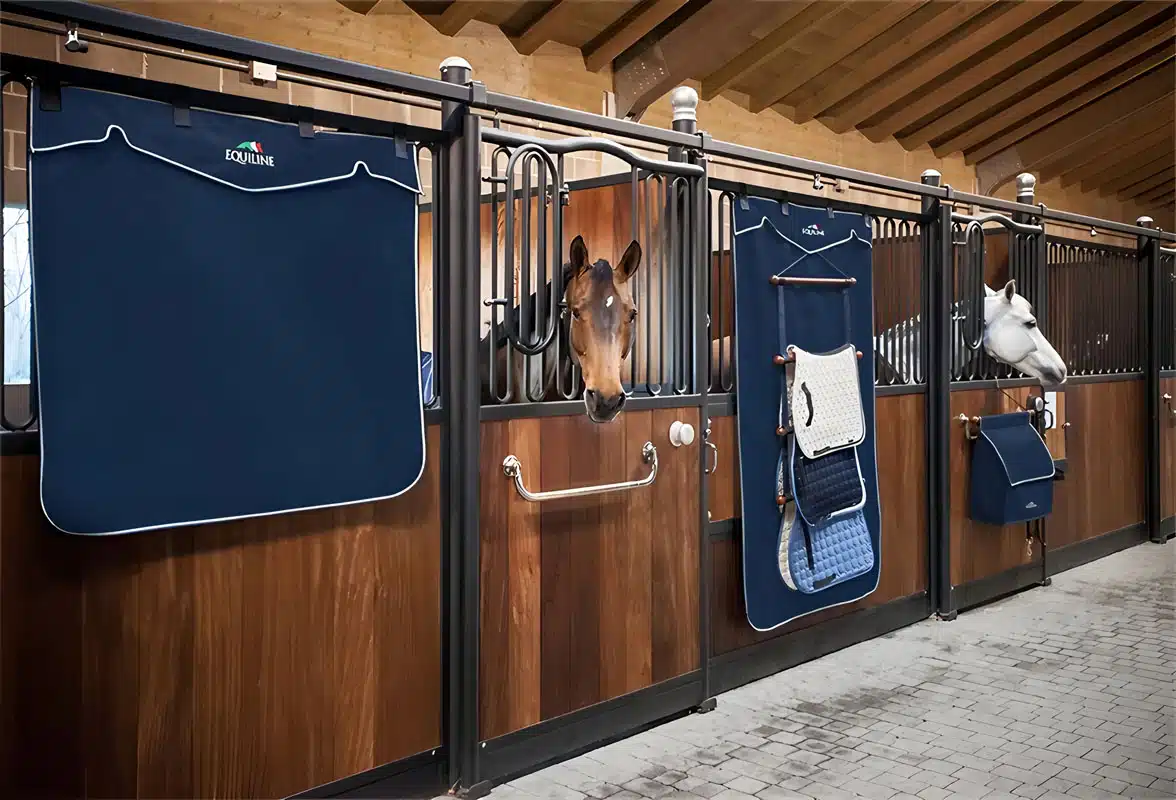
Engineered Stables for Maximum Durability & Safety.
Why You Must Replace Old Bar Spacing (3-Inch Rule)?
Old bar spacing wider than 3 inches is a severe entrapment hazard. A horse can easily trap a hoof or head, causing panic and serious injury. Adopting modern, tighter spacing is essential.
The Entrapment Dangers of Wide Gaps
Many older horse stalls were built with vertical bar spacing of 4 inches or more. This creates a gap perfectly sized to trap a horse’s hoof. During normal behaviors like pawing, kicking, or rolling, a horse can easily slide a leg through and get stuck. The resulting struggle often leads to devastating injuries like fractures or severe tendon damage.
The risk is even greater for foals and smaller breeds. Their smaller heads can become lodged in these wide gaps, causing panic, asphyxiation, and potentially fatal injuries. What was once considered standard is now recognized as an unacceptable safety liability.
Modern Safety and the ‘Cast-Proof Design’ Principle
Modern stall engineering focuses on eliminating all potential entrapment points, not just the obvious ones between vertical bars. It’s about a comprehensive approach to animal welfare. For example, our DB Stable systems incorporate a ‘Cast-Proof Design’ that addresses a different, but equally dangerous, risk.
This design ensures the gap between the bottom of the stall wall and the floor is minimal—approximately 50mm. This small gap prevents a horse from getting its legs caught underneath the wall when rolling over. This principle shows that true safety goes beyond just the traditional 3-inch rule for bars and considers every potential hazard in the stall environment.

How to Fix “Cast Traps” Under Old Doors?
A “cast trap” is a dangerous gap under a stall door where a horse can get its leg stuck. The correct fix is a stable front with a ‘Cast-Proof Design’ maintaining a minimal, safe clearance of 50mm.
Understanding the Danger of Gaps Under Stall Doors
A horse is ‘cast’ when it lies down or rolls too close to a wall and gets a leg trapped, making it impossible to stand back up. It’s a common and extremely dangerous situation that causes panic and can lead to severe injuries or even death.
Old, warped, or poorly fitted stall doors are a primary cause of these traps. Uneven flooring combined with a large gap creates a perfect wedge for a hoof or leg to slide into when a horse is rolling. Once the leg is stuck, the horse’s struggle can cause fractures, torn ligaments, or exhaustion.
Attempting to patch this with residential fixes like rubber sweeps or weatherstripping is a mistake. These materials are not designed to withstand the kicks, pressure, and abrasive environment of a horse stable. They will tear off quickly, offering a false sense of security while failing to solve the underlying engineering problem.
The Solution: A Standardized ‘Cast-Proof Design’
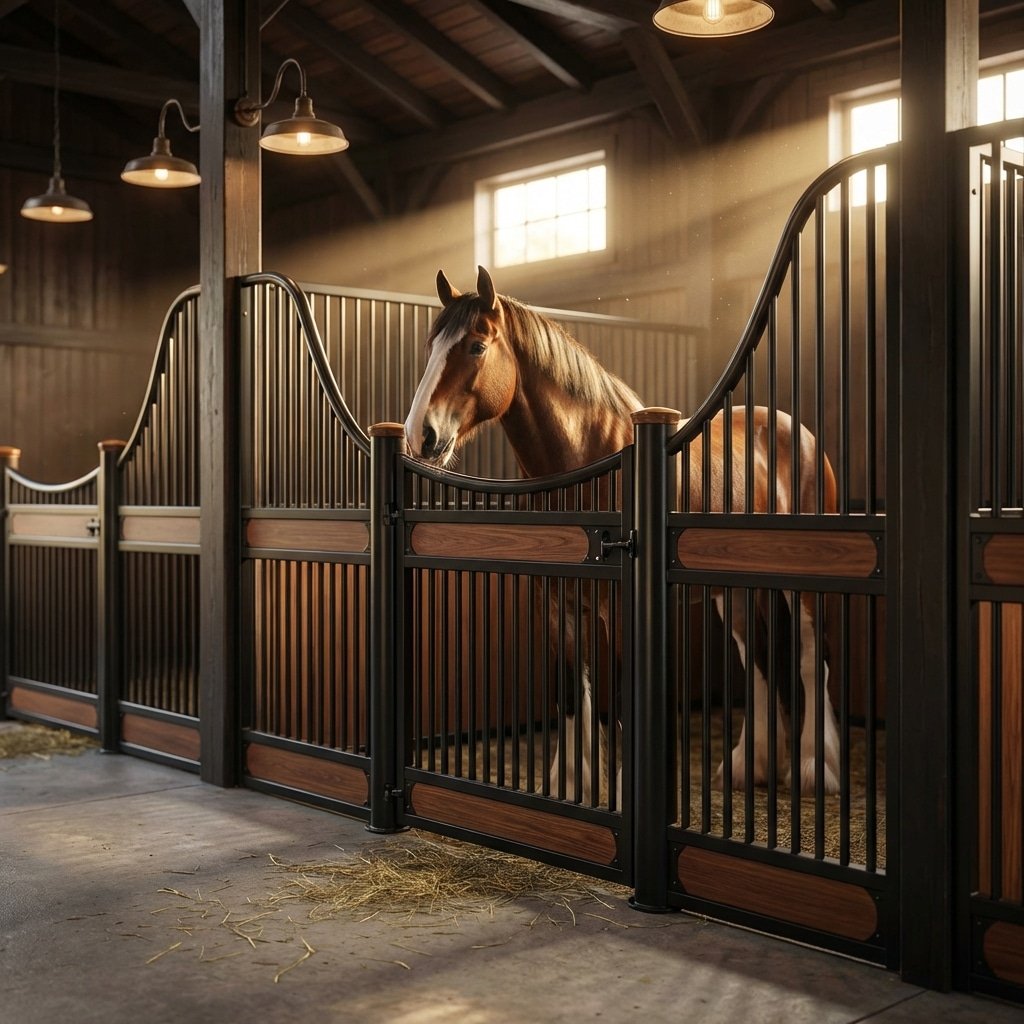
The only reliable fix is an engineered one. The accepted safety standard in modern stable manufacturing is a ‘Cast-Proof Design’ that strictly limits the gap under the door. DB Stable engineers its stall fronts with a precise clearance of approximately 50mm (about 2 inches).
This specific dimension is not arbitrary. It’s large enough for air circulation and to allow bedding to be moved in and out without jamming the door. But it is critically too small for a horse’s hoof or lower leg to become wedged underneath. This design detail eliminates the cast trap risk at its source, ensuring the horse can roll safely without the possibility of entrapment.

Are Your Old Latches Finger-Safe?
Many older stall latches have exposed pinch points and sharp edges. Modern systems use complete, engineered hardware kits to eliminate these risks for safer handling.
Identifying Pinch Points in Traditional Latch Designs
Older latches often create serious pinch hazards right where you operate them. The design itself, with a large gap between the sliding bolt and the frame, creates a perfect shearing point for a finger. Over time, these components wear down. They might not align correctly, forcing you to jam the latch shut and increasing the chance of an injury. This wear also creates sharp metal edges that can easily catch or cut a hand.
The Safety Advantage of a Complete Hardware Kit
This is why a complete system makes sense. DB Stable systems include a full hardware kit where every component is engineered to work together. The parts are made from durable 304 Stainless Steel, ensuring they won’t degrade into sharp hazards. Because the hardware is designed specifically for our stable fronts, the fit is precise. This precision eliminates the dangerous gaps and misalignments common in older, pieced-together hardware, resulting in smoother and much safer operation.
Frequently Asked Questions
Can I just weld new bars into my existing stall front?
Welding new bars requires professional techniques. Manufacturers use specialized concealed welding, recessing bars into the frame before welding them from the inside. This creates a clean, safe finish without exposed edges. DIY welding can compromise the stall’s structural integrity and create safety hazards for your horse.
Is a 4-inch gap between stall bars considered safe?
A 4-inch gap poses a significant safety risk, as it can be large enough for a horse, particularly a foal, to trap a hoof. Industry best practice recommends much tighter spacing, typically a 2 to 3-inch actual gap between bars, to prevent injuries. For clearance under a door, the gap should be less than 3 inches.
What is the best way to close the gap at the bottom of a stall door?
To effectively seal the gap under a stall door, installing a durable door sweep is the most common solution. These come in various styles, including aluminum and vinyl sweeps. For a simpler, temporary fix, adhesive weather-stripping can also be used.
Can I install a new night latch on an old stall door?
Yes, retrofitting a night latch onto an existing door is a common task. Most latches are designed for standard door thicknesses. The process involves carefully marking and drilling a new hole for the lock cylinder and ensuring the latch body is properly aligned with the door frame.
Are replacement safety grills available for purchase separately?
Yes, many manufacturers offer safety grills for stall fronts and partitions as separate components. This allows you to replace damaged sections or upgrade older stalls. They are typically available in standard sizes and can often be ordered in custom dimensions to fit a specific opening.
Final Thoughts
While patching old stalls seems cheaper, it fails to eliminate the core liabilities. An engineered system using hot-dip galvanized steel and a cast-proof design is the only way to prevent the injuries that lead to costly vet bills. This isn’t just an upgrade; it’s a permanent solution that protects both your animals and your reputation.
Your next step is to verify the engineering yourself. We recommend a small trial order of 3-5 stables to confirm the precise fitment and the quality of our ISO 1461 galvanization. Contact our team to get a quote and discuss your project’s specific requirements.

 English
  Spanish
  French
  Arabic
  German
0 Comments