


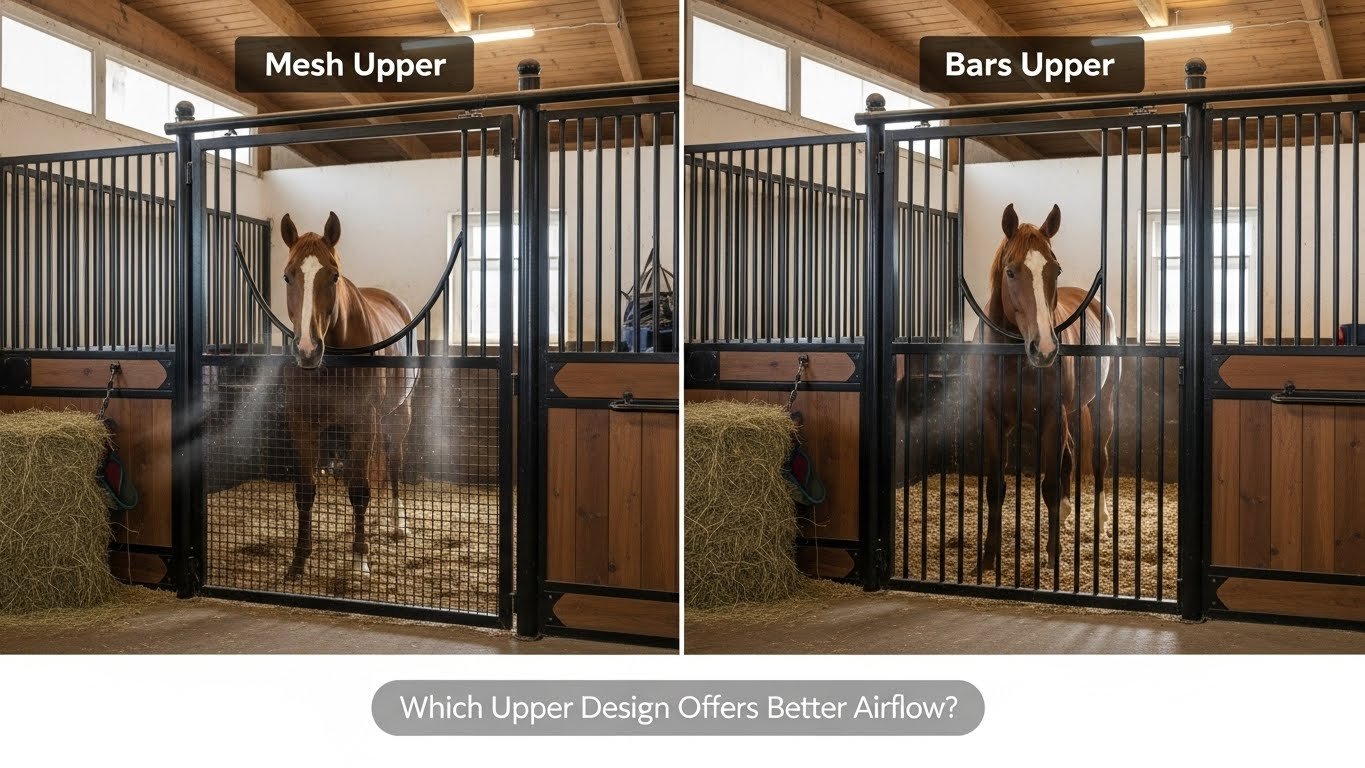
Ensuring optimal barn air quality is critical for the health and performance of horses, and for worker safety. The choice of upper stall design directly affects ventilation, influencing key factors like ammonia levels, dust, and temperature within equine environments. Making an informed decision here impacts long-term operational efficiency and animal welfare.
This article examines the ventilation capabilities of mesh versus vertical bar designs for horse stalls. We look at how each design impacts airflow, from mesh options that offer 80-100% open area for air circulation to vertical bar standards that maintain specific safety and airflow, like 1-inch spacing for lower panels. We also discuss considerations for hot climates and the balance between airflow and privacy.
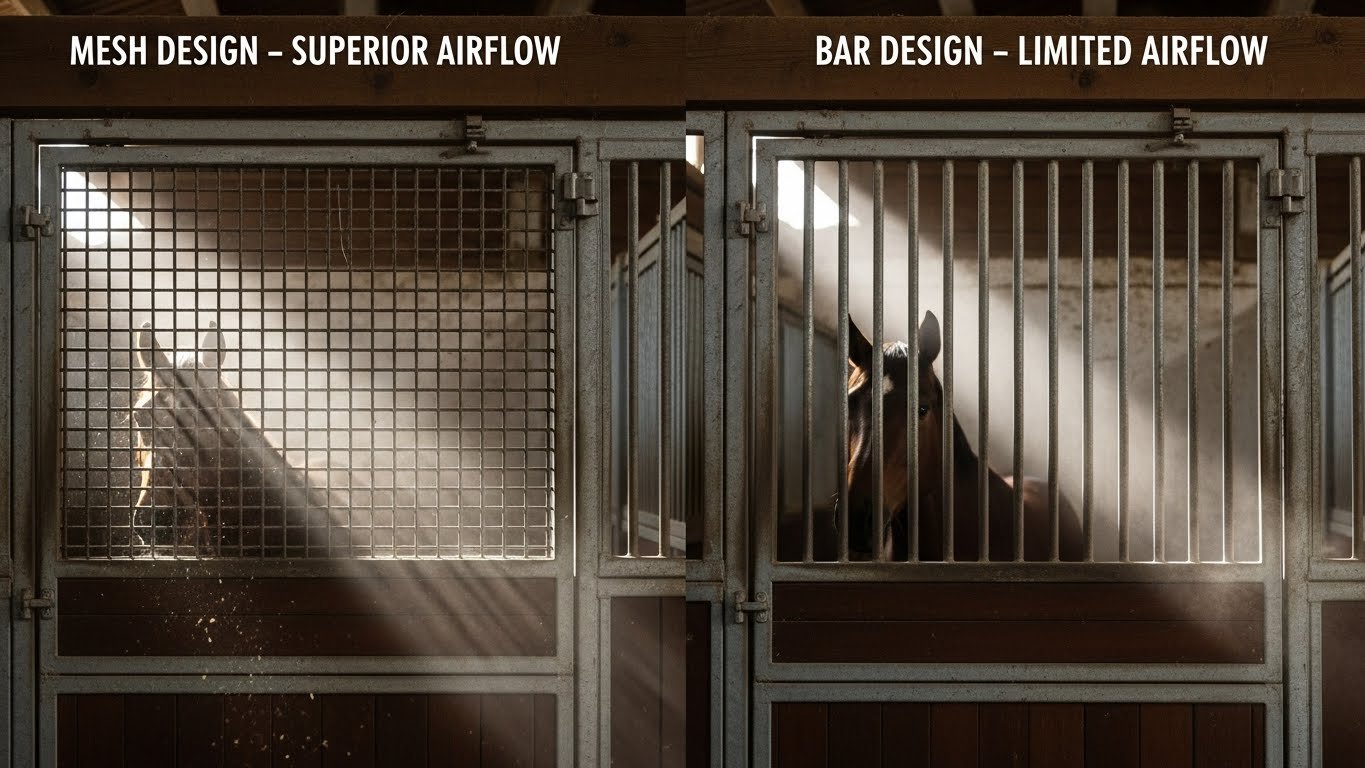
The Importance of Barn Air Quality
Maintaining optimal barn air quality is essential for horse health, performance, and worker safety. This involves controlling key contaminants like ammonia, carbon dioxide, and particulate matter within specific engineering targets, along with managing temperature and humidity. Effective ventilation and design strategies are vital for achieving these standards.
Defining Optimal Air Quality for Equine Environments
Ammonia (NH₃) levels should ideally remain below 10 ppm for animal and worker comfort, with an occupational safety threshold of 25 ppm.
Carbon dioxide (CO₂) targets for acceptable indoor air quality are between 1000–1500 ppm, well below the 5000 ppm occupational limit.
Respirable particulate matter (PM₂.₅ and PM₁₀) needs to be minimized to approach WHO 2021 guidelines (PM₂.₅ ≤ 15 µg/m³ and PM₁₀ ≤ 45 µg/m³ 24‑h means).
Maintaining a consistent indoor temperature range of 20–24 °C and relative humidity of 40–60% supports air quality control.
Engineering Targets for Effective Ventilation Systems
Ventilation systems must be designed to achieve and maintain contaminant concentrations significantly below occupational thresholds, targeting comfort bands.
Outdoor air quality strongly influences indoor particulate levels, with a Spearman coefficient Rₛ of +0.95 to +0.99 for PM₂.₅ and PM₁₀ levels inside and out.
Effective design integrates filtration, optimized airflow patterns, and meticulous bedding management to control particulates.
Barns may require continuous exhaust capacities, such as 9,400 m³/h, to manage air exchange effectively, even without filtration, to meet particulate targets.
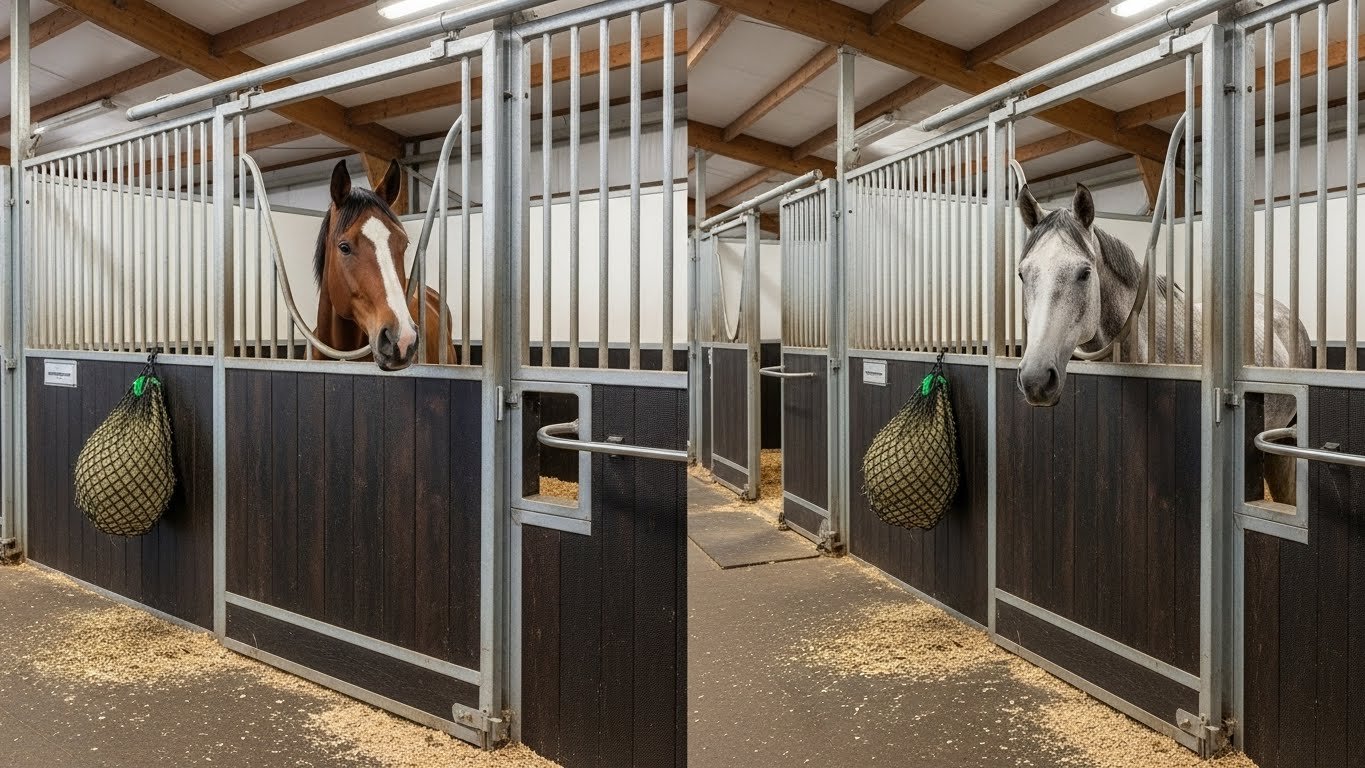
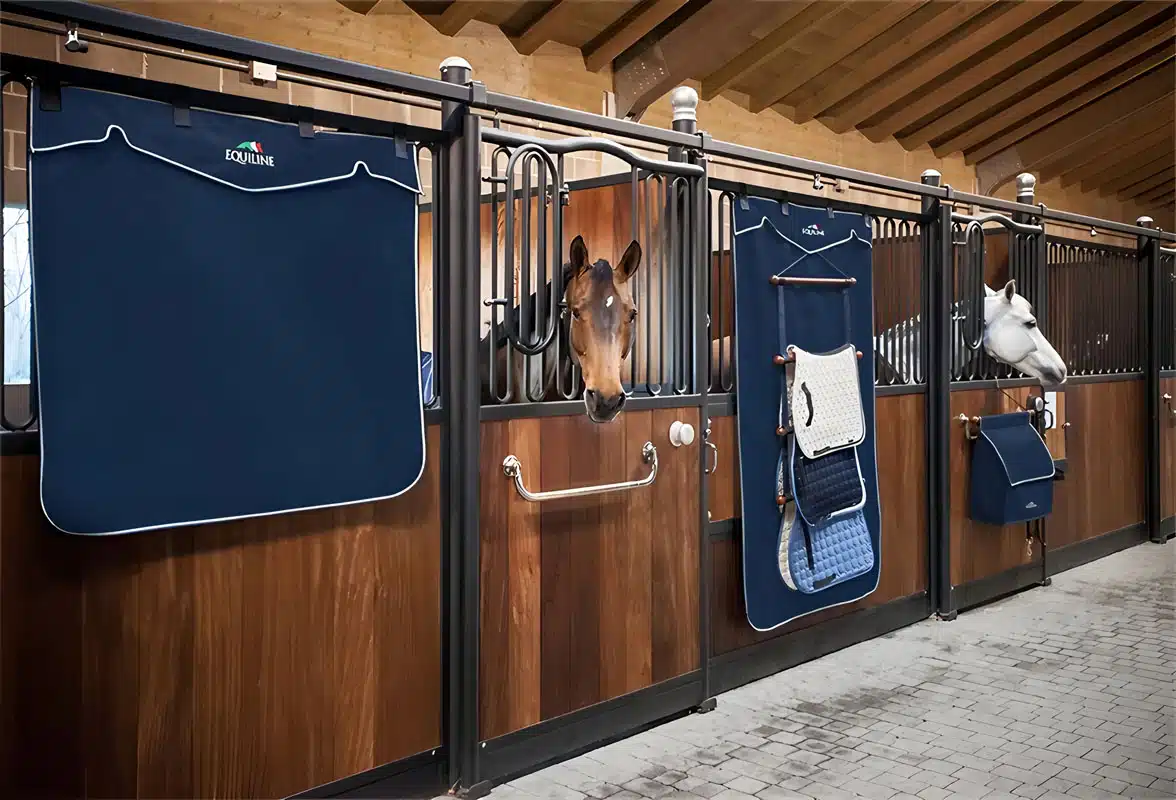
Vertical Bars (Classic Look, Good Flow)
Vertical bars offer a classic aesthetic for horse stalls while promoting essential natural airflow, preventing drafts, and ensuring safety through precise spacing. By 2026, designs balance ventilation needs with structural integrity, adhering to specific bar dimensions and spacing for optimal equine environments.
Integrating Vertical Bars for Natural Airflow
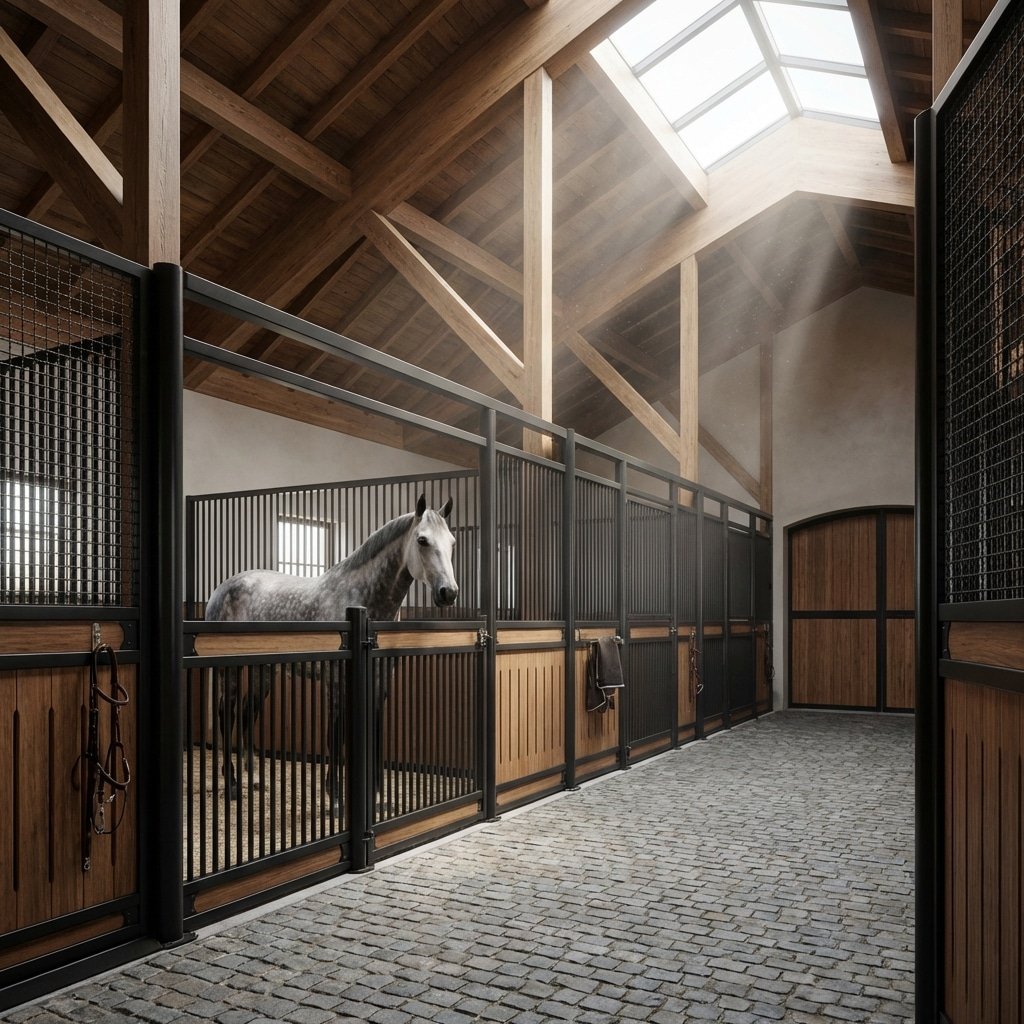
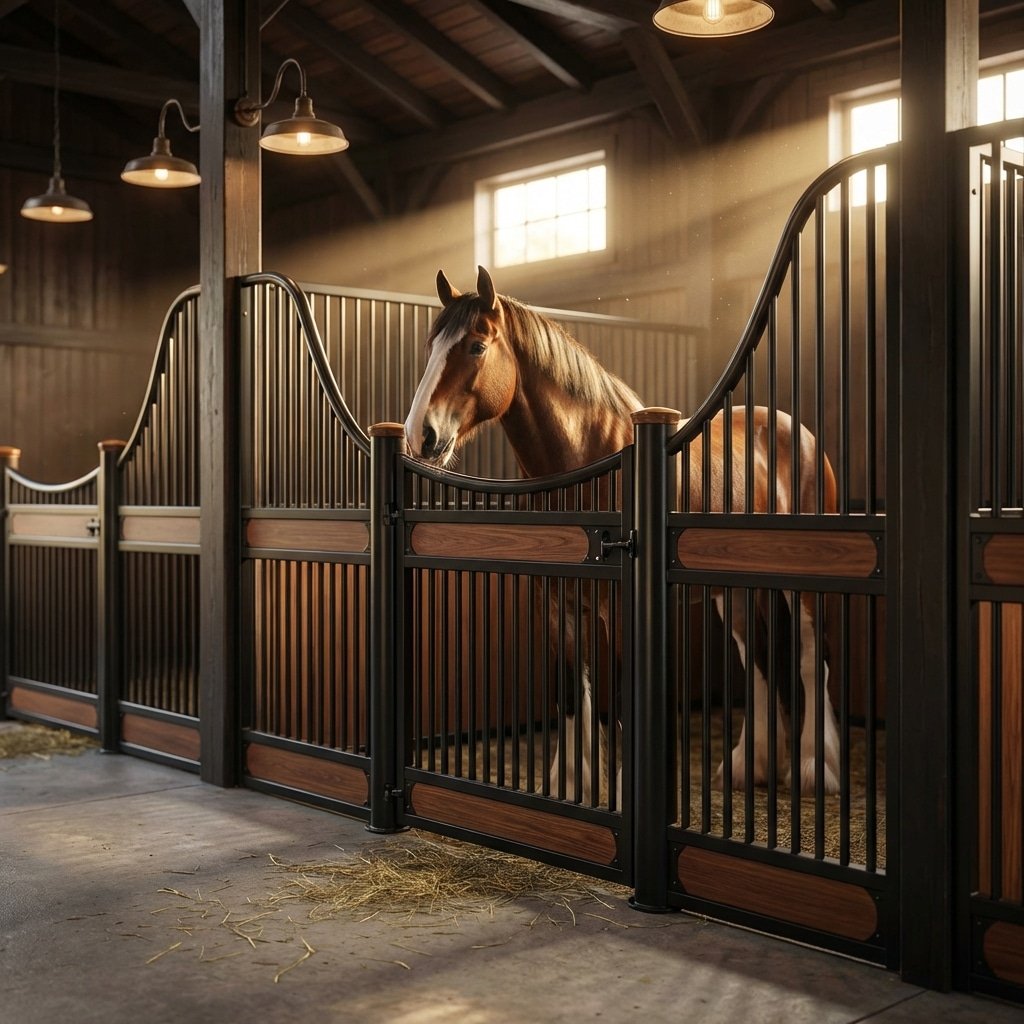
Vertical bar configurations provide a ‘classic look’ while ensuring consistent, good airflow.
They facilitate diffuse fresh air entry into stalls, crucial for maintaining air quality without creating harsh drafts.
Open grillwork on stall fronts and partitions actively contributes to the overall ventilation strategy for barn structures.
These designs are fundamental to natural ventilation systems, supporting continuous air exchange within the stable environment by 2026.
Technical Standards for Optimal Bar Ventilation
Bar spacing of 1 inch is the standard for vent panels below 48 inches in stall height to ensure horse safety and prevent leg entrapment.
For panels positioned above 48 inches in height, 2-inch or 3-inch spacing may be utilized to further enhance airflow.
Vent panel framing uses 1/8-inch thick, 1-inch wide bars with welded corners, forming a robust ‘picture frame’ style structure.
Vertical bar installations contribute to a minimum ventilation rate of 1 inch continuous-slot opening per 10 feet of building width, or approximately 1 square foot per 12-foot-wide stall.
Designs for vertical bars align with agricultural vent assemblies, preventing issues like freezing and condensation, particularly in unheated barns.
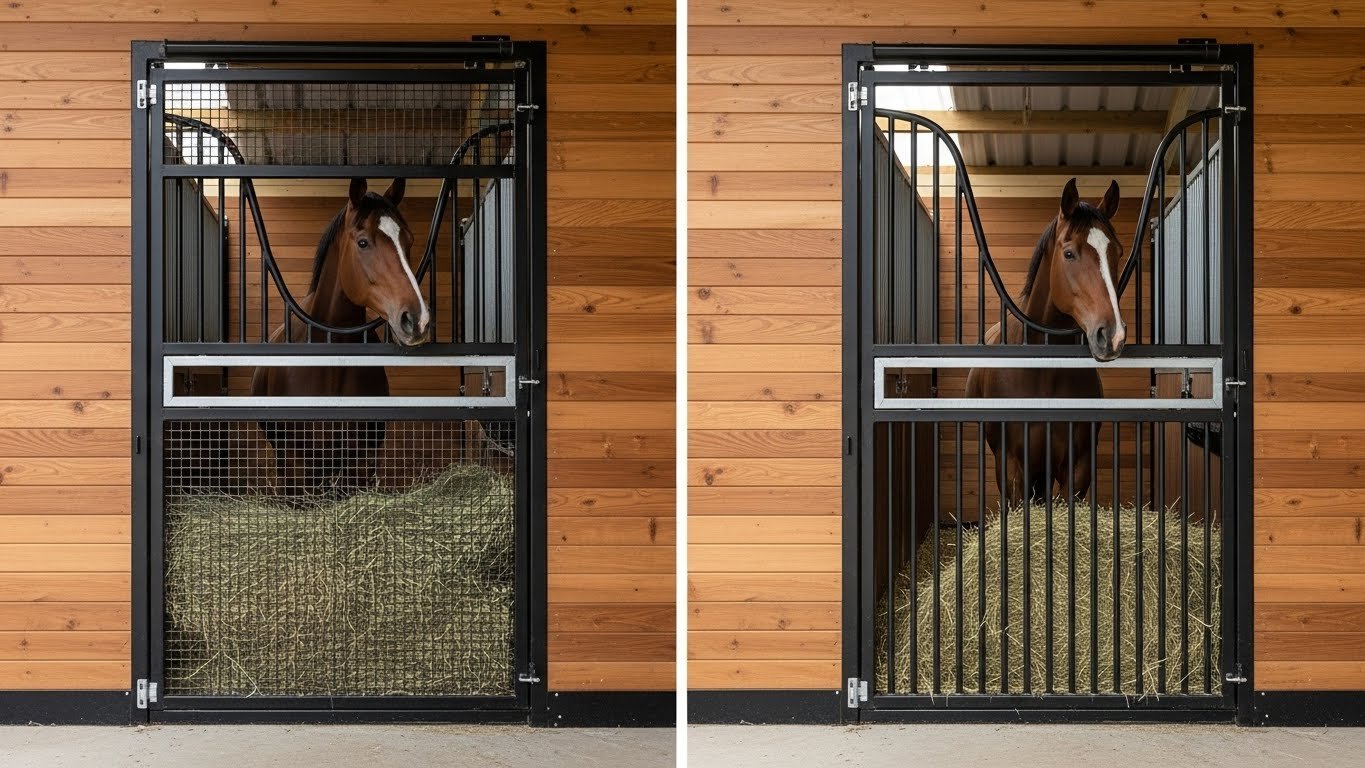
Wire Mesh (Safety, High Flow)
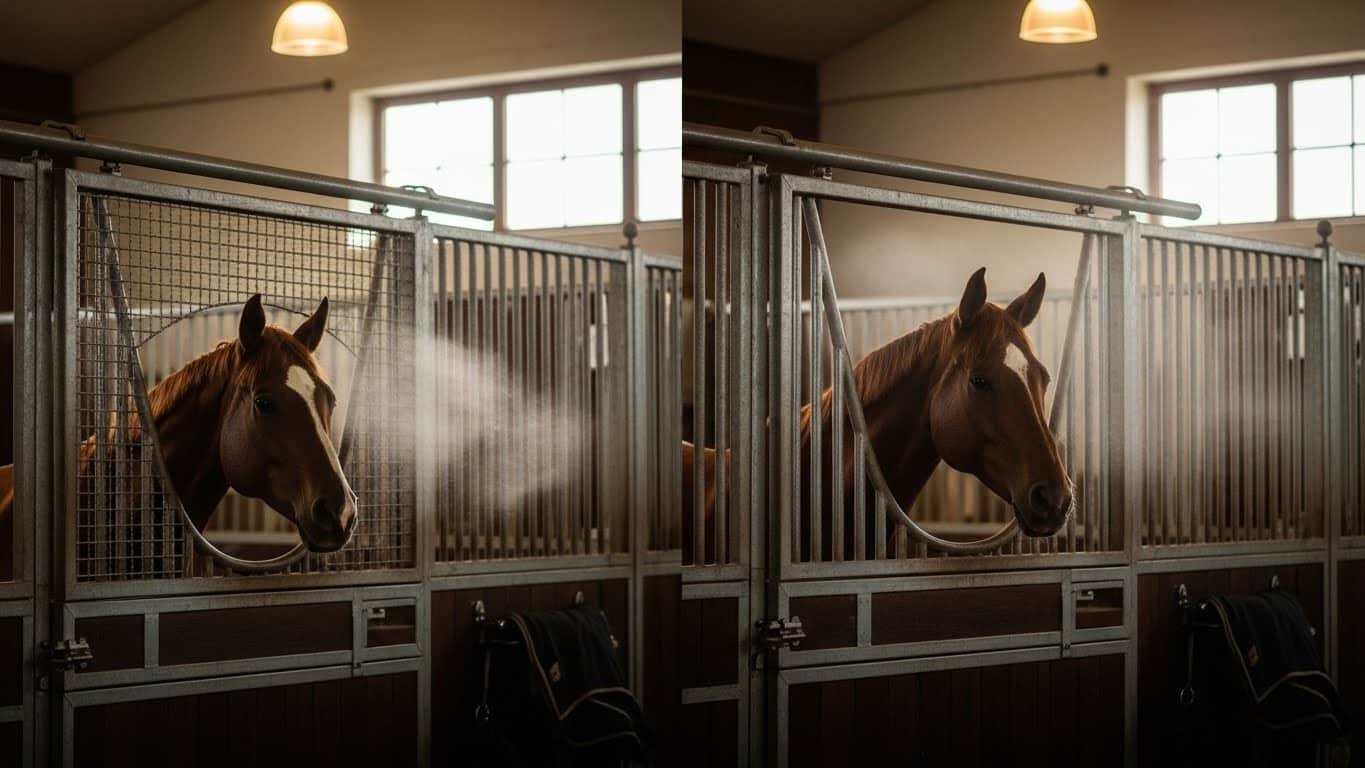
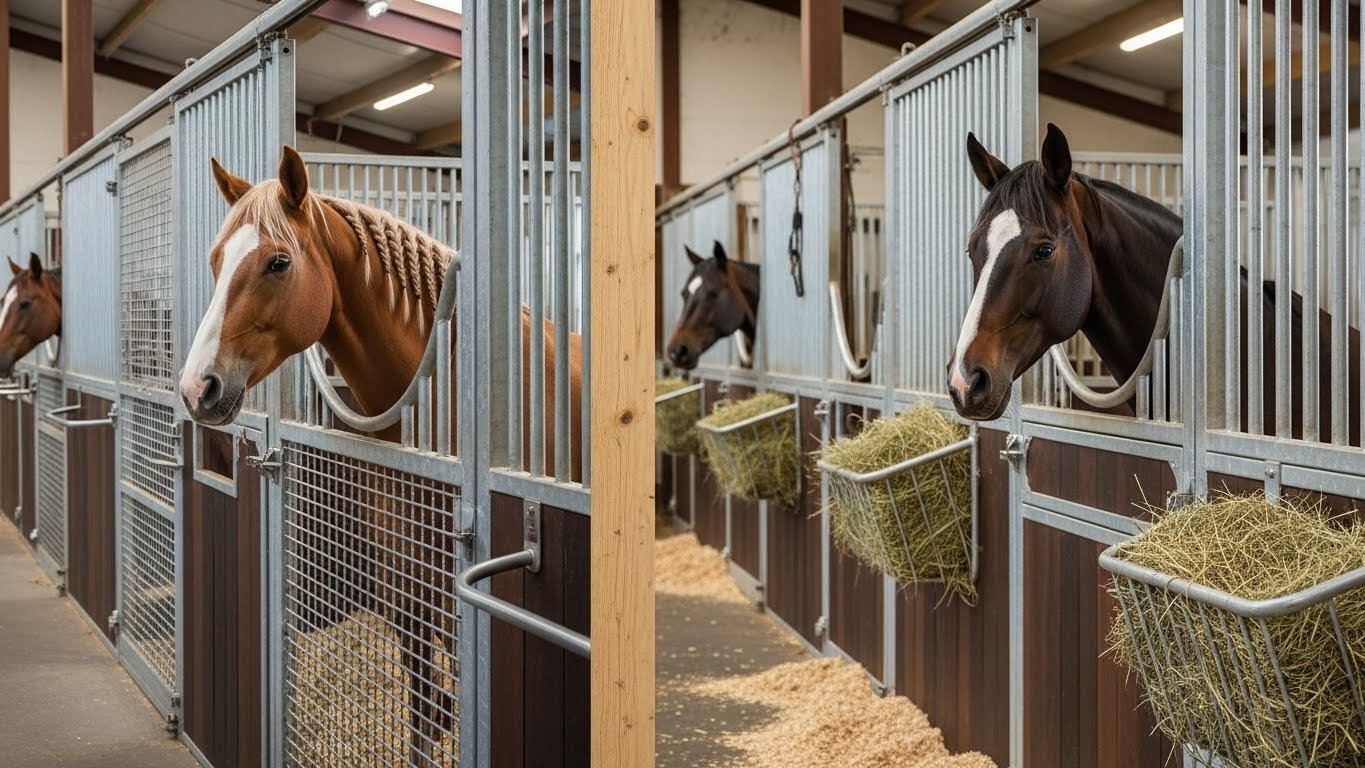
Wire mesh for horse stables, particularly in stall fronts and eaves, offers superior ventilation and safety. It features large openings (e.g., 2″ x 2″ for stalls, 3/4″-1″ for eaves) using robust materials like 1/4″-5/16″ steel rods, often hot-dip galvanized or stainless steel, to prevent injury while maximizing air circulation and reducing ammonia buildup.
| Application Area | Key Specification | Benefit / Purpose |
|---|---|---|
| Stall Fronts & Doors | 1/4″ (≈6 mm) steel wire/rod, 2″ x 2″ (50 x 50 mm) openings | Maximizes airflow (“100% ventilation”), full visibility, hoof safety |
| High-Strength Rods (Stalls) | 5/16″ (≈8 mm) solid steel rods, arc-welded | Enhanced structural stiffness and impact resistance |
| Eave Vent Openings | 3/4–1 inch wire mesh squares | Deters birds, preserves critical airflow (avoids clogging of smaller perforations) |
| Material Options | Carbon steel (hot-dip galvanized or powder coated), stainless steel | Corrosion resistance and long-term durability in stable environments |
| Structural Framing | Formed 12-gauge steel (≈2.7 mm) | Provides robust support for heavy-duty mesh assemblies |
Optimal Design for Equine Safety and Ventilation
Welded wire or rod mesh is crucial for balancing hoof safety with high open area in horse stalls.
Typical stall mesh openings range from 1 3/4″ to 2″ on center to prevent hooves from getting caught.
Full-mesh stall doors with 2″ x 2″ openings are marketed to provide “100% ventilation” compared to solid panels, offering full visibility.
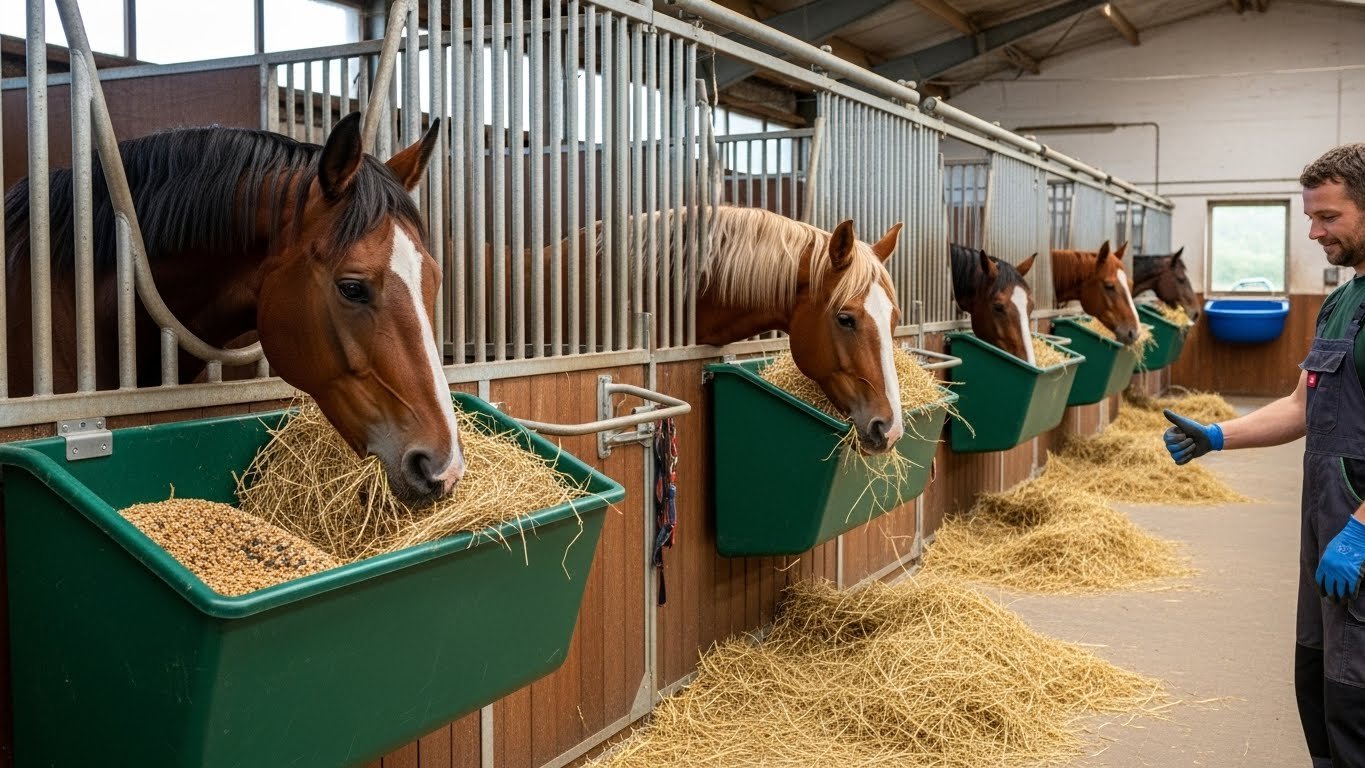
Strategically placing mesh in the lower half of stall fronts allows crossflow to effectively flush ammonia and odors at floor level.
Technical Specifications and Material Durability
Commercial full mesh doors commonly utilize 1/4 inch (approximately 6 mm) steel wire or rod.
High-strength applications use 5/16 inch (approximately 8 mm) solid steel rods, arc-welded at intersections for enhanced impact resistance.
Stall meshes are available in carbon steel (hot-dip galvanized or powder coated) and stainless steel for corrosion resistance.
Eave vent-opening mesh should feature 3/4–1 inch squares to effectively deter birds while preserving critical airflow, avoiding smaller residential perforations prone to clogging.
Structural framing for mesh assemblies often employs formed 12-gauge steel (approximately 2.7 mm) for durability.
Unrivaled Global Horse Stables: Built Tough, Customized for Any Climate
Privacy Panels (No Flow)
‘No flow’ privacy panels are solid barriers designed for maximum visual and sound privacy, offering minimal to no air permeability. This design results in high wind loads, necessitating robust structural support. They can impede air circulation, potentially leading to increased heat and humidity within enclosed spaces.
Characteristics and Structural Impact of Solid Panels
Solid privacy panels have low porosity and minimal airflow. They create significant wind loads on structures. This is an important consideration for installations in 2026.
Increased wind load requires stronger posts and deeper footings to meet building codes. These panels prioritize visual and sound barriers over effective cross-ventilation in horse stalls.
Panels with near-zero permeability, like continuous wood or vinyl sheets, increase the risk of failure in high-wind conditions.
Integrating Airflow with Privacy Solutions
Vented alternatives, such as 100% Polypropylene open mesh, allow air passage and still provide privacy.
Optional air vents (e.g., 8 inches wide x 10 inches high) can be included, with spacing at 10 ft intervals. Integrating these vents is helpful for screens taller than 6 ft, especially in windy environments.
Cedar wood fences with 1.5 inch slat spacing provide good airflow for privacy. Aluminum privacy screens with 3/16-inch spaces between boards also ensure air circulation.
The Verdict for Hot Climates
Effective ventilation in hot climates requires a dual approach: robust mechanical systems delivering 200-350 CFM per horse, complemented by generous natural openings. Precise sizing of inlets, eaves, sidewall openings, and exhaust systems is crucial to maintain air exchange, remove heat and moisture, and prevent ammonia buildup, keeping horses comfortable.
| Parameter | Specification | Details |
|---|---|---|
| Mechanical Ventilation Rate | 200-350 CFM | Per 1,000-pound horse in hot weather. |
| Inlet Sizing | 1.7 ft² per 1,000 CFM | Of fan capacity for uniform airflow. |
| Permanent Eave Opening | 1 inch continuous slot per 10 feet | Of building width; year-round minimum (e.g., 1 ft² for 12×12 ft stall). |
| Stall Sidewall Openings | 5-10% of floor area | E.g., 3×2.5 ft window for 5% in a 12×12 ft stall. |
| Ridge/Eave Vents | 3-4 inches (winter) to 6-8 inches (summer) | On each sidewall for center-aisle stables. |
| Chimney/Cupola Sizing | Minimum 1 ft² opening per horse | Insulate to R-10, extend 1 ft above roof peak. |
| Exhaust System Inlets/Vents | 1 ft² per 750 CFM | Of fan capacity to prevent drafts. |
Prioritizing Airflow and Exchange
Ventilation in hot climates focuses on high air exchange rates to efficiently remove heat and moisture.
Mechanical ventilation systems deliver 200-350 CFM (cubic feet per minute) per 1,000-pound horse.
The primary goal is preventing ammonia accumulation and supporting horse comfort, ideally within 5-10°F above outdoor temperatures.
Combining controlled mechanical rates with scalable passive openings optimizes fresh air entry and exhaust.
Technical Specifications for Design
Inlet sizing requires 1.7 ft² per 1,000 CFM of fan capacity to ensure uniform airflow.
Permanent eave openings should be at least a 1-inch continuous slot per 10 feet of building width (e.g., 1 ft² for a 12×12 ft stall).
Stall sidewall openings need to be 5-10% of the floor area (e.g., a 3×2.5 ft window for 5% in a 12×12 ft stall).
Ridge and eave vents should expand to 6-8 inches in summer conditions for efficient exhaust.
Chimney or cupola sizing requires a minimum of 1 ft² opening per horse, insulated to R-10, and extended 1 ft above the roof peak.
Exhaust system inlets and vents are sized at 1 ft² per 750 CFM fan capacity to prevent drafts.
Final Thoughts
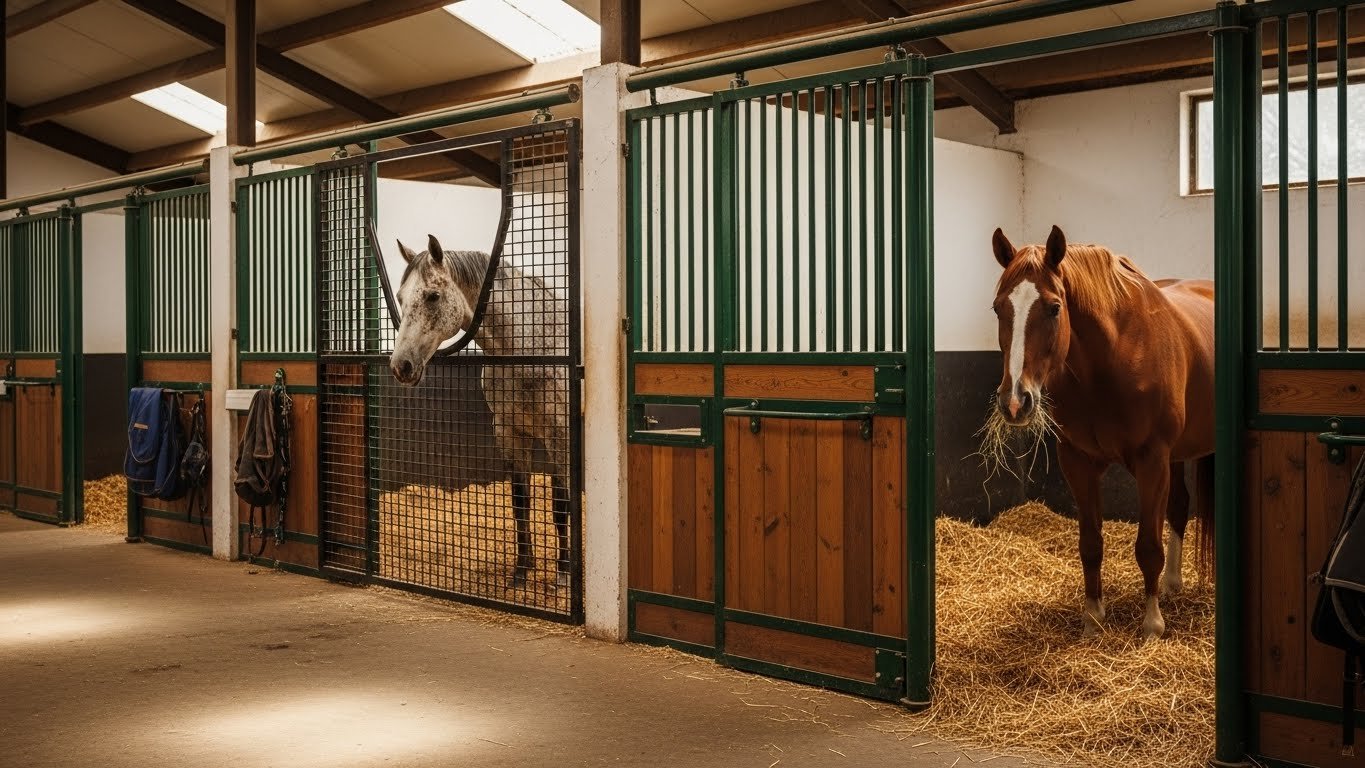
For upper barn designs, mesh generally offers more effective airflow and enhanced safety compared to vertical bars. Mesh provides wider open areas, often allowing close to 100% ventilation, while preventing entanglement risks for horses. Vertical bars also contribute to good natural airflow and a traditional look, but they demand precise, narrow spacing to ensure safety and prevent injury. Solid privacy panels, on the other hand, prioritize visual and sound barriers over air movement, making them less suitable for maximizing barn air quality.
Ultimately, the ideal design choice balances climate, safety, and air quality goals. Hot climates, for example, greatly benefit from high-airflow solutions like mesh, often paired with robust mechanical ventilation. Regardless of the chosen material, a comprehensive barn ventilation strategy must integrate both passive openings and, if needed, active systems. This ensures continuous air exchange, minimizes contaminants, and maintains a healthy environment for horses.
Frequently Asked Questions
Are mesh stalls safer than bars?
Mesh stall fronts and gates are safer than bar-only designs for preventing entrapment injuries, as they prevent hooves, legs, and heads from getting through while maintaining ventilation. Bar systems require precise spacing (no more than 2–3 inches clear gap) to prevent injuries. Mesh also supports better airflow and odor control, making it preferred in warmer or enclosed barns.
What is the best stall design for hot climates?
For hot climates, a 12 ft × 12 ft box stall with at least 8 ft high partitions and a 10–12 ft interior ceiling is ideal. It should feature fully open grill or mesh upper partitions and doors, with direct access to large, screened exterior openings. An open-aisle or center-aisle barn with continuous eave and ridge vents (sized for 200–350 CFM per 1,000 lb horse) is recommended. Deep overhangs and breezeways help shade openings and funnel air.
Do mesh stalls allow better airflow?
Yes, full or partial mesh stall fronts and doors provide significantly higher airflow compared to solid fronts. Engineered mesh designs typically offer 80–100% open area for ventilation into the stall interior. Industry guidance recommends open grillwork or mesh on partitions and doors to ensure fresh air and minimize airflow obstructions.
Can a horse get stuck in stall bars?
Yes, a horse can get stuck if the gaps in stall bars are too wide. To prevent this, grill openings are typically limited to about 2 inches of clear spacing between bars. Some building codes reference a maximum of 4–5 inches for head and limb safety, but 2 inches is a common safety specification to avoid hooves and heads getting caught.
What are the ventilation requirements for horses?
Industry standards suggest at least 1 square foot of permanent fresh air opening per stabled horse. Mechanical ventilation rates should be 25 CFM per 1,000-pound horse in cold weather for moisture control, 100 CFM in mild weather for heat removal, and 200-350 CFM in hot weather.
How do you balance privacy and airflow in stalls?
Balancing privacy and airflow involves using partial privacy partitions. These typically have a solid bottom for visual separation and a grilled or crosshatch upper section to allow cross-ventilation. Full solid partitions restrict airflow too much for adequate stable ventilation, while fully open mesh maximizes airflow at the expense of privacy.

 English
  Spanish
  French
  Arabic
  German
0 Comments