
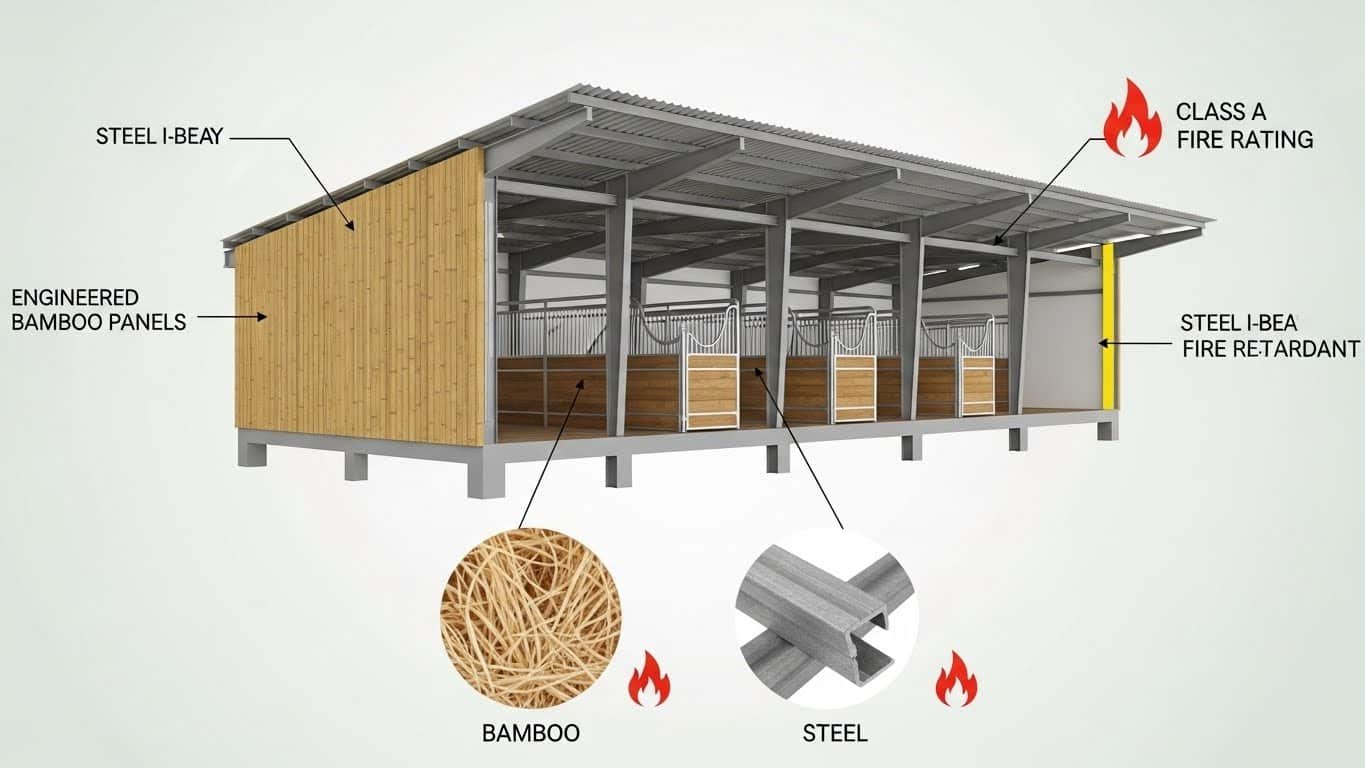
For facility managers and builders, fire safety in structures like horse stalls is paramount. The choice of building materials directly impacts how quickly a fire spreads, putting lives and property at risk. Many traditional options, like pine, can actually accelerate a fire, making material selection a critical safety decision.
This article unpacks Class A fire ratings, explaining why they are crucial for minimizing fire hazards. We’ll compare the inherent fire acceleration of pine, which has an effective heat of combustion of 14–15 MJ/kg, with the superior safety offered by engineered bamboo and steel. You’ll see how treated bamboo can achieve a Class A Flame Spread Index as low as 10, giving you actionable knowledge to make informed decisions for fire-rated construction.
The Reality of Barn Fires
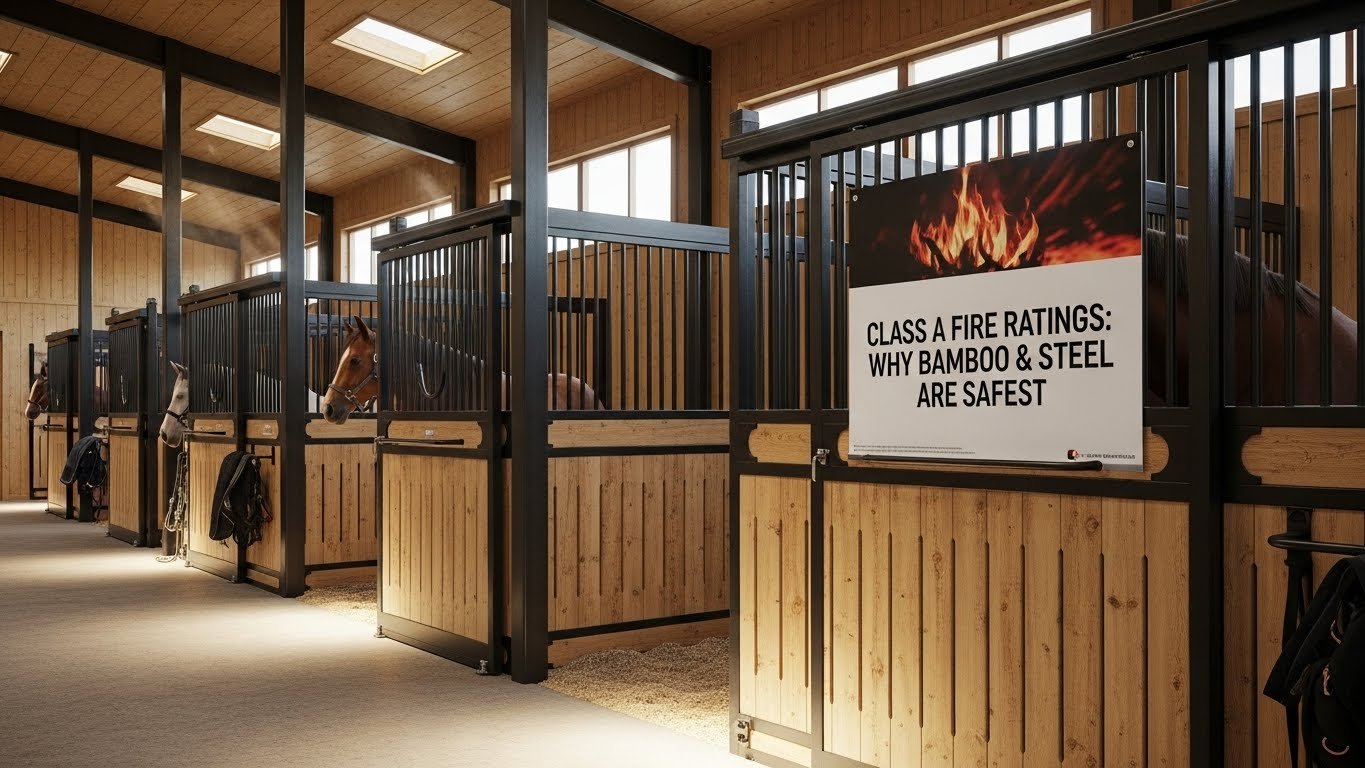
Barn fires pose extreme risks due to dense combustible materials and rapid fire spread, making animal and property safety critical. Modern fire codes and construction standards are essential for managing these hazards.
The Inherent Dangers of Barn Fires
Barns present a significant Class A fuel load. This includes hay, bedding, and timber, all of which contribute to intense fires.
Fire spreads and grows rapidly in these spaces because of confined areas and high fuel density.
Limited human presence, especially at night, creates major challenges for quickly evacuating animals.
NFPA 150 (2019) specifically categorizes horse housing because of these elevated risks, highlighting the need for specialized fire safety measures.
Code-Driven Safety Measures and Material Performance
NFPA 150 (2019) requires automatic, quick-response sprinklers (NFPA 13 compliant) in larger facilities or those with sleeping quarters.
Portable fire extinguishers with a minimum 2-A:10-B:C rating must be accessible within 50 feet of travel distance, as per NFPA 10.
Ventilation engineering suggests 1 square foot of ceiling vent area per 30–50 square feet of floor area in hay storage to relieve hot gases.
Fire walls must provide at least 1-hour fire resistance and extend at least 18 inches above the roof to stop fire from spreading.
Materials are rated by flame spread index (for example, concrete at 0, raw wood at 100) and smoke development index. These ratings help enhance tenability during a fire.
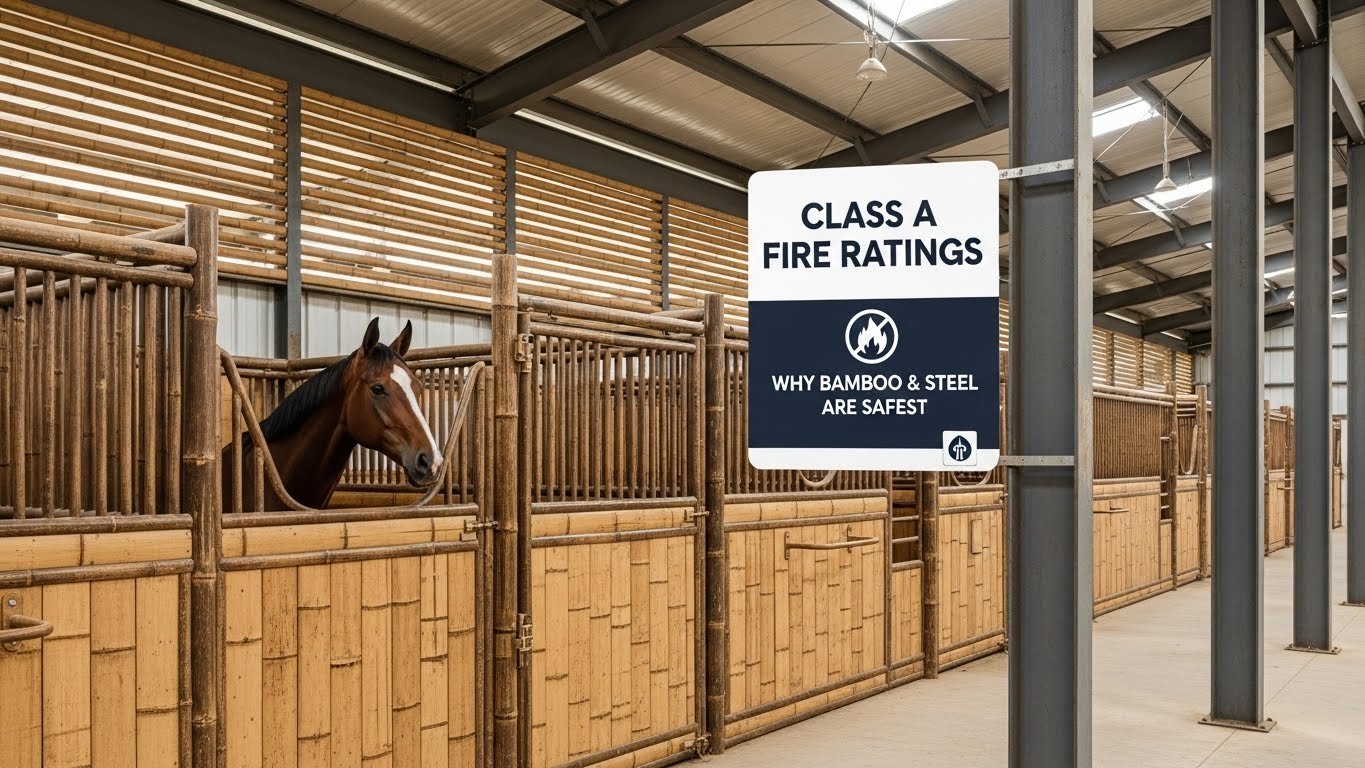
Understanding Flame Spread Ratings
Flame Spread Ratings, determined by tests like ASTM E84, classify how quickly flames spread across a material’s surface, using an FSI scale from 0 to 200. These ratings, alongside the Smoke Developed Index, are crucial for selecting appropriate materials to meet building codes and enhance fire safety in structures.
Flame Spread Index (FSI) and Classification System
The Flame Spread Index (FSI) quantifies a material’s surface burning behavior via the ASTM E84 Steiner Tunnel Test.
The FSI scale ranges from 0 (representing inorganic reinforced cement board) to 200 (benchmarked against red oak at 100).
Materials are categorized into Class A (FSI 0-25), Class B (FSI 26-75), and Class C (FSI 76-200) based on their flame spread characteristics.
The Smoke Developed Index (SDI), with a limit of ≤450 across all classes, is also assessed to measure smoke obscuration.
Testing Standards and Application in Building Codes
The primary test method is ASTM E84 (equivalent to UL 723, NFPA 255), using an 18-inch wide by 24-foot long specimen exposed to flame over 10 minutes.
Building codes such as IBC Chapter 8 and NFPA 101 Life Safety Code reference FSI and SDI for interior finishes.
For fire-rated horse stalls, Class A materials (FSI ≤25, SDI ≤450) are crucial to minimize ember ignition and surface flame propagation, particularly in Wildland-Urban Interface (WUI) zones.
Fire-rated MDF or particleboard cores are examples of materials designed to achieve Class A ratings through specific core selection.
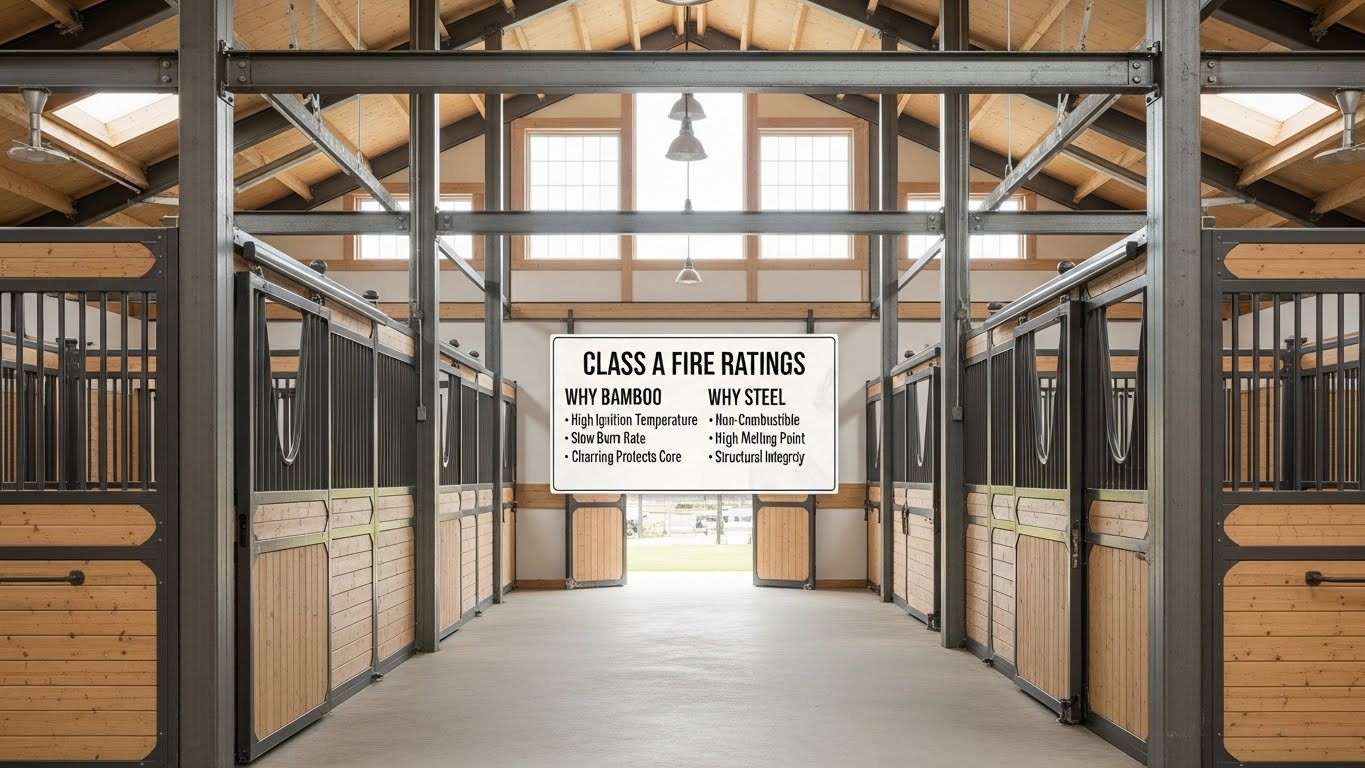
Why Pine Accelerates Fire
Pine accelerates fire due to its relatively low density, which leads to faster mass loss and charring, combined with an effective heat of combustion (14-15 MJ/kg) that, once ignited, releases energy quickly, contributing to rapid flame spread and earlier structural compromise.
| Property | Observation / Value | Impact on Fire |
|---|---|---|
| Species Effect (Pine vs. Hardwoods) | Higher burning rate & heat release | Faster fire growth under 15–55 kW/m² flux.[2] |
| Effective Heat of Combustion | 14–15 MJ/kg | Rapid energy release once ignited.[3] |
| Density / Charring Rate | Lower density woods (pine) have higher mass loss and charring rates. | Less protective char layer, faster heat penetration.[2] |
| Ignition Kinetics | Ignition time decreases sharply with incident flux (typical heat transfer coeff. ~31–35 W/m²·K). | Quicker ignition under heat exposure.[1][2] |
| Burning Rate vs. Heat Flux | Linear growth with 15–55 kW/m² flux; pine is at the high end. | Consistent tendency for faster fire growth.[1][2] |
| Char Properties | Lighter, more porous char | Less insulation, deeper heat penetration, sustained burning.[2] |
| Regulatory Design Context | AWC Fire Design Specification (2021, 2024) | Provides methods for calculating thermal separation and burn-through.[4][6] |
Pine’s Inherent Combustion Properties
Pine’s lower density, compared to hardwoods like red oak, results in a higher mass loss rate under heat exposure.
It exhibits a high effective heat of combustion, approximately 14–15 MJ/kg, releasing energy efficiently once ignited.
Rapid charring and a less protective char layer allow for deeper heat penetration and sustained burning.
Measured Fire Response and Design Impact
Tests show southern pine has significantly higher burning rates and heat release compared to other woods under 15–55 kW/m² heat flux.
The resulting char is lighter and more porous, offering less insulation and accelerating heat transfer into unburned wood.
Regulatory standards, such as the AWC Fire Design Specification (2021, 2024), account for pine’s accelerated char rates in fire-resistance calculations for wood construction.
Unprotected pine linings can significantly increase internal fuel load and accelerate compartment fire growth, demanding evaluation against fire-rated alternatives.
Research Summary
Engineering calorimetry work on solid wood shows that pine accelerates fire because it combines relatively low density, high effective heat of combustion, and fast charring under a given heat flux.[1][2] In controlled tests on thick samples of southern pine, red oak, redwood, and basswood in a heat release rate calorimeter, burning rate, heat release, and charring were measured across 15–55 kW/m²; pine exhibited higher mass loss and heat release at the same exposure, confirming a species-dependent tendency toward faster fire growth.[2]
The calorimeter data also confirm that heat release rate and mass loss are tightly coupled via an effective heat of combustion on the order of 14–15 MJ/kg for wood-based fuels, so once pine ignites the energy output per unit mass is comparable to other woods but is delivered more quickly due to higher mass loss rates.[2][3]
From a fire-safety design standpoint (e.g., in horse stalls), the issue is not just that “pine burns,” but that its thermal response—shorter ignition times at a given flux, higher burning rate per unit area, and less protective char—supports faster flame spread and earlier structural compromise than many denser hardwoods.[1][2][4] The AWC Fire Design Specification codifies this behavior into calculable char rates and effective section properties, allowing engineers and risk managers to choose species, thickness, and protective linings that control burn-through and maintain fire separations.[4][6]
For a risk manager, this means unprotected pine linings or framing in stall partitions can significantly increase the internal fuel load and accelerate compartment fire growth, and should be evaluated against fire-rated alternatives or protected by tested fire-rated assemblies (e.g., assemblies designed using AWC FDS methods or other NFPA-aligned design tools).[4][6]
Companies / URLs
American Wood Council (AWC) – publisher of the *Fire Design Specification for Wood Construction* (2021, 2024).[4][6]
Global Horse Stables: Built for Every Climate
![Matching Infill to Flooring Why Bamboo Pairs Best with [Rubber Mats] (2)](https://dbhorsestable.com/wp-content/uploads/2025/12/Matching-Infill-to-Flooring-Why-Bamboo-Pairs-Best-with-Rubber-Mats-2.jpeg)
Why Bamboo is Self-Extinguishing
While natural bamboo ignites, engineered flame-retardant systems enable it to form protective char layers, drastically delaying ignition, reducing heat release, and curbing smoke production. This demonstrates a self-limiting combustion behavior under controlled fire conditions, making it suitable for fire-rated applications by 2026 standards.
| Fire Performance Metric | Untreated Bamboo | Treated Bamboo (FR System) |
|---|---|---|
| Time-To-Ignition (TTI) | ≈ 20 s | 116 s (5.8× increase) |
| Total Heat Release (THR) | ≈ 13 MJ/m² | 0.7 MJ/m² (18.6× lower) |
| Peak Heat Release Rate (HRRₚₑₐₖ) | Baseline reference | Reduced by 34.46% |
| Mean Specific Extinction Area (Smoke) | 110 m²·kg⁻¹ | 8.6 m²·kg⁻¹ (>90% reduction) |
Mechanisms of Fire Self-Limitation
Flame-retardant (FR) treatments, such as Na₂SiO₃ + SiO₂ + silane, or phosphocalcium–aluminum hydrotalcite (PCaAl-LDH), facilitate the formation of stable intumescent or ceramic-like char layers.
These char layers act as effective thermal barriers, insulating the unburnt material from heat and creating laminar diffusion barriers that starve the flame of flammable gases and oxygen.
This dual action significantly reduces the effective heat of combustion and limits thermal feedback, preventing further flame propagation once the initial phase passes.
Empirical Evidence and Fire Performance Metrics
Cone calorimetry (ISO 5660-2) shows treated bamboo systems increase Time-To-Ignition (TTI) from approximately 20 seconds for natural bamboo to 116 seconds.
Peak Heat Release Rate (HRRₚₑₐₖ) for FR-modified bamboo scrimber decreases by 34.46%, and Total Heat Release (THR) by 15.86% at 2 wt% additive.
Total Smoke Release (TSR) is reduced by 65.97%, with mean specific extinction area dropping from 110 to 8.6 m²·kg⁻¹ for certain transparent bamboo treatments.
The mass loss rate peak is delayed by up to 236 seconds in FR bamboo scrimber, indicating slower pyrolysis and burn-through.
These performance metrics directly support performance-based fire design methods for bamboo structures, considering its charring behavior and section loss rates in 2026 building codes.
Experimental fire testing shows that raw bamboo ignites relatively quickly and can sustain flaming. However, when engineered with flame-retardant systems, it develops strong self-limiting behavior: the heat release rate drops, ignition is delayed, and smoke production is dramatically curtailed. In cone calorimeter tests following ISO 5660‑2, multi‑layer barrier systems (sodium silicate impregnation, in‑situ SiO₂, and silane top coats) and inorganic lamellar additives (PCaAl‑LDH) form intumescent/ceramic‑like char layers and 2D laminar diffusion barriers that choke off the supply of flammable volatiles and oxygen. This reduces effective heat of combustion and available thermal feedback so that once the initial flaming phase is past, combustion tends to die down rather than propagate—functionally a self‑extinguishing behavior at the element scale under standardized heat flux.
From a fire‑safety engineering perspective, bamboo’s self‑extinguishing potential is governed less by the natural culm and more by its treatment, cross‑section, and composite configuration. Performance‑based bamboo fire design methods treat bamboo like other charring materials: the formation of a stable char layer and reduced HRR/THR are directly used to justify fire resistance and to predict section loss rates over design fire curves.
For risk managers assessing fire‑rated stalls or partitions, the key levers are selection of FR bamboo scrimber or coated products tested under ISO 5660‑2 or equivalent, verification of HRR/THR and smoke parameters, and demonstration that the system’s ignition delay and char formation will prevent flame spread and flashover in the target fire scenario, aligning with broader structural fire codes and performance‑based design frameworks.
While no specific commercial stall-system manufacturers were identified in the research, the relevant entities are the ISO 5660‑2 (cone calorimetry standard) and material systems such as PCaAl‑LDH–modified bamboo scrimber and liquid sodium silicate / SiO₂ / silane transparent bamboo developed through peer‑reviewed research.
![Matching Infill to Flooring Why Bamboo Pairs Best with [Rubber Mats] (3)](https://dbhorsestable.com/wp-content/uploads/2025/12/Matching-Infill-to-Flooring-Why-Bamboo-Pairs-Best-with-Rubber-Mats-3.jpeg)
Final Thoughts
Pine’s low density and high heat release contribute to rapid fire growth, making it a poor choice for fire-safe construction. While steel is non-combustible and does not add fuel to a fire, engineered bamboo offers a robust solution. It forms a protective char layer that delays ignition, drastically cuts heat release, and reduces smoke, limiting flame spread and acting as a self-extinguishing material.
Building codes and safety standards prioritize Class A materials for fire-safe design, especially for structures like horse stalls or in Wildland-Urban Interface zones. Opting for treated bamboo or steel, both achieving high fire ratings, significantly boosts safety. These choices reduce the risk of fast fire spread and provide valuable time for response and evacuation, meeting modern fire safety requirements.
![Matching Infill to Flooring Why Bamboo Pairs Best with [Rubber Mats] (6)](https://dbhorsestable.com/wp-content/uploads/2025/12/Matching-Infill-to-Flooring-Why-Bamboo-Pairs-Best-with-Rubber-Mats-6.jpeg)
Frequently Asked Questions
Is bamboo flooring fireproof?
Bamboo flooring is not fireproof. It achieves fire reaction classes like Bfl-s1 or Cfl-s1 under EN 13501-1 standards, showing limited combustibility. Truly fireproof materials generally need A1/A2 classification. MOSO® Bamboo UltraDensity® flooring achieves Bfl-s1 (EN 13501-1), which is better than most natural woods without fire retardants.
How to fireproof a horse barn?
To fireproof a horse barn to current expectations, design and operate it to meet NFPA 150: Fire and Life Safety in Animal Housing Facilities Code for Category 2 Horse Facilities. This includes fire-resistive construction (1-hour fire barriers), automatic sprinklers (NFPA 13), ABC extinguishers every 50 feet (NFPA 10), and using fire-retardant or noncombustible materials. Key Construction Aspects: Use noncombustible materials or fire-retardant-treated wood (FRTW) with UL or FM stamps meeting AWPA standards. Build true firewalls between hazard areas (e.g., hay storage and stalls) with at least a 1-hour fire-resistance rating. Doors in these walls must be fire-rated and self-closing, with sealed penetrations. Extend firewalls at least 18 inches (approximately 450 mm) above a frame-constructed roof for increased fire separation. For Class A (>5,000 ft²) and any Class B (<5,000 ft²) with sleeping quarters, install an automatic sprinkler system meeting NFPA 13 using quick-response sprinklers. Install fire alarm and detection systems where needed. Place at least one 2-A:10-B:C extinguisher at each entrance, ensuring no point is more than 50 feet travel distance from one. ABC-type is generally recommended. Maintain 12-foot-wide lanes for fire apparatus, with bridges supporting a 40,000-pound fire truck. Separate hay and bedding storage from stalls with rated fire partitions. Ensure excellent electrical design and maintenance, using conduit and regular inspections. Remove unapproved heaters and limit extension cord use. Implement and practice an emergency and disaster plan annually, training staff on extinguisher use. Provide sufficient ventilation and compartmented spaces to slow flashover and allow escape. Firewalls need a minimum 1-hour fire-resistance rating and must extend at least 18 inches above the roof, with fire-rated, self-closing doors.
Fire rating of pine versus bamboo?
Thermally modified bamboo achieves superior fire ratings compared to untreated or standard pine. Bamboo can reach Class A (ASTM E84, FSI as low as 10) and Class B-s2-d0 (EN 13501-1). Untreated pine plywood typically rates Class C (ASTM E84) or requires chemical treatment to reach B-s1,d0. Bamboo FSI 10 (Class A, ASTM E84) is a key statistic.
Safe materials for barn aisles?
Industry standards recommend one-hour-rated gypsum board (flame-retardant treated) over plywood for barn aisles and walls to prevent fire spread. Steel is a good non-combustible alternative. For flooring, concrete or rubber mats offer fire resistance, non-slip surfaces, and easy cleaning. A key recommendation is a 1-hour fire rating, meaning materials can withstand flames for 1 hour without spreading.
Does steel burn?
Steel is a non-combustible material; it does not burn or sustain flame. At elevated temperatures, steel softens and loses strength. Structural design often considers “failure” when steel reaches about 500–600 °C (932–1112 °F), well below its melting point. Fire protection is vital to maintain its load-bearing capacity in a fire. Structural steel loses about 50 % of its load-bearing capacity at 1,000 °F (approximately 537 °C).
Reducing fire risk in stables?
To reduce fire risk in stables, current guidance focuses on noncombustible or fire-rated construction, code-sized fire separations, and NFPA-compliant detection, suppression, and extinguishers. Specific actions include: Using masonry, steel, or fire-retardant-treated wood with documented flame-spread ratings. Designing true firewalls with at least a 60-minute rating that extend 18 inches above a frame roof. Providing ceiling vent area of 1 ft² per 100 ft² of floor area (or 1 ft² per 30–50 ft² where hay is stored) for smoke and heat relief. Installing quick-response sprinklers and 2-A:10-B:C extinguishers at each entrance and within 50 feet travel distance, as per NFPA 150/10. Stables should have firewalls with at least a 1-hour fire rating, extending 18 inches above a frame roof to be effective.

 English
  Spanish
  French
  Arabic
  German
0 Comments