


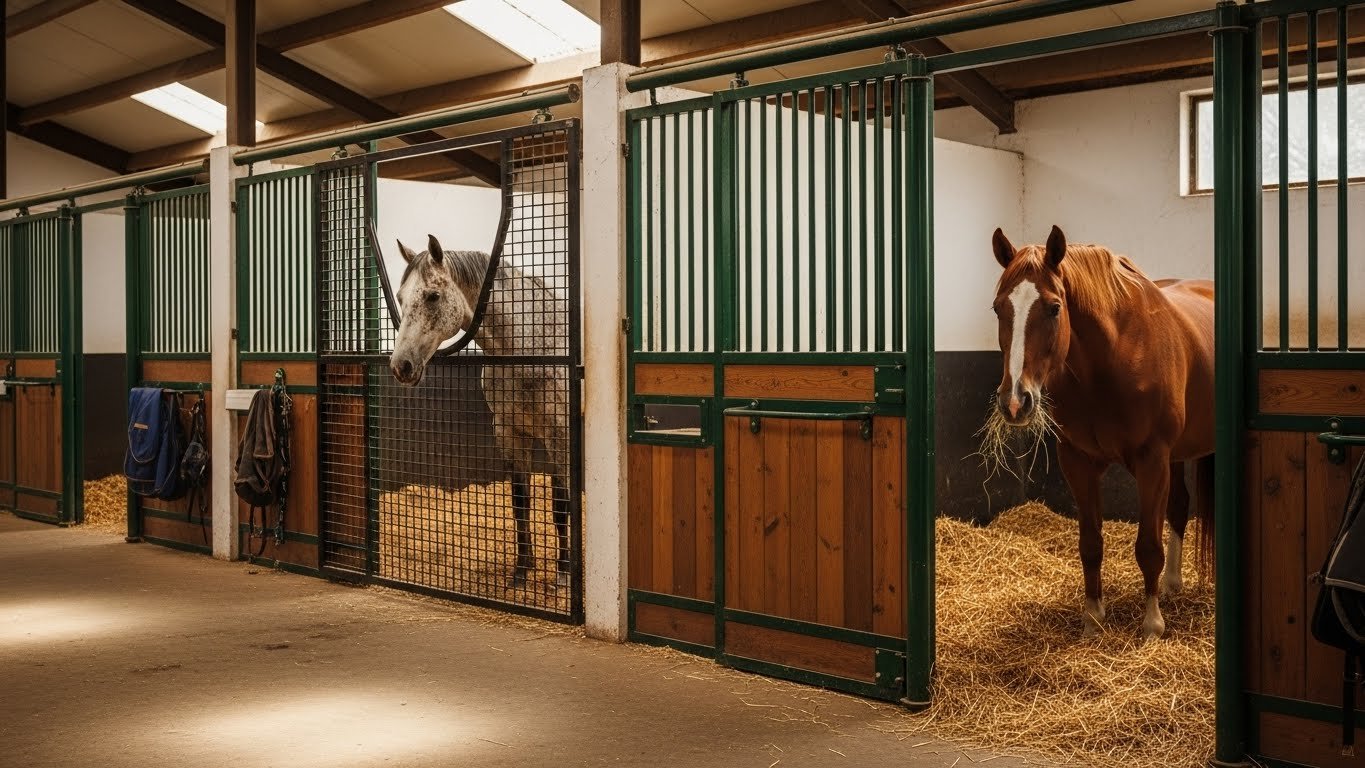
Choosing the right upper design for horse stalls is a critical decision for barn owners and managers. Your choice directly impacts airflow, horse health, and operational safety. Selecting between mesh and traditional vertical bars means balancing ventilation needs with structural integrity and long-term durability, especially when aiming for high air exchange rates of 200–350 CFM per 1,000 lb horse in hot climates.
This article compares mesh and vertical bar designs for horse stall ventilation. We will look at their specific technical details, like how mesh can offer 1.75–2 inch clear openings for airflow, versus the typical 2-3 inch spacing found in vertical bars above 48 inches. We also cover safety standards, material considerations, and practical applications, helping you make an informed choice for your equine facility.
The Importance of Barn Air Quality
Maintaining pristine barn air quality is vital for horse health, worker safety, and preserving facility structures. It involves diligent management of dust, harmful gases like ammonia and carbon dioxide, and fine particulate matter to prevent respiratory issues and promote overall well-being.
Defining Healthy Barn Air for Equine Well-being
Direct impact on horse respiratory health, preventing conditions such as chronic obstructive pulmonary disease (heaves).
Ensuring a safe working environment for barn staff by mitigating exposure to airborne contaminants.
Mitigating structural degradation from moisture and corrosive gases, preserving barn infrastructure.
Overview of critical contaminants: inhalable dust, ammonia, carbon dioxide, and fine particulate matter.
2026 Standards and Measurable Air Quality Parameters
Dust Levels: Maintaining respirable dust concentration (RDC) below 3.0 mg/m³, with measured inhalable dust typically around 2.15 mg/m³.
Gas Concentrations: Carbon dioxide (CO₂) levels ideally below 1500 ppm, and ammonia (NH₃) maintained below the ACGIH Threshold Limit Value of 25 ppm.
Particulate Matter: Daily PM₁₀ concentrations should remain below 45 µg/m³, and PM₂.₅ below 15 µg/m³, aligning with WHO guidelines.
Environmental Control: Optimal air temperature between 21.5-24.2°C and relative humidity (RH) between 42-43% to deter pathogen growth.
Ventilation Capacity: Targeted airflow rates, such as 9400 m³/h for effective contaminant dilution, are crucial for achieving these standards.
Vertical Bars (Classic Look, Good Flow)
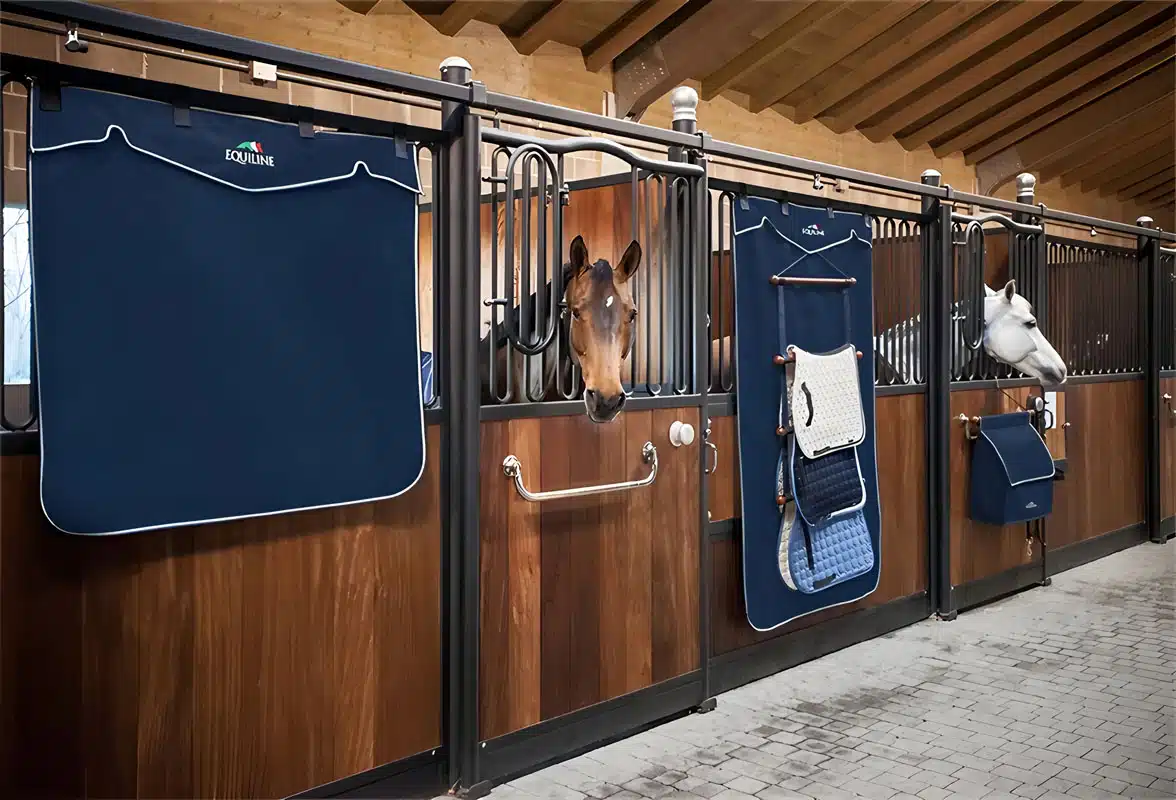
Vertical bars in horse stalls are engineered steel grilles that provide critical ventilation for barn air quality while offering a traditional aesthetic. They are constructed with specific bar spacing for safety and are integral to achieving optimal airflow in equine facilities by 2026.
Role in Barn Ventilation
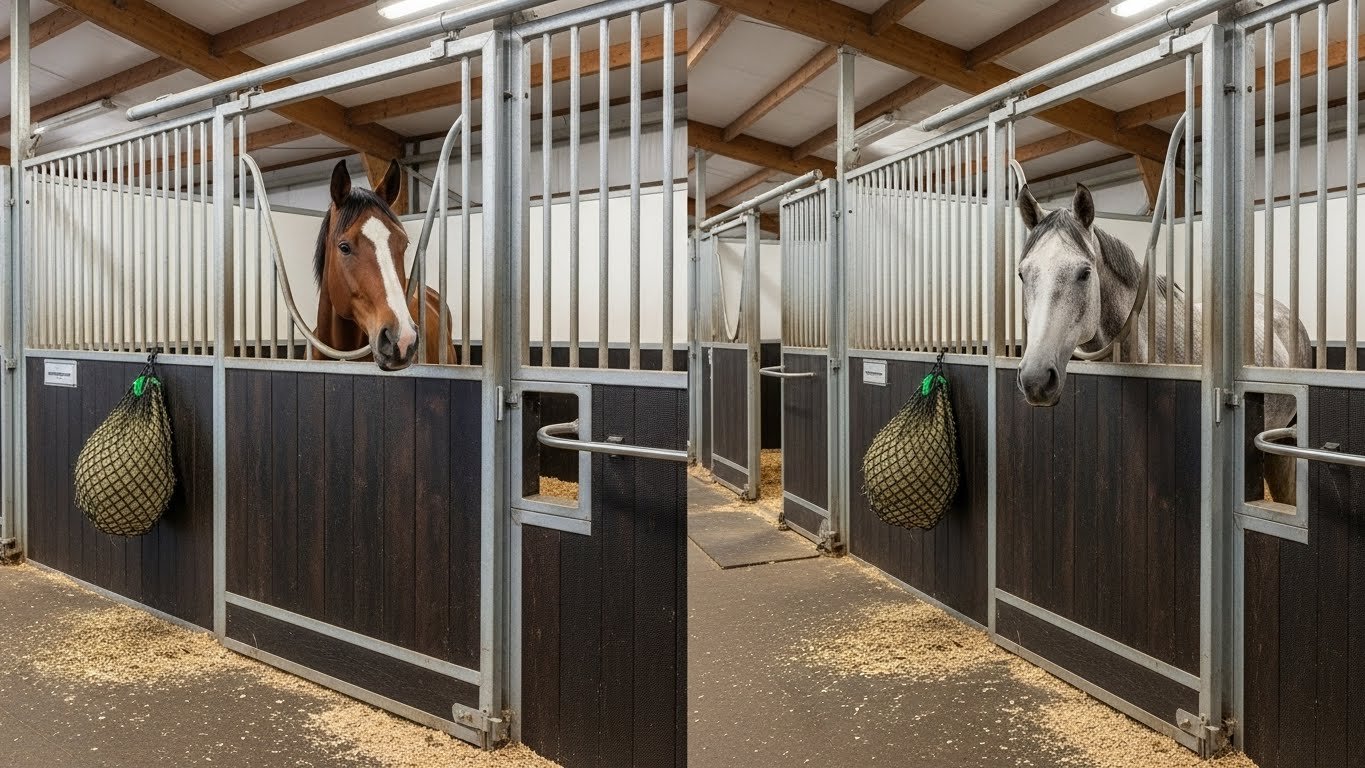
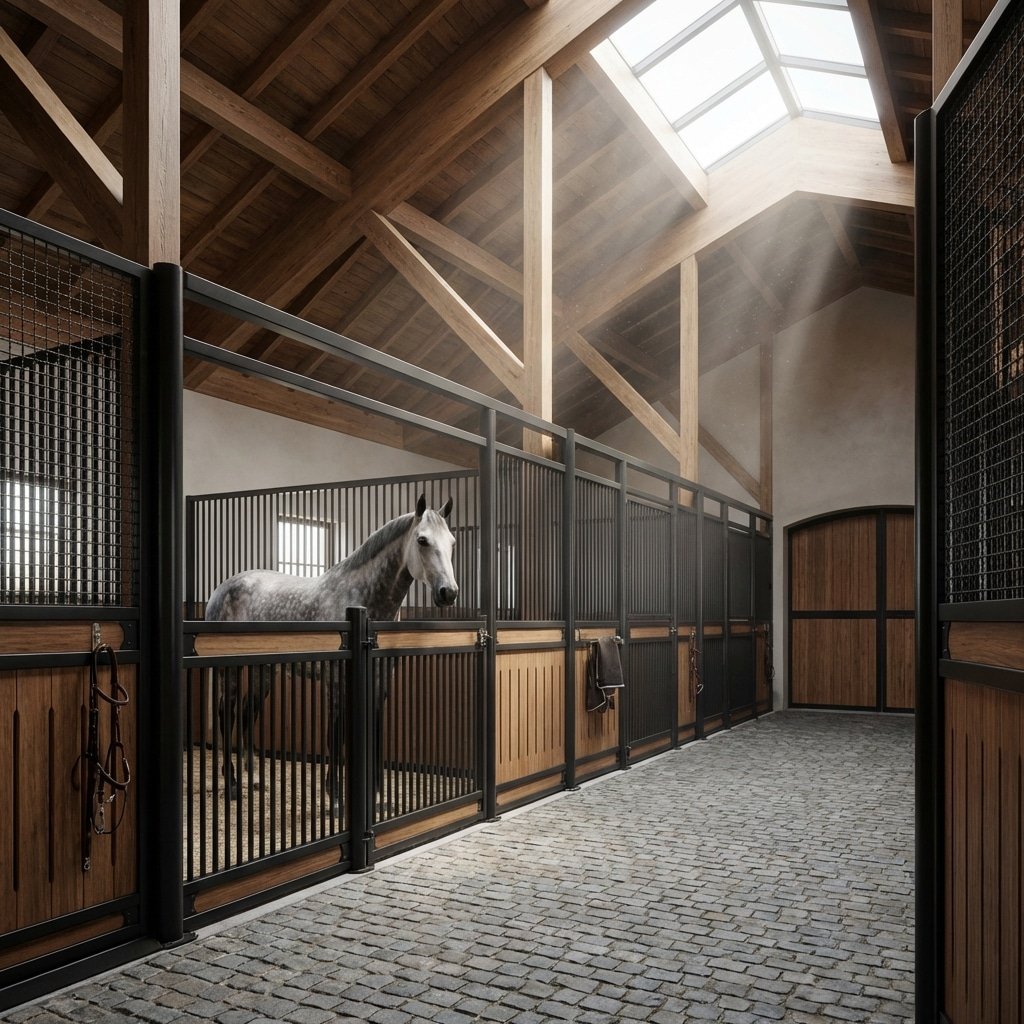
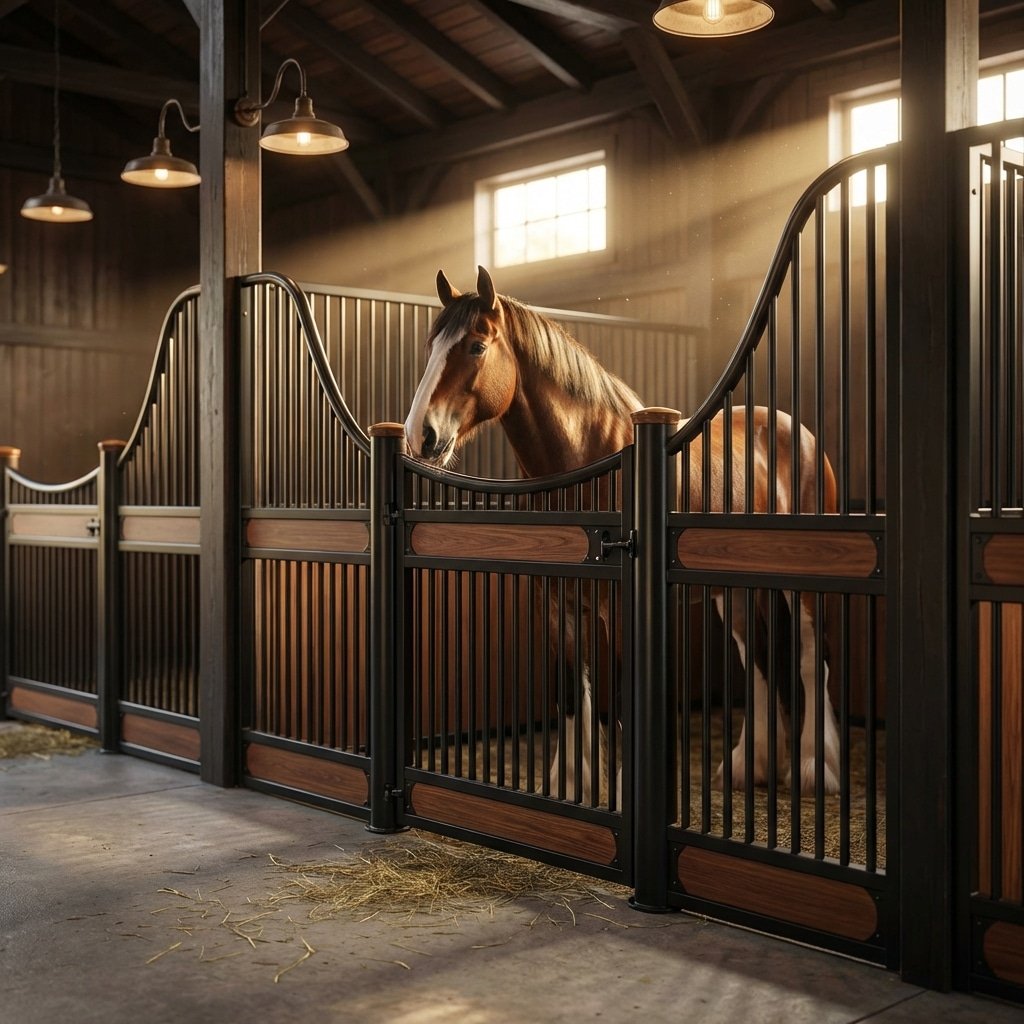
Vertical bars in horse stalls serve as engineered ventilation openings in stall fronts and partitions, offering a classic aesthetic while ensuring essential airflow. These grilles, often forming a 38-inch-high section above a solid kick wall, create a wide vertical band of free area. This design promotes consistent cross-stall airflow at the horse’s breathing height, which improves air mixing and overall barn air quality.
They are a crucial component of natural ventilation systems, working with eave and ridge openings to achieve proper air exchange. Barns use open grillwork on stall partitions to meet recommended air exchange rates, which range from 25 CFM per 1,000-lb horse in cold weather to 350 CFM in hot weather. This integrated approach ensures adequate airflow without relying solely on mechanical systems.
Design and Safety Specifications
Horse stall grilles are typically welded steel constructions. Manufacturers use 1-inch diameter, 16-gauge round or square steel tubing for the vertical bars. Frame components often consist of 12-gauge steel channels, such as those found in Triton Barns’ HS10V panels, supporting a 38-inch-high vent grille section above the solid kick wall. To ensure structural integrity under horse impact, center channels are sometimes welded back-to-back.
Bar spacing is engineered for safety; gaps are 1 inch or less below 48 inches in height to prevent hoof entrapment, with wider 2 to 3-inch spacing standard above 48 inches where the risk is lower. Frame perimeters are usually 1/8 to 3/16-inch thick steel. They incorporate 7/16-inch drainage holes to facilitate proper hot-dip galvanizing, which protects against corrosion and enhances product longevity.
Wire Mesh (Safety, High Flow)
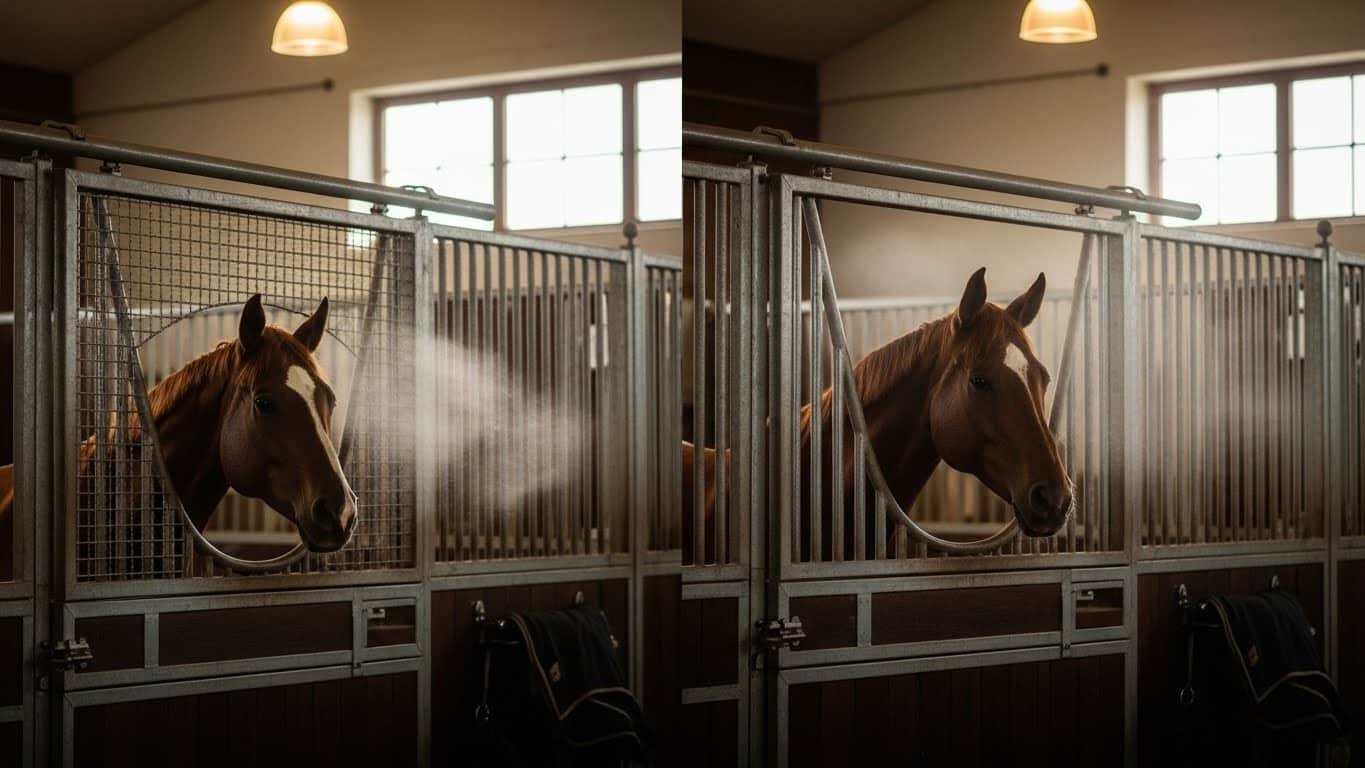
Wire mesh provides essential ventilation and safety in horse stables by preventing bird entry at eaves and facilitating high airflow within stalls. Optimal designs feature specific mesh sizes (e.g., 0.75-1.0 inch for eaves, 1.75-2 inch clear openings for stalls) and durable materials like hot-dip galvanized or stainless steel to withstand harsh barn environments and horse impact.
| Application | Component | Key Specification / Material |
|---|---|---|
| Eaves | Bird Screen | 0.75–1.0 inch square wire mesh for bird exclusion and maintaining airflow. |
| Stall Fronts/Partitions | High-Flow Mesh | ¼–5/16 inch steel rods with 1.75–2 inch clear openings (e.g., 2″x2″ square holes). |
| Structural Support | Frame Members (Stall Doors) | 2″ × 2″ square steel tubing to provide impact protection. |
| Durability | Corrosion Resistance | Hot-dip galvanized or stainless steel for ammonia-rich environments. |
| Ventilation Strategy | Stall Design Principle | Open grillwork or grids for maximum airflow, especially at lower stall levels. |
Optimizing Airflow and Safety with Mesh Design
Strategically placed wire mesh is critical for flushing ammonia and odor-laden air, especially at lower stall levels.
Open grillwork or grids in stall fronts and partitions are the most effective upgrade for improving stall ventilation.
Eave mesh with approximately 0.75–1.0 inch square openings restricts bird entry without significantly impeding natural airflow.
Properly sized mesh allows for very high free areas, balancing horse containment safety with maximum air movement, which is crucial for hot climates.
Technical Specifications and Material Considerations
Eave bird screens should use 0.75–1.0 inch square wire mesh; residential perforated soffits are inadequate, providing only one-third of required airflow and clogging easily.
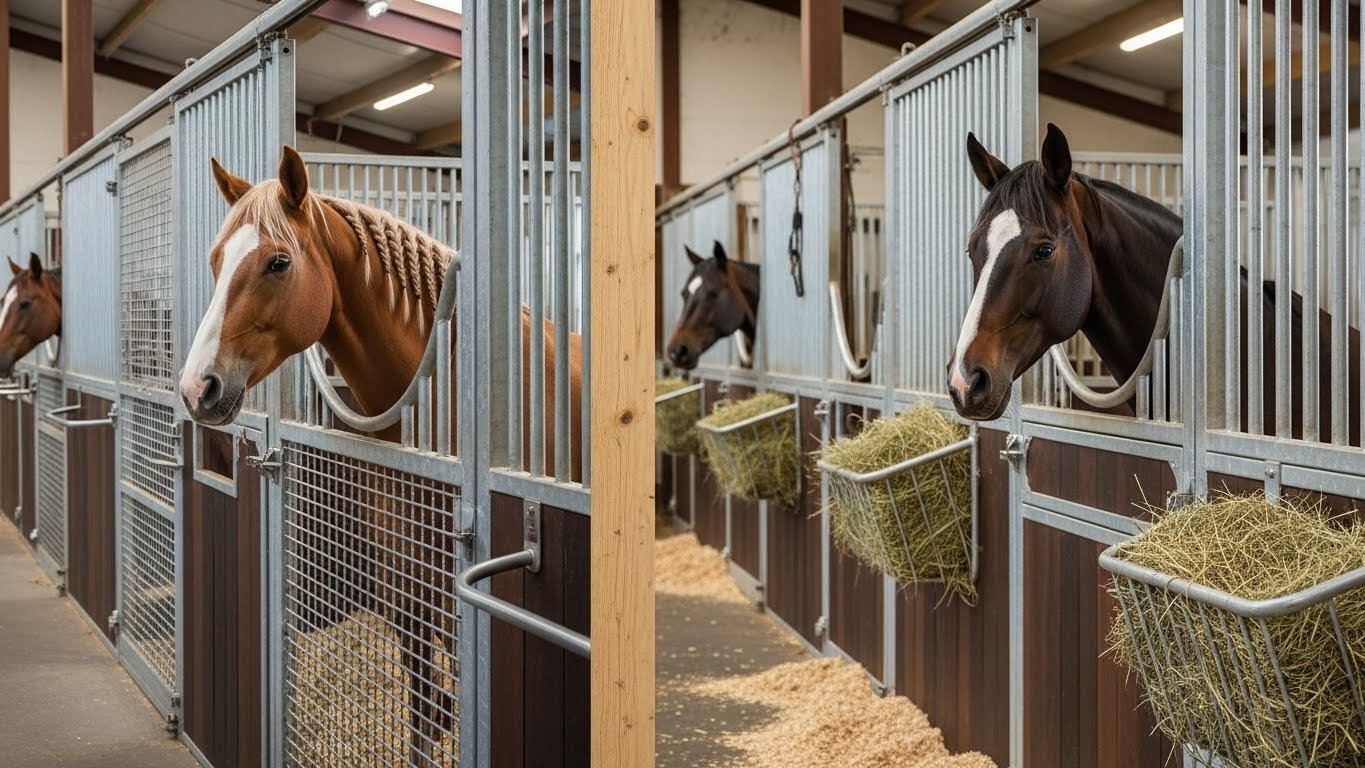
Stall front mesh commonly features 1/4–5/16 inch steel rods with 1.75–2 inch clear openings (e.g., 2″ × 2″ square holes) to ensure both high flow and hoof safety.
Corrosion resistance is achieved through materials like hot-dip galvanized steel (full immersion zinc coating) or stainless steel, essential for ammonia-rich environments.
Frames supporting mesh, particularly for stall doors, typically use robust 2″ × 2″ square steel tubing to provide impact protection and structural integrity.
Global Horse Stables: Built Tough, Tailored for Your Climate.
Privacy Panels (No Flow)
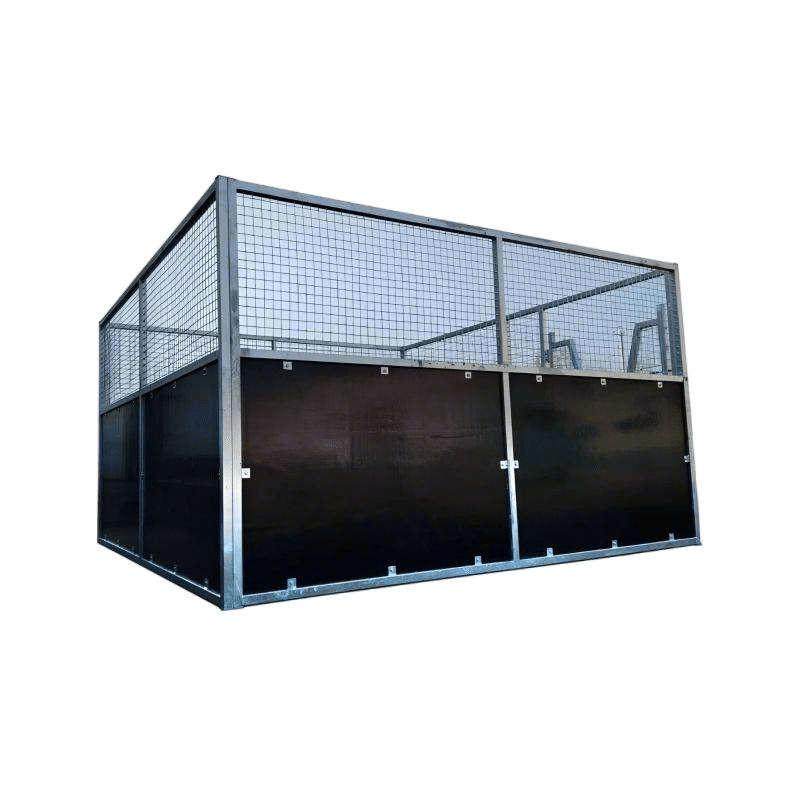
No-flow privacy panels are solid barriers with low porosity, effectively blocking visibility and sound but trapping air. This design results in high wind loads, demanding reinforced structural engineering for safe installation, especially at common heights of 6–8 ft.
Defining Solid ‘No-Flow’ Privacy Panels
Solid privacy panels are characterized by low porosity and minimal airflow, creating a continuous barrier. They are designed to effectively block both visibility and sound. The ‘no flow’ design leads to trapped air, resulting in significant wind pressure accumulation on the panel surface. These panels contrast sharply with gapped or mesh alternatives, which permit air passage.
Structural Demands and Wind Load Management
High wind load on no-flow panels necessitates reinforced engineering, including deeper footings or stronger anchors. Typical installation heights range from 6–8 ft, which amplifies structural stress due to wind. The continuous surface of these panels prevents air passage, concentrating wind forces directly onto supporting structures like posts and frames. In contrast, gapped designs (e.g., 1.5 in slat spacing in cedar wood or 3/16 in spaces in aluminum) are employed to allow airflow and reduce structural load.
The Verdict for Hot Climates
For hot climates, effective horse stable ventilation prioritizes high air exchange rates of 200–350 CFM per 1,000 lb horse. Design principles focus on maximizing heat rejection through strategic sizing of air inlets, openable stall areas, and exhaust systems rather than significantly lowering indoor temperatures below ambient.
| Ventilation Aspect | Specification | Details |
|---|---|---|
| Hot Climate Ventilation Rate | 200–350 CFM per 1,000 lb horse | For heat removal; 2-3 times higher than mild conditions. |
| Air Inlet Sizing (Mechanical) | 1.7 ft² per 1,000 CFM fan capacity | Prevents excessive inlet velocity and drafts. |
| Openable Stall Area (Windows/Doors) | 5–10% of stall floor area | E.g., 3×2.5 ft to 4×3.5 ft for a 12×12 ft stall. |
| Permanent Eave Openings | ≥1 inch continuous slot per 10 ft building width | Provides permanent opening into the stall. |
| Exhaust Opening (Ridge/Cupola/Chimney) | ≥1 ft² per horse housed | Individual chimneys minimum 2×2 ft. |
| Ceiling Fan Mounting Height | ≥11 ft above floor | For safety and optimal air movement. |
High-Volume Air Exchange Principles
Design for high air exchange rates, specifically 200–350 CFM per 1,000 lb horse, which is 2–3 times higher than mild conditions.
Prioritize maximizing air exchange for heat rejection, not attempting large temperature differentials from ambient.
Utilize high airspeed and evaporation as primary cooling mechanisms for horses.
Critical Design Specifications and Sizing
Provide 1.7 ft² of air inlet per 1,000 CFM of fan capacity to prevent excessive inlet velocity.
Size openable stall areas (windows/doors) to 5–10% of the stall floor area; for example, 3 x 2.5 ft to 4 x 3.5 ft for a 12 x 12 ft stall.
Ensure permanent eave openings provide at least 1 inch of continuous slot per 10 ft of building width.
Design ridge/cupola/chimney exhaust openings to at least 1 ft² per horse housed, with individual chimneys being minimum 2 x 2 ft.
Mount ceiling fans at least 11 ft above the floor for safety and optimal air movement.
Final Thoughts
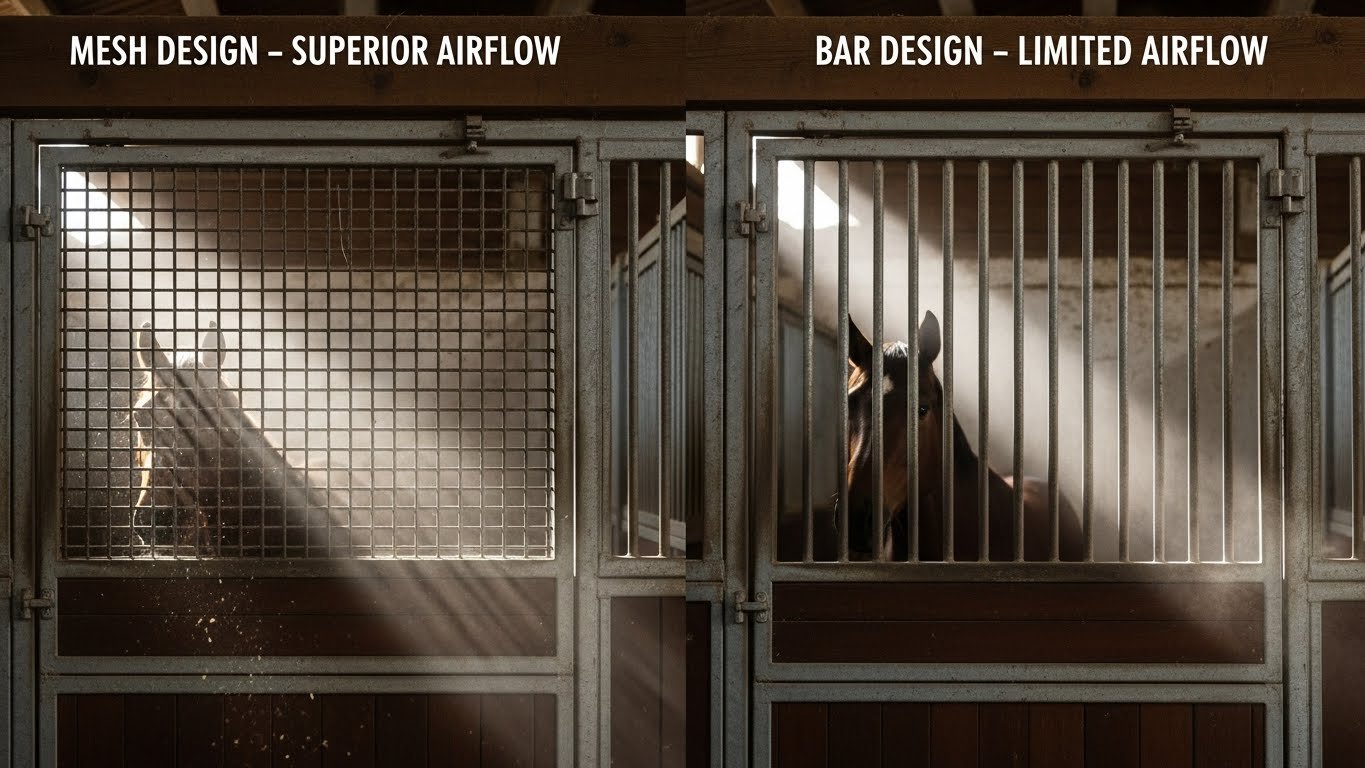
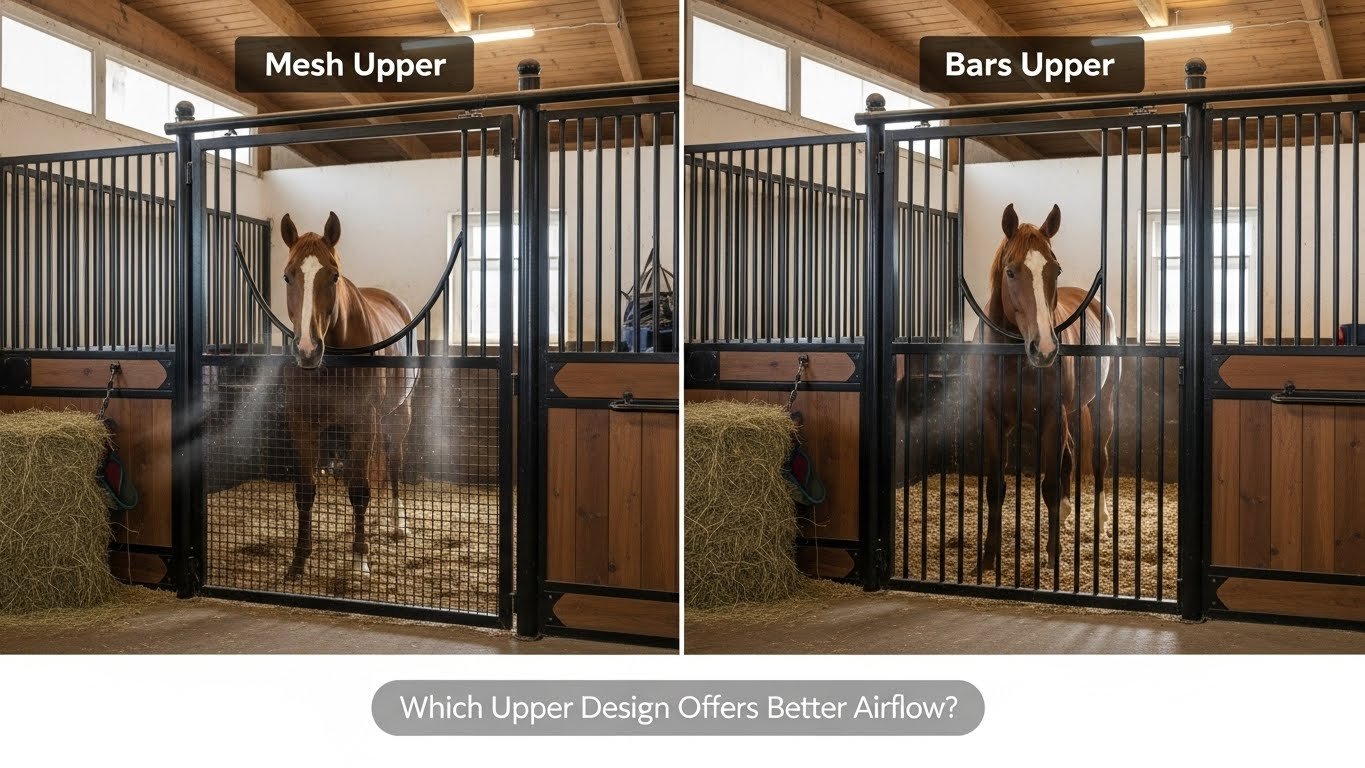
For horse stalls, especially in hot climates, wire mesh designs typically offer the best airflow, achieving the high air exchange rates needed to keep horses cool and flush out ammonia. Mesh also reduces safety risks like hoof or leg entrapment, making it a strong choice. While vertical bars with proper spacing provide good ventilation and a classic look, mesh often allows for a larger open area, making it ideal when maximum air movement is the top priority.
The choice between mesh, vertical bars, and privacy panels ultimately comes down to balancing airflow requirements, horse safety, and desired aesthetics. For optimal horse health and comfort, particularly in hot environments, prioritizing designs that maximize air exchange, like mesh, is key. Barn owners should carefully assess their climate, horse activity levels, and ventilation goals to make a selection that best supports a healthy and safe barn environment.
Frequently Asked Questions
Are mesh stalls safer than bars?
Properly-sized steel mesh stall fronts and gates are generally considered safer than vertical bars as they eliminate hoof and leg entrapment gaps while still providing ventilation and visibility. This holds true provided the mesh is heavy-gauge steel and correctly framed. Bars are safe when built to an industry standard spacing of 2–3 inches (5–7.5 cm). Mesh gates are specifically recommended where foals, shod horses, or very active horses might increase entrapment risk.
Best stall design for hot climates?
For horse stalls in hot climates, the optimal design includes 8-foot-high partitions where the top half features grills, mesh, or spaced boards. Examples are 2×2-inch mesh openings or 1-inch steel bars spaced 3 inches apart, ensuring maximum airflow. Combine this with a 12×12-foot stall size, 10-12-foot ceiling height, and 4-foot-wide by 8-foot-tall doorways.
Do mesh stalls allow better airflow?
Yes. Full or partial mesh stall fronts and doors are recognized in engineering guides as effective ways to increase stall-level airflow and air exchange. They remove obstructions to natural air movement, exposing nearly the full stall face to the barn’s ventilation stream. A typical full mesh stall door provides close to 100% of its area as open, ventilating surface, unlike solid or grilled doors that offer limited effective opening.
Can a horse get stuck in stall bars?
A horse cannot get stuck in properly designed stall bars if they follow industry standards. These standards specify 1-inch round bars spaced on 3-inch centers, which leaves a 2-inch spacing between bars. Leading manufacturers implement these specifications to prevent hooves from becoming caught.
Ventilation requirements for horses?
Authoritative guides recommend providing about 1 square foot of permanent inlet and outlet opening per horse. Also, mechanical or natural air exchange should be 25 CFM per 1,000-pound horse in winter, 100 CFM in mild weather, and 200–300 CFM in hot weather. For cold-climate naturally ventilated barns, size continuous eave slots at 1 inch of opening per 10 feet of building width and ridge or cupola openings at 1 square foot per horse housed.
Privacy vs airflow in stalls?
Industry standards recommend balancing privacy and airflow in horse stalls using partial privacy partitions. These feature a solid bottom with a grilled or crosshatch upper section, offering visual separation below while ensuring cross-ventilation above. Full solid partitions restrict airflow and are unsuitable for adequate horse stable ventilation, while fully open mesh prioritizes maximum airflow, compromising privacy.

 English
  Spanish
  French
  Arabic
  German
0 Comments