



This guide details essential specifications, including 12×12 stall dimensions and 300 CFM mechanical ventilation rates. We explore NEC 547 electrical compliance and compare 42-micron hot-dip galvanization against traditional timber for lasting biosecurity and structural integrity.
Key Principles of Safe Stable Design
Safe stable design relies on three engineering pillars: structural resilience against 1,000-pound impact forces, dimensional adequacy (minimum 12’x12′ stalls), and injury prevention protocols. Critical specs include 14-gauge steel framing, 7.5-foot partitions to prevent climbing, and proper ventilation clearance to support equine biomechanics and respiratory health.
Building a horse stable requires strict adherence to engineering standards that prioritize animal safety and structural longevity. Before selecting specific products, we must establish a baseline for quality. A stable is not just a shelter. It is a containment system that must withstand massive physical force while maintaining a healthy environment for respiratory function.
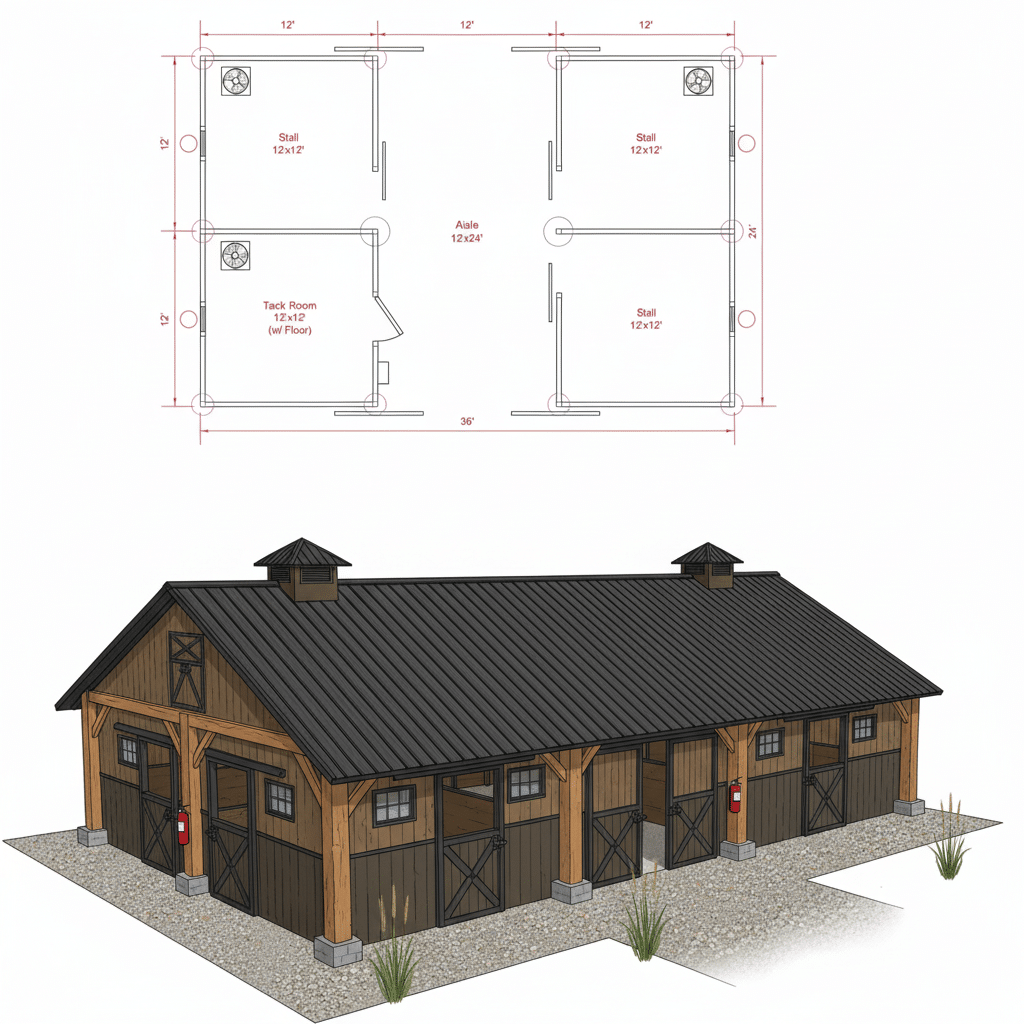
Optimizing Stall Dimensions for Equine Biomechanics
The physical space inside a stall directly impacts a horse’s safety. If a stall is too small, a horse cannot lie down or stand up without risking injury. We define spatial requirements based on the biomechanics of a standard 1,000-pound animal. Think of this as sizing a bedroom so the occupant can move freely without hitting the walls.
- Standard Footprint: A 12 feet x 12 feet (approx. 3.65m x 3.65m) area is the baseline size. This provides enough radius for a horse to turn around comfortably.
- Large Breed Adjustments: Horses standing 17 hands or higher need more room. A dimension of 12 feet x 14 feet (3.65m x 4.25m) prevents them from becoming cast against the wall.
- Vertical Containment: Partitions must reach 7.5 feet to 8 feet. Horses can kick as high as 7 feet, so this height prevents legs from getting hung up over the wall.
- Doorway Clearance: Openings require a minimum height of 8 feet and a width of 4 feet (1.25m). This prevents hip injuries when a horse rushes through the entry.
Material Specifications for Structural Integrity
Horses are powerful animals that will lean, kick, and chew on their surroundings. The materials used must withstand this behavior without bending or breaking. We look for materials that offer high tensile strength and resistance to environmental factors like moisture and ammonia.
- Steel Gauge Standards: Structural components typically require 14-gauge pre-galvanized steel minimum. This thickness resists bending under the pressure of a leaning horse.
- Impact Resistance: Infill materials must endure repeated high-force impacts. We prefer hardwood or high-density polymers over standard softwood, which can splinter and cause injury.
- High-Touch Durability: Latches and frequent contact points often use brass or stainless steel. These metals resist wear from constant handling.
- Corrosion Protection: Stables are high-ammonia environments. Steel components require hot-dip galvanization, which acts like a permanent zinc shield to prevent rust.
Critical Safety Features and Airflow Dynamics
Beyond the frame and walls, the finishing details determine how safe the barn is during daily use. This includes airflow management and the elimination of protrusion hazards. Proper ventilation is essential to clear ammonia fumes and dust from the horse’s breathing zone.
- Vertical Clearance: Barn ceilings should range from 10 to 12 feet. This maintains 60-90cm (2-3 feet) of clear space above the horse’s ears when standing to prevent head injuries.
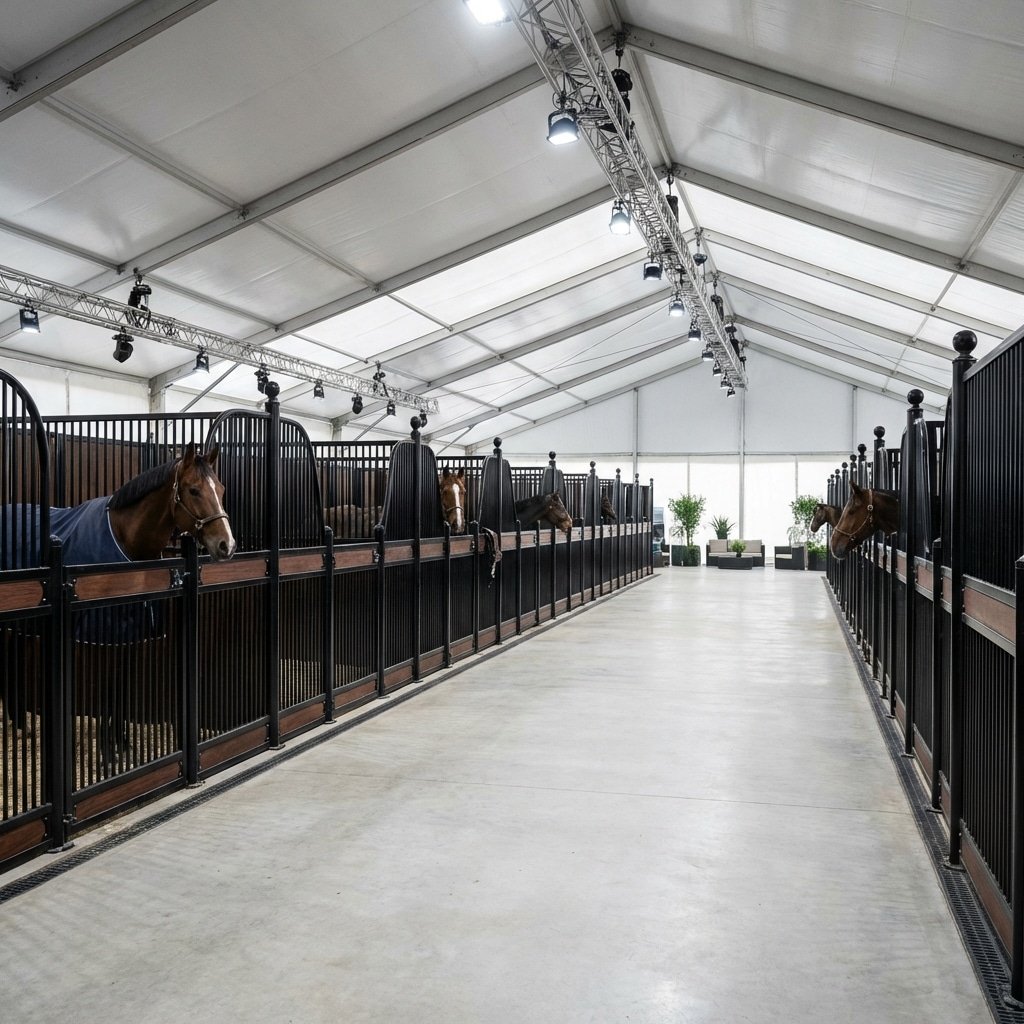
- Aisle Safety: Minimum 12-foot aisle widths allow handlers to pass safely. This width reduces stress levels for horses moving through the barn.
- Glazing Standards: Windows placed below 5 feet must use tempered glass protected by steel bars to prevent shattering upon impact.
- Hardware Safety: Sliding doors are safer than swinging doors in aisles because they do not block the walkway. All latches must be horse-proof yet accessible for humans in emergencies.
How DB Stable Aligns with Engineering Standards
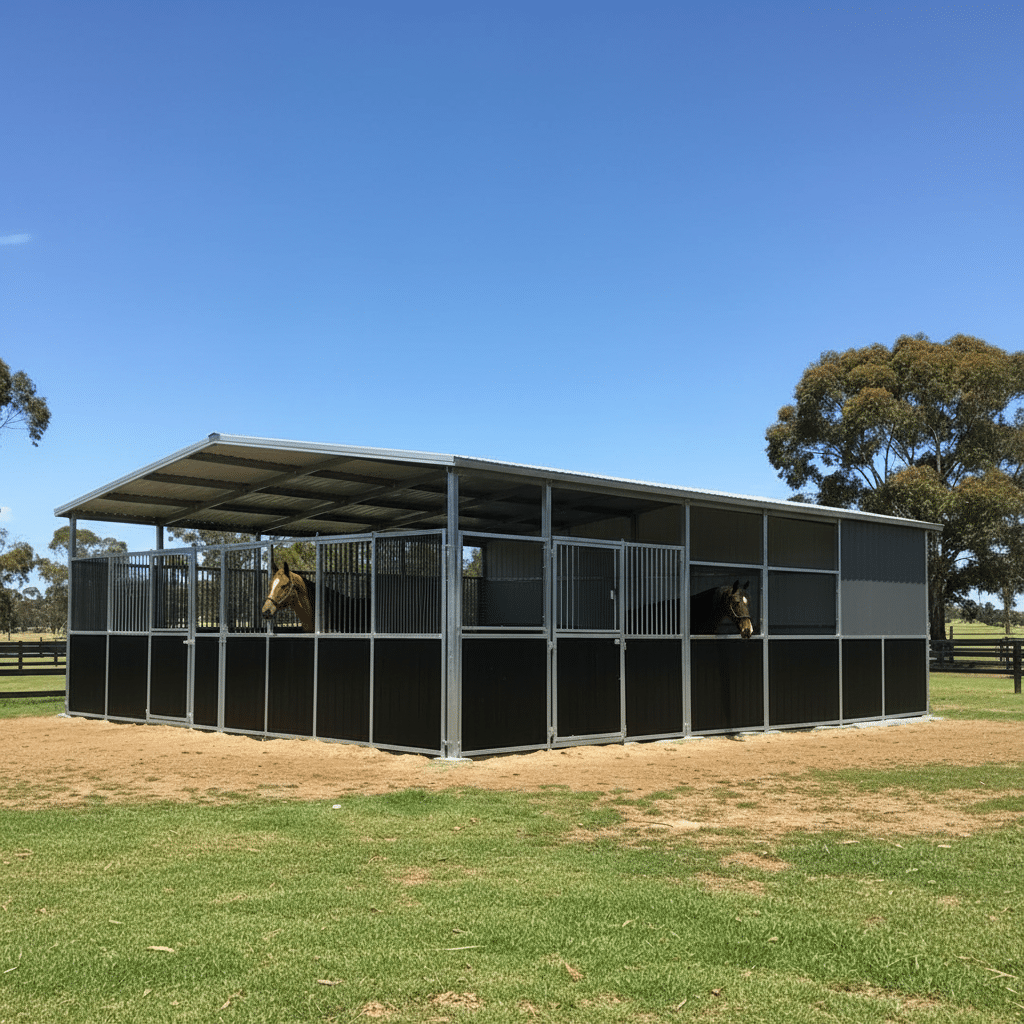
DB Stable applies these general safety principles directly to their manufacturing process. Their designs specifically address the common failure points found in generic stabling, such as rust and kick-through damage, ensuring the final product meets rigorous safety codes.
- Galvanization Spec: Frames feature hot-dip galvanization exceeding 42 microns. This thick zinc coating is rated to last 10+ years against rust even in humid conditions.
- Infill Technology: The system utilizes 10mm UV-resistant HDPE boards. Unlike wood, which expands with moisture, these boards eliminate thermal expansion and withstand UV degradation.
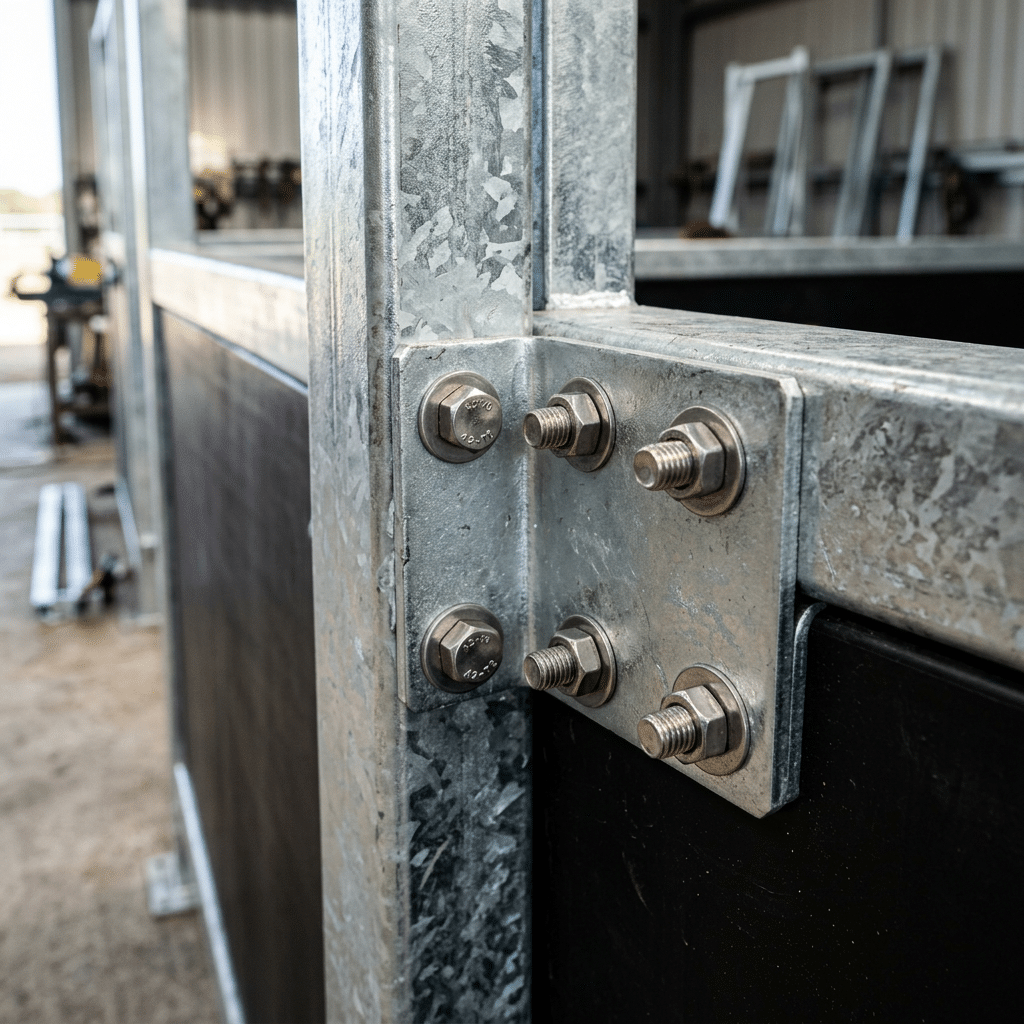
- Connection Strength: Assembly relies on fully welded 40x40mm square metal tubes and 6mm steel plate connectors. This ensures structural rigidity superior to bolted connections.
- Design Flexibility: These prefabricated portable designs maintain safety standards while allowing relocation. This makes them particularly suitable for the dynamic needs of the AU/NZ market.
Optimal Stall Dimensions for Different Breeds
Industry consensus establishes 12′ x 12′ as the standard stall size for general riding horses, such as Thoroughbreds and Quarter Horses, providing sufficient room to turn and lie down. Large breeds over 16 hands require 14′ x 14′ or 16′ x 16′ spaces, while foaling mares need a minimum of 16′ x 20′. Vertical clearance must reach 10 feet in enclosed barns to ensure ventilation and prevent injury.
| Horse Category | Height (Hands) | Recommended Size | Square Footage |
|---|---|---|---|
| Standard Riding | 14–16 hh | 12′ x 12′ | 144 sq ft |
| Warmbloods / Drafts | > 16 hh | 14′ x 14′ to 16′ x 16′ | 196–256 sq ft |
| Foaling Mare | Various | 16′ x 20′ (Min) | 320 sq ft |
| Ponies | < 14 hh | 10′ x 10′ | 100 sq ft |
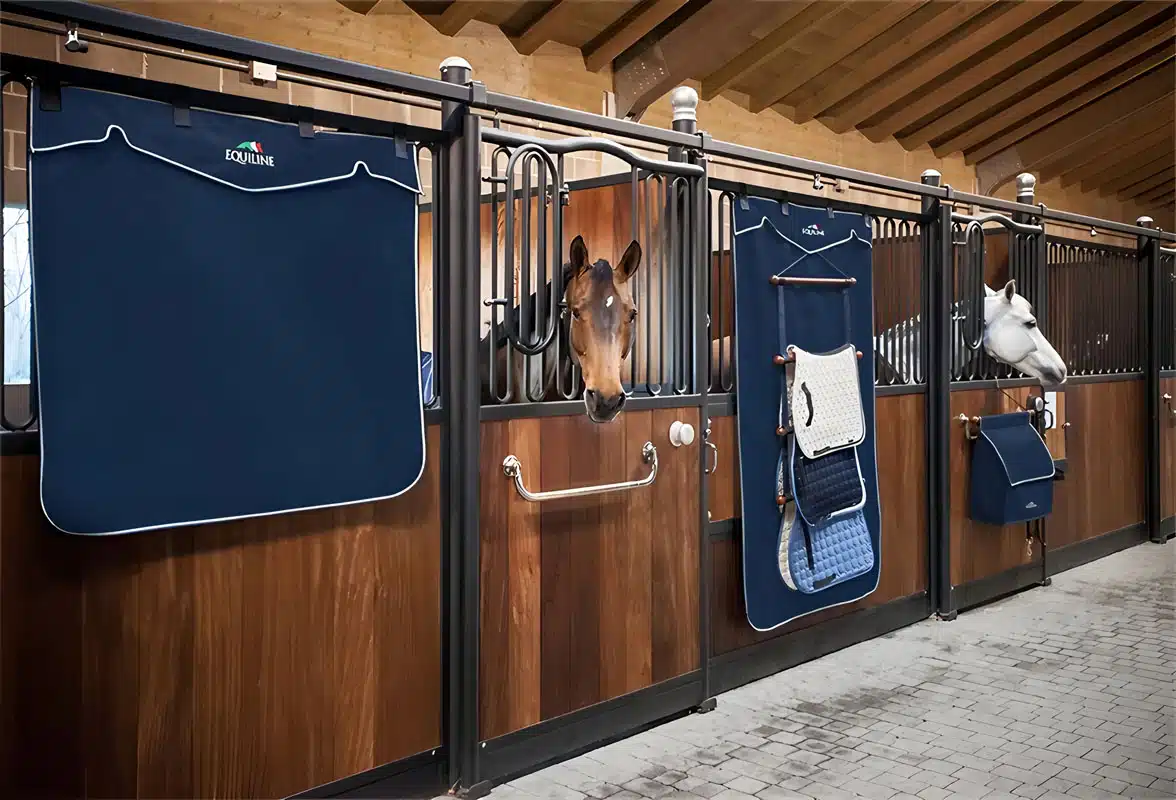
Standardizing Floor Area by Horse Size
Selecting the correct floor area is a balance between animal comfort and spatial efficiency. The 12′ x 12′ configuration serves as the universal baseline for most riding horses. This size allows an average horse to turn around comfortably and lie down flat without becoming cast. Casting happens when a horse lies down too close to a wall and cannot get the leverage needed to stand back up because its legs are trapped against the partition.
For larger animals, such as draft horses or warmbloods exceeding 16 hands, the risk of casting increases significantly in standard stalls. Expanding the dimensions to 14′ x 14′ or even 16′ x 16′ provides the necessary clearance for these longer bodies. Foaling operations operate under different safety rules. A foaling stall must be large enough to accommodate both the mare and the newborn foal safely, often requiring a minimum of 16′ x 20′ so human handlers can assist during birth without being crowded.
- Universal Baseline: The 12′ x 12′ size fits most breeds between 14 and 16 hands.
- Large Breed Requirements: Horses over 16 hands need 14′ x 14′ spaces to prevent injury.
- Foaling Safety: A 16′ x 20′ area prevents overcrowding during the birthing process.
- California Formula: Some standards use math to define size: 2.5 × (height of horse)². For a 16-hand horse, this equals roughly 176 sq ft.
Vertical Clearance and Partition Engineering
The volume of the stall is just as important as the floor area. In enclosed barns, a minimum vertical clearance of 10 feet is essential. This height facilitates proper airflow, which reduces respiratory risks, and prevents horses from hitting their heads if they rear up. Think of the vertical space as a heat sink; higher ceilings allow warm, ammonia-filled air to rise away from the horse’s breathing zone.
Partition walls between stalls are engineered to manage social interaction. A standard height of 7 feet prevents horses from biting or fighting over the wall while still allowing them to see their neighbors. The front panels usually feature a solid base of 5.5 feet topped with a grill guard. The bars on these grills must be spaced less than 4 inches apart to ensure a hoof cannot get stuck if a horse kicks out.
- Ceiling Height: A 10-foot minimum prevents claustrophobia and aids ventilation.
- Partition Walls: These stand 7 feet high to stop aggression while allowing socialization.
- Grill Spacing: Bar gaps must be under 4 inches to prevent hoof entrapment.
- Aisle Widths: A 12-foot aisle allows for safe cross-tying, while 14-16 feet is needed if tack boxes are stored in the walkway.
How DB Stable Materials Support Large Structures
Building larger stalls, such as the 14′ x 14′ units required for large breeds, introduces structural challenges. As the length of a portable panel increases, it becomes more prone to sagging or warping under its own weight or from the force of a horse leaning against it. To counteract this, high-strength materials are required to maintain rigidity without needing permanent foundation posts.
DB Stable addresses this by using hot-dip galvanized steel for all structural frames. Galvanization is a process where steel is submerged in molten zinc, creating a metallurgical bond that acts as a permanent shield against rust. With a coating thickness exceeding 42 microns, these frames maintain their structural integrity for over a decade, even in damp stable environments. The infill panels use 10mm thick HDPE boards. Unlike wood, which can rot or splinter under impact, HDPE is a dense plastic that absorbs shock and resists UV damage, ensuring the larger walls remain straight and secure.
- Rigid Framing: Hot-dip galvanized steel prevents sagging in wide 14-foot panels.
- Rust Protection: A >42 micron zinc coating protects the metal for over 10 years.
- Impact Resistance: 10mm HDPE boards withstand kicks without warping or splintering.
- Connection Strength: Joints use 40x40mm square tubes welded to 6mm steel plates for maximum shear strength.
Aisle Width: Balancing Safety and Workflow
The consensus standard for private stable aisles is a minimum of 12 feet, providing a safety envelope for a single handler and horse. Commercial or show facilities often require 14 to 16 feet to accommodate machinery and simultaneous horse movement. Critical vertical clearance rules dictate ceilings should be either 7 feet or above 9 feet to avoid turbulence and head-strike hazards.
The Engineering Logic Behind Aisle Dimensions
Defining the width of a stable aisle is less about preference and more about physics and psychology. The dimensions must accommodate the unpredictable nature of large animals while ensuring humans can work efficiently without obstruction.
- Emergency Egress Capacity: In a fire or panic situation, the aisle acts as the primary escape route. It must be wide enough to prevent bottlenecks, similar to how wide exits are required in crowded theaters to ensure everyone gets out safely.
- Behavioral Safety Zone: Horses are prey animals and need personal space to feel secure. A sufficient width prevents behavioral escalation, such as kicking or biting, when two horses pass each other in the aisle.
- Operational Flow: The 12-foot threshold ensures a handler can lead a horse down the center while staying clear of obstacles like blanket bars or latches on stall fronts.

Standard Specifications: Width and Vertical Clearance
Different facility types require specific dimensions to handle varying levels of traffic and equipment use. Adhering to these standards ensures compliance with safety codes and improves daily functionality.
- Private Facilities: A width of 12 feet is the industry standard for safe daily handling. This allows enough room for a horse to turn around comfortably without hitting the walls.
- Commercial/Show Barns: High-traffic zones require 14-16 feet. This extra space accommodates equipment vehicles, such as tractors or carts, and allows multiple handlers to work simultaneously.
- Absolute Minimum: A width of 8 feet is the lowest threshold. This is only suitable for areas where movement is restricted and horses will not need to turn around or pass one another.
- Ceiling Height Physics: Design must be 9+ feet or kept at 7 feet. Avoiding the 8-foot mid-range prevents turbulent airflow patterns and reduces the risk of head injuries if a horse rears up.
Critical Alignment: Doors, Equipment, and Flooring
The aisle width dictates how other components of the stable function. These elements must align correctly to create a seamless and safe workflow for both horses and handlers.
- Door Correlation: A 12-foot aisle typically dictates 12-foot barn doors at the ends. This alignment prevents entrapment hazards during entry and exit transitions.
- Stall Openings: Standard 4-foot stall doors, or wider options for large breeds, must open without blocking the central driving lane. This ensures the path remains clear even when stalls are active.
- Equipment Clearance: Layouts must accommodate feed carts and wheelbarrows without restricting the path. A cluttered aisle creates tripping hazards and slows down chores.
- Surface Safety: Non-slip rubber pavers or textured concrete are essential. These materials provide traction to prevent slips during sharp turns in the aisle.
How DB Stable Supports Flexible Aisle Configurations
Using portable stable designs offers significant advantages for aisle layout. The modular nature of these systems allows owners to customize the width based on the specific barn shell rather than being limited by permanent construction.
- Customizable Spacing: DB Stable’s portable design allows owners to set the aisle width to 12ft, 14ft, or wider during installation. This flexibility is ideal for retrofitting existing structures.
- Structural Integrity: The connectors use 40*40mm square metal tubes fully welded with 6mm steel plates. This robust construction ensures stability even in wide-aisle configurations where structural demand is higher.
- Long-Lasting Materials: Components feature hot-dip galvanization over 42 microns. Think of this as a heavy-duty shield that prevents rust, which is critical in aisles that experience high airflow and moisture.
- Door Options: Offering both sliding and swing doors helps optimize aisle clearance. Sliding doors are particularly useful in narrower aisles as they do not swing out into the walking path.
Custom Horse Stables Built for Extreme Climates
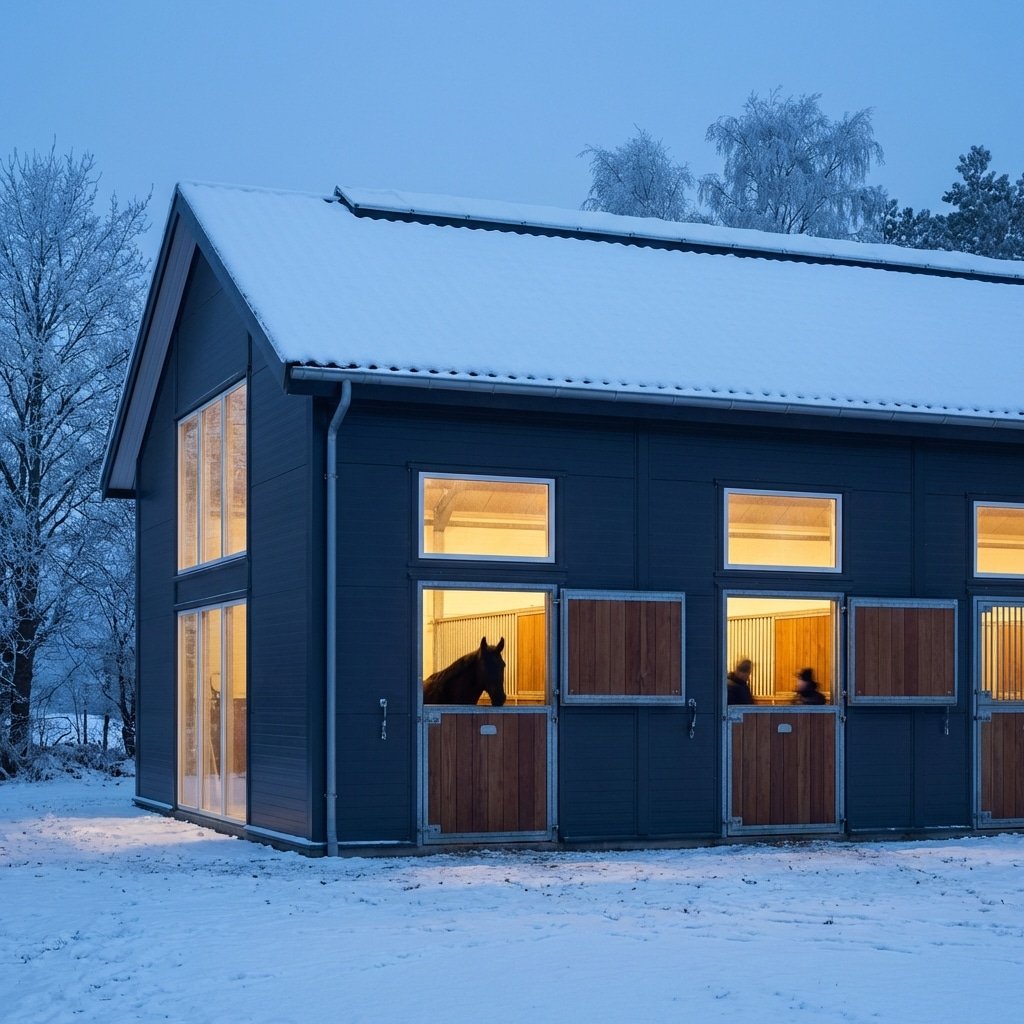
Engineer safety and comfort into your equestrian facility with precision-welded designs. Our modular stables withstand harsh weather conditions, meeting international standards like BHS and ISO 9001. Experience rapid installation and materials crafted for long-term durability.
Ventilation Strategies: Passive vs. Mechanical
Effective stable ventilation balances natural thermal buoyancy with mechanical controls to remove moisture and pathogens. Standards require permanent passive openings of 1 square foot per horse or mechanical exchange rates scaling from 25 CFM in winter to 350 CFM in summer per horse to maintain air quality.
| Specification | Passive System Standard | Mechanical System Standard |
|---|---|---|
| Primary Driver | Wind and Thermal Buoyancy | Electric Fans (Exhaust/Intake) |
| Sizing Rule | Min. 1 sq ft opening per horse | 25 to 350 CFM per horse |
| Summer Adjustment | Expand openings 2.5 to 3x | Increase to 350 CFM velocity |
| Inlet Requirement | Continuous eave slots | 0.2 m² intake per 1,000 CFM |
Principles of Passive and Mechanical Airflow
Ventilation in horse stables relies on two main methods: passive natural airflow or active mechanical exchange. Passive systems use thermal buoyancy, which is the natural tendency of warm air to rise like smoke up a chimney. This system requires a minimum of 1 square foot of permanent opening per horse to function correctly year-round.
Mechanical control becomes necessary when natural airflow cannot clear stagnant air. This method uses fans to push or pull air through the building, ensuring a uniform exchange. In well-ventilated facilities, the goal is to maintain a stable air volume of 40 cubic meters per horse. During winter, systems run at low velocity to avoid chilling drafts, while summer settings aim for air speeds of 4 to 5 meters per second to help with evaporative cooling.
Critical Sizing Specifications for Ventilation Systems
Proper sizing is vital to prevent respiratory issues. If the inlets or fans are too small, moisture and ammonia build up rapidly.
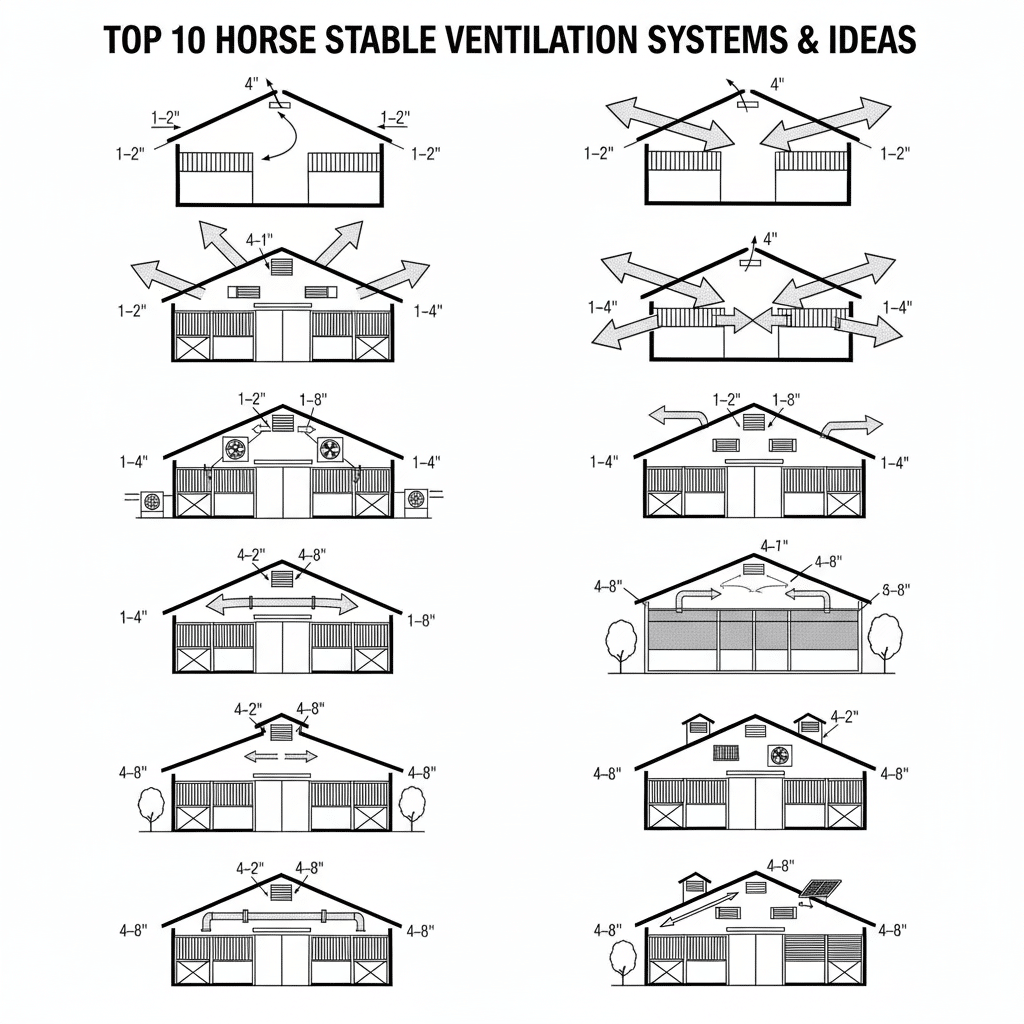
- Passive Eave Sizing: ✅ Engineers recommend 1 inch of continuous-slot opening for every 10 feet of building width. For a standard 36-foot center aisle barn, this means you need 3 to 4 inches of open slot on each sidewall.
- Mechanical Flow Rates: ✅ Fans must be adjustable based on the season. You need 25 CFM (Cubic Feet per Minute) per 1,000 lb horse in cold weather to remove moisture, rising to 100 CFM in mild weather, and up to 350 CFM in hot weather for cooling.
- Chimney Dimensions: ✅ Exhaust chimneys act as the exit point for stale air. They require R-10 insulation to stop warm moist air from condensing into water droplets and dripping back into the stall. Dimensions should be at least 2×2 feet for single-story barns.
- Summer Expansion: ✅ To keep indoor temperatures within 4°C of the outside temperature, passive openings must be adjustable, expanding to 2.5 to 3 times their winter size.
Choosing the Right Strategy for Stable Layouts
The shape of your building often dictates the ventilation method. Simple center-aisle and single-aisle layouts work efficiently with passive ridge vents provided there is 1 square foot of opening per horse. However, wider buildings with double aisles often create dead zones where air does not move, requiring mechanical fans to force circulation.
In regions with low wind, mechanical systems offer more reliability. They ensure a consistent 300 CFM exchange even on still, hot summer days. Regardless of the method, the airflow must be directed upward and toward the center aisle. This ensures fresh air reaches the horse’s breathing zone without creating a cold draft directly on the animal.
How DB Stable Designs for Optimal Airflow
We integrate these ventilation standards directly into our portable stable designs to ensure safety and comfort without requiring complex retrofitting.
- Mesh Integration: ✅ Our stalls feature hot-dip galvanized mesh upper panels. This supports the passive ventilation requirement by allowing continuous horizontal airflow through the stall, preventing stagnant pockets of ammonia.
- Flexible Openings: ✅ The choice between swing and sliding doors allows owners to easily manage the summer expansion rule. By opening top doors or sliding panels, you can instantly increase the inlet size by the recommended 2.5 to 3 times.
- Modular Placement: ✅ Because our stables are portable, you can orient them to maximize natural wind intake. This reduces reliance on expensive mechanical systems in mild climates, while our heavy-duty materials resist the wear of constant environmental exposure.
Lighting and Electrical Layout Essentials
Electrical systems in horse barns must comply with National Electrical Code (NEC) Article 547 due to moisture, dust, and corrosive environments. Standard residential wiring like Romex is strictly prohibited. Use PVC conduit for corrosion resistance, install NEMA 3R weatherproof panels, and ensure all outlets have GFCI protection. Wiring below 8 feet requires physical protection from equine damage.
Regulatory Framework: NEC Article 547 Compliance
Wiring a horse barn is fundamentally different from wiring a house because the environment is far more aggressive. The National Electrical Code (NEC) Article 547 specifically addresses agricultural buildings. Think of a barn environment like a slow-motion chemical attack on metal and plastic. The combination of animal waste, dust, and moisture creates an atmosphere that corrodes standard electrical components rapidly.
- ✅ NEC Article 547 Application: Agricultural buildings fall under specialized code rules due to excessive dust, moisture, and corrosive atmospheres common in animal housing.
- ✅ Cable Prohibition (NEC 547.5): Nonmetallic sheathed cable, often called Romex, is strictly prohibited in animal habitats. It acts like a sponge for moisture and offers zero protection against rodents chewing through the insulation.
- ✅ Grounding Standards: A separate copper equipment grounding conductor is mandatory. If installed underground, NEC 547.5(F) requires the conductor to be fully insulated to prevent stray voltage, which can spook horses.
Critical Safety Components and Materials
Preventing fire and electrocution requires specific hardware designed to withstand wet and dirty conditions. Standard metal pipes used in commercial buildings often rust quickly in barns due to ammonia fumes from stall bedding. Therefore, material selection is just as important as the circuit design itself.
- ✅ Conduit Selection: PVC conduit is the standard for barns because it is immune to rust and corrosion caused by ammonia gases and high humidity.
- ✅ Enclosure Ratings: Electrical panels must be NEMA 3R rated for wet locations. This rating ensures the box seals tightly against rain, snow, and dust ingress.
- ✅ Circuit Interrupters: All 120-volt outlets require GFCI protection to shut off power instantly if a shock hazard is detected. AFCI devices are also recommended to detect arcing wires that could ignite hay or wood dust.
Fixture Placement and Physical Protection
Horses are large, curious, and occasionally destructive animals. The layout of your electrical system must account for their physical reach and behavior. A horse standing on its hind legs can reach surprisingly high, and a well-placed kick can shatter standard glass fixtures.
- ✅ The 8-Foot Rule: Any wiring located within 8 feet of the floor must be physically protected by rigid conduit. This prevents horses from chewing on cables or kicking through soft wiring.
- ✅ Luminaire Standards: Lighting fixtures must meet NEC 547.8 standards for damp locations. They should always include protective cages or impact-resistant lenses to prevent glass from falling into the stall if struck.
- ✅ Wash Bay Specifics: This is the most dangerous zone in the barn. All equipment here requires strict wet location approval to handle direct water spray safely.
Integrating Electrical Systems with DB Stable Structures
The structural design of the stable itself plays a significant role in how easily and safely you can install electrical components. Using prefabricated structures often simplifies the mounting process compared to retrofitting wood barns.
- ✅ Mounting Surfaces: DB Stable utilizes 40x40mm square metal tube frames. This flat, rigid surface provides an ideal non-combustible substrate for securely mounting surface-run PVC conduit without the need for complex blocking.
- ✅ Material Synergy: The frame consists of hot-dip galvanized steel coated to over 42 microns. This high level of corrosion resistance matches the longevity of PVC electrical components, ensuring the entire infrastructure resists barn ammonia levels equally.
- ✅ Fire Safety: Utilizing 10mm HDPE infill boards significantly reduces the fire fuel load compared to traditional wood planks. This complements AFCI electrical protection strategies by removing combustible material from the immediate vicinity of outlets.
Designing for Feed, Tack, and Wash Bay Efficiency
Optimal feed and tack room sizing ranges from 10’×10′ to 12’×12′ for standard stables, scaling up for larger facilities. Wash bays require a minimum footprint of 8’×10’—ideally 12’×12′ for safety—with a 2% floor slope (1 inch per 6 feet) and 6-inch concrete slabs to ensure efficient drainage and structural integrity.
Creating functional service areas is just as critical as the stall design itself. A well-planned stable layout ensures that daily chores flow smoothly while keeping horses safe during grooming and washing. The dimensions of your utility rooms must scale directly with the number of horses you manage to prevent clutter and operational bottlenecks.
| Area Type | Recommended Dimensions | Key Engineering Requirement |
|---|---|---|
| Feed & Tack (Small Stable) | 10’×10′ to 12’×12′ | Sufficient for 4-12 stalls |
| Feed & Tack (Large Stable) | 10’×20′ to 12’×24′ | Required for 8-20 stalls |
| Wash Bay (Standard) | 8′ wide × 10′ deep | Minimum for handler mobility |
| Wash Bay (Optimal) | 12′ wide × 12′ deep | Prevents injury; better drainage |
| Floor Drainage | 2% Slope | 1 inch drop per 6 feet |
Optimizing Spatial Dimensions for Workflow
The size of your support rooms should be determined by your stable’s capacity. For facilities housing between 4 and 12 horses, a room size of 10’×10′ to 12’×12′ provides adequate storage for feed drums and tack equipment. If your operation expands to 8-20 stalls, you need to double this footprint to approximately 10’×20′ or 12’×24′. This scaling prevents the workspace from becoming cramped, which can lead to accidents or inefficient feeding routines.
Wash bays require specific attention to spatial safety. While commercial standards often cite 8 feet by 10 feet as a minimum, this can be tight when a horse moves unexpectedly. A 12’×12′ configuration is safer, giving the handler enough room to move around the horse without being pinned against a wall.
- ✅ Zoning Safety: Separate wash bays from feed storage to stop moisture from spoiling grain.
- ✅ Utility Efficiency: Place wet areas near existing laundry or restrooms to share plumbing lines and reduce costs.
Engineering Standards: Drainage and Material Specifications
Water management is the most critical engineering challenge in a wash bay. To prevent standing water, which breeds bacteria and compromises hoof health, the floor must have a 2% grade. Think of this as a gentle ramp where the floor drops about one inch for every six feet of length. This slope is steep enough to move water quickly toward the drain but subtle enough that the horse remains stable.
The foundation underneath the horse must be robust. A concrete slab in a wash area should be at least 6 inches thick to withstand the repetitive stomping and shifting weight of a 1,000-pound animal. For tie posts and railings, heavy-wall galvanized steel with a minimum diameter of 3 inches is required. For true structural integrity, these posts should be set at least 24 inches deep into the concrete, ensuring they do not bend or uproot if a horse pulls back.
How DB Stable Materials Withstand High-Moisture Environments
Wash bays create a harsh environment where standard metals rust quickly. DB Stable addresses this by using hot-dip galvanized steel frames. This process dips the steel into molten zinc, creating a protective coating over 42 microns thick. You can visualize this as a permanent shield that seals the steel off from water and oxygen, preventing rust from ever starting.
Traditional wood often rots or warps when exposed to constant water in wash areas. DB Stable replaces wood with 10mm HDPE (High-Density Polyethylene) boards. These are solid plastic panels that are completely impervious to water, ensuring the walls remain hygienic and structurally sound over years of daily washing. The structure is further reinforced using fully welded 40mm square metal tubes with 6mm steel plates, ensuring the frame stays rigid even under heavy use.
Drainage & Flooring Requirements
Effective stable drainage relies on a 1-2% surface gradient and a base elevation minimum of 12 inches above exterior ground level to prevent groundwater infiltration. Standard construction utilizes a stratified base of 4-5 inches of compacted gravel topped with 2 inches of sand, while modern geo-cell systems can reduce excavation needs by up to 50% compared to traditional French drains.
Critical Elevation and Grading Principles
Proper ground preparation uses simple math to manage water flow. You want gravity to move water away without making the ground feel uneven to the horse. If the ground is too flat, water sits and creates mud. If it is too steep, the footing material slides away.
- ✅ Surface Slope Standard: Engineering guidelines for arenas recommend a 1-2% gradient. Slopes steeper than 2% risk shifting the surface material, while lower gradients fail to disperse water.
- ✅ Stall Floor Incline: Inside the stall, a 1.5-2% incline moves liquid waste to drains. This equals about 1/4 inch of drop for every foot of length, which is subtle enough that a horse standing in the stall will not feel the slope.
- ✅ Perimeter Grading: The ground outside the barn must slope away from the structure at a 5% grade to divert rain runoff.
- ✅ Base Elevation: The finished floor height must sit at least 12 inches above the outside ground level. Think of this as a high-water barrier that stops groundwater from seeping up into the bedding.
Base Layer Composition and Subsurface Design
The ground beneath the visible flooring acts like a multi-layered filter. This system allows liquids to drain down while keeping the surface solid enough to support the weight of a horse.
- ✅ Stratified Construction: A standard base starts with a foundation of 3-4 inches of clean stone, followed by 4-5 inches of gravel, and is finished with 2 inches of sand or pea gravel.
- ✅ Compaction Protocols: Builders must pack down each layer separately in 3-4 inch steps. This prevents the floor from sinking later while still leaving tiny gaps for water to pass through.
- ✅ Subsurface Depth: A complete drainage system usually requires digging down 6-12 inches depending on how well the local soil drains naturally.
- ✅ Geo-Cell Technology: Modern grid systems lock dirt in place like a honeycomb. These can reduce project costs by 30-40% compared to digging deep trenches for French drains.
Flooring Installation for Equine Safety
Correct installation impacts both the safety of the animal and the long-term cost of running the stable. Small details in how the floor meets the wall prevent injuries and improve hygiene.
- ✅ Gap Clearances: Installers leave a maximum 2-inch gap at the bottom of stall walls. This space lets water wash out during cleaning but is too small for a hoof to get stuck.
- ✅ Maintenance ROI: Investing in proper sub-floor installation pays off. One therapeutic riding center reduced annual maintenance costs by $12,000 simply by fixing their drainage base.
- ✅ Ridability Impact: Good drainage means business continuity. Commercial stables with proper bases can often resume riding lessons just 3 hours after heavy rainfall.
How DB Stable Integrates with Drainage Bases
Our portable units are designed to work seamlessly with these prepared drainage pads. Since moisture naturally collects at the floor level, the materials touching the ground must be highly resistant to rot and rust.
- ✅ Moisture Resistance: We use hot-dip galvanized steel frames with a coating thickness over 42 microns. This acts as a heavy-duty shield against corrosion, even when the frame sits on a damp gravel base.
- ✅ Material Durability: The 10mm HDPE infill boards are non-absorbent. Unlike wood, which acts like a sponge and rots over time, these boards prevent the wicking of ground moisture.
- ✅ Portable Application: Our prefabricated units sit directly on leveled gravel or concrete pads. You simply prepare the ground with the recommended 1-2% slope, and the stable assembles on top without complex foundations.
Biosecurity Zoning
Biosecurity zoning is a layered risk management architecture that divides equine facilities into Access, Separation, and Production zones. It relies on physical infrastructure and specific isolation distances—ranging from 30 feet for respiratory viruses to 200 yards for vector-borne diseases—to prevent pathogen transmission.
The Three-Zone Framework for Disease Containment
A secure facility layout functions much like a water filtration system, where multiple layers trap contaminants before they reach the core. The Access Zone serves as the outer boundary for visitors and deliveries, allowing necessary movement without requiring vehicle cleaning. This area keeps external traffic away from sensitive operations.
The Separation Zone acts as a middle buffer, establishing controlled pathways for vehicles to further distance outside risks from the animals. The Production Zone is the high-security center where the horses are housed. This area requires the strictest controls, such as restricted personnel access and color-coded equipment, ensuring that any potential disease vectors are filtered out before they can touch the animal population.
Mandatory Isolation Distances and Perimeter Specs
Preventing disease transmission often relies on maintaining specific physical gaps between animals. For respiratory viruses like equine herpesvirus, which spread through the air, facilities must maintain a 30-foot separation between isolation areas and resident horses. For diseases carried by insects or blood, such as infectious anemia, the safe distance increases to a 200-yard radius to ensure vectors cannot cross the gap.
Security walls enforce these zones. Standards recommend an outer perimeter consisting of an 8-foot high concrete wall topped with wire fencing. Inside this boundary, a secondary 6-foot wall defines the immediate control zone around the stables. This double-wall structure acts like an airlock, creating multiple physical stops for unauthorized entry or animal escape.
Operational Protocols and Disinfection Cycles
Physical barriers must be supported by strict daily routines to remain effective. If a facility experiences a casualty, the affected area must stay vacant for at least 7 days after disinfection. This waiting period ensures any lingering pathogens die off naturally before a new animal is introduced.
Routine hygiene involves completely stripping stalls of bedding and applying chemical disinfectants between every occupant. To catch health issues early, staff must record horse temperatures twice daily. This monitoring acts as a biological alarm system, detecting fever before clinical signs appear. Additionally, 24/7 gate monitoring ensures that all people and vehicles are logged, creating a clear record of movement in and out of the secure zones.
How DB Stable Materials Support Biosecurity Goals
The choice of construction materials directly impacts how well a facility can maintain hygiene. DB Stable utilizes 10mm HDPE boards which are non-porous and UV resistant. Unlike wood, which acts like a sponge that absorbs moisture and bacteria, these boards provide a sealed surface that is easy to sanitize completely.
frequent cleaning with harsh chemicals is necessary for biosecurity, but it can ruin standard metal. To prevent this, the stable frames undergo hot-dip galvanization with a 42-micron coating. Think of this as a permanent shield that protects the steel from corrosion, even after years of exposure to disinfectants. Furthermore, the portable nature of these stables allows managers to rapidly deploy isolation units at the required 30-foot or 200-yard distances, adapting the facility layout instantly to meet health requirements.
Common Layout Mistakes
The most frequent layout mistakes involve undersizing critical dimensions: aisles narrower than 3 meters (10 feet) create entrapment hazards, while stalls smaller than the standard 12′ x 12′ (3.6m x 3.6m) restrict movement for average 1,000 lb horses. Additionally, failing to provide minimum 8-foot door heights and 10-foot overhead clearance significantly increases the risk of head trauma and handling accidents.
Undersized Aisleways and Restricted Traffic Flow
Designing a functional stable starts with the central artery of the barn. Many facility owners underestimate the space required for safe movement, treating aisles merely as walkways rather than active workspaces.
- Violation of Minimum Widths: Facilities often fail to meet the absolute minimum of 3 meters (approx. 10 feet) between stall rows. This creates a bottleneck effect similar to a single-lane road trying to handle two-way traffic.
- Ideal Operational Width: Research indicates center aisles should ideally be 3.65 meters (12 feet) wide. This width ensures you can lead a horse safely even if equipment or tack trunks are temporarily placed on the sides.
- Safety Consequence: Narrow aisles under 3 meters prevent horses from turning safely without hitting walls. More importantly, they impede emergency evacuation routes, making it difficult to remove agitated animals quickly during a fire or medical crisis.
Incorrect Stall and Door Dimensions
The physical dimensions of the stall directly impact the animal’s physical health. If a space is too small, a horse cannot rest properly, leading to stress and injury.
- Stall Area Standards: Designers frequently overlook the 12′ x 12′ (approx. 3.6m x 3.6m) industry standard. This size is necessary for a 1,000-pound horse to lie down, stretch out, and stand back up without getting cast or stuck against a wall.
- Doorway Geometry: A critical error is installing doors under 4 feet (1.2m) wide or 8 feet (2.4m) high. FBi actually recommends doorways be 10 feet high for maximum safety. A low door header acts like a low ceiling beam for a human; it forces the horse to duck, which creates anxiety and increases the risk of head trauma.
- Partition Height Risks: Installing partitions below the 7.5-foot minimum threshold allows horses to get legs over the wall during play or aggression. The standard safe height is 8 feet to ensure total containment.
Neglecting Vertical Clearance and Ventilation Gaps
Air volume and overhead space are often sacrificed to save on building costs, but this compromises respiratory health and physical safety.
- Overhead Clearance: A minimum of 10 feet clearance is required above stalls. This vertical space prevents rearing injuries where a horse might strike its head on rafters and allows a sufficient volume of air to circulate, diluting ammonia and dust.
- Door Headroom: Overhead doors must maintain at least 9 feet of headroom even when fully open. This clearance is essential to accommodate machinery like tractors for cleaning and to allow mounted riders to enter or exit safely.
- Airflow Spacing: Solid walls without gaps stifle ventilation. Boards should be spaced up to 1.5 inches apart. Think of this like opening a window; it facilitates air movement between stalls, reducing the stagnant air that harbors pathogens.
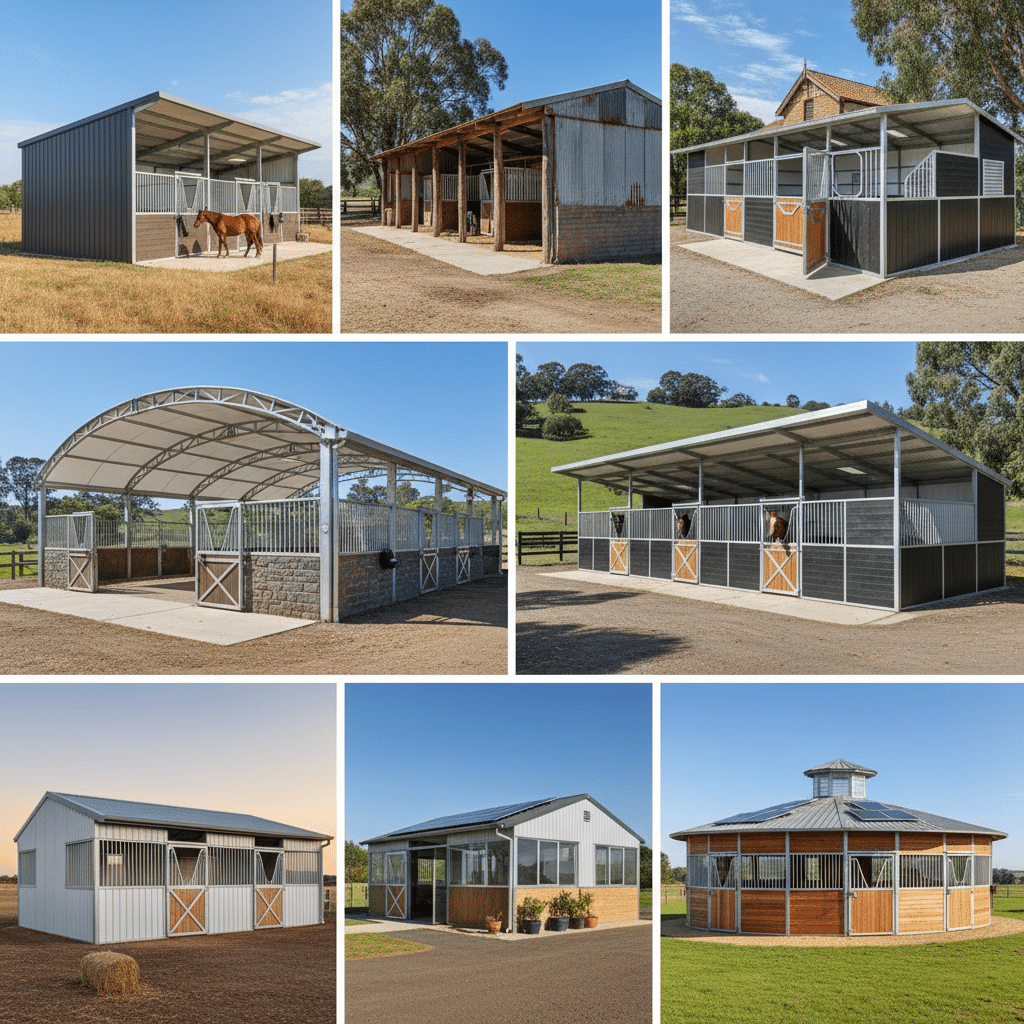
How DB Stable Mitigates Design Errors via Prefabrication
One effective way to avoid calculation errors is to utilize prefabricated systems that are engineered to code. Modular designs remove the guesswork associated with onsite construction.
- Standardized Dimensions: DB Stable portable units are pre-engineered by a professional team to meet industry standard dimensions. This ensures adequate door heights and stall widths are built-in features, removing the risk of on-site construction errors by local contractors who may not know equine safety codes.
- Material Safety: Unlike DIY wood builds that rot or splinter, DB Stable uses hot-dip galvanized steel with a coating over 42 microns. Think of this galvanization as a permanent shield that prevents rust from eating away at the structure. Combined with HDPE infill, this ensures partitions remain structural and safe for decades.
- Modular Flexibility: The prefabricated nature allows for correct spacing and alignment without requiring complex architectural planning from the buyer. You simply assemble the components, ensuring the final layout meets safety standards automatically.
Frequently Asked Questions
What are the optimal stall dimensions for Warmblood horses?
Warmblood horses generally require a minimum floor area of 14 feet by 14 feet (4.25m x 4.25m) to ensure their safety and comfort. Because these breeds are often larger than standard riding horses, the typical 12-foot stall can be too restrictive, preventing them from turning or lying down easily.
For vertical space, partitions must be at least 8 feet high to prevent horses from interacting over the wall or attempting to jump. Ceilings should be a minimum of 12 feet high to provide adequate head clearance. To protect the horse’s joints, the floor should be lined with high-quality rubber mats, preferably over a drained base.
Is a 12-foot aisle wide enough for tractor access?
A 12-foot aisle is usually insufficient for safe tractor maneuvering. While a tractor might physically fit in a straight line, the turning radius required for machinery makes a narrow aisle dangerous or impossible to navigate without hitting stall fronts.
For safe operations involving tractors, industry standards recommend a minimum aisle width of 20 to 24 feet for one-way traffic. Tractors typically need an inner turning radius of 28 to 35 feet, meaning a wider aisle is necessary to perform turns or access feed rooms efficiently.
Passive vs Mechanical ventilation: Which is best for respiratory health?
Mechanical ventilation is generally superior for respiratory health because it offers consistent control over air quality. Studies indicate that mechanical systems can reduce carbon dioxide levels by nearly 50 percent compared to passive systems, which rely heavily on wind speed.
Passive ventilation works well in mild climates but can fail when wind speeds drop below 1 mph. In contrast, mechanical fans ensure air exchange happens regardless of the weather. This consistent airflow helps lower airborne allergens and dust, creating a healthier environment for stabled horses.
Do sliding doors save more space than swing doors?
Sliding doors save significantly more space than swing doors, preserving up to 30 square feet of usable floor area per stall. By eliminating the swing arc, sliding doors allow you to design tighter corridors and maximize the layout efficiency of smaller barns.
Beyond saving space, sliding doors improve safety by preventing doors from swinging out into the aisle. This reduces the risk of collisions with passing horses or handlers. They are an excellent choice for portable stables where maximizing internal dimensions is critical.
What is the ideal window height for natural lighting?
The ideal placement for windows is above 7 feet (approximately 2 meters) from the floor. Positioning glazing at this height prevents the horse from accidentally contacting or breaking the glass while still allowing ample natural light to enter the stall.
If windows must be placed lower than 7 feet, they require protection such as heavy-duty steel grating or mesh guards. Standards suggest a minimum window area of 0.4 square meters per stall to ensure adequate illumination without compromising containment or safety.
Final Thoughts
Effective stable design is more than a floor plan; it is an engineering discipline that balances animal safety with operational efficiency. Ignoring critical specs like aisle width or steel gauge often results in costly injuries or premature structural failure. A facility must withstand massive physical force while maintaining a healthy respiratory environment.
Investing in proven materials—specifically hot-dip galvanized steel and HDPE—ensures your facility resists rust and impact for decades. Choosing a modular, pre-engineered solution guarantees these safety standards are built-in from day one, protecting both your horses and your bottom line.

 English
  Spanish
  French
  Arabic
  German
0 Comments