



This guide covers optimal dimensions for standard and Warmblood stalls, critical aisle width standards, and 300 CFM ventilation requirements. We also analyze safe latch mechanisms and fire safety protocols, helping you ensure a secure, high-performance facility.
What are the optimal dimensions for standard vs. warmblood horse stables?
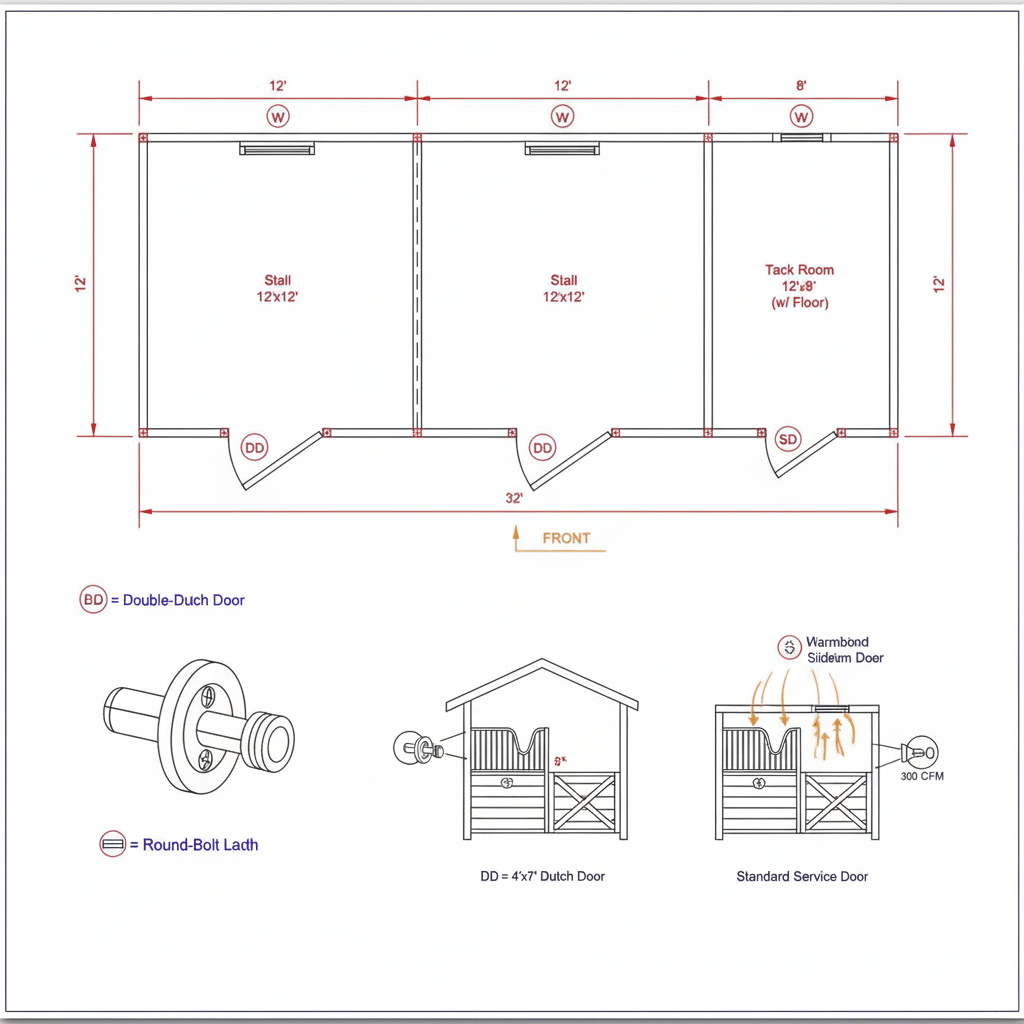
For standard horses (approx. 1,000 lbs), the industry benchmark is a 12′ x 12′ stall, providing adequate room to turn and rest. Warmbloods and larger breeds (16+ hands) require more floor area, with 12′ x 14′ being the minimum and 14′ x 14′ preferred to prevent casting and ensure comfort.
The 1.5x Rule: Determining Safe Stall Sizes
Determining the correct stall size is a matter of biological necessity and safety, not just luxury. Stalls must allow horses to turn around, lie down, and roll without getting “cast”—a dangerous situation where a horse becomes trapped against a wall and cannot stand up. The general safety formula used by architects and equine facility planners suggests that the stall width should be at least 1.5 times the horse’s body length.
For a standard 1,000 lb horse, a 12′ width satisfies this requirement. However, a 19-hand Warmblood will struggle to turn safely in a standard 12′ x 12′ box. This makes larger dimensions a welfare necessity. When square footage is limited, we often recommend rectangular configurations (e.g., 12′ x 14′) as a practical compromise. This layout provides the necessary length for the horse to lie flat while fitting into narrower barn footprints.

Detailed Dimension Guidelines: Standard vs. Warmblood
Below is a breakdown of the specific sizing requirements based on breed size and usage. We design our DB Stable prefabricated kits to meet these exact specifications, ensuring that structural integrity is maintained even at larger spans.
| Horse Category | Standard Dimension | Usage & Notes |
|---|---|---|
| Standard Horses (14–16 hands) | 12′ x 12′ (144 sq. ft.) | The universal standard. Smaller 10′ x 12′ stalls are acceptable only for smaller breeds or ponies. |
| Warmbloods (16+ hands) | 12′ x 14′ (Minimum) 14′ x 14′ (Preferred) | Requires extended length to prevent casting. 14′ x 14′ is ideal for long-term stabling comfort. |
| Draft Horses | 14′ x 14′ to 16′ x 16′ | Requires significantly more space for safe movement. Reinforced framing is essential at these spans. |
| Foaling Stalls | 12′ x 24′ or 14′ x 14′ | Ideally double the standard space. We often use removable partitions to create these large spaces temporarily. |
Critical Height Requirements for Safety
While floor area is the primary concern, vertical dimensions are equally critical, especially for athletic Warmbloods capable of rearing or jumping high. Vertical spacing ensures adequate ventilation and prevents catastrophic head or leg injuries.
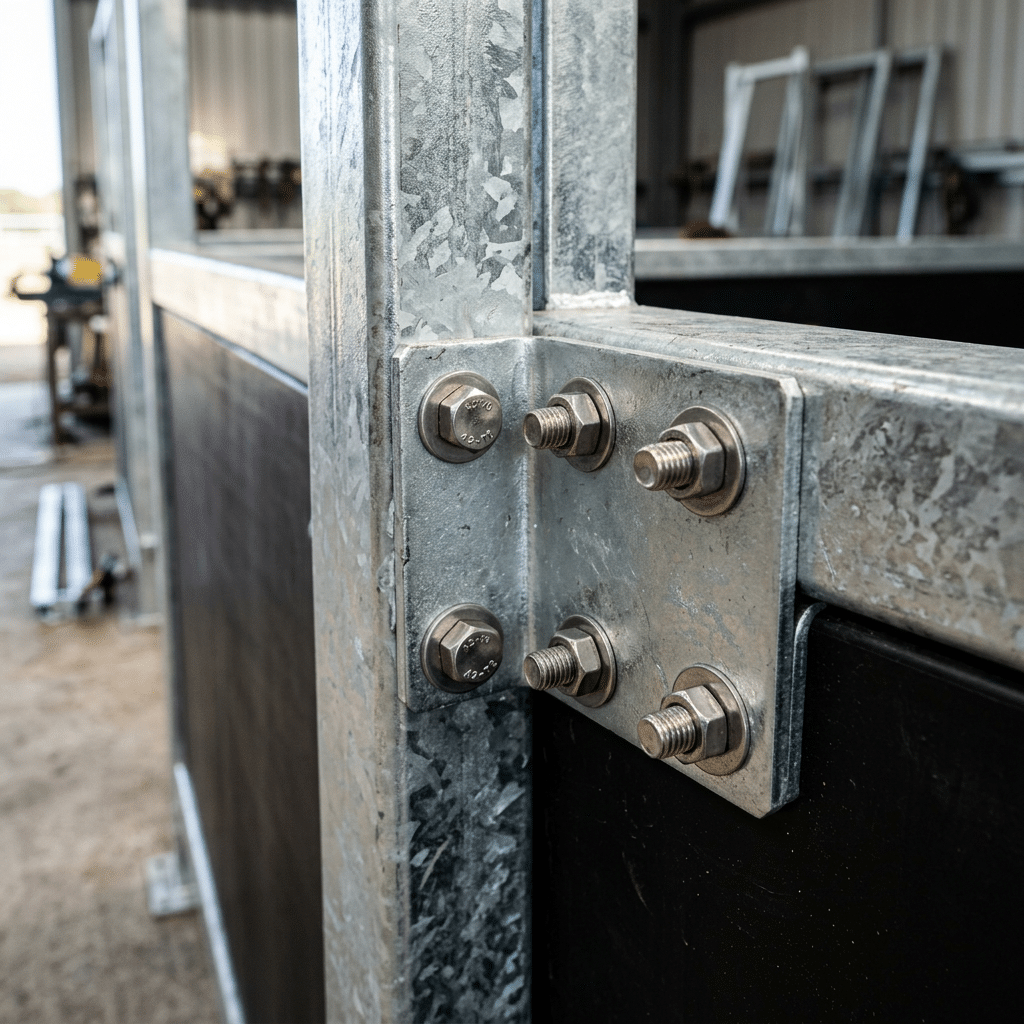
- Partition Height: Standard partitions should be 8 feet high. The absolute minimum is 7.5 feet to prevent horses from getting legs over the walls. To ensure these high walls remain rigid under impact, we utilize hot-dip galvanized steel frames (over 42 microns) that resist bending better than standard aluminum.
- Head Clearance: Ceilings or roof structures must provide 2–3 feet (60–90 cm) of clearance above the horse’s head when standing in a natural position.
- Kick Resistance: Taller walls mean more surface area for impact. We install 10mm UV-resistant HDPE boards in our high partitions because they absorb shock without shattering like timber, reducing injury risk during containment.
How DB Stable Accommodates Custom Sizing Needs
Standard kits often fail to meet the specific needs of the Australian and New Zealand warmblood markets. We utilize modular manufacturing to produce flexible sizing options that go beyond the generic 12′ x 12′ box.
Our prefabricated design allows facility owners to configure 12′ x 14′ or even 16′ x 16′ stalls easily. Extending the span of a stall front usually introduces structural risks, such as sagging doors or warping frames. We solve this by using heavy-duty hot-dip galvanized frames that maintain structural integrity even across wider Warmblood spans.
For breeding facilities, flexibility is key. Our adjustable partition options allow owners to convert two standard stalls into a large foaling box (e.g., 12′ x 24′) simply by removing the center panels. This modular approach provides the “lowest price” advantage of a kit with the functionality of a custom build.
How wide should the aisle be in horse stables for safe passing?
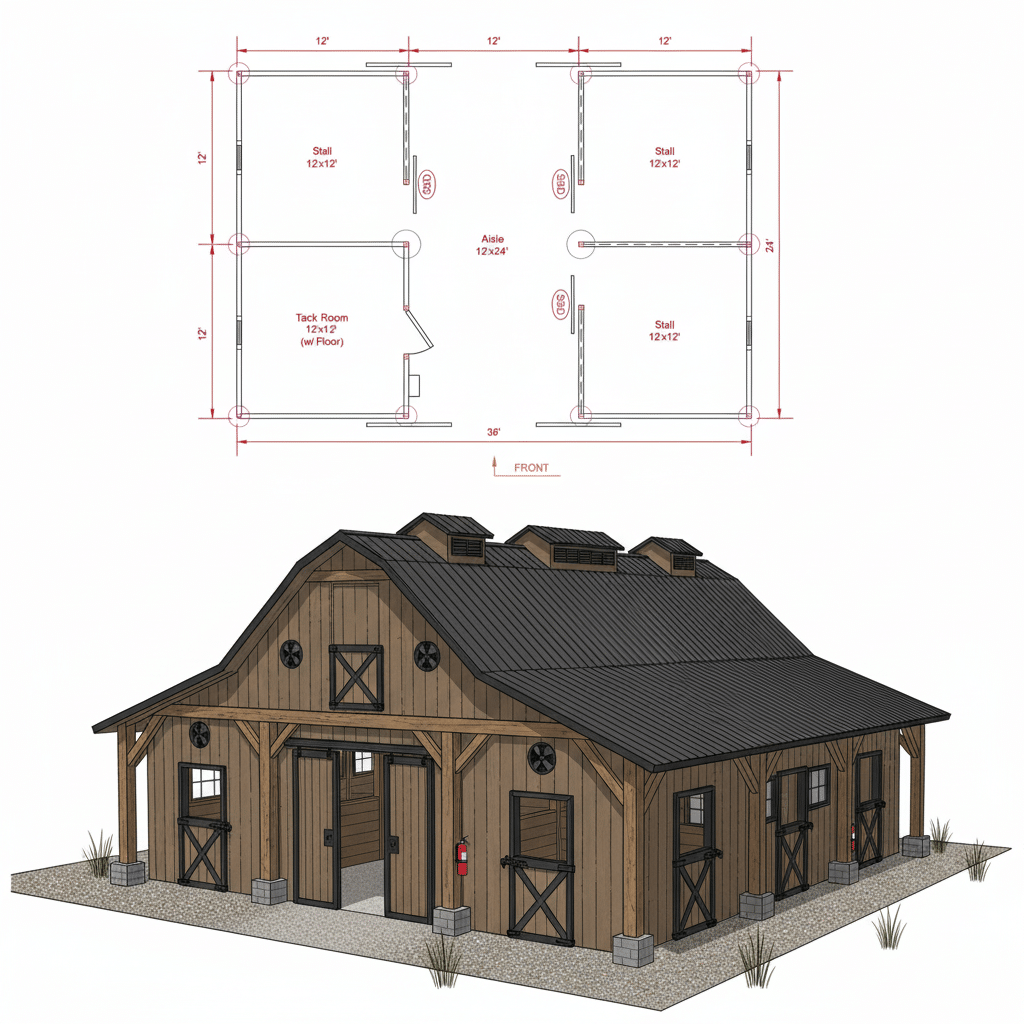
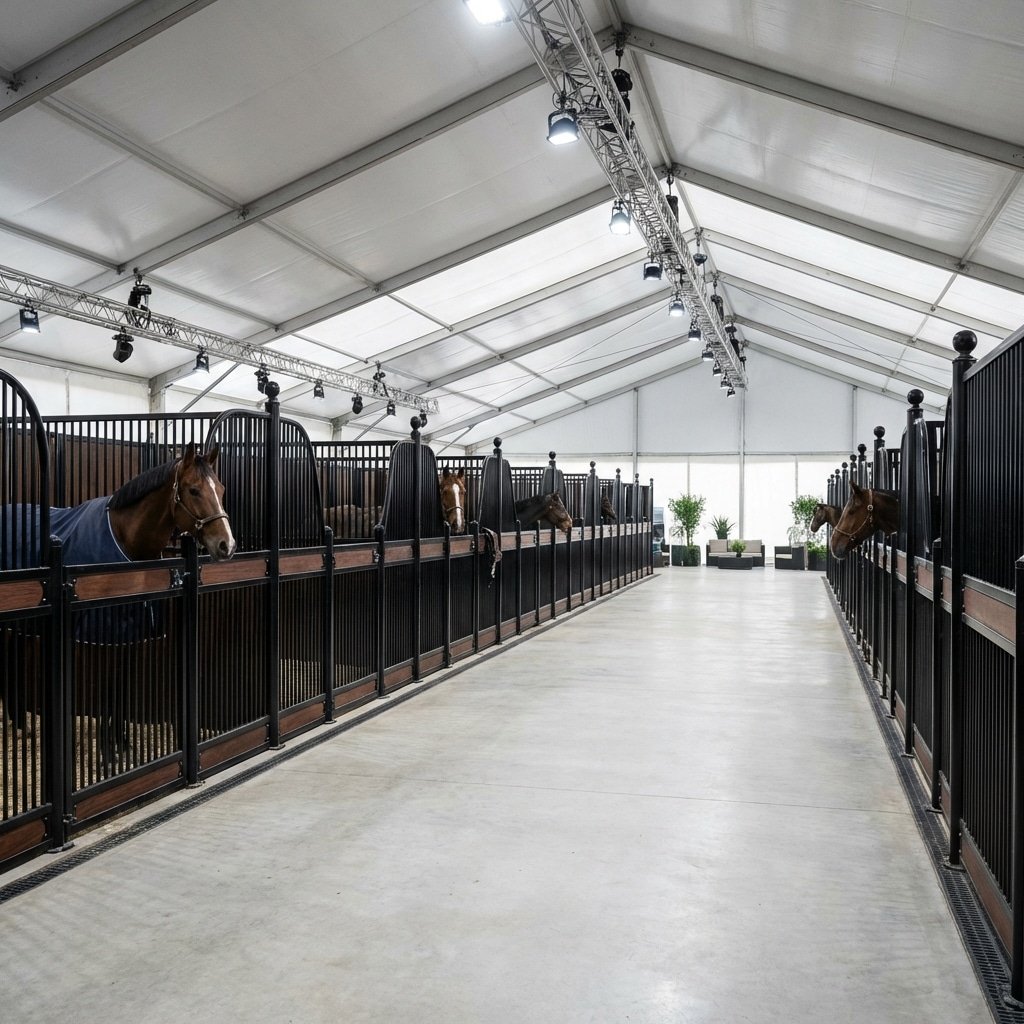
For safe passing and emergency access, the recommended minimum aisle width is 12 feet. Commercial facilities and show barns often require 14 to 16 feet to accommodate machinery and simultaneous activity. While 8 feet allows two horses to pass, wider dimensions prevent crowding, improve airflow, and ensure handler safety during daily operations.
The 12-Foot Safety Standard
Most equestrian facility designers and architects consider 12 feet the functional minimum for standard stables. This dimension is not arbitrary; it is calculated based on the flight zone of the horse and the physical space required for safe handling. At this width, two horses can pass each other comfortably without triggering a fight-or-flight response, which is common in narrower, confined spaces.
Beyond equine psychology, a 12-foot aisle provides the necessary turning radius for handlers leading horses in and out of stalls. Narrower aisles often force handlers to make sharp, awkward turns that can result in hip injuries to the horse or crushing injuries to the handler. Furthermore, emergency evacuation protocols rely heavily on this width to ensure rapid, unobstructed exit routes if a fire or panic situation occurs.
Adjusting Width for Commercial Operations
While 12 feet serves as a baseline, high-traffic environments often require expanded dimensions. Commercial boarding facilities and show barns frequently benefit from widening aisles to 14 or 16 feet. This additional space is critical for accommodating the machinery used in daily chores, such as tractors, manure spreaders, and vet trucks, which need to drive directly through the barn structure.
| Facility Type | Recommended Width | Key Considerations |
| Private Barn | 10 – 12 Feet | Suitable for single-handler operations and manual cleaning carts. |
| Commercial / Show Barn | 14 – 16 Feet | Allows tractor access, multiple tack trunks, and simultaneous grooming. |
In a busy commercial setting, wider aisles also support multiple handlers working simultaneously. It provides room for tack trunks, farriers, and veterinary equipment to be set up outside the stall door without blocking the passage for other users.
Essential Vertical and Surface Considerations
Aisle safety is not defined by width alone; vertical clearance and flooring surfaces play equally vital roles. Ceiling height in the aisle should measure between 10 to 12 feet. This clearance is necessary to prevent severe head injuries should a horse rear up while being led. Additionally, the overall volume of the aisle contributes to proper airflow, with 8 feet being the absolute minimum vertical clearance to avoid stifling, dusty environments.
Flooring materials must act as a safety counterpart to the aisle dimensions. Even a wide aisle becomes dangerous if the surface is slick. ⚠️ Key surface requirements include:
- High Traction: Rubber pavers or textured concrete are essential to prevent slips when horses turn tightly to enter stalls.
- Lighting Placement: Fixtures must be positioned high enough to avoid contact with rearing horses or machinery.
- Flush Transitions: Door thresholds should be level to prevent tripping hazards during movement.
Creating Flexible Aisle Layouts with DB Stable
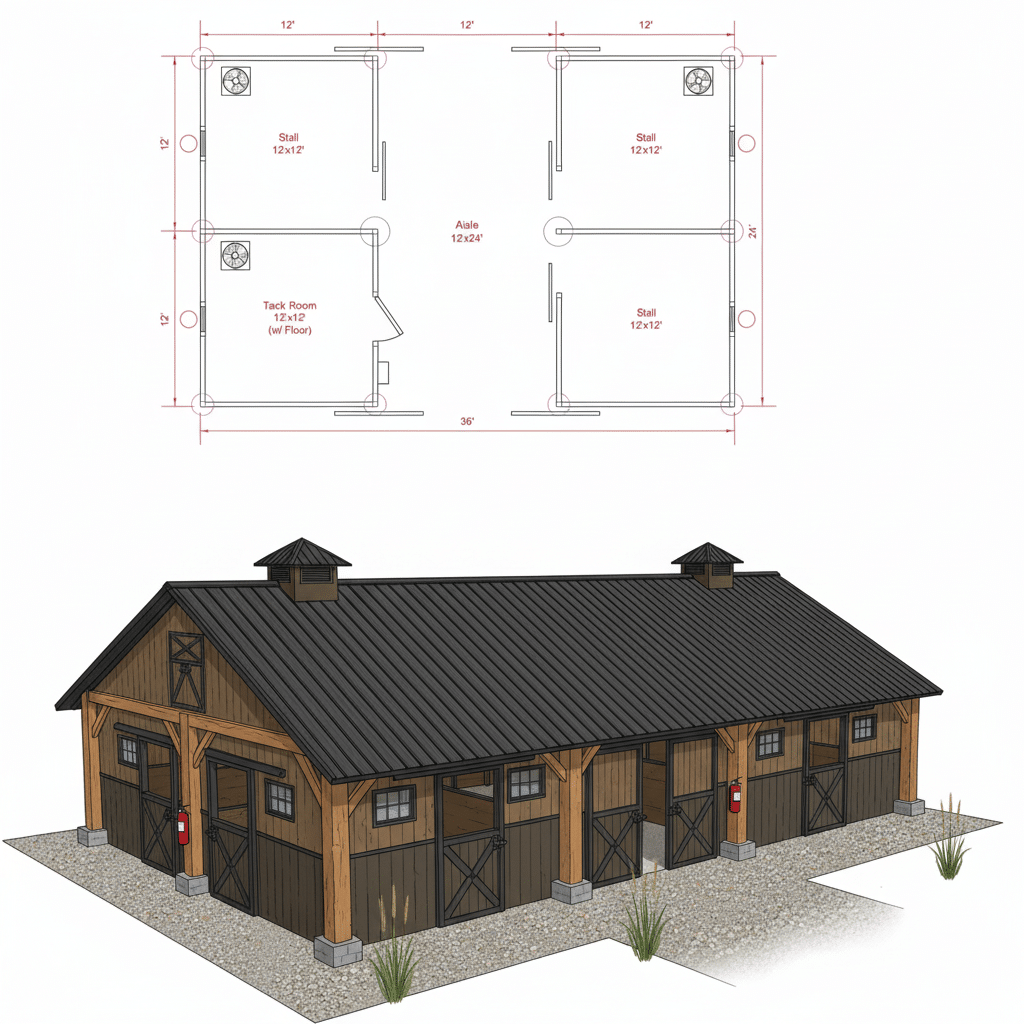
One of the distinct advantages of modular stable construction over fixed concrete blocks is the flexibility to determine your own aisle width. Because DB Stable’s portable designs are not structurally tied to the building shell, owners can space the stable rows exactly 12, 14, or 16 feet apart during installation to suit their specific machinery needs.
This flexibility is supported by our heavy-duty manufacturing standards designed for high-traffic zones:
- ✅ Impact Resistance: Our frames utilize hot-dip galvanized steel (over 42 microns), ensuring they withstand the potential impact of tractors or nervous horses in busy aisles.
- ✅ Safety First: We utilize flush welding and smooth edges on all stall fronts to prevent injury, even in tighter aisle configurations where horses pass closer to the steelwork.
- ✅ Modular Connection: The system allows for wide, open configurations that match the 14-16 foot commercial standard without compromising structural integrity.

Why is 300 CFM ventilation critical in horse stables design?
A ventilation rate of 300 CFM per horse is the minimum summer requirement to prevent heat stress and respiratory issues. While winter demands only 25 CFM for moisture control, the significantly higher summer rate ensures rapid heat dissipation and 6-8 complete air changes per hour, crucial for maintaining equine health and athletic performance.
The Impact of Summer Heat on Equine Respiratory Health
Horses are massive metabolic heat generators. In enclosed spaces, this heat accumulates rapidly, turning a poorly designed stable into a sauna that compromises equine health. While winter ventilation primarily focuses on moisture control (requiring only ~25 CFM per horse), summer demands a massive increase in airflow capacity.
Failing to meet the 300 CFM threshold during warmer months creates stagnant air pockets. This lack of circulation leads to severe consequences for stabled horses:
- ❌ Respiratory Ailments: Ammonia and dust settle at the horse’s breathing zone without adequate air cycling.
- ❌ Bacterial Growth: Warm, humid air accelerates pathogen reproduction in bedding materials.
- ❌ Compromised Recovery: Athletic horses suffer from stiffness and delayed recovery when they cannot dissipate body heat effectively.
Calculating Airflow: CFM Standards and Vent Sizing
Achieving optimal air quality requires precise calculations rather than guesswork. Architects and barn owners must balance air exchange rates with physical vent dimensions to reach the 300 CFM target.
| Calculation Category | Technical Standard | Design Application |
| Air Exchange Rate | 6-8 Changes Per Hour | The entire volume of air in the stall must be replaced every 8-10 minutes to maintain oxygen levels. |
| Weight Scaling | 300 CFM per 1,000 lbs | Standard calculation base. Larger warmbloods or draft breeds require proportionally higher CFM rates. |
| Vent Sizing Rule | 1 sq ft per 300 sq ft floor | For a standard 12×12 stall, this dictates the minimum aggregate opening size for eaves and ridge vents. |
| Balance Ratio | 60% Intake / 40% Exhaust | Design for slightly more lower intake area to force warm air upward and out through roof vents. |
Mechanical Systems vs. Passive Airflow Limitations
Passive ventilation relies heavily on thermal buoyancy and external wind pressure. While energy-efficient, it often fails when barns are sheltered by dense tree lines or positioned in low-lying terrain. In these scenarios, natural drafts cannot achieve the required 6-8 air changes per hour.
Mechanical systems provide a guarantee of 300 CFM flow regardless of the weather outside. However, consistent airflow also introduces humidity cycling. If moist air is not evacuated quickly, condensation forms on structural elements.
💡 Material Insight: Condensation is the primary enemy of metal barns. This is why we utilize hot-dip galvanized steel frames (coated over 42 microns) for all DB Stable structures. This specific treatment prevents the rust and corrosion that typically attacks intake vents and frame joints in high-humidity stable environments.

How DB Stable Structures Support Ventilation Goals
We engineer our portable stables specifically to facilitate the 300 CFM standard through passive design features that maximize natural airflow dynamics.
- 🚀 Optimized Upper Ventilation: We integrate galvanised mesh on the upper panels of our stables. This design choice removes airflow barriers, allowing warm, stale air to escape freely while promoting cross-ventilation between stalls.
- 🚀 Flexible Cross-Breezes: Our units feature both swing and sliding door options that can be fully opened. This allows owners to transform the enclosed structure into an open-air environment during peak summer heat, instantly maximizing air exchange.
- 🚀 Heat-Reflecting Roofs: The steel board roof design prevents the stable from becoming a heat trap. By reflecting solar radiation and allowing hot air to rise and exit, the roof system actively aids in maintaining the internal temperature balance required for the 300 CFM target.
- 🚀 Moisture-Resistant Infill: High airflow often brings humidity. We use 10mm HDPE boards that are UV resistant and impervious to moisture, ensuring the stall walls do not warp or degrade even under high-ventilation conditions.
What are the best door latch types for horse stables safety?
The safest stable latches use flush designs like plunger or flip mechanisms to prevent injury. Key safety standards require latches to be operable with one hand for emergencies, horse-proof to stop escapes, and made from durable materials like 304 stainless steel or hot-dip galvanized steel to resist corrosion in barn environments.
Critical Safety Design Features
Selecting the right hardware goes beyond simple functionality; it is a critical component of equine injury prevention. Protruding bolts or sharp edges on a latch can cause severe lacerations to a horse moving through a doorway or rubbing against a stall front.
We prioritize specific engineering criteria to minimize these risks:
- Flush and Smooth Profiles: Latches must sit flush against the stable frame. This design prevents horses from catching their shoulders, hips, or halters on protruding hardware while entering or exiting the stall.
- One-Handed Operation: This is a vital safety standard. In emergencies such as a barn fire, a handler must be able to unlatch the door instantly with one hand while using the other to control a panicked horse.
- Horse-Proof Mechanisms: Many horses are intelligent enough to manipulate simple sliding bolts. Safe latches utilize spring-loaded pins or gravity flips that require dexterity a horse lacks, while automatic locking secures the door without requiring manual checks.
- Offset Designs: For swinging doors, offset latches prevent the door from accidentally popping open due to vibration from horses kicking or general barn movement.
Recommended Latch Mechanisms and Materials
Different stall configurations require specific hardware solutions to balance accessibility with security. We have analyzed the most effective latch types and material standards below.
| Latch Type / Material | Best Application | Safety & Technical Benefits |
| Flip and Pin Lock | Standard Swing Doors | Best when machined from solid 304 stainless steel with rounded edges. These offer a low profile and high durability against cribbing. |
| Plunger Latches | European Stall Fronts | Offers smooth, spring-loaded operation that sits completely flush against the frame to minimize impact injury risks. |
| Sliding Door Integrations | Tight Aisleways | Safer than swinging options as they eliminate aisle obstruction. Latches must be engineered to withstand significant lateral force from leaning horses. |
| Galvanized Steel Finish | Wet/Humid Climates | Zinc plating provides structural integrity. Hot-dip galvanizing is essential for extending lifespan in corrosive environments with ammonia exposure. |
How DB Stable Ensures Secure Hardware Integration
Hardware failure is often caused by rust weakening the internal springs or connection points. To combat this, we integrate industrial-grade protection directly into our manufacturing process.
Our approach ensures that every latch remains functional and secure, even after years of heavy use:
- Anti-Corrosion Standards: We utilize hot-dip galvanized steel applied at a thickness of over 42 microns for all connection pins and structural components. This specific thickness prevents rust from seizing the latch mechanism over time.
- Rigid Structural Welding: A latch is only as strong as the frame holding it. Our prefabricated units feature heavy-duty full welds with 6mm steel plates to ensure door fittings remain rigid and secure, even under direct horse impact.
- Modular Compatibility: Whether using swing or sliding door models, our portable stable designs incorporate high-quality metal frames pre-engineered to accept secure, flush-mounted latches without requiring on-site modification.
Do horse stables need emergency exits within 50 feet?
Quick Answer: Technically, no; the 50-foot travel distance requirement specifically applies to fire extinguisher placement under NFPA 150 standards, not necessarily exit doors. However, commercial stables and indoor arenas typically require fire exit doors on each wall, and stall doors must feature outward-swinging designs with adequate width for safe equine evacuation.
Clarifying the 50-Foot Rule: Extinguishers vs. Exits
Many barn owners and architects confuse fire suppression guidelines with structural egress requirements. Understanding the difference ensures your facility meets code without unnecessary structural changes.
Fire Extinguisher Standard: The NFPA 150 standard mandates that a minimum 2-A:10-B:C-rated fire extinguisher be located at each entrance and within 50 feet of travel distance from any point in the stable. This ensures suppression equipment is always within reach but does not dictate door placement.
Exit Door Location: Building codes for indoor arenas or commercial barns generally require exits on all exterior walls rather than at specific 50-foot intervals. The goal is to prevent dead ends rather than sticking to a rigid distance metric for structural openings.
Signage Requirements: Regardless of distance, every exit must be clearly marked. We recommend installing lighted signs with backup battery power to ensure visibility during power outages or smoky conditions.
Critical Specifications for Safe Egress
Simply having a door is not enough; the physical mechanics of the door determine if it is a valid emergency exit.
Minimum Widths: Door openings must be at least 32 inches wide or 1.5 times the width of the largest animal housed. Narrow doorways create bottlenecks that can lead to injury during a panicked evacuation.
Swing Direction: Stall doors must open outward. If a frightened horse presses against the door, an inward-swinging design becomes impossible to open. Outward swings allow handlers to release the latch even when the animal’s weight is against the panel.
Latching Mechanisms: Latches must be easily operable with one hand. In a panic situation, complex locking systems delay removal. We prioritize simple, robust latches on all our portable units to facilitate immediate release.
How DB Stable Designs for Safety and Accessibility
Safety is often a matter of durability. A rusted hinge or a warped frame can turn a standard door into a trap during an emergency.
Functional Integrity: Rust causes friction in hinges and bolts, making doors difficult to open. We solve this by using hot-dip galvanized steel frames coated to over 42 microns. This heavy-duty protection ensures that latches and hinges remain smooth and operable for decades, even in humid stable environments
Door Configuration: We offer reliable outward-swinging door options that align with safety standards. This prevents the “entrapment zone” scenario where a cast or panicked horse blocks their own exit.
Clear Pathways: Our portable, prefabricated design allows for flexible aisle layouts. This modularity lets facility managers configure barns with wide, unobstructed aisleways, ensuring a clear path to exterior exits without permanent structural constraints.

How to design horse stables with attached living quarters?
Designing horse stables with attached living quarters requires a strict separation of zones to ensure safety and hygiene. The most effective layouts prioritize ground-level separation or reinforced loft designs with independent ventilation systems. Key considerations include fire-rated walls, separate utility lines, and positioning living areas upwind to minimize odor and dust exposure.
Strategic Layout Configuration: Ground-Level vs. Loft
When integrating residential spaces with equestrian facilities, the primary decision involves the vertical or horizontal arrangement of the zones. This choice impacts structural costs, accessibility, and daily workflow.
The following comparison outlines the structural implications of the two most common architectural approaches:
| Layout Type | Structural & Lifestyle Implications |
| Ground-Level Apartments | Building horizontally creates easier accessibility and simplifies utility connections. This layout is ideal for long-term living as it eliminates the need for stairs and allows for distinct “clean” and “dirty” entrances. |
| Loft Spaces (Barndominiums) | This approach utilizes vertical space efficiently but demands complex structural support to handle live loads. It requires strict air sealing to prevent ammonia and barn odors from rising into the living quarters. |
Regardless of the chosen layout, you must maintain distinct zones. We recommend designing separate entrances for the residence and the stable. This separation ensures privacy and acts as a physical barrier to keep mud, manure, and stable debris out of the living area.
Critical Infrastructure: Ventilation, Utilities, and Insulation
Living adjacent to livestock requires advanced environmental control systems. You cannot rely on passive airflow alone when human health is involved.
- Ventilation Systems: Never rely on shared air between the stable and the apartment. Install roof ridge vents for the stable area and independent HVAC systems for the living quarters. This prevents humidity, allergens, and animal odors from transferring to your home.
- Utility Planning: Position kitchens and bathrooms near existing barn plumbing lines to reduce installation costs. However, ensure your electrical panel has the capacity to handle residential appliances alongside high-draw barn equipment like water heaters or wash bay pumps.
- Insulation & Sound: Use high-grade insulation and vapor barriers between the barn and living walls. This control is vital for temperature regulation and noise reduction. At DB Stable, we utilize non-thermal expansion materials in our stall fronts to complement these insulation efforts, minimizing structural shifting that could compromise air seals.
Safety Protocols and Essential Dimensions
Safety regulations are stricter for mixed-use agricultural buildings. Fire suppression and evacuation routes take priority during the design phase.
⚠️ Fire Safety Mandates
A fire-rated separation wall between the stable and living quarters is mandatory in most building codes. The design must include independent emergency exits for both humans and horses. We fabricate our portable stable frames using hot-dip galvanized steel, which contributes to the overall fire resistance of the structure compared to traditional wood-only frames.
✅ Standard Stall Dimensions
Adhere to standard 12′ x 12′ stalls and 12-14′ center aisles. These dimensions ensure a smooth workflow without encroaching on residential structures. Our prefabricated stall systems are engineered strictly to these dimensions, ensuring that your barn interior fits perfectly within the structural shell without requiring on-site modification.
🚪 Access Point Control
Doorways connecting zones should utilize self-closing, weather-stripped doors. These act as a final barrier against dust and fumes. The door leading from the residence to the barn should never open directly into a stall but rather into a neutral aisle or tack room.

How DB Stable Supports Integrated Design Projects
Constructing a mixed-use facility is complex. Using prefabricated components for the equestrian side simplifies the process and ensures the longevity of the animal housing matches the residential build.
- Modular Integration:DB Stable’s prefabricated frames allow builders to quickly erect the equestrian portion of the structure. This reduces overall construction time for the combined project and ensures precise fitment within the building shell.
- Hygiene & Maintenance: Living close to animals requires superior sanitation. We utilize 10mm HDPE infill boards in our stables specifically because they do not absorb moisture or harbor bacteria. Unlike wood, which can trap urine odors that permeate living quarters, HDPE remains easy to sanitize.
- Structural Integrity: The stable side of the building faces aggressive corrosion from ammonia. We use hot-dip galvanized steel frames (coated over 42 microns) to provide the necessary durability. This ensures the stable infrastructure remains safe and visually appealing for decades, matching the lifespan of the attached home.
Custom Horse Stables Built for Any Climate
DB Stable engineers high-performance equestrian facilities using hot-dipped galvanized steel and bamboo infills. Our modular designs meet strict international safety standards, ensuring your horses remain safe in Australian heat or Polish winters. Experience rapid installation and lasting durability tailored to your region.

Frequently Asked Questions
What is the standard size for a horse stable?
Choosing the right dimensions is critical for your horse’s comfort and safety. The size requirements typically depend on the breed and activity level of the horse.
- Standard Horses: The industry standard is 12×12 feet (3.65m x 3.65m). This allows average horses to turn around and lie down comfortably. Most of our DB Stable portable units are engineered to these exact dimensions to meet global equine standards.
- Large Breeds: For Warmbloods or draft horses (17hh+), a 12×14 feet (3.65m x 4.25m) or 14×14 feet space is recommended. This extra space helps prevent casting and reduces the risk of injury.
- Ponies: Smaller breeds and ponies (under 13.2hh) can be safely housed in 10×10 feet (3.05m x 3.05m) or 10×12 feet stalls.
What is the minimum ceiling height for safety?
Vertical clearance is vital to prevent severe head injuries if a horse rears. Ceiling height also impacts air quality and heat dissipation.
- ⚠️ Absolute Minimum:8 feet (2.4m) is the lowest acceptable height, though this presents risks for taller horses.
- ✅ Optimal Height:10 to 12 feet is recommended. This allows for safe rearing and ensures proper air circulation, preventing respiratory issues.
- 💡 Clearance Check: Ensure light fixtures and truss components sit above the minimum clearance zone. Our prefabricated steel board roofs are designed to maximize this vertical space without compromising structural integrity.
Should I choose Dutch doors or sliding doors?
The choice between Dutch and sliding doors often comes down to your aisle width and ventilation goals. We offer both configurations using high-quality metal frames to suit specific barn layouts.
- Sliding Doors: Ideal for barns with narrow aisles or limited space. They eliminate swing radius hazards and are generally safer for busy facilities. DB Stable sliding doors utilize smooth-gliding tracks to ensure easy operation even after years of use.
- Dutch Doors: Best for maximizing ventilation and socialization. They allow the top half to open independently, promoting airflow. However, they require adequate swing space outside the stall.
- Selection Strategy: Choose sliding doors for operational efficiency and Dutch doors for traditional aesthetics and superior airflow control.
How much window space is required per stall?
Windows are not just for views; they are essential for regulating the stable environment. Proper lighting and ventilation contribute directly to equine health.
- Minimum Area: A stall requires at least 4 square feet of window space to ensure sufficient natural light.
- Safety Measures: Windows must be positioned out of reach (above 7 feet) or protected. We integrate hot-dip galvanized bars or mesh over window openings to prevent glass breakage and injury while maintaining airflow.
- Strategic Placement: Placing windows at the back of the stall improves cross-ventilation, which is crucial for reducing ammonia buildup.
What are the emergency exit requirements for stables?
Egress safety is a non-negotiable aspect of stable design. You must plan for rapid evacuation in the event of a fire or natural disaster.
- 🚀 General Guidelines: While specific agricultural codes vary by region, general safety standards suggest exits be at least 28 inches wide and 7 feet 6 inches high.
- Exit Strategy: Stables should have at least two exits located remotely from each other to prevent trapping during a fire. Our modular design allows for flexible placement of exit doors to meet these safety protocols.
- Consult Local Codes: Always verify requirements with local fire marshals or agricultural building codes, as they differ from standard commercial regulations.
Final Thoughts
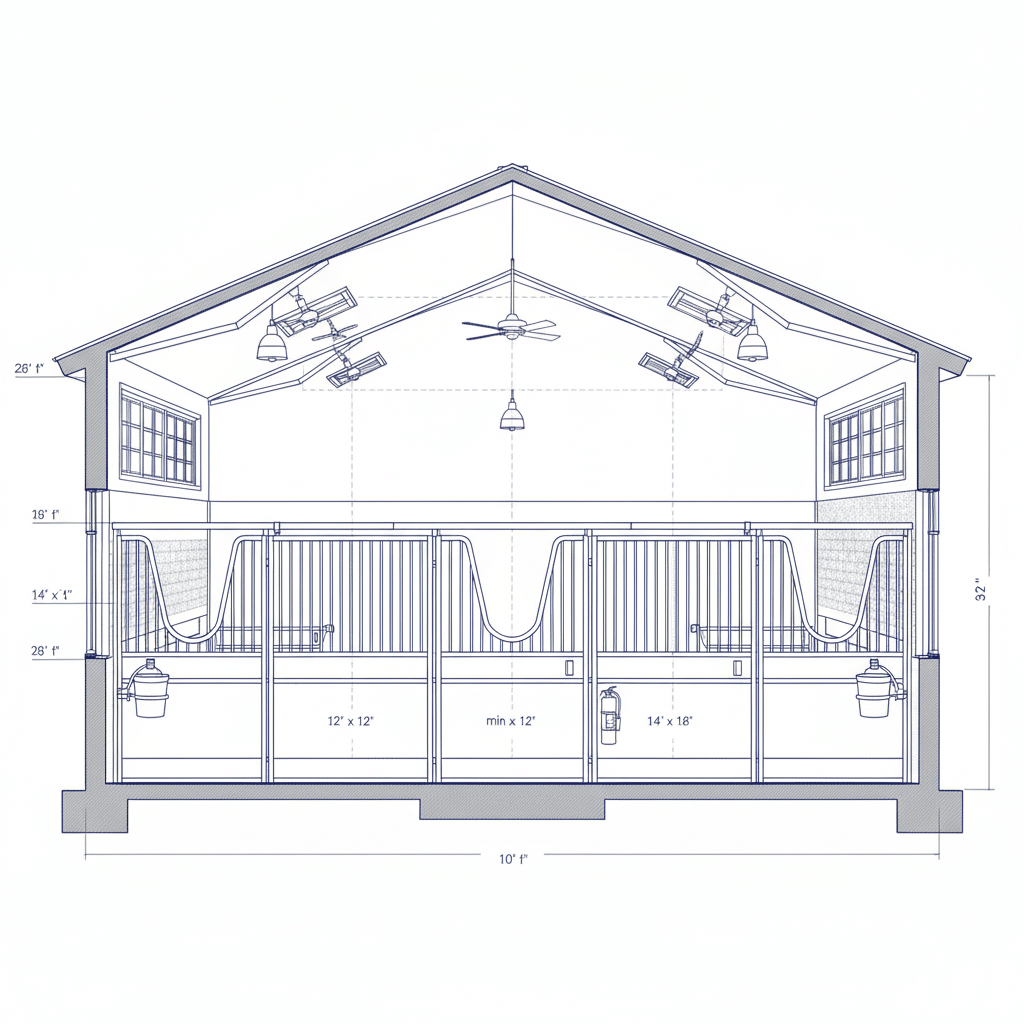
Effective equine facility planning demands a rigorous balance between structural durability and biological necessity. Moving beyond generic dimensions to accommodate Warmblood spacing and integrating 300 CFM ventilation strategies ensures your design supports long-term equine health.
Prioritizing 12-foot minimum aisles and flush, hot-dip galvanized hardware reduces injury risks while optimizing daily workflow for handlers. These technical specifications transform a simple shelter into a professional-grade asset that minimizes operational liabilities.
For architects and facility owners, the challenge lies in executing these safety standards without escalating construction costs. Leveraging modular, prefabricated systems allows you to deploy heavy-duty structures that meet strict fire and safety codes immediately.
Choosing engineered components designed to resist corrosion and heavy impact protects your investment, ensuring your facility remains functional and compliant for decades.

 English
  Spanish
  French
  Arabic
  German
0 Comments