


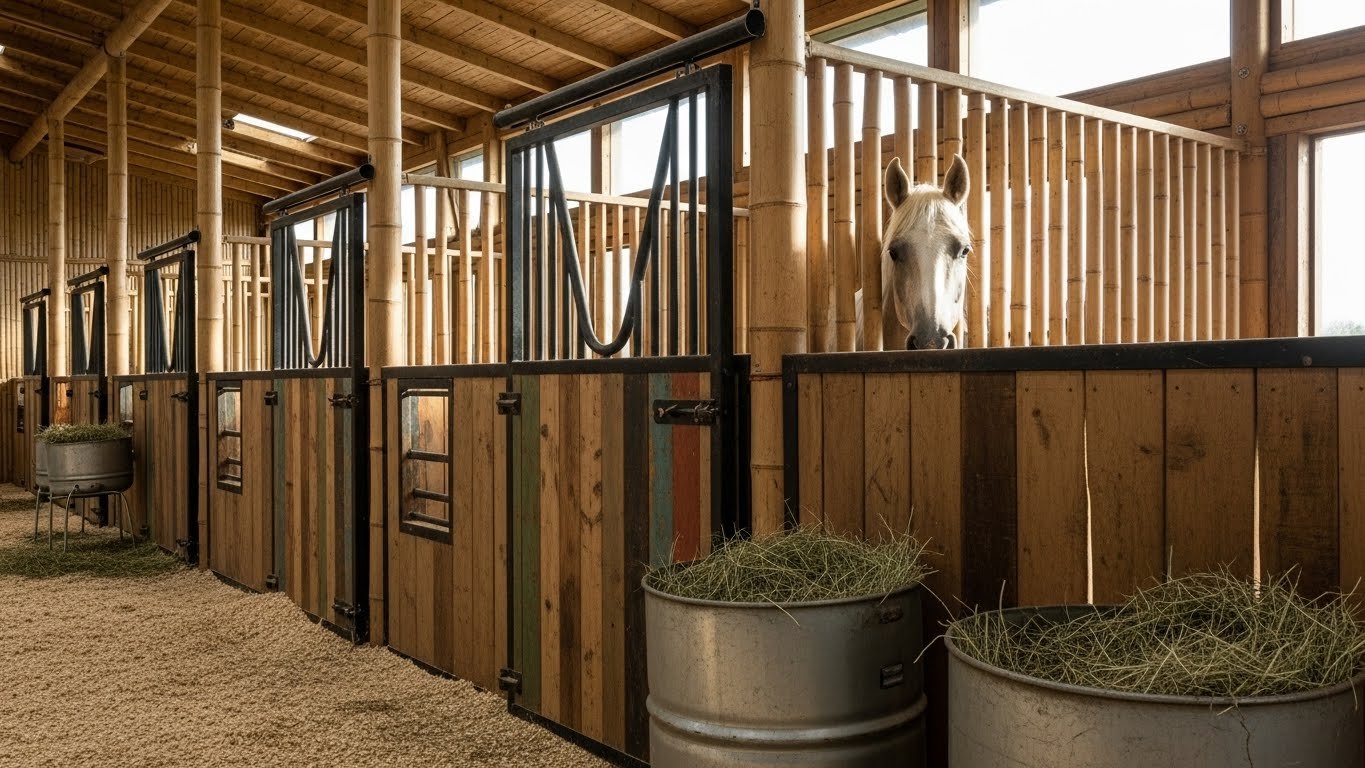
Building a durable, low-maintenance horse barn involves more than just traditional design. Facility owners and builders now look for materials that reduce long-term costs and meet growing environmental standards, moving away from wood that rots and requires constant upkeep.
This article analyzes two key materials driving this trend: bamboo and recycled plastic. We’ll examine the technical data behind their performance, from bamboo’s ability to sequester up to 259 tons of carbon per hectare to recycled paddock slabs engineered to support truck-level loads (AASHTO HS25). We will also explain how these choices can help a barn project earn LEED certification points.
![The Rise of Green horse Stables Bamboo and [Recycled Materials] (5)](https://dbhorsestable.com/wp-content/uploads/2025/12/The-Rise-of-Green-horse-Stables-Bamboo-and-Recycled-Materials-5.jpeg)
The Carbon Footprint of Barn Building
A barn’s carbon footprint is calculated by combining the ’embodied carbon’ from its construction materials like steel and concrete with ‘operational carbon’ from daily energy use, feed, and bedding. Tools like the Equine Carbon Calculator use IPCC-aligned methods to measure these emissions in kg of CO₂e per square meter.
Measuring Embodied and Operational Carbon
A barn’s total environmental impact is measured by calculating its full life-cycle carbon footprint. Specialized tools like the Equine Carbon Calculator provide a formal framework for this assessment, following established guidelines from the IPCC 2019 reports and the GHG Protocol for agriculture. This process combines two distinct emission sources: embodied carbon from construction and operational carbon from daily activities. For a typical barn, the calculation assumes a standard portal-frame building with a steel frame, concrete floor, roof sheeting, and timber walls.
Embodied carbon accounts for all emissions produced during the manufacturing and transport of building materials. Each material, from structural steel to timber, is assigned a carbon factor from the Inventory of Carbon & Energy (ICE v3.0). These factors are expressed in kilograms of carbon dioxide equivalent per square meter (kg CO₂e/m²), allowing for a precise calculation based on the barn’s total floor area. Operational carbon includes emissions from energy consumption for lighting and ventilation, as well as the production and transport of resources like animal feed and bedding.
Emission Hot Spots and Reduction Strategies
Certain materials and activities contribute disproportionately to a barn’s carbon footprint. In construction, the primary “hot spots” for embodied carbon are high-mass materials like ready-mix concrete and structural steel. Operationally, the largest emission sources often include electricity for lighting and ventilation systems and the resources required for animal care, such as the production and transport of bedding materials.
Simple upgrades can significantly reduce a barn’s operational emissions. For example, replacing older incandescent light fixtures with modern CFL or LED lighting can cut energy use for illumination by approximately 70%. Each new lamp can prevent around 200 kg of CO₂ emissions over its service life. Another effective strategy is planting trees around the property. Trees are natural carbon sinks and are composed of about 50% carbon by dry mass, providing a direct, on-site method for carbon sequestration.
![The Rise of Green horse Stables Bamboo and [Recycled Materials] (4)](https://dbhorsestable.com/wp-content/uploads/2025/12/The-Rise-of-Green-horse-Stables-Bamboo-and-Recycled-Materials-4.jpeg)
Why Bamboo is Rapidly Renewable (5 Years)
Bamboo is a rapidly renewable resource because it’s a grass that reaches structural maturity in just 3-5 years, compared to 10-30 years for trees. Its underground rhizome system allows for continuous harvesting every year without needing to replant the entire grove.
| Metric | Bamboo | Traditional Timber |
|---|---|---|
| Growth to Maturity | 3–5 years | 10–30 years |
| Regeneration | Self-regenerates from rhizome system | Requires replanting after harvest |
| Carbon Sequestration | Up to 259 tons per hectare | 50–150 tons per hectare |
The 5-Year Harvest Cycle Explained
Bamboo’s classification as a rapidly renewable resource comes from its biological identity as a grass, not a tree. While trees require 10 to 30 years to mature, individual bamboo culms (stems) are ready for harvest in just 3 to 5 years. This rapid cycle is possible because the culms achieve their full vertical height in only 60 to 90 days and spend the next few years densifying and maturing. An extensive underground rhizome network allows established bamboo groves to produce new shoots annually, enabling selective harvesting each year for over a century without depleting the forest or requiring replanting.
Structural Maturity and Carbon Sequestration Data
Data on industrial Moso bamboo confirms it reaches peak biomass and structural integrity between years four and five, making this the optimal time for harvest. In terms of environmental impact, bamboo forests are highly efficient at carbon sequestration, storing up to 259 tons of carbon per hectare (t C/ha)—significantly more than the 50–150 t C/ha stored by typical wood forests. Formal Life Cycle Assessments (LCA) conducted under ISO 14040/14044 standards validate these benefits, showing bamboo has low embodied energy and high biogenic carbon storage, capturing approximately 0.5 kg of carbon for every kg of bamboo.

Recycled Plastic: Diverting Landfill Waste
Recycled plastic lumber, made from materials like HDPE and mixed polyolefins, repurposes post-consumer waste into durable, non-toxic components for horse barns. It is used for stalls, fencing, and paddock flooring, offering resistance to rot, moisture, and chewing, which diverts waste from landfills.
| Material Type | Common Barn Applications | Key Properties |
|---|---|---|
| High-Density Polyethylene (HDPE) | Horse stalls, fencing, posts, trailer beds | Resists chewing, rot, and moisture; zero water absorption; withstands extreme temperatures. |
| Mixed Polyolefins (hanit®) | Paddock slabs, ground reinforcement | Supports truck loads (AASHTO HS25); prevents mud; non-toxic (DIN 71-3); 100% recyclable. |
How Recycled Plastics Replace Traditional Materials
Using recycled plastic lumber turns post-consumer waste into a high-performance building resource, directly diverting it from landfills. Unlike traditional wood, these materials do not rot, absorb moisture, splinter, or suffer damage from chewing. This makes them a superior, low-maintenance alternative for equine environments. Products made from recycled polyolefins also contribute to a closed-loop system because they are fully recyclable after their long service life.
Material Properties and Barn Applications
High-Density Polyethylene (HDPE) is commonly used to construct standard 12 ft x 12 ft horse stalls, fencing, and posts due to its durability against chewing and weathering. For high-traffic areas, paddock slabs made from mixed polyolefins offer a solution to prevent mud and erosion. These slabs are engineered to support truck-level loads (AASHTO HS25) while cushioning horse hooves. Both materials have zero water absorption, which prevents bacterial growth and makes them easy to disinfect. They are also certified non-toxic according to DIN 71 Section 3, a standard for playground equipment, ensuring horse safety.
Stables Engineered for Durability. Customized for the World.
![The Rise of Green horse Stables Bamboo and [Recycled Materials] (3)](https://dbhorsestable.com/wp-content/uploads/2025/12/The-Rise-of-Green-horse-Stables-Bamboo-and-Recycled-Materials-3.jpeg)
LEED Credits for Barns
A barn can earn LEED certification by scoring points across categories such as Materials and Resources, Energy and Atmosphere, and Sustainable Sites. Achieving at least 40 points earns a ‘Certified’ rating, with higher levels available. Key strategies include using recycled steel, minimizing waste, and optimizing energy efficiency.
Understanding LEED Categories and Points
The LEED certification system uses a point-based scale with four performance levels: Certified (40–49 points), Silver (50–59 points), Gold (60–79 points), and Platinum (80 or more points). Barn projects accumulate points across nine primary categories. The most influential category is Energy and Atmosphere, which accounts for 34% of the total available points, followed by Indoor Environmental Quality at 16%.
Before a barn can earn credits, it must meet fundamental prerequisites for permanent buildings. These requirements include satisfying minimum floor area standards, adhering to site boundaries, and agreeing to share data on energy and water consumption.
How to Earn Credits with a Barn Project
To accumulate points, barn projects can implement several strategies. In the Materials and Resources category, credits are available for using recycled materials like steel, sourcing building components locally, and adopting lean construction practices to reduce waste. You can also earn points in the Sustainable Sites category by applying responsible site management and erosion control measures during the construction phase.
Since Energy and Atmosphere is the highest-value category, improving energy performance offers a significant opportunity for points. This can be achieved with efficient insulation, well-designed ventilation systems, and modern lighting. Once the project documentation is submitted, the Green Building Certification Institute (GBCI) performs an initial review, which typically takes 20 to 25 business days.
![The Rise of Green horse Stables Bamboo and [Recycled Materials] (9)](https://dbhorsestable.com/wp-content/uploads/2025/12/The-Rise-of-Green-horse-Stables-Bamboo-and-Recycled-Materials-9.jpeg)
Final Thoughts
The move toward “green” stables shows a practical shift in construction priorities. Materials like bamboo and recycled plastic lumber offer clear advantages for modern equine facilities. Bamboo’s rapid 5-year growth cycle presents a strong, renewable alternative to traditional timber, while recycled plastics convert landfill waste into durable, moisture-proof components that resist chewing and rot. These materials demonstrate that sustainable building choices can also deliver high-performance, low-maintenance results.
Adopting these materials also aligns with broader green building standards, such as the LEED certification system. By choosing recycled steel, managing construction waste, and optimizing energy use, a barn project can earn formal recognition for its low environmental impact. A green stable is more than just eco-friendly—it’s a healthier environment for horses and a more efficient, resilient, and valuable asset for its owners. This approach is setting a new standard for equine architecture.
![The Rise of Green horse Stables Bamboo and [Recycled Materials] (8)](https://dbhorsestable.com/wp-content/uploads/2025/12/The-Rise-of-Green-horse-Stables-Bamboo-and-Recycled-Materials-8.jpeg)
Frequently Asked Questions
What are the most common eco-friendly materials for horse barns?
Eco-friendly horse barns often use FSC-certified or reclaimed wood for framing, recycled steel for roofing, and natural insulation like cellulose or sheep’s wool. Cellulose insulation, for instance, can contain up to 85% recycled content. Many designs also incorporate low-VOC finishes and alternative materials like bamboo or straw bale for walls.
Is bamboo a sustainable building material?
Bamboo is considered highly sustainable because it is a rapidly renewable resource. It matures in about 4–5 years, much faster than the 60–80 years required for many hardwoods. Engineered bamboo used in durable products can even be CO₂-negative over its life cycle, storing carbon instead of releasing it.
Can a horse barn receive LEED certification?
Yes, a barn can earn LEED certification as a permanent building. It falls under the LEED for Building Design and Construction (BD+C) or LEED for Homes categories. A project must achieve a minimum of 40 out of 110 possible points to become LEED Certified.
What kind of recycled materials are used in stables?
Common recycled materials for stables include interlocking recycled rubber mats and recycled plastic (HDPE) lumber. The rubber mats, typically 1 inch (25 mm) thick, are used for stall flooring. The HDPE lumber serves as a durable substitute for traditional wood in stalls, fencing, and paddocks.
What is the carbon footprint of steel?
The carbon footprint of steel depends on how it is made. Steel from a traditional blast furnace generates about 2.33 tonnes of CO₂ per tonne of steel. Steel produced in an electric arc furnace using scrap metal has a much smaller footprint, at approximately 0.77 tonnes of CO₂ per tonne.
What makes a horse barn a ‘green’ building?
A green horse barn applies sustainable principles to standard equine design. A barn may still have typical 12×12 ft stalls but will incorporate a high-efficiency building envelope, low-impact materials, and renewable energy features like solar panels or a green roof.

 English
  Spanish
  French
  Arabic
  German
0 Comments