


Sourcing the correct stall windows is critical for preventing liability claims from aisle obstructions. Traditional swing-out shutters are a known hazard in busy barns, creating chokepoints that risk injury to staff and horses. For distributors, selling this outdated design introduces unnecessary risk and damages their reputation when safer, space-efficient alternatives exist.
This analysis benchmarks designs on the ‘Zero Aisle Intrusion’ metric. We evaluate systems built with Q235B structural steel and protected by Hot-Dip Galvanization After Fabrication, providing the data to select a functionally superior and safer product for your market.
The Psychological Need for Stall Front Socialization
Horses are herd animals needing social contact to feel secure. Stall fronts allowing visual interaction reduce stress and prevent stable vices, directly supporting their psychological needs.
Herd Instincts in a Stabled Environment
Horses are fundamentally herd animals. When you isolate them in a solid-walled stall, you’re fighting against their core instin
cts. This isolation often triggers stress and anxiety, which can manifest as stable vices like cribbing or weaving. Allowing horses to see, hear, and smell their neighbors helps satisfy this deep-seated need for social contact, resulting in a much calmer and healthier barn environment.
Facilitating Interaction with Open Grill Designs
Smart stall design works with a horse’s nature, not against it. Our Economy Series comes standard with an Open Top Grill front, which is a straightforward and safe way to facilitate visual communication between stalled horses. This feature isn’t just for their mental well-being. The open design also improves the entire stall environment by promoting vertical airflow, a principle we call “Stack Effect Ventilation.”
Swinging Yoke Shutters: The Classic but Clunky Design
Swinging yoke shutters are hinged windows that allow horse socialization. They are ‘clunky’ because they obstruct aisles and their exposed hinges pose safety and durability risks.
The Mechanics of a Traditional Hinged Yoke
A swinging yoke shutter is a simple design. It’s a hinged panel on the stall front that swings outward, creating an opening for a horse to extend its head. This mechanism requires significant open space in the barn aisle to function without blocking traffic. The entire system depends on external, exposed hinges and latches, leaving them completely open to wear from the environment and potential impacts.
Why ‘Clunky’ is a Concern for Modern Stables
This old-school design creates practical problems related to space, long-term durability, and safety. For any facility focused on operational efficiency and animal welfare, these drawbacks are significant.
- Aisle Obstruction: An open shutter juts directly into the walkway. This creates a serious traffic hazard for handlers leading other horses, staff with wheelbarrows, and any small equipment. The aisle effectively becomes a restricted zone.
- Durability Issues: Exposed hinges are the weak point. They are vulnerable to being bent by equipment, developing rust that seizes the mechanism, and falling out of alignment. This is a sharp contrast to modern, integrated systems protected by hot-dip galvanization after fabrication, which covers every weld and edge to prevent corrosion.
- Potential Pinch Points: The swinging motion of the shutter and the exposed latch mechanism create areas where a horse’s halter, lead rope, or even its nose could get caught or pinched, leading to injury and panic.
Invest in Stables Engineered for Any Climate
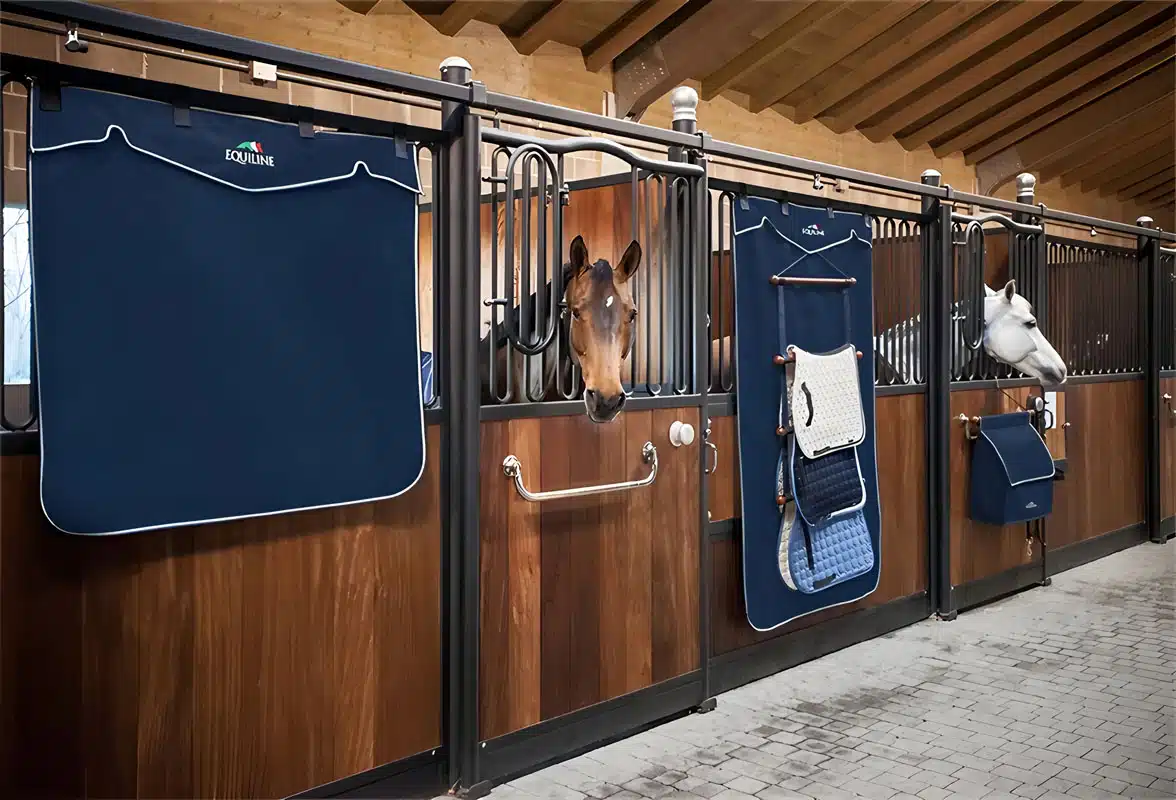
V-Drop Doors: Folding Down for Zero Aisle Intrusion
A V-Drop door folds downward, staying flush with the stall front. This ‘Zero Aisle Intrusion’ design keeps barn aisles completely clear, improving safety and workflow.
| Fonctionnalité | Traditional Swing-Out Window | DB Stable V-Drop Door |
|---|---|---|
| Aisle Intrusion | Swings out, creating a significant obstruction. | Folds down, remaining flush with the stall front. |
| Safety Hazard | High risk for handlers and horses in busy aisles. | Eliminates aisle obstruction for a clear walkway. |
| Mechanism Durability | Exposed hinges are prone to rust and seizing. | All parts are Hot-Dip Galvanized to prevent rust. |
The Advantage of Zero Aisle Intrusion
Any barn manager knows that a busy aisle is a high-risk area. Traditional swing-out windows, when opened, protrude directly into the walkway. This creates a dangerous obstruction for handlers leading horses, moving feed carts, or operating equipment.
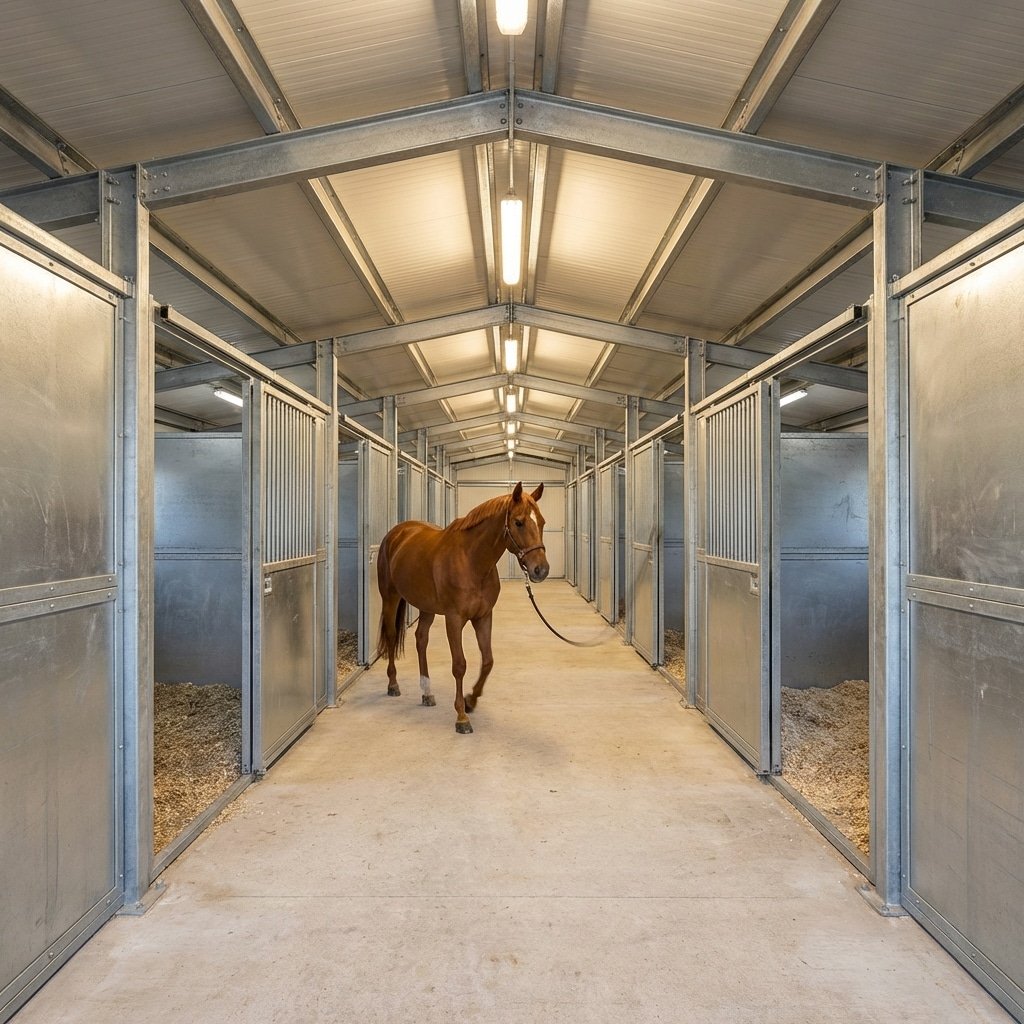
The V-Drop mechanism solves this problem completely. It folds downward and inward, so the entire door assembly rests within the stall’s own footprint. The passageway remains 100% clear at all times, which is a critical safety feature for efficient and hazard-free barn operations.
Construction: Hot-Dip Galvanization After Fabrication
A folding door is only as good as its hinges and moving parts. If the mechanism rusts, it seizes up and becomes useless. We prevent this by building the entire door unit from Q235B structural steel first, then submerging the finished piece in molten zinc.
This process, Hot-Dip Galvanization After Fabrication, coats every weld, corner, and moving component according to the ISO 1461 standard. Unlike competitors who weld pre-galvanized parts—leaving the welds exposed to rust—our method ensures the folding mechanism is fully protected. This guarantees smooth, reliable operation for years without failure from corrosion.
Safety Check: Preventing Pinched Noses and Ensuring Security
A safe stall eliminates hazardous gaps and sharp edges. This requires precise engineering, minimal floor clearances, and durable materials like HDPE and hot-dip galvanized steel.
Key Design Principles for Injury Prevention
You can’t compromise on safety. The entire structure, from the welds to the infill material, must be designed to prevent common injuries. A horse will always find a weak point or a design flaw, so you have to engineer those risks out from the start.
- No Sharp Edges or Burrs: All welds must be ground smooth before any coating is applied. This prevents lacerations and creates a clean finish, especially around high-contact areas like feeder openings and door latches.
- Splinter-Proof Infill: Wood splinters. It’s a fact. Using materials like UV-stabilized HDPE or high-density bamboo eliminates this risk entirely. A powerful kick won’t create dangerous shards that could injure a leg.
- Proper Gap Sizing: Any opening in the stall is a potential trap. Gaps between bars, under doors, or in window grilles must be sized to prevent a hoof or nose from getting caught. Too wide, and a hoof gets through; too narrow, and a nose can get pinched.
The DB ‘Cast-Proof’ Engineering Standard
We build to a set of internal standards that directly address these known risks. It’s not just about meeting a basic requirement; it’s about anticipating how a 1,200-pound animal interacts with its environment.
- ‘Cast-Proof Design’: A horse getting cast (stuck against a wall) is a serious danger. We implement a minimal bottom gap of approximately 50mm (2 inches) between the panel and the floor, making it nearly impossible for a hoof to get wedged underneath during a roll.
- ‘Kick-Proof Guarantee’: The framework is the skeleton of the stall. We use Q235B structural steel as standard, with an option for Q345B for extreme cold climates. This provides superior impact toughness to prevent fractures from kicks.
- Hot-Dip After Fabric
ation:
We weld the entire panel first, then dip it in molten zinc. This process coats every surface, inside and out, and flows smoothly over weld joints. It eliminates the sharp zinc drips and uncoated weld points common with cheaper pre-galvanized tubing.
Customizing Your V-Drop and Yoke Stall Fronts
Customizing a yoke front means choosing its shape and function—fixed, folding, or removable. For a premium look, add dual-layer finishes and decorative brass finials for a European style.
Selecting Yoke Styles and Operational Features
The first decision is the shape of the opening, which impacts both aesthetics and how the horse interacts with the aisle. Common designs include V-Shaped Yokes that keep the horse centered, traditional Rectangular Yokes, and more decorative European Arches for a refined appearance. The choice depends entirely on the barn’s operational needs and visual goals.
Next, you define how the opening functions. A permanently open or cut-out design is the simplest option. For more flexibility, a hinged fold-down yoke allows you to close the opening when needed. A fully removable fill-piece is another option, often preferred in larger facilities because it eliminates the noise and potential wear of hinged hardware, providing quieter operation.
Aesthetic Upgrades: Finishes and Decorative Finials
For premier facilities demanding maximum longevity and a superior look, our Royal Series offers a dual-protection finish. We apply a powder coat over the hot-dip galvanized steel frame, which provides exceptional durability against rust while allowing for custom color matching.
To complete the high-end appearance, custom arched tops can be added to the stall fronts. Pairing these arches with decorative brass finials creates a distinctive and classic European style, turning a functional stall front into a key architectural feature of the barn.
Questions fréquemment posées
What is a V-door for a horse stall?
A V-door is a horse stall door with a V-shaped opening that lets a horse safely put its head into the aisle for socialization. It reduces stall boredom and often features a removable insert to close the opening, adapting to different needs. They are typically built from heavy-duty, hot-dip galvanized steel for longevity.
What’s the difference between a yoke and a V-drop stall front?
A ‘yoke’ is a general term for any opening that lets a horse look out, coming in various shapes like rectangular or arched. A ‘V-drop’ is a specific type of yoke with a V-shaped opening that has a drop-down mechanism, giving handlers flexible control over when the opening is accessible.
Are swinging yoke shutters safe for horses?
Yes, when properly designed. Safe swinging yoke shutters feature solid welded construction with no sharp edges, smooth stainless-steel hardware, and secure latches to prevent accidental opening. The design ensures horses can look out without risk of getting caught or injured.
What is the best stall door for a narrow barn aisle?
Sliding stall doors are the best choice for narrow aisles because they don’t swing outward, saving crucial space. They glide on a track, making them efficient for high-traffic barns and safer for handlers leading horses, as there is no risk of a door blocking the path.
Réflexions finales
Swinging shutters built from pre-galvanized tubing expose dealers to warranty claims when the welds inevitably rust. Our standard is Hot-Dip Galvanization After Fabrication (ISO 1461), which fully coats every edge to safeguard your reputation. This engineering prevents the service calls that erode your profit margins.
Validate our engineering firsthand with a trial order of 3-5 stables to confirm the fitment and galvanization quality. Contact our team to configure a container load or to discuss OEM production for your brand.

 French
  English
  Spanish
  Arabic
  German
0 commentaires