


A horse stall steel gauge guide is the document buyers wish they had read before signing a purchase order on stalls that flex, rack, or rust out years early. Steel thickness is the spec that most separates a stall that shrugs off a 500 kg animal leaning on it from one that bends at the first kick. It is also the spec most open to manipulation, because a number on a quote sheet costs a supplier nothing until someone measures the steel. This guide covers how thickness is specified, how inflated specs slip past buyers, and how to verify what arrives in the container.
The perspective here comes from the manufacturing side. DB HorseStable has produced equestrian infrastructure in Anping, China since 2013 — CNC machining, automated 360-degree welding, above 500 stable sets monthly — and publishes its commercial terms so buyers can hold every supplier to the same standard of verifiable numbers.
Key Takeaways
- Gauge numbers run backwards: a lower gauge number means thicker steel, and gauge conventions differ between sheet, tube, and regional markets — which is why millimeters belong in your contract, not gauge numbers alone.
- The “Steel Gauge Scam” has three faces: quoting the thickest single component as the stall’s gauge, quoting pre-coating thickness, or quietly thinning hidden internal parts while the visible frame stays heavy.
- Demand paper before payment: written millimeter specs per component, mill test reports per steel batch, and the right to third-party pre-shipment inspection.
- Verify on arrival: calipers on cut tube ends and ultrasonic thickness gauges on closed sections catch inflated specs before the container leaves the yard.
- Thickness is not the whole story: weld quality and hot-dip galvanization — which carries 20 years of rust protection on this factory’s steel — decide longevity as much as raw gauge.
What Steel Gauge Actually Measures
“Gauge” is a legacy numbering system from wire drawing, and it survives in the steel trade mainly because North American buyers still use it. The counterintuitive part trips up first-time buyers: the larger the gauge number, the thinner the steel. A 14-gauge tube has thicker walls than a 16-gauge tube, and the difference between those two numbers is not cosmetic — it is the difference between a frame that survives a decade of kicks and one that starts deflecting in its second season.
The deeper problem is that gauge conventions are not one system. Sheet steel gauges, tube wall references, and regional variants do not map cleanly onto each other, and a supplier in one market may use a numbering that means something different in yours. Most of the world sidesteps the ambiguity entirely by quoting millimeters, and that is exactly what your purchase order should do. A wall thickness stated as a decimal in millimeters leaves no room for creative interpretation; a bare gauge number leaves plenty.
One subtlety deserves its own sentence: galvanization adds thickness. A hot-dip galvanized coating is a real zinc layer bonded to the steel, so a caliper reading on a coated surface measures base metal plus zinc. When you verify thickness, measure at a cut or machined end, or compare against a mill certificate that states the base metal separately.
Write thickness in millimeters per component, and treat any gauge-only spec as an incomplete quote.
The Steel Gauge Scam: How Thickness Gets Inflated
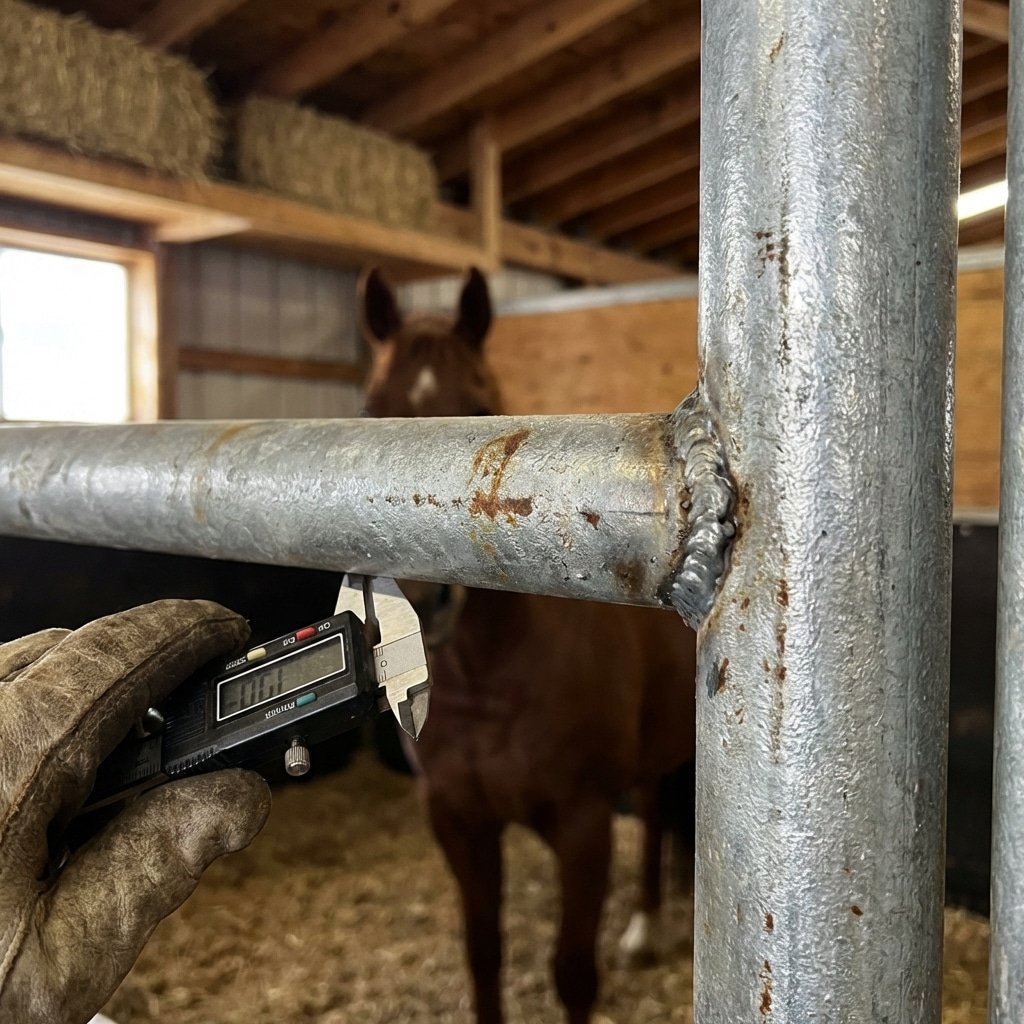
The industry’s dirty secret — and the reason thickness verification deserves a line item in your inspection budget — is that some suppliers quote specs they have no intention of delivering. The practice is common enough in the steel equipment trade that repeat importers treat written specs and arrival checks as standard procedure rather than paranoia. It usually shows up in one of three patterns.
- The best-part quote: the headline gauge describes the one heavy component — say, the front frame upright — while divider rails, bottom bands, and gate frames run thinner. True for one part, false for the stall as a system.
- The rounding-up quote: nominal thickness is quoted as if it were minimum thickness. Steel production carries real tolerances, and a supplier quoting only the nominal can ship at the bottom of the tolerance band — or below it — without changing a word on paper.
- The thin-middle quote: visible components meet spec, hidden ones do not. Internal bracing, back-frame channels, and hinge reinforcement plates are where material quietly disappears, because buyers rarely disassemble a stall to check them.
The behavioral tell is consistent across all three: hesitation when you ask for millimeters in writing. A supplier running genuine material puts numbers on paper without friction, because the paper matches the goods. If the answer is “same as industry standard,” ask what the standard is and who publishes it — the conversation usually ends there.
What to Demand in Writing Before You Sign the PO
Verification starts long before the container arrives. Every line below belongs in the purchase order or its annexes, and a supplier with consistent material will supply each one as a matter of routine.
- Millimeter thickness per component: one table listing frame uprights, rails, gates, bottom bands, and infill supports separately, with minimum values, not just nominal.
- Mill test report: the producing steel mill’s certificate for the batch, showing the actual chemistry and dimensions of the material your stalls were cut from. Reputable manufacturers can produce this on request.
- Coating specification: hot-dip galvanized after fabrication or pre-galvanized coil — two different products with different lifespans. DB HorseStable hot-dip galvanizes its stall steel and rates the coating for 20 years of rust protection; the distinction from pre-galvanized material is worth its own reading before you compare quotes.
- Third-party inspection clause: the right to appoint an inspection agency (SGS, Bureau Veritas, TÜV, and similar firms all do this work) to check dimensions, coating, and welds before shipment, at a defined pass/fail standard.
- Tolerance and remedies: what thickness range counts as conforming, and what the supplier does — rework, replacement, or credit — when it does not.
Certifications frame the same question at the system level: ISO 9001 means a documented quality process exists, and CE marking means the product meets applicable European requirements — but neither certificate states the thickness of your steel. Every commercial term, from the 10-set minimum order to tiered discounts of 5%-15% and 4-6 week lead times, is easier to negotiate once the material spec is settled — see the wholesale horse stables pricing guide.
The Arrival Check: Calipers and Ultrasonic Gauges
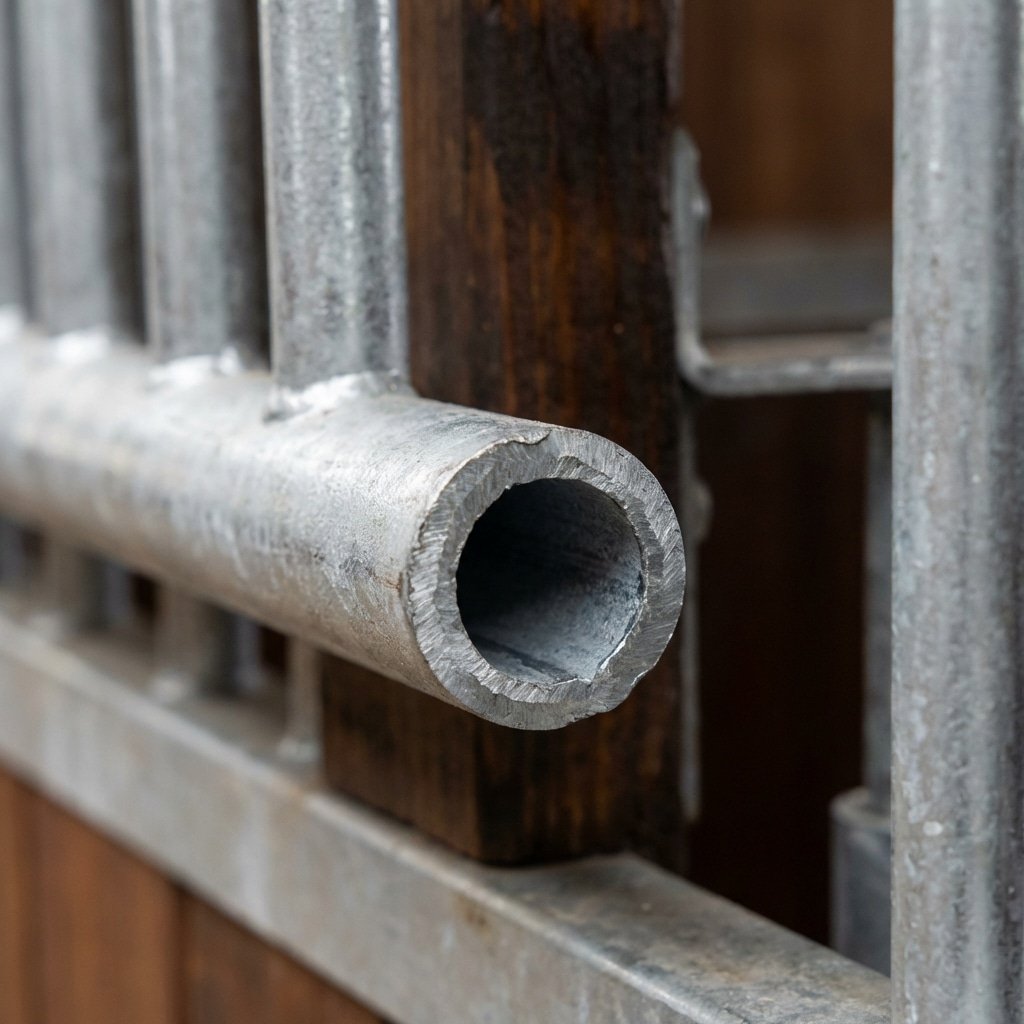
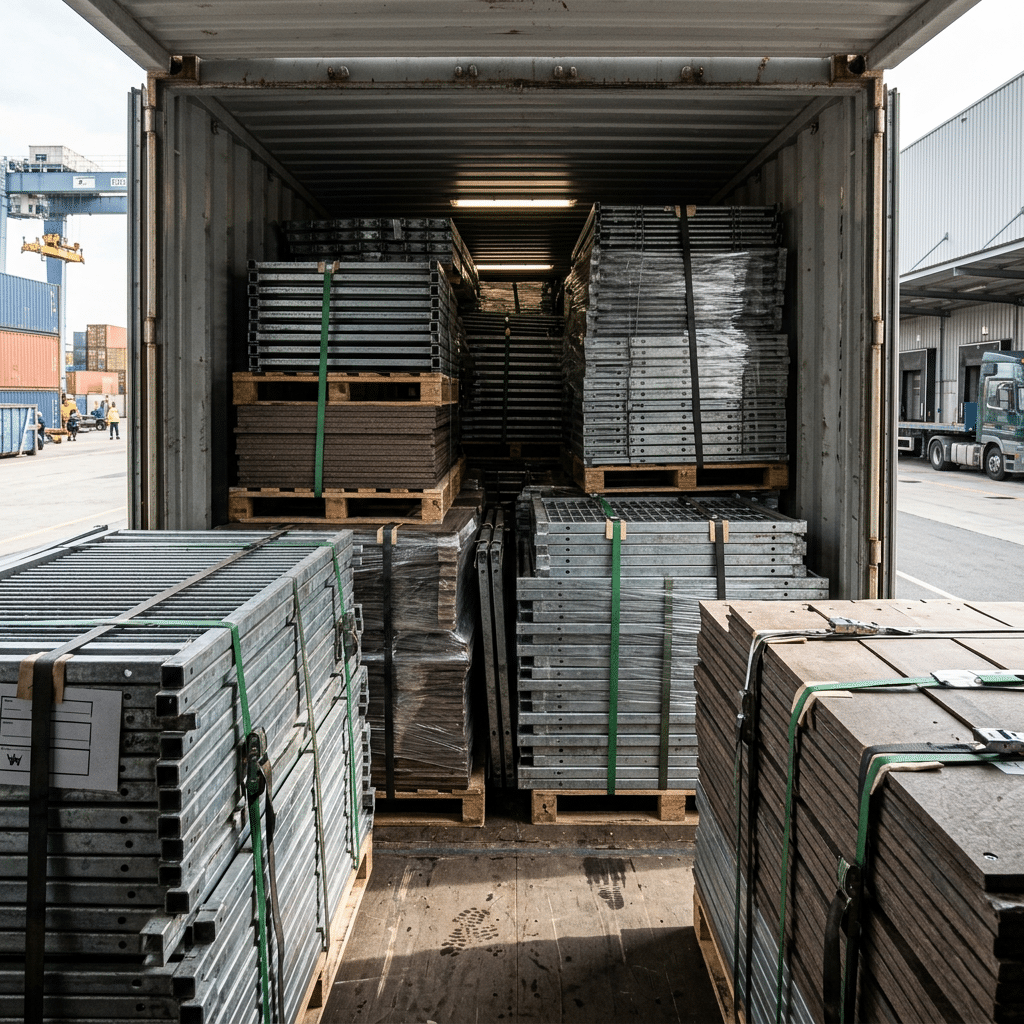
The inspection that matters most happens in the first hours after the container opens, before unpacking scatters components and before the driver leaves. Two affordable tools do most of the work. A caliper — digital ones read to two decimal places — measures wall thickness at any cut or drilled end where bare base metal is exposed. An ultrasonic thickness gauge reads through paint and coating on closed sections. Both fit in a jacket pocket, and both cost less than a single replacement stall front.
Structure the check like an audit, not a stroll. Pull a fixed number of components at random — frames, gates, and internal parts from different positions in the container — and log each reading against the spec table in your PO. Photograph everything before unloading, so any claim has a timestamp.
The reason is arithmetic. Production and shipping run 4-6 weeks, so a thickness problem discovered after installation means another 4-6 weeks of waiting for parts, with stalls out of service and horses relocated. Discovery at the container door keeps every remedy on the table: refusal, claim, or hold on final payment.
Thickness Is Not the Whole Story
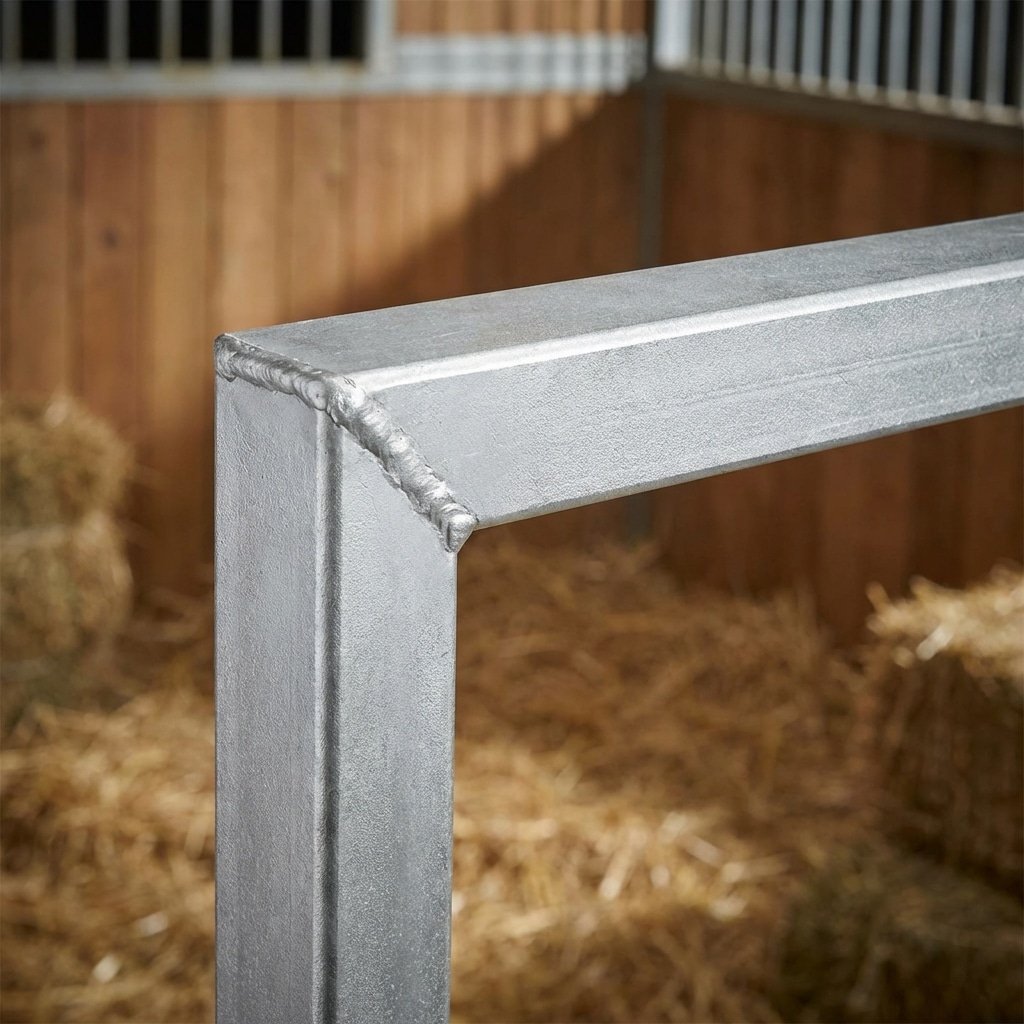
A thick-walled tube joined with a bad weld is still a weak stall. Loads travel through joints, and a stall’s life is dominated by how its frame is cut and welded, not just how much metal it contains. This is where production method earns its place in your supplier evaluation: CNC machining holds cut tolerances that hand-guided tools cannot, and automated 360-degree welding produces consistent full-perimeter seams on every joint of every set — the reason a factory running both can sustain a monthly output above 500 stable sets without quality drifting between the first container and the fifth.
Design choices matter alongside process. Rounded profiles, braced corners, kick bands at hoof height, and hinge reinforcement spread point loads instead of concentrating them, so two stalls with identical thickness can carry different real-world lifespans. When you compare suppliers, ask to see the full customization options for frame reinforcement and infill materials — a manufacturer confident in its structure will show you the load-bearing details, not just the finish colors.
None of this softens the thickness rule; it widens it. Verified millimeters, verifiable welds, and a coating process rated in decades are three legs of the same stool, and a supplier should be able to evidence all three before you sign.
Conclusion
Steel thickness decides whether your stalls survive their horses, and it is the easiest spec for a supplier to inflate and the cheapest one for you to verify. Millimeters per component in the contract, mill test reports per batch, third-party inspection before shipment, and a caliper in your pocket at the container door — that sequence closes every version of the gauge scam, from the best-part quote to the thin-middle quote.
Before your next order, re-read the spec table on the quote in front of you and mark every line where a number is missing or a gauge number stands alone. Those marks are your negotiation agenda, and settling them in writing costs nothing but a conversation.
Questions fréquemment posées
How do I measure the thickness of stall steel after it arrives?
Use a caliper on any cut or drilled end where bare metal is exposed, and an ultrasonic thickness gauge to read through paint and coating on closed sections. Measure a random sample of components from different positions in the container and log readings against your PO spec table.
Does the galvanized coating count toward the thickness I measure?
Yes, hot-dip galvanizing adds a real zinc layer, so a caliper on a coated surface reads base metal plus coating. Verify base-metal thickness at a cut end or against a mill certificate that states the two separately.
Can I appoint a third-party inspector before the stalls ship?
Yes, and a supplier with consistent material should accept it as routine. Build the clause into the purchase order, naming an agency such as SGS, Bureau Veritas, or TÜV and defining pass/fail criteria for dimensions, coating, and welds.


 French
  English
  Spanish
  Arabic
  German
0 commentaires