


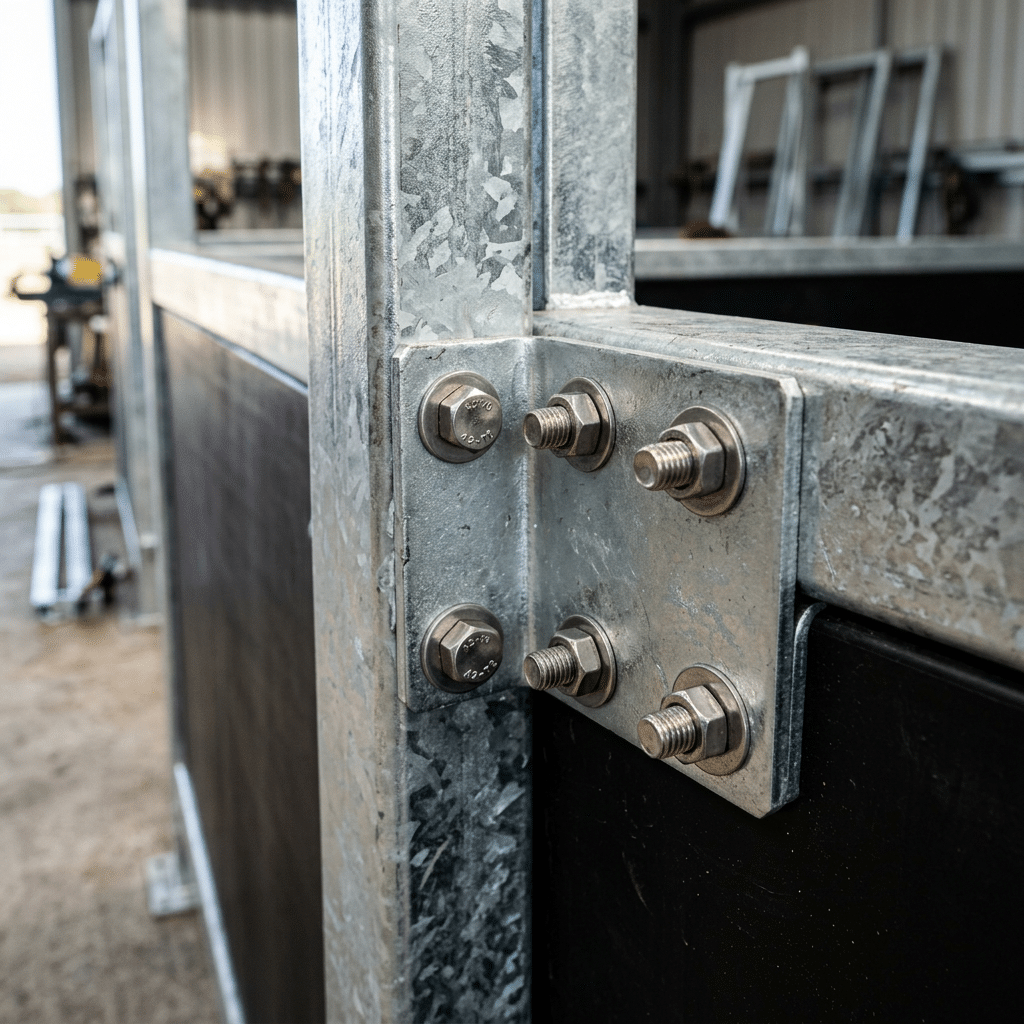
Effective Trade Show Sourcing for equestrian stables is a defense against the high costs of freight and future rust claims. A misstep at Spoga or Canton Fair can lock your business into a partnership with a factory that uses pre-galvanized tubing, jeopardizing your inventory investment and dealer reputation before the first container even lands.
This analysis benchmarks suppliers against the ISO 1461 standard for hot-dip galvanization after fabrication. We evaluate factories on their use of Q235B structural steel and their ability to provide a sistema de montaje en kit, helping you protect logistics margins and secure a reliable manufacturing partner.
Diseño de establos accesibles para sillas de ruedas (ADA)
ADA-accessible stables require pathways at least 36 inches wide, 30×48 inch clear floor spaces, and components like wide sliding doors to ensure safe, effective wheelchair use.
Core Requirements for Accessible Pathways and Spaces
When designing a stable for wheelchair accessibility, the layout must follow specific ADA standards. These rules aren’t just about compliance; they ensure the facility is genuinely usable and safe for everyone. The fundamental requirements focus on creating unobstructed, navigable routes and functional spaces.
- Continuous Pathways: All barn aisles and routes between stalls, tack rooms, and common areas must have a minimum clear width of 36 inches for unobstructed wheelchair movement. Surfaces must be firm and slip-resistant.
- Ramps for Elevation Changes: Any change in floor level greater than a half-inch must be managed with a ramp. The ramp cannot have a slope steeper than 1:12 (one inch of rise for every 12 inches of length).
- Clear Floor Spaces: Key areas like tack rooms, feed rooms, and viewing platforms need a designated clear floor space of at least 30 inches by 48 inches. This allows a wheelchair user to position themselves without obstruction.

How Modular Stable Fronts Support ADA Layouts
Using a modular stable system simplifies the process of meeting these accessibility standards. Instead of requiring extensive custom fabrication, a well-engineered system provides the necessary components right out of the box. Our Stable Front Panels come standard with wide-opening sliding doors. This design is critical for accessibility because the door doesn’t swing out and obstruct the 36-inch minimum aisle width, a common problem with hinged doors in busy barns.
The modular nature of our Front and Partition Panels gives facility designers the flexibility to create custom layouts that conform to ADA rules. Arranging panels to guarantee the required pathway and clear space dimensions becomes a straightforward planning task, ensuring the final build is both functional and compliant from day one.
La experiencia del pasillo: Puertas correderas anchas frente a puertas batientes
Sliding doors maximize aisle space and are safer for busy barns by eliminating swing obstruction. Swing doors are simpler but can block pathways, creating operational and safety risks.
Impact on Aisle Space and Daily Workflow
The choice between sliding and swing doors directly dictates how your barn functions. Sliding doors operate parallel to the stable front. This design req
uires zero outward clearance, preserving the full width of the aisle for moving horses, feed carts, and equipment without obstruction.
Swing doors project directly into the aisle when opened. In a busy facility, this creates immediate bottlenecks and potential safety hazards. Handlers must account for the door’s arc, which can disrupt traffic flow and complicate moving nervous or young horses through the barn.
The Safety Advantage of a Hidden Track System
Good design removes unnecessary risk. Our DB Stable Professional Series features a hidden track system that conceals all rolling hardware inside the door’s top frame. This isn’t just about looks; it’s a critical safety feature.
By eliminating protruding rollers, guides, and stops, the design removes snag points for blankets, lead ropes, or even a horse’s hip. The result is a completely clean, flat surface along the top of the stable front, which significantly improves safety in high-traffic training centers and riding schools.
Durable Horse Stables Engineered for Any Climate
Suelos sin umbral: Eliminación del riesgo de tropiezos
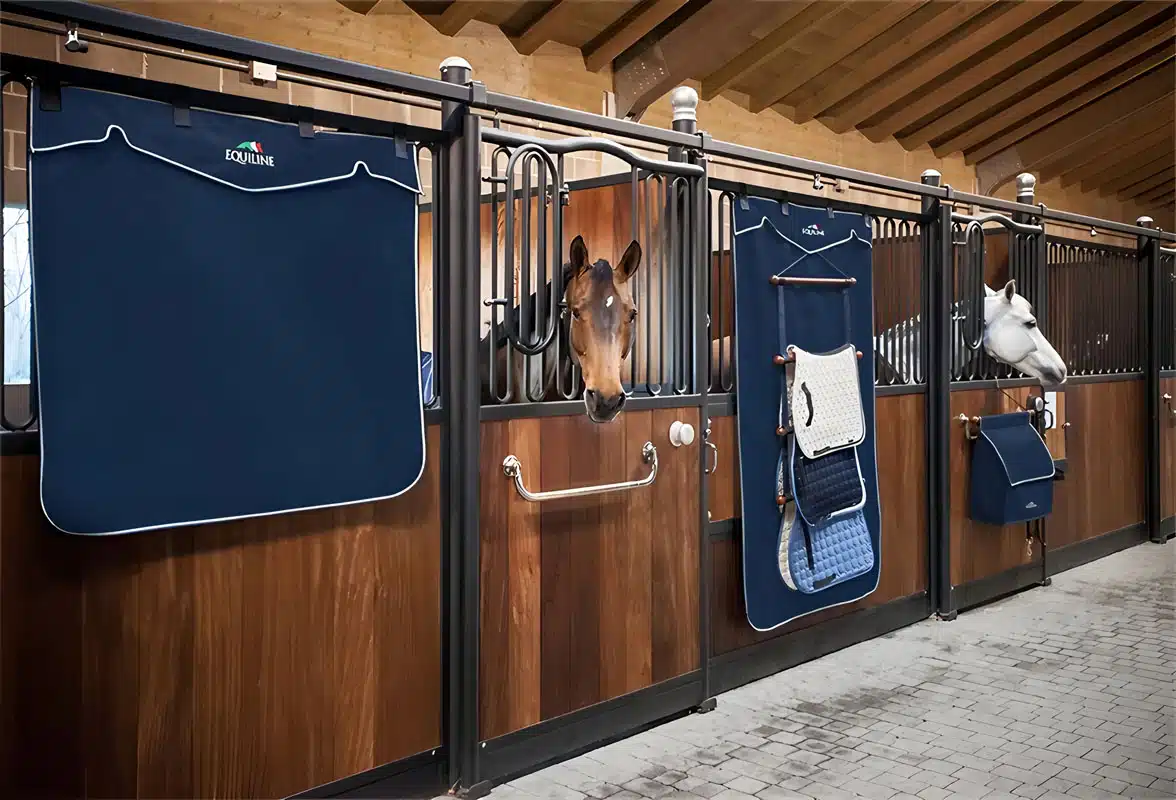
In stables, a ‘trip hazard’ is any gap where a horse can trap its leg. Designs with minimal floor clearance are critical to prevent severe injuries when a horse rolls.
The Risk of Leg Entrapment in Stalls
The most serious floor-level danger for a horse is getting a leg or hoof trapped under a stall door or partition, which often happens when it lies down or rolls. This situation is called being ‘cast’. A cast horse will often panic and struggle, leading to severe injuries. Managing the gap at the bottom of stall components is not a minor detail—it’s a critical element of safety engineering.
The DB Stable Cast-Proof Design Standard
We address this risk directly with our Cast-Proof Design standard. We engineer every stable panel to have a bottom gap of approximately 50mm. This clearance is precise and intentional; it is too small for a horse’s hoof to get stuck. This design feature effectively eliminates one of the most dangerous floor-level hazards inside a stable.
Los mejores proveedores de ingeniería para la comunidad PATH/RDA
Sourcing suppliers for therapeutic riding is fragmented. Success means evaluating providers on safety engineering, accessibility features, and proven experience in equine environments, not just finding a generic list.
There is no central, verified directory of “top” suppliers specifically serving the PATH Intl. or RDA communities. The market is a mix of specialized equipment makers, facility contractors, and industrial stable manufacturers whose products meet the high standards required for therapeutic use. Finding the right partner means knowing what engineering specifications to look for.
Instead of a simple list, a better approach is to evaluate potential suppliers across key categories based on their engineering and safety standards.
| Categoría de proveedor | Core Engineering Focus | Stable & Barn Manufacturers | Animal safety, handler efficiency, and accessibility. | Hot-dip galvanization after fabrication (ISO 1461), zero-threshold designs, sliding door mechanics, cast-proof gaps. | |
|---|---|---|---|---|---|
| Adaptive Riding Equipment | Rider safety, custom fit, and therapeutic value. | Material certifications, adjustability, collaboration with therapists, weight capacity ratings. | |||
| Facility Infrastructure & Flooring | ADA compliance, ground stability, and user navigation. | Experience with agricultural settings, non-slip surfaces, seamless transitions between areas. |
What to Demand from Stable & Barn Suppliers
The stable itself is the most critical piece of infrastructure. For therapeutic settings, safety and accessibility are non-negotiable. Sliding doors are strongly preferred over swing doors because they don’t obstruct aisles and can’t be caught by the wind, reducing the risk of spooking a horse.
Zero-threshold flooring is another critical feature. Any raised edge creates a barrier for wheelchairs or participants with mobility challenges. A professional facility should have smooth transitions from the aisle to the tack room and wash bay.
When evaluating the actual stable panels, demand these technical specifications:
- Protección contra la corrosión: The entire steel frame must be galvanizado en caliente *after* fabrication, conforming to ISO 1461. This ensures every weld and cut is fully protected. Pre-galvanized tubing that is welded later will rust at the joints.
- Steel Strength: The frame should use Q235B structural steel as a minimum. For colder climates, Q345B steel is necessary to prevent brittle fractures from horse kicks in freezing temperatures.
- Espesor de pared: Insist on calibre 14 (2.0mm) tubing at a minimum. Anything thinner presents a safety risk.
- Material de relleno: High-density polyethylene (HDPE) is a good choice as it requires zero maintenance and absorbs impact. High-density bamboo is another durable, mold-resistant option.
Finding Adaptive Equipment and Facility Builders
Sourcing adaptive saddles, mounting ramps, and specialized therapeutic technology often requires direct outreach. Start by consulting with organizations like PATH Intl., which can provide guidance or connect you with centers that have already sourced and vetted this type of equipment.
For facility builders, look for contractors with experience in both equestrian and accessible construction. They need to understand the unique demands of barn environments—like drainage, ventilation, and durable surfaces—while also correctly implementing ADA standards for ramps, pathways, and restrooms.
Sistema de carriles cerrados Smooth-Glide de DB
Our enclosed track protects rollers from debris, delivering quiet, jam-free operation. This design boosts safety by concealing moving parts that could snag halters or injure horses.
Why Enclosed Tracks are the Standard for Modern Stables
Any experienced stable manager knows that exposed door tracks are magnets for dust, hay, and shavings. An enclosed track protects the rolling mechanisms from this constant barrage of debris. The result is a door that slides effortlessly year after year, without the sticking and jamming common in older designs.
This design also creates a much safer stall. By eliminating external moving parts, you remove potential snag points for halters, lead ropes, and blankets. It’s a simple engineering choice that prevents a common source of barn accidents.
The Professional Series Hidden Track Design
Our Professional Series stables feature a fully concealed ‘Hidden Track System’ as a core component. This isn’t just an aesthetic choice; it’s an engineering standard. We build the system with durable, corrosion-resistant components from our 304 Stainless Steel hardware kit. This ensures maximum longevity and reliable performance in demanding equestrian environments.
Preguntas frecuentes
What are the key design considerations for an accessible horse barn?
An accessible horse barn must prioritize safety and ease of movement. Key features include extra-wide doorways (at least 48 inches), level flooring without raised thresholds, wider-than-standard aisles (over 12 feet), and ADA-compliant bathrooms. Tack and equipment should be placed at an accessible height, typically no more than 48 inches from the ground.
What is the standard minimum door width for wheelchair access in a barn?
The baseline ADA standard for commercial buildings is a minimum door width of 32 inches. But for centros de equitación terapéutica and public equestrian facilities, a 48-inch width is highly recommended to comfortably accommodate all types of wheelchairs and support personnel.
Are sliding stall doors easier to use than hinged doors?
Yes, sliding stall doors are generally easier to operate in a busy barn environment. They can be opened and closed with one hand, which is a significant advantage when leading a horse. They also save space in narrow aisles and prevent the risk of a swinging door startling an animal.
What are PATH Intl safety standards for therapeutic riding centers?
PATH Intl standards mandate a comprehensive safety protocol. This includes non-negotiable helmet use for all riders, required closed-toed footwear, and clearly defined emergency procedures. Facilities must be ADA accessible, maintain equipment properly, and enforce strict rules of conduct, such as no running or yelling, to ensure a safe environment for both participants and horses.
Reflexiones finales
While low-cost stables seem attractive at sourcing fairs, they often use pre-galvanized tubing that rusts at the welds. Our ISO 1461 ‘hot-dip after fabrication’ standard is the only way to safeguard your brand against costly rust claims and warranty issues. Investing in certified engineering protects your reputation and ensures repeat business from discerning clients.
Don’t take chances on sourcing trips; verify the engineering yourself. We recommend requesting our technical catalog or scheduling a call to discuss a small trial order for your market. Our team is ready to detail the OEM specifications and flat-pack logistics that protect your profit margins.

 Spanish
  English
  French
  Arabic
  German
0 comentarios