



Structural integrity failures often stem from invisible defects like cold welds or insufficient zinc coating rather than obvious design flaws. Relying on visual estimates instead of data-backed instrumentation risks accepting units that corrode or warp within three years.
This guide outlines the inspection protocols necessary to verify 42-micron galvanization thickness against ASTM A123 standards. We examine methods for detecting cold welds, measuring 1/8 inch door tolerances per NFPA 80, and validating hardware durability using magnetic thickness gauges and precision calipers.
What Tools Are Required for a Professional Stable Inspection?
Professional estable inspection relies on standardized instrumentation rather than visual estimates. Key tools include the Rotational Penetrometer 100 Series for verifying surface stability against ASTM F1951 standards, and Peel or Bond Strength Testers to check coating adhesion. Technicians also employ precision wide-jaw calipers and sheave gauges to verify structural dimensions and hardware integrity.
Precision Measurement Devices for Structural Components
Verifying the physical dimensions of a marco de acero requires tools that go beyond a standard tape measure. Accurate measurement ensures that every joint and beam fits together perfectly, preventing structural weakness over time.
- Wide-jaw Calipers and Metric Steel Rulers: These tools verify the exact dimensions of structural tubing. For example, they confirm that profiles meet the required 40x40mm specifications used in high-quality frames.
- Sheave Gauges: Technicians use these specialized gauges, ranging from 15mm to 36.5mm, to inspect pulleys and door tracks for wear. Think of this like checking the tread depth on a tire to ensure it is still safe to drive.
- Depth Gauges: These instruments measure cavity depths or weld throat thickness to ensure structural connections meet safety specifications.
- Granite Surface Plates: Inspectors employ these heavy stone tables as a perfectly flat reference point when checking the alignment of prefabricated components.

Advanced Stability and Material Integrity Testing
To ensure a stable is safe for horses, inspectors use advanced equipment to test surface hardness and material bonding. This process moves beyond visual checks to provide data-backed safety assurance.
- Rotational Penetrometer 100 Series: This Instrumented Surface Indenter (ISI) provides firmness readings correlated to ASTM F1951. It acts like a mechanical hoof, pressing into the ground to ensure the surface is firm enough for movement but soft enough for impact.
- Peel and Bond Strength Testers: This equipment adheres to ASTM D903 with a test speed of 50-300 mm/min and a load capacity of 20 Kgf. It tests how well protective coatings stick to the metal, similar to testing how well tape sticks to a box.
- Hardness Testers (Rockwell Method): These devices determine the tensile strength of metal components. This helps prevent structural failure under the heavy load of a leaning horse.
- Data Accuracy: Professional testers maintain ±1% accuracy at full load to ensure compliance with strict safety codes.
Verifying DB Stable’s Material Specifications
When inspecting premium stables like those from DB Stable, specific tools are necessary to validate the high-quality claims regarding rust resistance and impact strength. These measurements confirm the longevity of the investment.
- Galvanization Verification: Inspectors use precision coating tools to confirm the hot-dip galvanized layer exceeds 42 microns. This thick layer acts as a permanent shield against moisture to ensure the 10-year rust-free lifespan.
- Infill Panel Testing: Calipers measure the 10mm thickness of HDPE boards to confirm they meet impact resistance standards. This ensures the walls can withstand a kick without shattering.
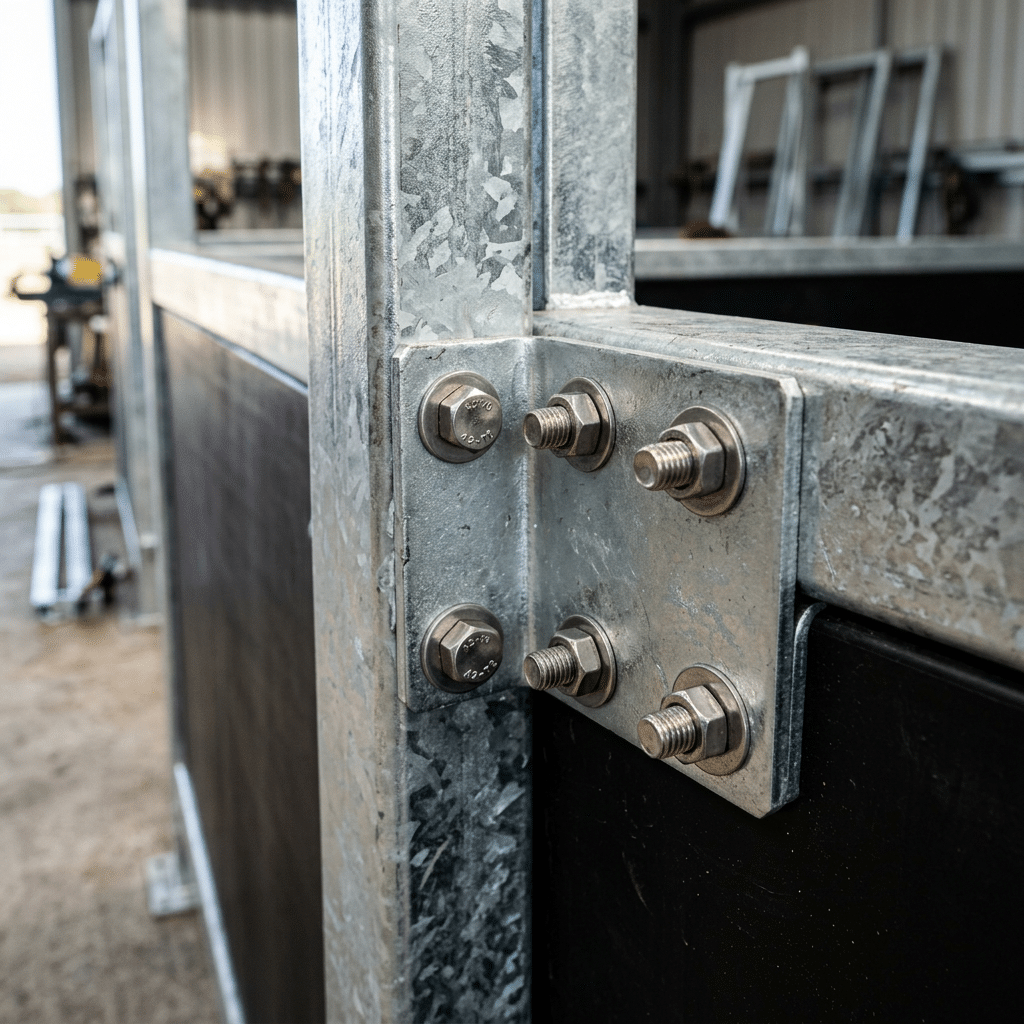
- Connection Strength: Tools verify the dimensions of the 6mm steel plate connectors and full welds on the 40x40mm square metal tubes.
- Hardware Durability: Technicians check the aluminum swivel feeders and door tracks to ensure they show no signs of rust or deformation after use.
Step 1: How to Measure Galvanization Thickness on Horse Stalls?
Measuring galvanization thickness relies on non-destructive magnetic thickness gauges, which provide instant readings in microns or mils without damaging the coating. According to ASTM A123 and ISO 1461 standards, hot-dip galvanized components typically require a thickness range of 50–100 microns to ensure adequate corrosion resistance.
The Magnetic Gauge Method: Non-Destructive Inspection
To check the quality of the zinc coating on horse stalls, inspectors use magnetic thickness gauges. Think of this tool like a specialized sonar that pings the steel beneath the zinc layer. It measures how far the magnetic signal travels before hitting the steel, instantly calculating the thickness of the protective coating. This method is preferred because it is non-destructive, meaning it does not scratch or damage the rust protection you are trying to verify.
While there are different types of tools available, digital electronic gauges are the most reliable option for field work. They offer precise numbers rather than rough estimates found with older banana-style gauges. This precision helps buyers verify that the steel has enough zinc to survive wet stable environments without relying on guesswork.
Interpreting Thickness Standards (ISO 1461 & ASTM A123)
Global standards such as ASTM A123 and ISO 1461 act as the rulebook for hot-dip galvanization. These documents specify exactly how thick the zinc layer must be to fight off rust effectively. For structural steel components used in horse stalls, the industry benchmark usually falls between 50 and 100 microns. A micron is a tiny unit of measurement, but these layers accumulate to form a substantial barrier against corrosion.
Understanding the units is helpful for verifying quality reports. One mil is equal to exactly 25.4 microns. Some reports might convert this into weight, shown as ounces per square foot. Regardless of the unit used, the goal is to confirm there is enough physical material to stop moisture and manure from reaching the raw steel frame.
Field Measurement Protocols for Accurate Readings
Getting a true reading requires more than a single click of the gauge. Steel surfaces can have microscopic peaks and valleys, so inspectors must follow a specific sampling protocol. You should take at least five distinct readings across the surface to calculate a fair average. This average value accounts for natural variations in the coating process and provides a scientifically valid result.
- ✅ Central Positioning: Place the gauge in the middle of flat sections for the best data.
- ✅ Avoid Edges: Keep the sensor at least 4 inches away from edges or holes to prevent magnetic distortion.
- ✅ Consistent Sampling: Test multiple areas on the stall frame to ensure the entire product is protected.
DB Stable Quality Assurance: Meeting the 42+ Micron Standard
DB Stable aligns its manufacturing process with strict durability requirements to ensure longevity. The frame tubes and connectors undergo hot-dip galvanization that consistently exceeds 42 microns. This specific thickness serves as a robust shield, designed to last 10 years even in active equestrian environments where urine and moisture are common challenges.
We pay special attention to critical connection points like connect way pins and cleeks. These small but vital components receive the same heavy-duty coating treatment as the main frames. By maintaining this high standard across all parts, we ensure the structural integrity of the portable establo de caballos remains strong and rust-free for the long haul.
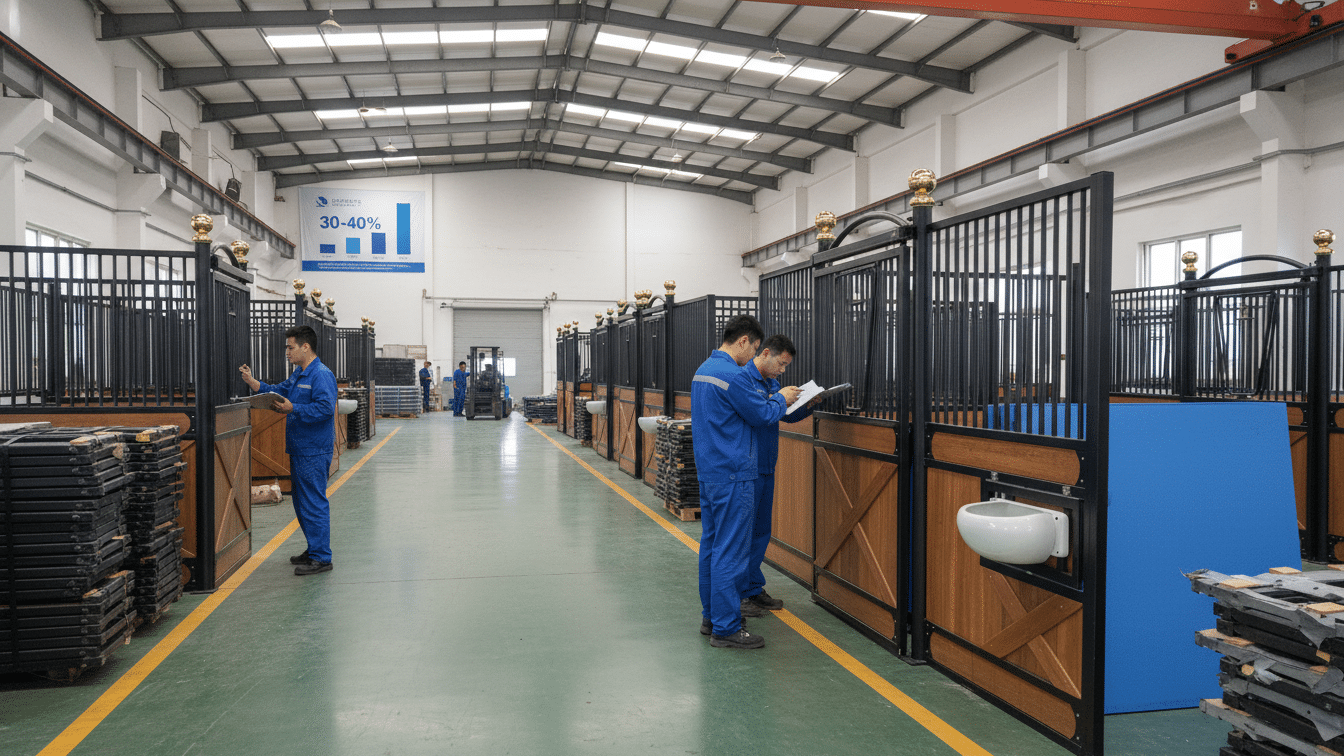
Step 2: How to Identify Cold Welds and Sharp Burrs?
Cold welds, technically known as ‘lack of fusion,’ occur when the weld metal fails to bond completely with the base metal, often visible as irregular beads or crevices. Sharp burrs are jagged metal edges left from cutting or drilling. Identifying these defects requires visual inspection adhering to standards like AWS D1.1 and tactile checks to ensure surfaces are smooth enough for livestock safety.
Recognizing Cold Welds (Lack of Fusion)
A cold weld, or lack of fusion, is a structural defect where the welding material sits on top of the base metal without actually penetrating it. Think of it like using cold glue on two pieces of paper; the glue sits on the surface but does not soak in to create a true bond. This usually happens when the heat from the welding arc is insufficient to melt the base steel.
Identifying these flaws early is critical for structural integrity. You can spot them by looking for specific visual cues during a control de calidad inspection.
- Defect Definition: Cold lap occurs when the weld bead “rolls over” the metal surface without fusing, often caused by low heat input or fast travel speeds.
- Visual Indicators: Look for weld beads that appear high-crowned or lumpy. A proper weld should have a smooth, concave transition into the base plate, whereas a cold weld often shows sharp edges or deep gaps at the “toes” of the weld.
- Standard Reference: These defects are classified under strict industry standards such as AWS D1.1 and ISO 5817, which dictate visual acceptance criteria for structural steel.
Detecting Sharp Burrs and Edge Irregularities
Burrs are small, razor-sharp ridges of metal left behind after steel is cut, drilled, or punched. Imagine a piece of wood that has been sawed but not sanded; the jagged splinters left at the edge are similar to metal burrs. While they may look insignificant, they pose a serious safety risk in animal environments.
Proper inspection requires both visual and physical checks to ensure the steel is safe for contact.
- Origin: These irregularities typically form during the fabrication phase when saw blades or drill bits exit the steel material.
- Inspection Method: Inspectors perform tactile checks by running a gloved hand along cut edges and drilled holes. The glove helps detect snags or roughness that might be missed by the eye alone.
- Safety Impact: In equine settings, even microscopic steel burrs can cause lacerations to horses. Removing these is mandatory before any coating is applied.
How DB Stable Ensures Smooth, Fully Welded Connections
To prevent these common defects, specific manufacturing protocols are enforced. DB Stable implements a rigorous quality control process designed to eliminate cold welds and hazardous edges before the product ever reaches the galvanization stage.
- Full Welding Protocol: Unlike spot welding which can leave gaps, DB Stable utilizes full welding on 6mm steel connector plates. This ensures a complete bond and structural rigidity.
- Surface Finishing: Every frame undergoes a comprehensive deburring process. Technicians grind and smooth all edges to remove sharp irregularities before the steel is treated.
- Revestimiento protector: The final hot-dip galvanization layer is applied at a thickness exceeding 42 microns. This creates a smooth, bonded zinc shell that seals the steel against rust for over 10 years, covering any remaining microscopic imperfections.
Custom Horse Stables Engineered for Any Climate
Create safe, long-lasting environments for your horses with diseños modulares built from hot-dipped galvanized steel and high-durability bamboo. Whether facing Australian heat or European winters, our stables meet strict international safety standards like BHS and ASPCA to ensure comfort and compliance worldwide.
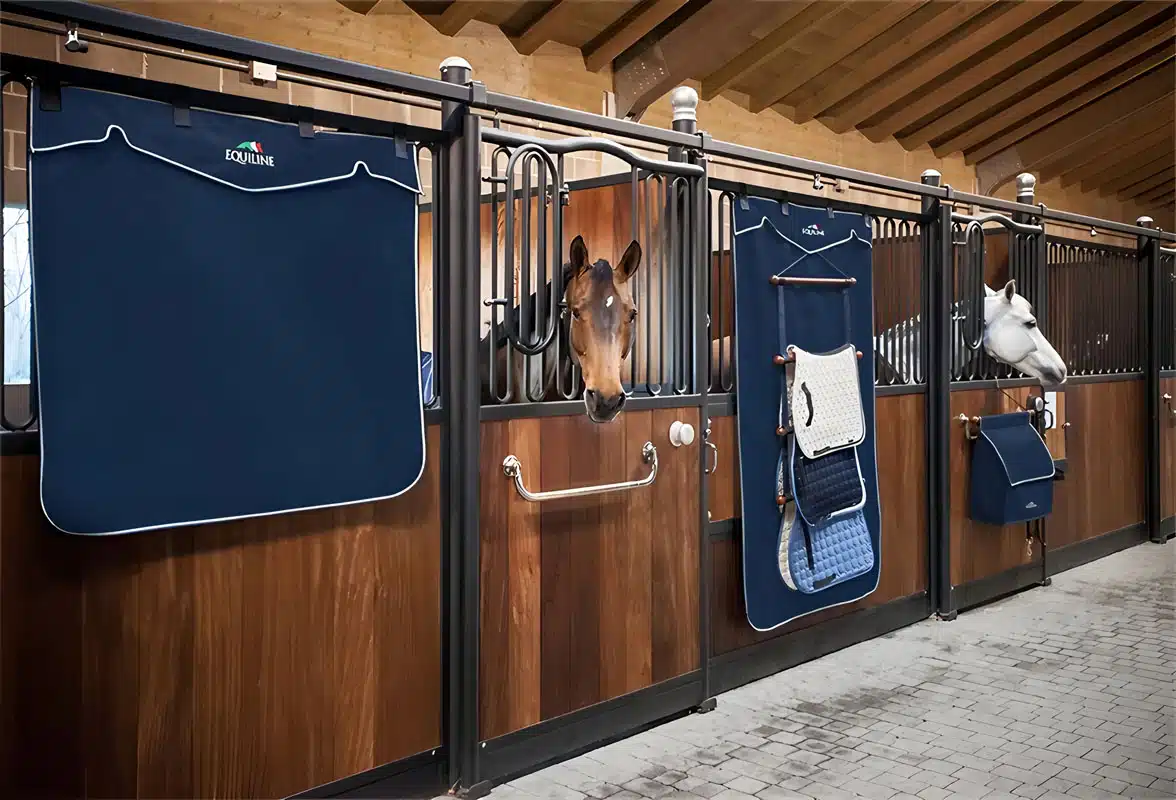
Step 3: How to Verify Assembly Tolerances for Doors?
Verifying door assembly tolerances requires strict adherence to NFPA 80 standards, limiting perimeter clearances to a maximum of 1/8 inch (0.125 inches). Unlike manufacturing tolerances, fire-rated clearance limits are absolute and do not permit over-tolerance additions. Verification involves measuring gaps at the head, jambs, and stiles, ensuring hardware mortise depth falls within ±1/64 inch, and confirming operational stability after cycling.
Distinguishing Manufacturing Tolerances from Clearance Limits
It is vital to understand the difference between allowed manufacturing variations and absolute safety code limits. You can think of manufacturing tolerance as the factory’s margin of error, while the code limit is a strict safety law that cannot be bent.
Manufacturing tolerances operate independently from code-mandated clearance limits. For example, standards like SDI-117 allow for slight variations of ±1/16 inch in steel frames during production. However, critical fire safety rules found in NFPA 252, UL 10B, and UL 10C specify that no over-tolerance is permitted for final clearance dimensions. This means you cannot add the factory’s allowed variance to the maximum gap allowed by NFPA 80.
If the gaps around a door are too wide, the assembly loses its ability to perform like the unit that passed the fire test. Excessive space compromises the protection the door offers against fire and smoke spread.
Technical Standards and Allowable Dimensions
To verify compliance, inspectors must measure specific points against precise numerical limits. These dimensions ensure the door fits tightly enough to function correctly during an emergency.
- ✅ Perimeter Clearance: The maximum gap allowed between the door and frame at the head, jambs, and meeting stiles is 1/8 inch (0.125 inches) per NFPA 80.
- ✅ Wood/HPDL Exception: The 2016 edition of NFPA 80 permits a tolerance of 1/8 inch ±1/16 inch specifically for 20-minute-rated wood and high-pressure decorative laminate doors.
- ✅ Hardware Precision: The depth of the cutouts (mortises) for hinges, strikes, lock fronts, and flushbolts must stay within ±1/64 inch.
- ✅ Opening Cutouts: Tolerances for lights or panels cut into the doors are limited to ±1/16 inch.
Verification Procedure and Operational Testing
The verification process involves practical measurement steps during inspection and throughout the service life of the door. Inspectors verify the actual gap at the head, jambs, and meeting stiles of paired doors against the 1/8 inch limit.
Service life stability is also critical. Operational testing requires that perimeter clearances shall not increase more than 1/16 inch from the initial measurements after the door has undergone 100,000 cycles of opening and closing. Effective quality control combines this gap measurement with a check of hardware cutouts to ensure the total integrity of the assembly.

How DB Stable Ensures Durability in Door Assemblies
While NFPA 80 standards apply specifically to fire doors, the principles of rigorous tolerance and structural stability are central to the design of high-quality horse stables. DB Stable applies similar industrial precision to ensure longevity and safety for equine housing.
- ✅ Robust Framework: DB Stable utilizes hot-dip acero galvanizado coated to over 42 microns for frame tubes and connection pins. This acts as a heavy-duty shield against rust, ensuring structural stability comparable to rigorous industrial standards.
- ✅ Operational Longevity: The swing or sliding doors are designed to withstand heavy daily use. They are supported by 6mm steel plate full-welded connections, which prevent the sagging or gap increases that often occur over time with weaker frames.
- ✅ Material Precision: Infill panels use 10mm thick HDPE boards explicitly chosen because they exhibit no thermal expansion. Unlike wood which may warp and alter door fits, these boards maintain consistent dimensions in changing weather.
Troubleshooting: What If Your Stables Fail the Inspection?
When stable inspections fail, immediate production halts and evidence preservation are critical. Adopting a systematic troubleshooting framework—prioritizing external variables like connectors before assessing structural integrity—ensures accurate root cause analysis. This prevents masking symptoms and aligns with safety hierarchies that prioritize personnel over equipment preservation.
The Systematic Elimination Framework
When an inspection fails, the instinct is often to blame the stable structure immediately. Instead, engineers use a logical sequence to avoid wasting time on the wrong variables. This method prevents random guessing, where changes are made without knowing the true source of the problem.
A proven approach is the 25-25-25-25 Failure Distribution Model. This concept suggests that the root cause is equally likely to come from four distinct areas rather than just the product itself.
- Cabling and Connectors: Loose bolts or misaligned pins often mimic structural failures.
- Non-Cabling Hardware: Accessories like feeders or latches may be the issue, not the main frame.
- Test Facilities: Sometimes the inspection tool itself is calibrated incorrectly.
- Unit Under Test (UUT): The actual stable frame or panel is the final variable to check.
You should test the external factors first. Check the tools and connections before taking apart the stable. Avoid randomly disconnecting parts during the check. Reseating a pushed pin or tightening a bolt during a random check can hide the true cause of the failure, making it impossible to fix systematically.
Root Cause Analysis and Structural Compliance
Finding the origin of a defect is distinct from simply fixing the visible damage. Root Cause Analysis (RCA) is like finding the source of a leak rather than just mopping up the water. It distinguishes between a one-time assembly error and a deep flaw in the materials, such as weak steel.
Inspectors often use criteria similar to commercial vehicle standards to assess these structures. They look for specific failure points.
- Integridad estructural: Verifying that the frame does not bend under standard loads.
- Frame Alignment: Ensuring the square metal tubes meet at precise 90-degree angles.
- Weld Consistency: Checking that welds are smooth and unbroken, without porous holes.
Once the cause is found, you must separate the fix into two types. Corrective Action repairs the specific broken stable. Preventive Action updates the manufacturing process to ensure the error never happens again.
Immediate Response Protocol: Safety and Evidence
If a failure is detected, specific operational steps protect both the team and the data. The first step is a mandatory Production Halt. You must stop the line to prevent more non-compliant units from being built. This buys time for a proper investigation without the pressure of a running assembly line.
Safety always follows a strict hierarchy during this process.
- Personnel Safety: Protect the inspectors and workers first.
- Unit Safety: Protect the stable structure from further damage during testing.
- Equipment Safety: Protect the tools and facility gear last.
Finally, you must preserve the evidence. “Safe” the test configuration by leaving everything exactly as it was when the failure happened. Moving a panel or adjusting a latch can destroy the data needed to understand why the failure occurred. Review maintenance logs to ensure the equipment was up to date, ruling out human error.
How DB Stable Designs to Prevent Inspection Failures
Many inspection failures result from inconsistent materials or manual welding errors. DB Stable mitigates these risks by using prefabricated designs and industrial-grade specifications that inherently pass rigorous checks.
- Corrosion Resistance: Frames feature hot-dip galvanization over 42 microns. Think of this as a permanent zinc shield that exceeds standard requirements, preventing rust failures for over a decade.
- Integridad estructural: Connector pins utilize 40*40mm square metal tubes fully welded with 6mm steel plates. This robust skeleton ensures alignment checks pass consistently without bending.
- Durabilidad del material: Infill panels use 10mm thick HDPE boards. Unlike wood, this synthetic material does not expand with heat, ensuring fit tolerances remain compliant year-round.
- Standardization: The prefabricated design ensures every dimension is identical. This reduces the variance that typically triggers red flags during quality control inspections.
Preguntas frecuentes
How is galvanization thickness measured on ¿establo de caballos?
The industry uses magnetic thickness gauges to measure galvanization without damaging the steel. This tool works by reading the magnetic pull between the gauge and the steel base, which varies depending on the thickness of the non-magnetic zinc layer. It allows inspectors to quickly verify if the coating meets the required depth for long-term rust protection.
Measurements are typically recorded in microns or mils, where one mil equals 25.4 microns. Standard manufacturing often targets a range between 0.001 and 0.004 inches per side. For example, DB Stable ensures a hot-dip galvanization layer exceeding 42 microns to guarantee a lifespan of over ten years, aligning with international standards like ASTM A123.
How can I verify welding quality in horse stalls?
Verifying welding quality involves a careful visual inspection to ensure safety and durability. You should look for concealed welding techniques where bars are punched through the frame and welded internally. This method creates a cleaner look and removes sharp external edges that could injure a horse.
Inspectors also check that all exterior weld seams are ground smooth and free of spatter or burrs. It is critical that every welded joint is fully protected by hot-dip galvanizing or powder coating. If a weld is left exposed, it becomes a weak point where rust will begin to form almost immediately.
Should I request a trial assembly before shipment?
Requesting a trial assembly is a vital quality control step for any custom structural system. This process involves setting up the stable panels at the factory exactly as they would be installed on your property. It serves as a physical dress rehearsal to confirm that all components fit together correctly.
This step verifies precision and ensures there are no gaps or misalignments between panels and connectors. By detecting compatibility issues early at the manufacturing facility, you prevent costly delays and the need for difficult modifications once the materials arrive at the installation site.
What are the standards for checking rust before shipping?
Rust inspection typically follows the ABS HIMP grading scale, which rates surface conditions from zero to six. A grade of Good (0-2) indicates negligible rust, with less than three percent of the area affected and minimal corrosion near welds. This is the expected standard for new products being prepared for export.
Inspectors visually examine critical areas like decks, bulkheads, and overheads for signs of pitting or coating failure. A rating of Poor (5-6) would indicate significant breakdown requiring immediate treatment or replacement. This standardized approach ensures that the condition of the metal is quantifiable and meets buyer expectations before the product leaves the factory.
What are the acceptable dimensional tolerances for stable components?
Manufacturing precision generally follows ISO 286 standards. For typical steel features between 50 and 80 millimeters, the acceptable variance is very small, often around 19 micrometers (0.019 mm). This ensures that heavy steel parts align perfectly during assembly without requiring force.
For plastic components, tolerances depend on the material. Dimensionally stable plastics like Acetal or PEEK can achieve tight tolerances of roughly 0.001 inches. However, softer materials like UHMW polyethylene expand and contract with temperature changes, so they require broader tolerances of about 0.005 inches to prevent warping.
Can I hire a third-party QC for horse barn inspections?
Yes, hiring a third-party Quality Control professional is a common practice to audit facilities against established safety benchmarks. These professionals conduct impartial inspections to verify that the structure meets specific design and safety criteria that a factory internal audit might miss.
A standard audit includes verifying stall dimensions, such as a minimum 12-foot width and 8-foot ceiling height. Safety audits check for hazards like exposed nails, sharp corners, or slippery flooring. They also ensure aisles are at least 12 feet wide to allow for safe emergency access and daily traffic flow.
Reflexiones finales
True quality control requires measuring microns and testing welds rather than relying on a simple visual scan. Validating these technical metrics confirms that the steel frame will withstand aggressive corrosion and heavy impact without compromising structural integrity.
Demanding precision, such as DB Stable’s 42-micron coating, guarantees a facility that remains rust-free for over a decade. Prioritizing verified specs today prevents expensive maintenance issues and secures the long-term safety of your stock.

 Spanish
  English
  French
  Arabic
  German
0 comentarios