


Effective Wall Protection directly impacts your maintenance budget by eliminating the constant cost of replacing chewed stall boards. Exposed lumber edges create a ‘chew zone’ that guarantees costly repairs and devalues your facility, turning a manageable issue into a recurring financial drain.
This analysis benchmarks bare edges against steel caps protected by hot-dip galvanization after fabrication. We test against the BS EN ISO 1461 standard to define how proper material specification permanently solves this critical point of failure in stable design and investment.
The Impact Test: Equine Hooves vs. Chemical Coatings
A horse’s hoof is a natural model for impact absorption. Inspired by this, modern stall materials like HDPE and steel are engineered to dissipate kick force, protecting the horse and stall.
The Hoof as a Benchmark for Impact Resistance
The equine hoof wall is not a simple, hard shell. Nature engineered it with a complex viscoelastic structure designed to absorb and distribute high-velocity forces during movement. This natural performance makes it the ideal benchmark for developing impact-resistant materials for stable walls.
This principle of bio-inspired engineering guides material selection for modern stalls. The goal is to choose materials that can mimic the hoof’s ability to cushion blows safely. It’s about managing the repetitive stress of kicks within a confined space, a very different challenge from absorbing impact over open terrain.
The Kick-Proof Advantage of HDPE and High-Strength Steel
Our UV-stabilized HDPE infill is specifically chosen for its impact-absorbing properties. It flexes under force and returns to its original shape, significantly reducing the shock from kicks that would otherwise transfer to the horse’s joints or the stall’s frame.
For operations in cold climates, the optional Q345B steel frame provides superior low-temperature impact toughness. Standard steel can become brittle in freezing temperatures, but Q345B maintains its ductility, preventing dangerous brittle fractures from powerful kicks in winter.
Wet Paint: The Quick and Dirty Mistake
Applying paint to a wet surface traps moisture, preventing a proper bond. This mistake leads to peeling and bubbling, rendering the protective coating useless and causing long-term damage.
The Problem of Adhesion Failure
Applying a protective coating to a damp or wet surface is a fundamental error that guarantees failure. You can’t just cover u
p a moisture problem and hope for the best. The water gets trapped between the new paint layer and the steel substrate, creating a barrier that prevents the coating from ever forming a secure bond.
- The coating quickly starts to peel, bubble, or flake off as the trapped water tries to escape.
- These failed areas create new entry points for water, accelerating corrosion instead of preventing it.
- The entire waterproofing effort is made ineffective from the start, wasting time and materials.
Factory Solution: Hot-Dip Galvanization
This on-site mistake is completely avoided in a controlled factory environment. We don’t rely on paint applied in variable field conditions. Our process ensures the surface is perfectly prepared for maximum protection.
- Galvanización en caliente después de la fabricación: Each steel component is fully welded and then submerged in a bath of molten zinc. This ensures 100% coverage on a completely dry, chemically cleaned surface.
- Guaranteed Bond: The factory-controlled method creates a perfect molecular bond that conforms to ISO 1461 standards, something impossible to achieve with a brush on a damp wall.
- Proper Repairs: For minor scratches that might occur during installation, every kit includes a Cold Galvanizing Touch-up Spray. This allows for correct, dry-surface repairs to maintain the integrity of the coating.
Engineer Horse Stables That Outlast the Elements
Standard Powder Coating: Why it Eventually Flakes
Standard powder coating flakes when its bond breaks. This is usually caused by poor surface prep—like leftover oils or moisture—and environmental stress from UV light and temperature changes.
The Role of Surface Contamination and Environmental Stress
The most common reason a powder coat fails is improper surface preparation. If the steel isn’t perfectly clean, any leftover oils, dirt, or moisture create a barrier. The coating can’t form a strong molecular bond with the metal, which leads to weak spots that eventually peel away.
Environmental factors finish the job. Constant exposure to UV light breaks down the coating, making it brittle. At the same time, daily temperature changes cause the steel and the coating to expand and contract. This cycle creates tiny stress fractures that grow over time, allowing moisture to get underneath and lift the coating off the surface.
The Dual-Layer System: Powder Coating Over Galvanized Steel
For our Royal Series, we use a dual-protection system to avoid these problems. We apply a durable powder coat over a hot-dip galvanized steel base. This approach is sometimes called a duplex system.
The underlying galvanized zinc layer provides the real, long-term corrosion protection. It acts as the primary defense against rust. This lets the powder coat focus on its main job: providing a tough, aesthetic finish that holds its color. The powder coat isn’t the only thing stopping rust, so the entire system lasts much longer.
DB’s “Dual Finish”: Powder Coat OVER Hot-Dip Galvanization
DB’s “Dual Finish” is a duplex system that applies a durable powder coat over hot-dip galvanization. It combines cathodic rust protection with an aesthetic top layer for maximum longevity.
| Characteristic | Hot-Dip Galvanization Only | Powder Coat Only | DB Dual Finish (Galv + Powder) |
|---|---|---|---|
| Corrosion Protection | Sacrificial (Cathodic) | Barrier Only (Vulnerable if Scratched) | Synergistic (Cathodic + Barrier) |
| Industrial Silver/Grey | Full RAL Color Palette | Full RAL Color Palette | |
| Primary Weakness | No color customization | Rust creep can occur under a scratch | Higher initial investment |
| Governing Standard | BS EN ISO 1461 | Application Specific | BS EN ISO 1461 Foundation |
The Synergistic Effect of a Duplex Coating
This finish combines two different protection mechanisms into one system. First, the steel frame gets a base layer of molten zinc, which provides cathodic rust protection. Then, a polymer powder coat is applied over it, creating a durable and aesthetic barrier. This “duplex” process creates a synergistic effect where each layer protects the other. The zinc base prevents rust from creeping under the powder coat if it gets scratched, and the powder coat protects the zinc from the elements. This combination extends the effective service life to well over 15 years, even in tough environments.
It solves two problems at once. You get the non-negotiable rust prevention of galvanization while also getting the full color palette offered by powder coating.
The Royal Series Standard: Aesthetics Built on an ISO 1461 Foundation
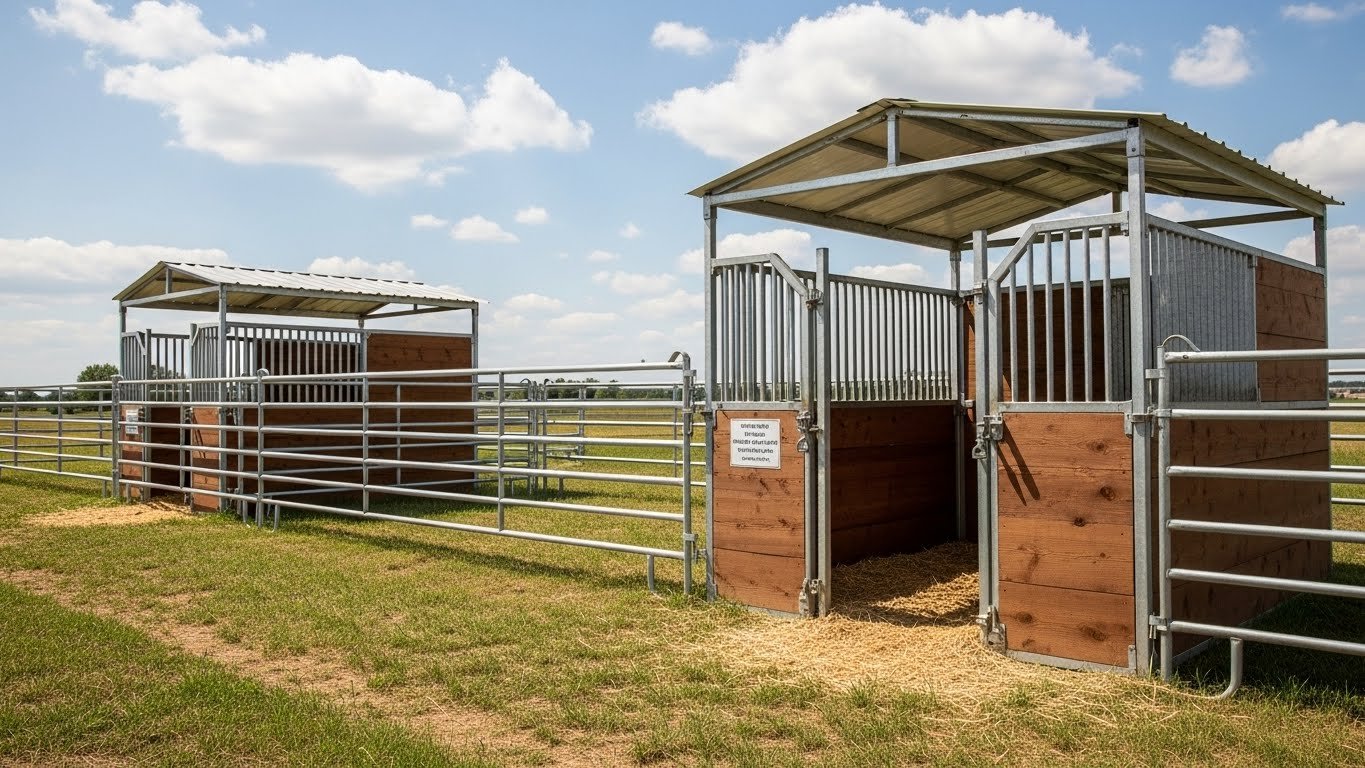
The dual-finish process is the standard specification for the DB Stable Royal Series, which is engineered for private estates and premier stud farms where both performance and appearance are critical. The foundation for this premium finish is a structural steel frame that is hot-dipped galvanized *after* all welding and fabrication is complete. This process fully conforms to the BS EN ISO 1461 standard, ensuring no weld points are left exposed.
Basing the finish on a properly galvanized frame allows for complete color customization. Clients can match facility branding or specific architectural palettes using the RAL system without ever compromising the core principle of long-term structural integrity.
Matching Estate Colors (RAL Codes)
The RAL system provides standardized color codes, letting us apply a precise powder coat finish over a galvanized frame for our Royal Series stables.
What Is the RAL Color System?
The RAL system is a European color matching standard used to define paint and coating colors. Instead of subjective names, it uses a precise numeric code for each shade. This creates a universal language for architects, designers, and manufacturers to communicate exact color requirements.
Using RAL codes eliminates guesswork and ensures visual consistency across different materials and suppliers. When a project specifies an exact RAL color, the finish will be a perfect match, whether it’s on a stable door, a gate, or building trim.
Powder Coating Over Galvanization for Custom Finishes
We use this system for our Royal Series stables. The process starts with a steel frame that is hot-dip galvanized after fabrication, fully conforming to the ISO 1461 standard for robust corrosion protection.
After galvanizing, we apply a durable powder coat finish. Clients can select any color from the RAL Classic chart to match their property’s aesthetic. This dual-protection process delivers a customized finish that retains the underlying rust protection of the galvanized steel, providing both longevity and a precise color match.
Preguntas frecuentes
Can I get my horse stables in different colors?
Yes. While our standard finish is hot-dip galvanization for maximum rust protection, our Royal Series line offers a premium powder coating finish over the galvanized steel. This dual-protection system allows for a variety of colors to match your facility’s aesthetic without compromising on durability.
Is powder-coated steel completely rust-proof?
Powder coating creates a highly effective barrier against rust. It’s exceptionally durable but not entirely rust-proof if the coating is severely damaged down to the base metal. That’s why our Royal Series uses a dual system—powder coating over hot-dip galvanized steel—to ensure the underlying frame remains protected even if the surface is scratched.
Which is better for stables: traditional paint or a powder-coated finish?
For horse stables, powder coating is the superior choice. It’s thermally bonded to the steel, making it significantly more resistant to chipping, scratching, and impact from horses compared to wet paint. This durability means a longer service life and less maintenance for your facility.
What is the benefit of a “dual finish” like powder coat over galvanized steel?
A dual finish provides two layers of protection. The hot-dip galvanizing offers a foundational, sacrificial barrier against rust. The powder coat on top adds a sealed, durable, and aesthetic layer. This combination is the gold standard for equipment in demanding environments, ensuring maximum longevity and corrosion resistance.
Are the finishes and materials used safe for horses?
Yes, horse safety is a primary consideration in our material selection. Our powder coating is non-toxic and free of harmful solvents. Infill materials like our high-density bamboo and HDPE are chosen for their impact-absorbing properties and resistance to chewing, ensuring a safe environment for your animals.
Reflexiones finales
A standard powder coat saves a few dollars upfront but creates a business risk from rust claims and client callbacks. Our ISO 1461 compliant “Dual Finish” system makes the frame functionally immune to rust creep under the coating. This specification protects your long-term profit by eliminating warranty issues before they start.
The technical data proves the value, but seeing the product confirms it. Start with a trial order to test the fitment and durability of our dual-finish system in person. Contact our engineers to specify your project’s RAL colors and discuss your OEM requirements.

 Spanish
  English
  French
  Arabic
  German
0 comentarios