


Sourcing compliance-ready horse stables for the UK market demands strict adherence to British Horse Society welfare guidelines. Traditional hinged doors often fail in narrow heritage barns, creating dangerous obstruction hazards that increase operator liability and injury rates.
We analyze sliding stall fronts engineered with Q345B High Strength Steel to maximize safe passage in tight layouts. This guide examines how the Professional Series hidden track system and Hot-Dip Galvanization ISO 1461 standards prevent mechanical failure in damp, high-traffic commercial yards.
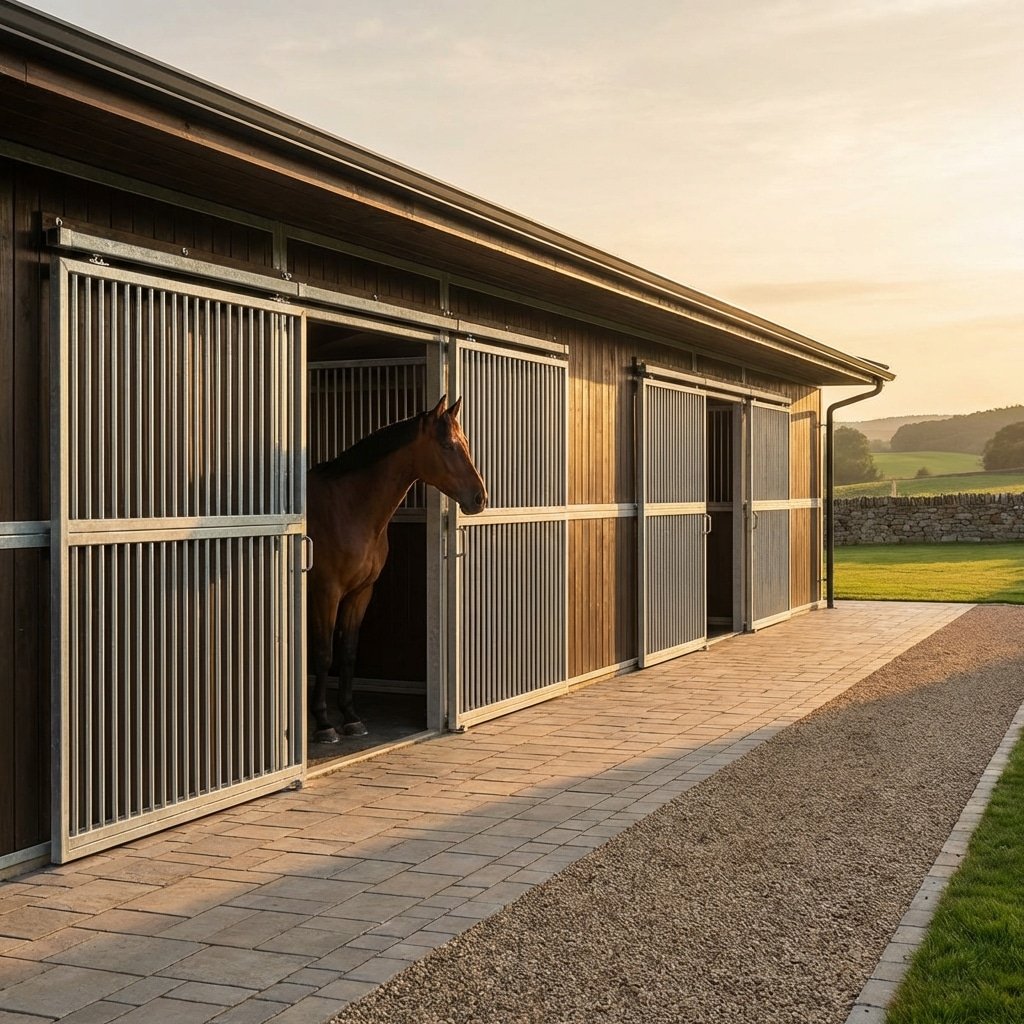
Navigating BHS (British Horse Society) Stabling Guidelines
Compliance requires a minimum 3.65m x 3.65m footprint for standard horses. Our modular Q345B steel system meets these specific spatial and safety engineering protocols.
| Specification Category | BHS Recommendation | DB Stable Engineering |
|---|---|---|
| Standard Space | 3.65m x 3.65m (12ft x 12ft) | Custom Modular Lengths (3.0m – 4.0m) |
| Large Horses (17hh+) | 3.65m x 4.25m (12ft x 14ft) | Extended Panel Fabrication |
| Ventilación | 60-90cm clear air space | Open Top Grill (Stack Effect) |
| Kick Safety | High impact resistance | Q345B High Strength Steel |
Minimum Dimensions: The 3.65m x 3.65m (12ft) Standard
The British Horse Society establishes welfare benchmarks that commercial projects must respect to avoid liability. A cramped stable leads to horses becoming cast or developing respiratory issues due to poor airflow. For a standard riding horse, the non-negotiable floor area is 3.65m x 3.65m (12ft x 12ft). This provides enough room for the animal to turn, lie down, and rise without hitting the walls.
- Standard Horses: BHS mandates a minimum 3.65m x 3.65m footprint for standard welfare compliance.
- Large Horses (17hh+): You need to expand the footprint to 3.65m x 4.25m (12ft x 14ft) to accommodate the larger stride and lying radius.
- Foaling Boxes: Safety for mare and foal dictates a square 4.25m x 4.25m (14ft x 14ft) layout.
- Flexibilidad modular: Unlike rigid competitors, our Flat-Pack System allows custom panel lengths from 3.0m to 4.0m. We adjust the fabrication to hit these precise internal dimensions without on-site cutting.
Safety Compliance: Kick-Proof Q345B Framework & Ventilation
Meeting BHS guidelines goes beyond floor plans. The physical structure must withstand aggressive behavior and prevent common injuries. We engineer our stables to exceed these safety protocols through material selection and “Cast-Proof” design features. While standard steel might hold up visually, it often lacks the impact toughness required for a 600kg animal kicking out in cold weather.
- Kick-Proof Guarantee: We use Q345B High Strength Steel (ASTM Grade 50 equivalent). This alloy offers superior impact resistance compared to standard mild steel, preventing brittle fractures during heavy impacts.
- Stack Effect Ventilation: BHS recommends 60-90cm of clear air space above the horse. Our open top grill designs facilitate vertical airflow, moving ammonia and dust away from the horse’s respiratory zone.
- Cast-Proof Design: We restrict bottom ground clearance to exactly 50mm. This prevents hooves from sliding under the door and becoming trapped if a horse rolls against the front.
- Smooth Finishes: Our Hot-Dip Galvanization After Fabrication process ensures every weld is coated and smooth. There are no sharp burrs or rough edges that could slice a horse’s skin.
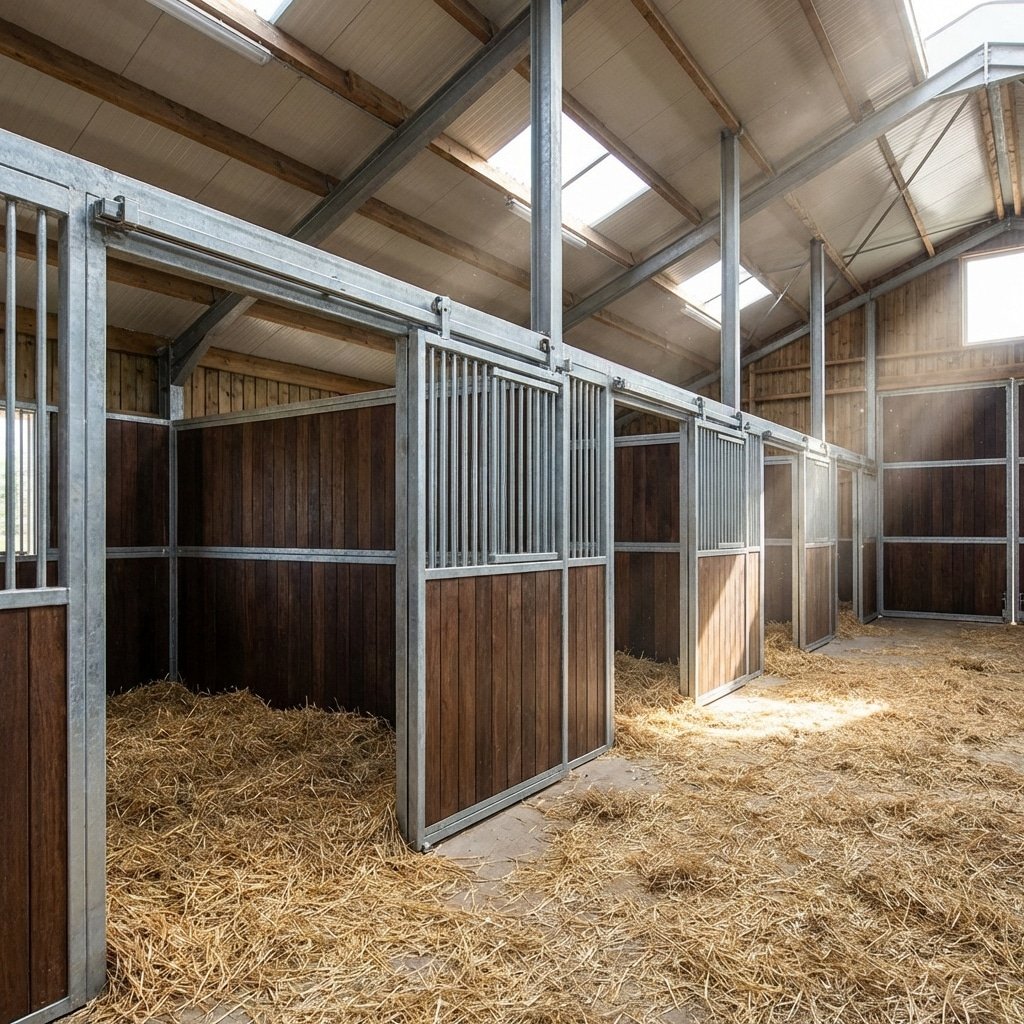
Aisle Space in Classic UK Barns: The Sliding Door Advantage
Sliding doors eliminate obstruction hazards in narrow UK heritage barns. Our hidden track system supports heavy infills while preventing the jamming caused by bedding and dust.
Maximizing Safety in Narrow Heritage Aisles
Traditional UK stone barn conversions often limit aisle width to under 3 meters. In these tight layouts, outward-swinging doors create immediate blockage hazards, forcing handlers to maneuver horses around moving obstacles. Sliding designs solve this by keeping the door flush against the stable front panel at all times.
This flush configuration ensures the central walkway remains fully clear for passing horses, staff, and machinery. Critically, it eliminates the risk of a horse catching a hip or stirrup on an open hinged door latch, a common injury vector in confined spaces where clearance is minimal.
The Professional Series Hidden Track System
Standard tracks often fail in barn environments because dust and debris degrade the rolling mechanism. DB Stable engineers the Professional Series with a specific hidden track solution to address this operational reality.
- Enclosed Overhead Design: The track is fully enclosed to prevent bedding, hay, and dust from entering the mechanism and clogging the rollers.
- Heavy-Duty Load Capacity: We use industrial-grade rollers engineered to support the weight of 40mm solid HDPE or High-Density Bamboo infills without sagging or derailing.
- Corrosion Resistance: The track assembly is constructed from Q345 steel and hot-dip galvanized to BS EN ISO 1461 standards (after fabrication), ensuring it resists rust in damp, ammonia-rich barn environments.
Premium Stables Engineered for Extreme Durability

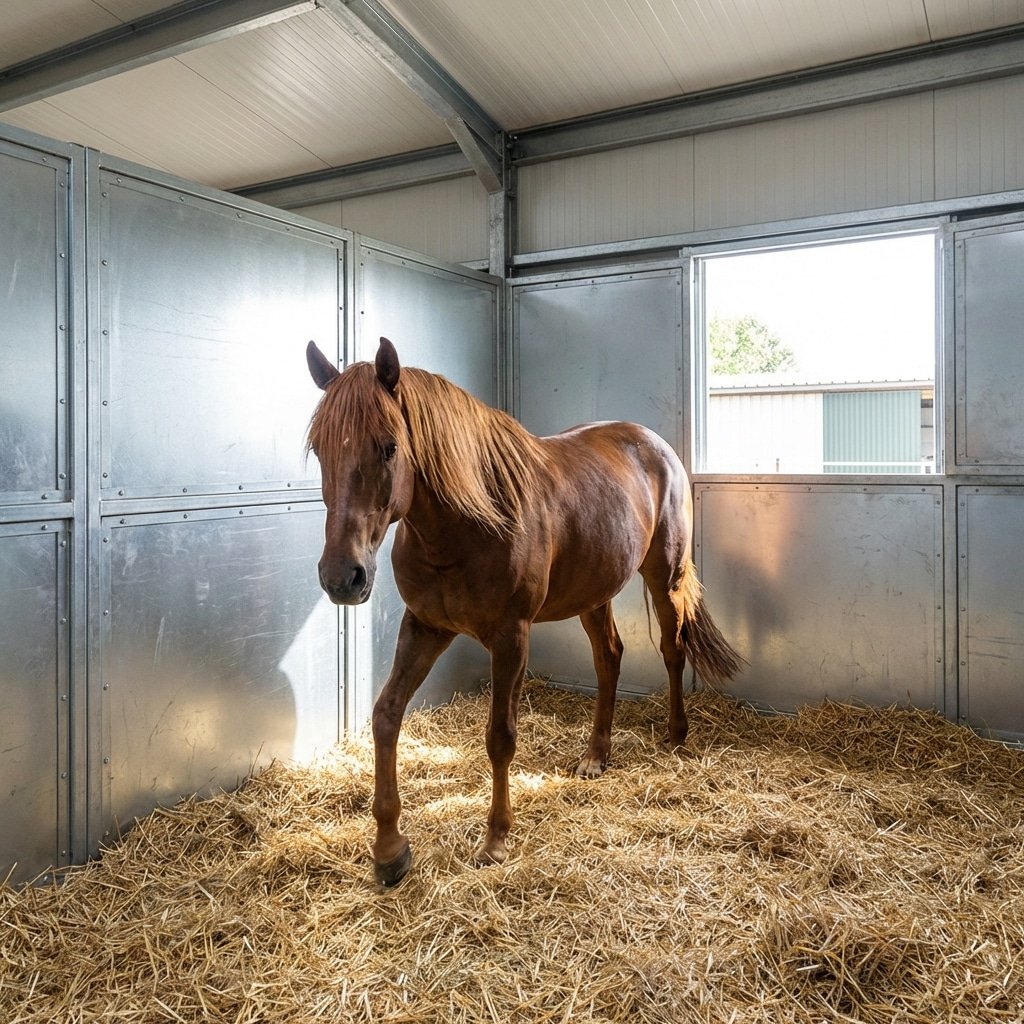
Safe Ventilation: Using Half-Mesh Horse Stall Dividers
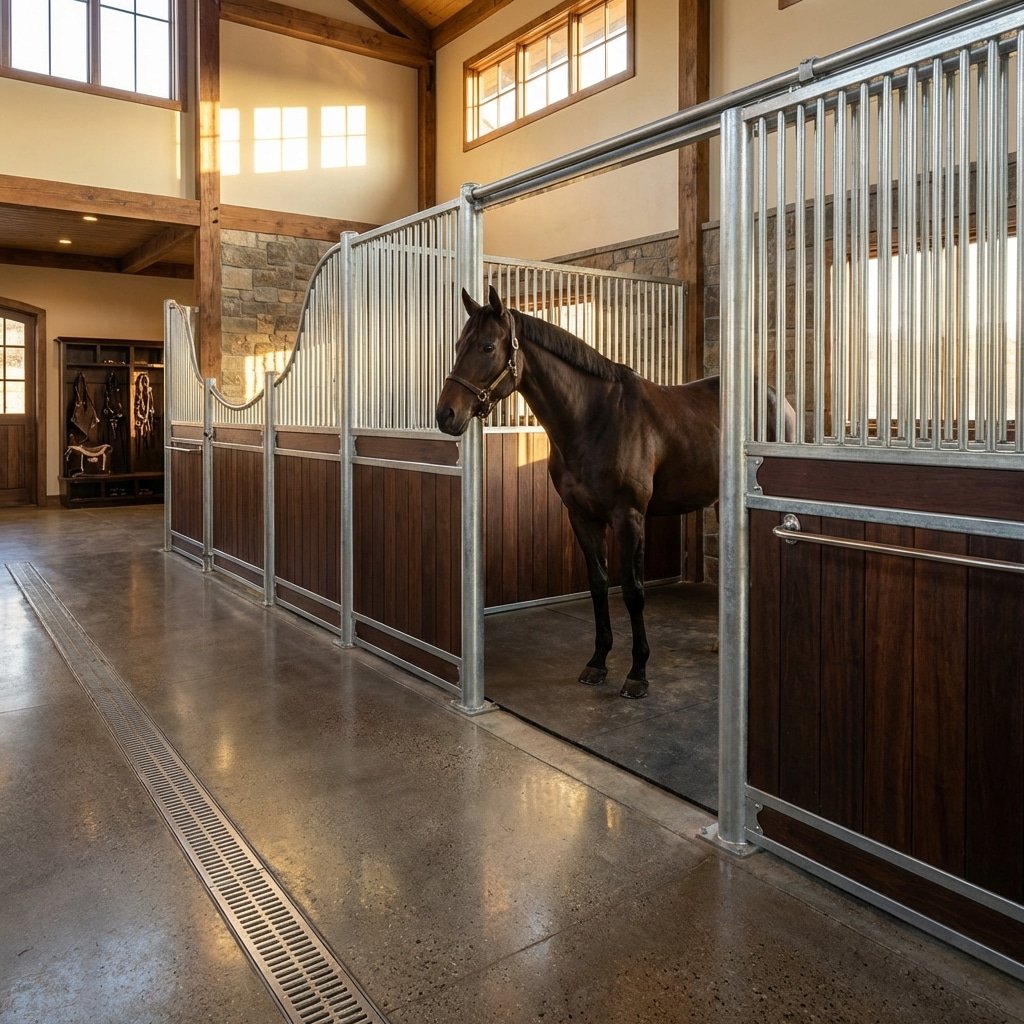
Half-mesh dividers utilize “Stack Effect” aerodynamics to clear ammonia while securing horses behind a solid, kick-proof lower section reinforced with Q345B steel.
Upper Grill Dynamics: Facilitating Stack Effect Ventilation
Stagnant air in a stable is a respiratory hazard. We engineer our upper mesh sections to leverage “Stack Effect Ventilation.” As body heat warms the air inside the stall, it rises naturally. The open upper grill allows this warm, ammonia-heavy air to escape into the aisle and out through roof vents, rather than trapping it at the horse’s nose level. This constant passive airflow reduces respiratory stress significantly compared to solid partitions.
Beyond air quality, these dividers manage equine behavior. We use specific bar spacing (typically 50mm) to allow visual access and socialization. Horses are herd animals; seeing their neighbors reduces anxiety and stall vices. The mesh barrier provides this contact safely, preventing the aggressive biting or fighting that can occur with fully open designs.
Lower Panel Durability: Implementing Kick-Proof HDPE and Bamboo
The lower section of a divider faces the most physical abuse. Standard structural steel often fails here. We specify Q345B Acero de baja aleación y alta resistencia for our frames. This material offers superior impact toughness, particularly in cold climates where standard steel becomes brittle and prone to fracturing under a heavy kick.
- Kick-Proof Infill: We use 28mm-32mm HDPE for a “Zero Maintenance” finish or 28mm-38mm High-Density Bamboo (Janka Hardness > 3000 lbf).
- Safety Height: The solid section stands approximately 1.2m high, preventing horses from getting legs caught or injuring neighbors while lying down.
- Corrosion Defense: All frames undergo Hot-Dip Galvanization after fabrication (ISO 1461), ensuring welds are sealed against urine and moisture.
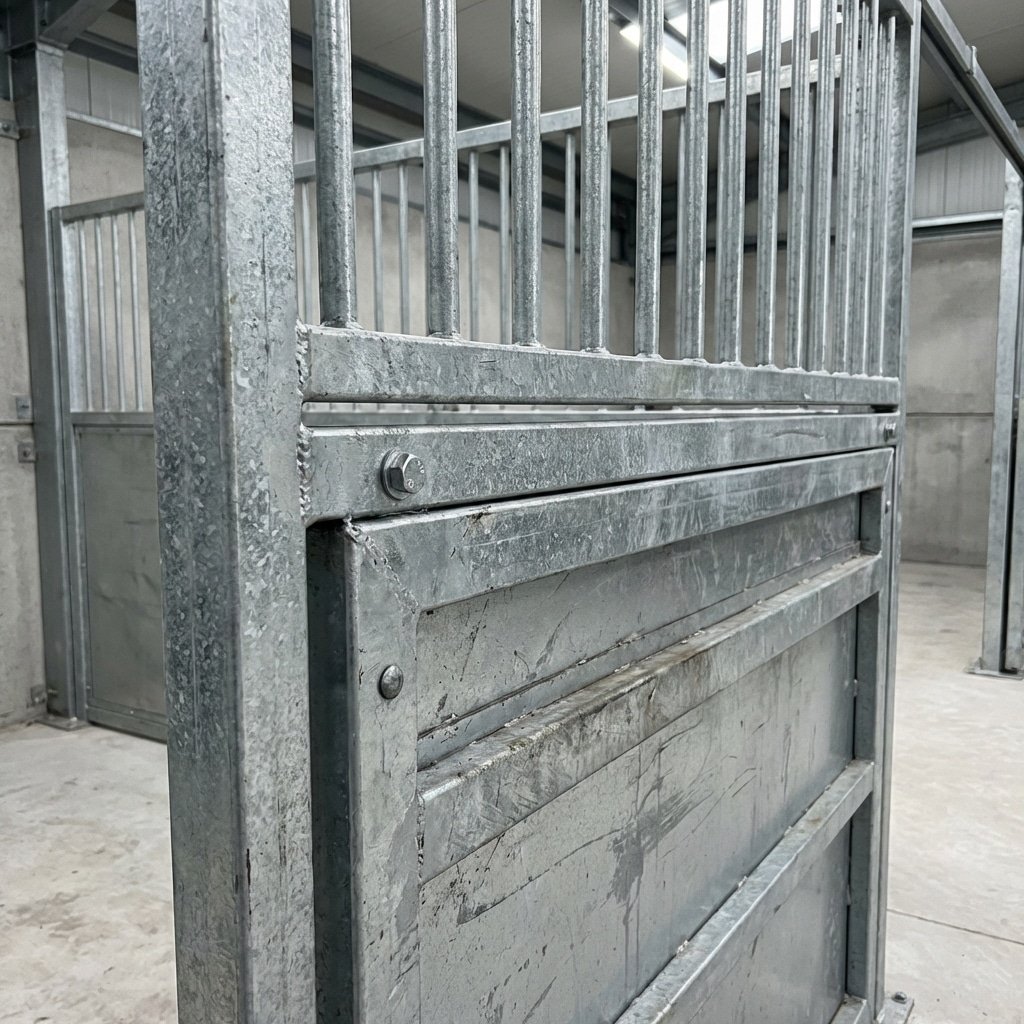
The V-Drop Door: Allowing Safe Socialization
The V-Drop design combats stable vices by allowing safe interaction. DB Stable secures this high-contact zone with smooth, hot-dip galvanized steel to prevent neck injuries and rust.
Reducing Isolation Stress Through Design
Horses are herd animals, and total isolation triggers expensive problems for facility owners. The V-Drop (or Yoke) profile allows the horse to hang its head into the aisle, maintaining visual contact with neighbors and monitoring barn activity. This simple design choice does more than just look good; it actively preserves the value of the stable by modifying behavior.
- Lowers Vices: Drastically reduces boredom-induced damage like weaving, cribbing, or stall walking.
- Herd Simulation: Mimics natural proximity, keeping stress levels manageable for high-performance animals.
- Secure Containment: Provides the mental benefits of an open stall while keeping the animal physically secure behind the door.
Hot-Dip Galvanization for High-Contact Zones
The V-opening is a “High-Contact Zone.” A horse’s neck rests here for hours, creating constant friction and exposure to acidic saliva. This is where budget manufacturing fails. Competitors often use pre-galvanized tubing, where the weld at the ‘V’ burns off the zinc protection and leaves sharp, abrasive burrs that can cut the horse.
At DB Stable, we strictly utilize Hot-Dip Galvanization After Fabrication (BS EN ISO 1461) to engineer this junction safely.
- Safety Sealed Welds: Dipping the door after welding fills the V-junction with zinc, creating a smooth, rounded edge that eliminates injury risks.
- Heavy Zinc Load: We apply a zinc coating averaging >70 microns, providing a sacrificial layer thick enough to withstand daily rubbing and moisture.
- Internal Protection: The dipping process coats the inside of the tube at the cut point, preventing rust from bleeding out onto the horse’s neck.
U-Channel Steel: Eliminating Chew Hazards
By capping exposed board edges with structural steel, U-channels eliminate the leverage points horses need to crib, protecting both the stable structure and equine dental health.
The Impact of Cribbing on Exposed Edges
Cribbing is a behavioral issue where horses grasp solid objects with their incisors, often arching their necks and sucking air. In a stable environment, exposed edges on stall walls become immediate targets for this behavior. If a horse can find a leverage point on a wooden or plastic board, they will exploit it.
This constant gnawing does more than ruin the aesthetics of a barn. It systematically compromises the structural integrity of the infill, weakening the barrier between stalls. There is also a severe veterinary risk: when horses chew on unprotected edges, they often ingest wooden splinters or sharp plastic fragments, leading to digestive impactions or internal injuries.
Encapsulating Infill with Galvanized Profiles
We eliminate this risk by engineering the stall front to be “bite-proof” rather than just resistant. We utilize Q235B Structural Steel to create rigid U-channel profiles that fully encase the top, bottom, and sides of our 28mm-38mm Bamboo or HDPE planks. This design removes the accessible edge entirely, leaving the horse with a smooth, hard surface that offers no purchase for their teeth.
- Structural Rigidity: We strictly use a 14-Gauge (2.0mm) wall thickness. Thinner gauges bend under the immense pressure of a horse’s jaw; our 2.0mm profile maintains its shape.
- Corrosion Resistance: Equine saliva is corrosive. Our channels undergo Hot-Dip Galvanization (ISO 1461) after fabrication, creating a zinc bond that prevents rust even with constant mouth contact.
- Complete Encapsulation: The profiles are sized to fit the infill precisely, ensuring no gaps exist for a horse to pry open.
Preguntas frecuentes
What are the recommended stable dimensions for horses in the UK?
According to British Horse Society (BHS) guidelines, the minimum stable size for a standard horse is 3.65m x 3.65m (12ft x 12ft). For larger horses (17hh+), a size of 3.65m x 4.25m (12ft x 14ft) allows the animal to turn and lie down safely. Foaling boxes require more space, typically 4.25m x 4.25m (14ft x 14ft). We manufacture DB Stable panels to these specific lengths to ensure your facility meets strict welfare compliance standards.
Why are sliding doors often preferred over hinged doors in busy barns?
Sliding doors maximize usable aisle space because they do not swing outward, eliminating the need for clearance radiuses. This improves safety by preventing doors from obstructing walkways or being caught by wind gusts. For professional facilities, sliding systems—specifically those in our Professional Series with hidden tracks—facilitate better traffic flow during high-volume feeding and turnout times.
How does the stable design impact ventilation?
Proper ventilation relies on the ‘Stack Effect,’ where warm air rises and escapes through high openings while fresh air enters lower down. Stables should feature open top grills or half-mesh partitions to promote cross-ventilation. We recommend a minimum of 1 square foot of permanent opening per horse. Our open-grill designs ensure continuous airflow to reduce ammonia buildup and respiratory risks.
What are the benefits of V-Drop or ‘Yoke’ style doors?
V-Drop doors allow horses to hang their heads into the aisle, promoting socialization and reducing boredom-induced stress, such as weaving or cribbing. They offer flexibility, as the V-insert can be closed for safety when needed or opened for daily interaction. This design works best for stabled horses that require mental stimulation without compromising containment.
Do I need anti-chew strips or ‘bite guards’ on my stables?
If you use wood infills, metal bite guards (U-channels) are essential to prevent cribbing and protect the structural integrity of the timber. However, our HDPE infill options offer a ‘Zero Maintenance’ alternative. HDPE is naturally impact-absorbing and resistant to chewing, eliminating the need for additional metal caps while ensuring a kick-proof barrier.
Reflexiones finales
Adhering to BHS welfare standards protects your facility from liability and expensive retrofits down the line. While budget pre-galvanized options rot in damp UK ammonia conditions, our ISO 1461 Hot-Dip Galvanized After Fabrication process ensures decades of structural integrity. Investing in Q345B safety specifications now eliminates the risk of injury claims and premature replacement.
Maximize your project margins by leveraging our Flat-Pack Logistics system, capable of fitting 30-45 sets in a single 40HQ container. We invite you to validate our “Kick-Proof” engineering directly by requesting a technical consultation or specific sample profile. Contact the DB Stable engineering team today to configure a BHS-compliant layout that fits your heritage barn dimensions.


 Spanish
  English
  French
  Arabic
  German
0 comentarios