


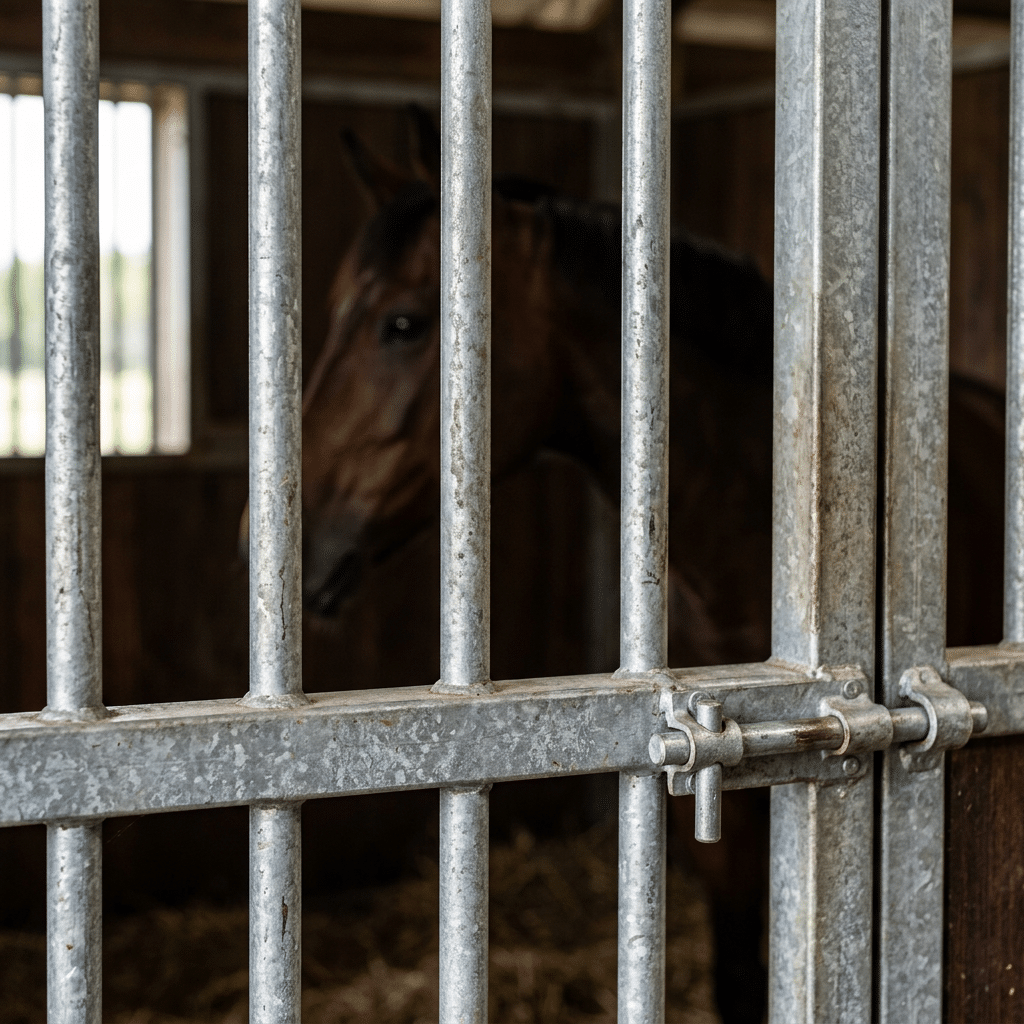
Choosing the right material for horse stall panels directly impacts long-term maintenance budgets. An infill like bamboo or HDPE that is mismatched to your climate’s humidity or UV exposure will warp, rot, or crack. This premature failure leads to expensive replacements and creates safety risks.
This analysis compares bamboo and HDPE performance but also assesses the steel frame holding them. We benchmark panel integrity against the BS EN ISO 1461 galvanizing standard and specify Q235B steel as the minimum for structural longevity. The right infill in a weak frame is a failed investment.
¿Qué debes tener en cuenta a la hora de elegir un fabricante internacional?
Focus on verifiable quality certifications like ISO 9001 and processes like ‘hot-dip galvanization after fabrication’. These factors ensure longevity and protect your investment better than unit price.
Verifiable Quality Standards and Certifications
Any supplier can claim to have “good quality.” Real B2B partners back it up with objective, third-party proof. Don’t waste time on discussions until you see the documentation. These certifications prove a manufacturer has a repeatable, audited system for delivering consistent products, not just a single good sample.
- Quality Management System: Check for a valid ISO 9001 certification. This is the global standard for quality management and shows a commitment to process control.
- Process-Specific Standards: For steel products, ask for proof of compliance with BS EN ISO 1461 for hot-dip galvanizing. This standard dictates non-negotiable metrics like coating thickness and adhesion.
The ‘Hot-Dip After Fabrication’ Process as a Benchmark
This single process detail separates serious manufacturers from corner-cutting operations. It means the entire steel panel is welded together first from raw black steel and *then* dipped into molten zinc. Cheaper competitors weld pre-galvanized tubes, burning off the zinc coating at the joints and leaving them to rust. This isn’t a premium feature; it’s the only acceptable method for long-term structural integrity.
- Complete Rust Protection: The process coats every single cut edge, weld, and crevice in zinc, eliminating the weak points where corrosion always starts.
- Sufficient Coating Thickness: An average zinc coating of over 70 microns is required to provide durable corrosion resistance, especially in coastal or humid climates. Anything less will fail prematurely.
¿Cuáles son las principales marcas de Estados Unidos y Australia?
US and Australian stable brands differ, with some focused on modular systems for distributors and others on custom luxury builds for private estates and clients.
| Fabricante | Country | Market Focus / Specialty |
|---|---|---|
| Lucas Equine Equipment | EE. UU. | Custom-made stall components and barn doors with over 40 years of experience. |
| Equipamiento clásico para caballos | EE. UU. | Custom-engineered stalls focused on safety and durability. |
| Puestos estadounidenses | EE. UU. | Handcrafted, powder-coated steel stalls for major equestrian facilities. |
| J&E Grill Manufacturing | EE. UU. | Prefabricated and custom stall doors in wood and steel. |
| Guerilla Steel | Australia | Prefabricated modular systems with long-life Duragal® alloy coating. |
| DoWell Equine | Australia | European-inspired designs using hot-dip galvanized Australian steel. |
| Equistall Premium | Australia | Supplier for the Sydney 2000 Olympics; modular, easy-assemble kits. |
| Superior Sheds & Stables | Australia | Custom prefabricated designs with flexible material options for various budgets. |
Durable, Compliant Stables for Global Facilities
¿Por qué elegir un fabricante OEM directo, como DB Stable?
A factory-direct OEM bypasses distributor markups for better pricing and gives you direct control over product quality, customization, and expert support without intermediaries.
Direct Sourcing for Better Pricing and Customization
Working directly with a manufacturer like DB Stable removes the layers of distributors and importers. Each intermediary adds their own markup, inflating the final price. By sourcing directly from the factory, you get wholesale pricing, which protects your margins and makes your business more competitive.
This direct line of communication also means you have full control over the final product. You can specify exact dimensions, choose materials like HDPE or high-density bamboo, and select specific features without your requests getting lost in translation. If a technical question or design challenge comes up, you get answers straight from the engineers who build the product, not a sales rep reading a brochure.
Ensuring Quality Through Controlled Manufacturing and Logistics
When you partner with the source factory, you gain transparency into the entire production process. You can verify that critical steps and materials meet your standards, instead of just hoping a third-party supplier did. This control is the only way to guarantee consistent quality across large orders.
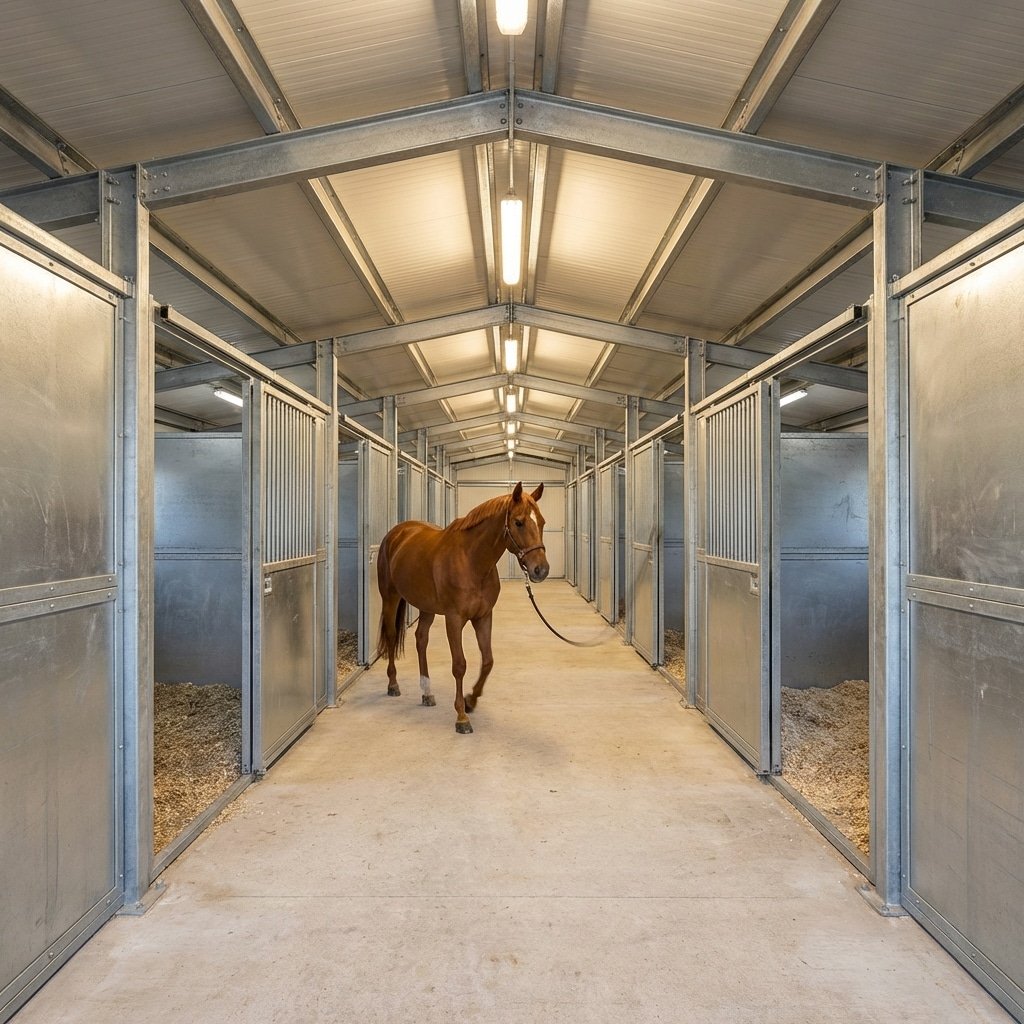
- Verified Rust Protection: We use a “Hot-Dip After Fabrication” process, where the entire welded panel is galvanized. This meets the BS EN ISO 1461 standard with coating thickness over 70 microns, unlike cheaper pre-galvanized tubes that rust at the welds.
- Specified Materials: We use Q235B or Q345B structural steel without making unapproved substitutions. This ensures the stables have the required strength and impact resistance, especially in cold climates.
- Smart Logistics: Our Steel Pallet Flat-Pack system allows us to load 30-45 stable sets into a 40HQ container, compared to just 12-15 sets for fully welded designs. This cuts container freight costs by over 60%, directly protecting your profit.
¿Cumple tu proveedor con las normas ISO 1461 sobre galvanizado?
ISO 1461 dictates minimum zinc thickness and quality for hot-dip galvanized steel. Compliant suppliers provide verifiable data, ensuring long-term rust protection for products like horse stables.
What ISO 1461 Actually Governs
ISO 1461 isn’t just a label. It’s a set of measurable, technical benchmarks that separate durable equipment from products that will rust within a few years. It provides a clear, international framework for what constitutes a properly protected steel product, especially one used in humid or corrosive environments like a stable.
- Espesor mínimo del recubrimiento: The standard specifies the required average zinc thickness based on the steel’s thickness. For example, steel thicker than 6mm must have an average coating of at least 85 microns.
- Coating Quality and Adhesion: It mandates a continuous coating that is fully bonded to the steel substrate. The surface must be relatively smooth and free of defects that could compromise rust protection.
- Process Control: The standard governs the chemical composition of the zinc bath itself, which ensures the galvanizing process is consistent and delivers a high-quality protective layer.

Verifying Compliance: Coating Thickness and Process
Talk is cheap, so verification comes down to two things: the galvanizing method and the resulting coating data. Many low-cost manufacturers weld pre-galvanized tubes, which burns off the zinc at the joints and guarantees rust. We only use ‘Hot-Dip Galvanization After Fabrication,’ which means the entire, fully welded panel is dipped into molten zinc. This is the only way to meet the standard correctly.
- Tubos (de acero de 3-6 mm): Our zinc coating averages over **70 microns (μm)**.
- Piezas estructurales (acero de más de 6 mm): The coating on thicker structural components averages over **85 microns (μm)**, exceeding the standard’s requirements.
¿Cómo se elige a la pareja adecuada?
Focus on verifiable manufacturing quality. A real partner has international certifications like ISO 9001 for management and ISO 1461 for galvanization, proving safety and durability.
Assessing a Supplier’s Core Competencies
First, confirm their business model. A true B2B OEM/ODM factory like DB Stable is structured to support distributors and large-scale projects, not one-off retail sales. This focus ensures they understand your commercial needs for consistency, volume, and predictable lead times.
Next, check their track record in key markets. A factory that ships to Australia, Europe, and North America has proven experience with diverse regional standards. They know how to engineer for Australia’s high UV and salt spray exposure, Europe’s frost resistance requirements, and North America’s demand for versatile designs.
Finally, look at their logistics. A smart partner protects your profit margins with efficient packaging. Our flat-pack system fits 30-45 stable sets in a 40HQ container, while traditional fully-welded stalls only fit 12-15. That difference in freight cost goes directly to your bottom line.
Verifying Quality Through Standards and Certifications
Don’t rely on marketing claims. A credible manufacturer backs up their quality with an ISO 9001 Quality Management System certificate. This isn’t just a piece of paper; it’s proof of a systematic approach to production that delivers consistent, repeatable results.
For rust protection, the process is everything. Ask if they use “Hot-Dip Galvanization After Fabrication.” This means every weld, cut, and drill hole is fully coated in zinc. Cheaper methods use pre-galvanized tubes, leaving welds exposed to rust. A compliant process meets BS EN ISO 1461, ensuring zinc coating thickness is over 70-85 microns.
The steel itself must match the application. While Q235B is a solid standard, a serious partner offers options like Q345B for colder climates. Its superior low-temperature toughness prevents brittle fractures from horse kicks in freezing weather—a critical safety feature that only an experienced engineering team would specify.
Preguntas frecuentes
What is the typical Minimum Order Quantity (MOQ) for factory-direct horse stalls?
MOQs for factory-direct stalls are flexible. Many manufacturers, including us, can handle orders for a single stall panel for small projects or trials. For larger project or distributor quantities, we define orders by container load, like a 20GP or a 40HQ, to maximize shipping efficiency.
How can I verify a manufacturer’s ISO certification?
First, ask the manufacturer for their official certificate. Check the issuing body’s name, the unique certificate number, and the expiration date. You can then validate this information using the International Accreditation Forum’s (IAF) global database, IAF CertSearch, or by contacting the issuing certification body directly.
Can you manufacture custom stall designs under my private brand?
Yes, this is the core of our OEM/ODM business. We engineer and produce stall systems based on your specifications, which are then sold under your brand. The process covers sample approval, production with strict quality control, and final packaging designed to your requirements.
How do you handle potential quality defects?
We manage quality through a multi-stage system. It starts with verifying all raw materials, like Q235B steel grades and galvanization thickness that meets ISO 1461 standards. We perform inspections throughout the fabrication process and a final quality check before products are packed into steel pallets. We can also provide video documentation of these final inspections for your records.
Do you offer exclusive distributor agreements?
Exclusivity is handled on a case-by-case basis and not something we advertise. These agreements depend on factors like order volume, geographic territory, and long-term business commitments. We encourage potential distribution partners to contact us directly to discuss these opportunities.
Who are the major US horse stall manufacturers?
The US market is served mainly by custom builders and fabricators, not large-scale mass producers. Established brands include Lucas Equine Equipment and Classic Equine Equipment. They typically focus on handcrafted, custom-designed stalls made domestically.
Reflexiones finales
The choice between bamboo and HDPE is secondary to the steel’s longevity. While a low unit price seems attractive, it exposes your business to rust claims and warranty replacements. Adhering to the ISO 1461 galvanizing standard is the only way to protect your margin and reputation.
Don’t take a supplier’s word for it—verify their process. Request a sample panel to inspect the weld quality and galvanizing finish yourself. Our team is ready to engineer a custom stall system for your brand that meets these non-negotiable standards.

 Spanish
  English
  French
  Arabic
  German
0 comentarios