


Sourcing Prefab Stall Kits involves a critical choice between high freight costs and unpredictable on-site labor. Fully welded systems can cut container capacity by over 60%, while kits requiring field welding transfer safety liabilities and hidden expenses to the installer. Both scenarios directly erode project profitability and create installation bottlenecks.
This analysis benchmarks bolt-together systems against a core engineering standard: hot-dip galvanization after fabrication. We evaluate kits based on steel thickness, the use of 304 stainless steel hardware, and flat-pack efficiency to identify partners that protect both structural integrity and your logistics margins.
Evaluating the “Bolt-Together” Mechanisms of Top Brands
The long-term value of a stable system hinges on two factors: the assembly design and the quality of its components. A hybrid approach, combining factory-welded panels with on-site bolting, offers the best balance of structural integrity and logistical efficiency. For distributors, the most critical details are the steel thickness (a true 14-gauge minimum), the use of 304 stainless steel hardware to eliminate rust at connection points, and a design that protects freight costs.
Assembly Philosophy: Pre-Welded vs. Fully Bolted Systems
The industry typically offers two main assembly types. Fully welded systems arrive as large, rigid panels. While they require less on-site labor, they are bulky and expensive to ship, often allowing only 12-15 sets in a container. This high freight cost directly cuts into a distributor’s profit margins. On the other end, fully field-bolted kits offer great shipping density but shift all assembly labor to the customer, increasing the risk of installation errors and extending project timelines.
We engineered our system as a hybrid solution. The critical structural components of our stable fronts and partitions are welded in our factory under strict quality controls. These completed panels are then shipped flat-packed, allowing 30-45 sets to fit in a single container. This method combines manufacturing precision with simple on-site assembly, protecting our partners’ logistics margins and ensuring a strong, reliable final structure. It’s a design that delivers both “Profit Protection” and engineered safety.
Material Specs and Fastener Quality
A stable’s resilience comes from the materials used at every point. While many kits use 14 to 16-gauge steel, we mandate a minimum wall thickness of 14-gauge (2.0mm) Q235B structural steel for all frames. For colder climates in Europe or North America, we upgrade to Q345B steel, which offers superior impact toughness to prevent fractures from horse kicks in freezing temperatures. This is our “Kick-Proof Guarantee.”
The hardware that holds everything together is just as important. Many systems provide standard galvanized bolts that can become a weak point for rust over time. Our installation kits include a full set of 304 Stainless Steel anchor bolts, connectors, and screws. This ensures that every connection point resists corrosion from moisture and ammonia, preserving the integrity of the entire structure for years. We avoid plastic components entirely, relying on precisely engineered, all-steel joins for maximum stability and animal safety.
| Característica | DB Stable System (Our Standard) | Common Industry Alternative |
|---|---|---|
| Assembly Design | Hybrid Flat-Pack: Factory-welded panels, bolted on-site. | Fully welded (high shipping cost) or fully bolted (high labor). |
| Shipping Efficiency | 30-45 series per 40HQ container. | 12-15 Sets per 40HQ container. |
| Steel Thickness | Calibre 14 (2,0 mm – 2,5 mm) minimum. | Often unspecified or can be as thin as 16-gauge. |
| Fastener Hardware | Acero inoxidable 304 bolts, nuts, and connectors. | Standard galvanized or zinc-plated hardware. |
| Rust Protection | Hot-Dip Galvanized After Fabrication (ISO 1461). | Pre-galvanized tubing welded together (burns off coating at joints). |
Establos duraderos y conformes para cualquier clima
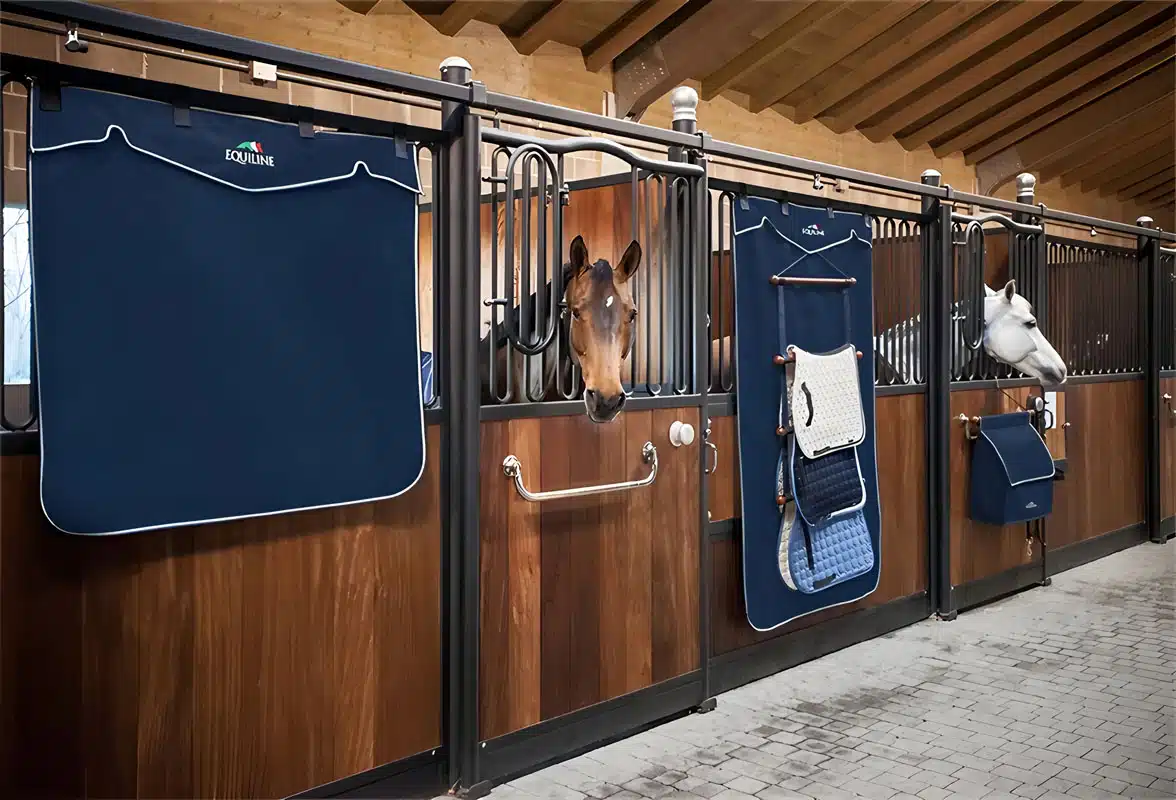
The DIY Barn Builder: Why Welding on Site is Obsolete
On-site welding introduces unpredictable costs, safety risks, and immediate corrosion points that undermine a project’s long-term value. Our factory-engineered, bolt-together stable systems eliminate these variables, providing guaranteed structural integrity and drastically reduced labor expenses for our partners.
The Hidden Risks of Field Welding: Inconsistent Quality and Safety Hazards
Our approach is fundamentally different and built for longevity. We perform all welding on the raw Q235B steel in our controlled factory environment first. Then, we submerge the entire completed panel in molten zinc in a process called Galvanización en caliente después de la fabricación, which conforms to ISO 1461 standards. This method completely seals every weld, corner, and seam with a thick, protective zinc coating—a level of corrosion protection that is impossible to achieve with on-site welding and touch-up paint.
Beyond quality, there are serious liability concerns. Field welding introduces fire hazards from sparks and requires specialized, certified labor to be done safely. Our pre-engineered, bolt-together stable systems completely eliminate these risks. By removing the need for on-site hot work, you create a safer construction environment and protect your project from unforeseen complications and insurance issues.
The True Cost of Labor: How Prefab Systems Reduce Project Timelines
The biggest hidden expense of any on-site fabrication project is labor. What might take days of cutting, fitting, and welding for a skilled crew can be accomplished in just a few hours with a prefabricated system. Our bolt-together stalls are designed for rapid assembly, allowing a small team to erect multiple stables in a single day. This efficiency directly translates to lower labor costs and faster project completion, protecting your profit margins.
While buying raw steel appears cheaper initially, the total project cost is often much higher. You must factor in material waste from cutting errors, the rental or purchase of welding equipment, and the premium rates for skilled welders. Our system provides cost certainty. You receive exactly what you need, engineered for a perfect fit, eliminating material over-runs and unexpected labor expenses.
A complete DB Stable kit transforms a complex construction job into a simple assembly process. Each delivery arrives on a steel pallet with every component included: the stable front, partition panels, pre-cut infill planks (like our zero-maintenance HDPE), and a full hardware kit with durable 304 Stainless Steel bolts and connectors. This turns a multi-day fabrication challenge into a straightforward and predictable installation.
DB’s Modular System: Adult Legos for Barn Builders
Our modular stable systems are engineered as complete, bolt-together kits. They arrive flat-packed with every component, including pre-fabricated panels and 304 stainless steel hardware, eliminating the need for any on-site welding or cutting. This design simplifies installation and protects the integrity of the rust-proof galvanized coating.
What’s in the Box: The Components of a DB Stable Kit
Every stable system we ship arrives on a steel pallet as a comprehensive flat-pack kit. This isn’t just a collection of parts; it’s a complete solution. Inside, you’ll find the pre-fabricated stable front with its door, a matching side or partition panel, and all the pre-cut infill planks (either our zero-maintenance HDPE or high-density bamboo). We also include a complete hardware kit containing every necessary anchor bolt, connector, and screw, all made from corrosion-resistant 304 stainless steel. To ensure a perfect finish, a can of cold galvanizing touch-up spray is supplied for any minor scratches during assembly.
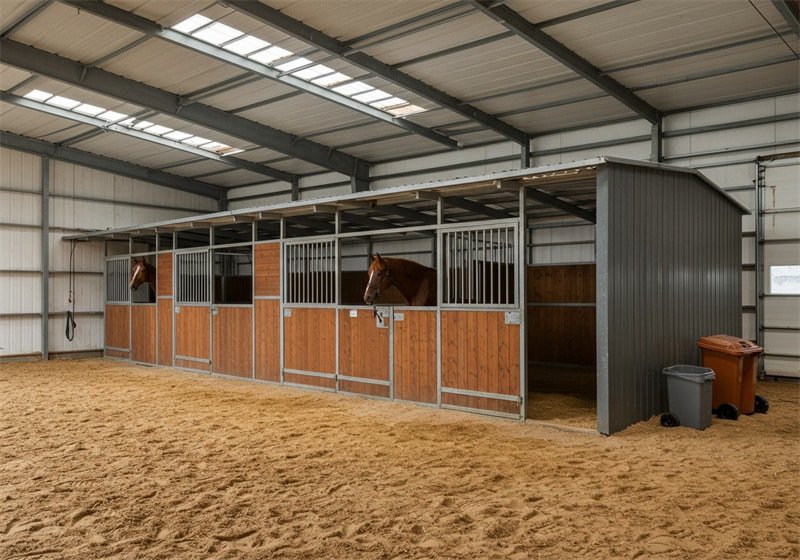
Precision Fit, No On-Site Welding Required
The core of our system’s design is precision. Every frame, post, and connector is engineered to bolt together perfectly on-site. This completely removes the need for skilled labor like welders or fabricators, drastically reducing installation time and complexity. More importantly, a bolt-together assembly protects the structural and anti-corrosion integrity of your investment. Because there’s no cutting or welding, the hot-dip galvanized coating remains intact across every surface, providing complete and lasting rust protection that meets ISO 1461 standards from the moment the last bolt is tightened.
The 304 Stainless Hardware Difference
We exclusively use 304 stainless steel for all hardware in our stable systems, including every bolt, screw, and connector. This choice directly counters the rapid rusting and structural failure common with standard steel in high-moisture barn environments, ensuring long-term safety and durability without constant replacement.
Corrosion Resistance in High-Moisture Barn Environments
Standard steel bolts and connectors degrade quickly when exposed to the constant moisture, ammonia from animal waste, and frequent wash-downs in a working barn. This corrosion compromises connection points and creates safety hazards. To prevent this, every hardware kit we supply features 304 stainless steel components. This material provides exceptional protection against rust and chemical decay, securing the structural integrity of your investment in demanding stable conditions.
Structural Strength and Long-Term Durability
Beyond rust prevention, 304 stainless steel has the high tensile strength needed to keep connections tight. This ensures that every joint can handle the significant operational stress from large animals leaning or kicking, without bolts shearing or deform
ing over time. This focus on premium hardware is a critical part of our kick-proof design philosophy. It guarantees that the entire stable system—from the steel frame to the smallest connector—works together to maintain its integrity for years, reducing maintenance needs and protecting your animals.
Logistics: How Flat-Pack Kits Save 60% on Freight
Our flat-pack stable systems are engineered to protect our distributors’ profit margins by dramatically lowering shipping costs. By deconstructing stalls into stackable components, we load 30-45 sets into a single 40HQ container, more than doubling the capacity of traditional welded stalls and cutting per-unit freight costs by over 60%.
The Math: Why Flat-Pack Doubles Container Capacity
Shipping fully welded horse stalls is inefficient and expensive. Their bulky, rigid shapes create significant empty, unusable space inside a container. This poor volume optimization means a standard 40HQ container can typically only hold 12 to 15 complete stable sets. We solved this problem by designing a smart flat-pack system. Each stable front and partition is broken down into its core components and packed neatly onto a steel pallet, eliminating wasted volume and ensuring every inch of container space is utilized effectively.
Protecting Profit Margins with Lower Per-Unit Freight
The ability to maximize container space is a direct form of profit protection for our B2B partners. By loading between 30 and 45 stable sets into one 40HQ container, we achieve a density that is impossible with welded stalls. This increase in capacity directly translates to a freight saving of over 60% per unit. This significant reduction lowers the final landed cost for each stall, giving our distributors a critical competitive advantage and safeguarding their profit margins in a logistics-heavy market.
Reflexiones finales
While generic pre-galvanized stalls offer a lower initial price, they expose your business to rust claims and safety liabilities at every failed weld. Our standard—Hot-Dip Galvanization After Fabrication and 304 Stainless Steel hardware—is non-negotiable. It protects your landed investment and the long-term customer trust your brand depends on.
The smartest business decision is based on physical evaluation, not just technical data. We recommend a small trial order to verify our engineering, fitment, and finish firsthand. Contact our team to configure your trial shipment or discuss OEM requirements for your market.
Preguntas frecuentes
What is the best indoor horse stall kit?
The best kit matches your specific business needs. Our Professional Series, with high-density bamboo and a heavy-duty Q345B steel frame, is ideal for busy training centers that demand maximum durability. For low-maintenance facilities like quarantine or rental barns, the Economy Series with our UV-stabilized HDPE infill is a practical, long-lasting choice. For premier estates, our Royal Series offers customized, dual-protection powder-coated finishes over the galvanized frame.
Are bolt-together horse stalls strong?
Yes, our modular systems are exceptionally strong. We build every frame with heavy-gauge Q235B or Q345B structural steel. The key to our strength is the “Hot-Dip After Fabrication” process—we fully weld the panels first, then submerge the entire structure in molten zinc. This seals every connection against rust and creates an incredibly robust, kick-proof panel without the need for on-site welding.
How long does it take to assemble a prefab stall?
Our modular kits are designed for labor efficiency. With two people using basic hand tools, a single stall can usually be assembled in just a few hours. All components are pre-drilled and engineered for a seamless fit, which greatly reduces installation time and on-site labor costs for your project compared to traditional construction.
What is the best hardware for stable kits?
For maximum longevity and safety, we supply a complete 304 Stainless Steel hardware kit with every stable system. This is our standard, not an upgrade. The kit includes every anchor bolt, connector, and screw required for assembly. Using stainless steel ensures all connections remain strong and secure over time, even in demanding and corrosive barn environments.
Do prefab stables include the wood?
Our kits do not use standard wood planks because we provide superior infill options. Every kit includes your choice of either high-density strand-woven bamboo or our “Zero Maintenance” HDPE. Both materials are pre-cut to size and offer better durability, moisture resistance, and impact absorption than traditional lumber, creating a safer and longer-lasting environment for the horse.

 Spanish
  English
  French
  Arabic
  German
0 comentarios