


Reactive Chew Guard Upgrades are a financial black hole for facility managers dealing with wood-chewing horses. Screwing metal strips over compromised timber creates a vapor barrier that accelerates internal rot while offering determined cribbers a leverage point to pry fasteners loose.
This analysis compares temporary retrofits against structural U-channel systems that fully encapsulate board edges. We examine how switching to 14-Gauge Q345B steel frames and impervious HDPE infill eliminates the maintenance loop by removing the organic materials and leverage points that cause failure.

The Frustration of Screwing Tin Over Rotted Wood
Covering rotted timber with metal sheets creates a vapor barrier that accelerates decay and creates sharp hazards. The only permanent fix is replacing organic wood with impervious HDPE infill.
The Acceleration of Rot Behind Sealed Metal
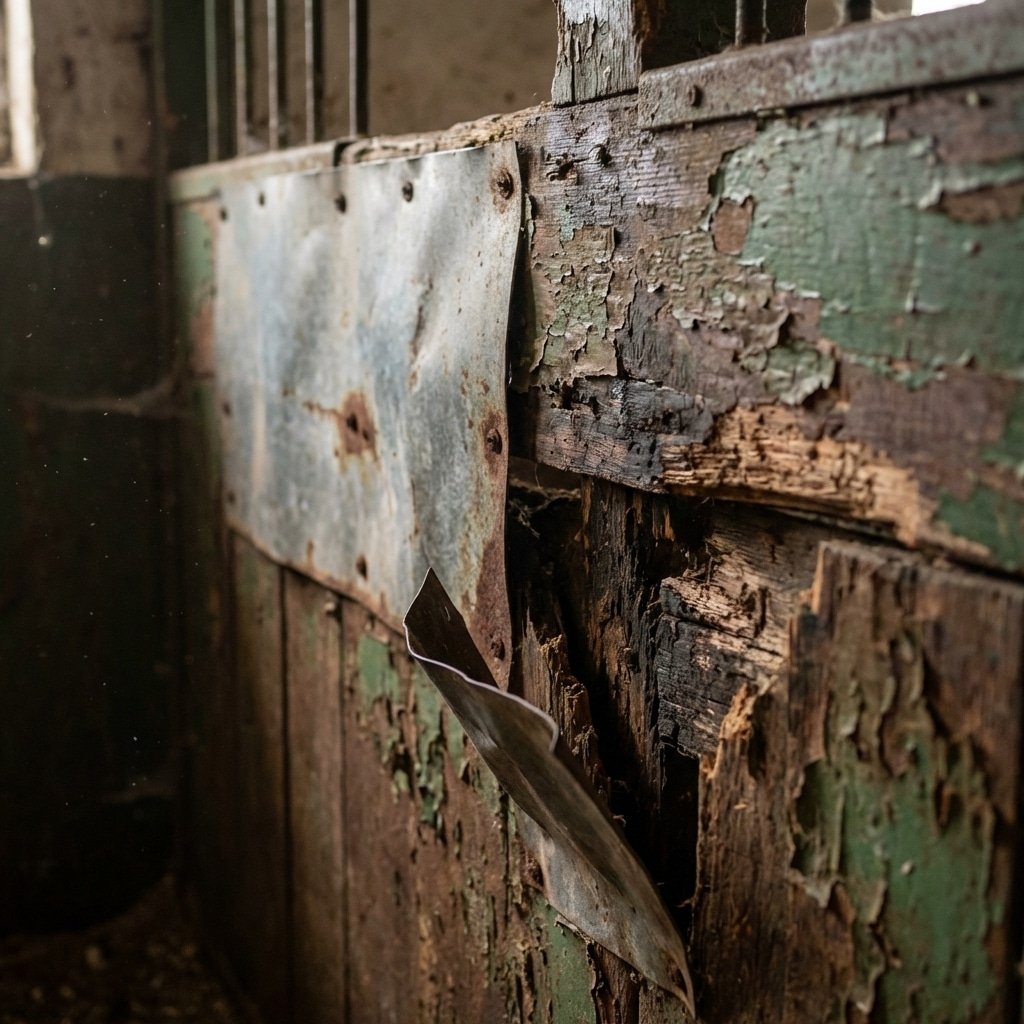
Many facility managers attempt to extend the life of a stable by screwing thin metal sheets or “tin” over chewed and rotting timber. While this looks like a quick fix, it usually destroys the structure faster than leaving it exposed. Screwing metal over compromised wood creates a tight vapor barrier. This seal locks in humidity and ammonia from urine, preventing the wood from breathing or drying out.
Trapped moisture creates an anaerobic environment. This condition accelerates fungal growth and rot, turning the structural timber into mush behind the metal facade. The structural integrity fails without any visual warning until the wall collapses.
Safety is the immediate concern. When a horse kicks a rotted wall covered in thin metal, the screws pull out of the soft wood and the metal shears. This leaves razor-sharp, jagged edges protruding into the stall, capable of slicing tendons or causing severe lacerations. A “protective” measure often becomes a liability.
Eliminating Organic Decay with 28mm HDPE Infill
The only way to stop rot is to remove the organic material that feeds it. DB Stable systems replace vulnerable softwoods with 28mm to 32mm UV-stabilized HDPE (High-Density Polyethylene) infill. This material is inorganic and impervious to moisture, meaning it physically cannot rot, swell, or harbor bacteria regardless of humidity levels.
- Impact Absorption: Unlike wood which splinters or tin which shears, HDPE absorbs the energy of a kick, supporting our “Kick-Proof Guarantee.”
- Zero Maintenance: The material requires no painting, staining, or sealing, eliminating the recurring labor costs associated with timber.
- No Chew Guards Needed: The dense, smooth surface of the plastic offers no purchase for cribbing, removing the need for add-on metal caps or guards.
Why Horses Eventually Pry Off Simple Chew Guards
Executive Summary: Surface-mounted guards fail when leverage loosens screws or rot softens the wood. Integrated steel frames eliminate this failure point entirely.
The Vulnerability of Surface-Mounted Fasteners
Horses apply massive torque when they crib or chew. Standard add-on guards fail because they rely on small surface fasteners—usually screws or nails—driven into wood. Over time, the repetitive force of the horse biting down works these fasteners loose. It is basic mechanics: the metal strip acts as a lever, and the screw is the fulcrum. Once the fastener backs out even slightly, the horse has a gap to exploit.
Material fatigue and environmental factors accelerate this failure:
- Leverage mechanics: A determined horse hooks their teeth under a loose edge and pries the metal strip away from the wood, often leaving dangerous, sharp exposed nails.
- Hidden rot: Moisture gets trapped behind add-on metal strips. This causes the underlying wood to rot unseen, turning the anchor point soft. When the screw pulls out, there is no solid wood left to re-fasten it to.
- Material deformation: Thin gauge aluminum or tin guards (often used to save cost) deform under bite pressure. This creates a bent “lip” that gives the horse a perfect grip to rip the entire guard off.
Structural Integrity of Hot-Dip Galvanized Steel Profiles
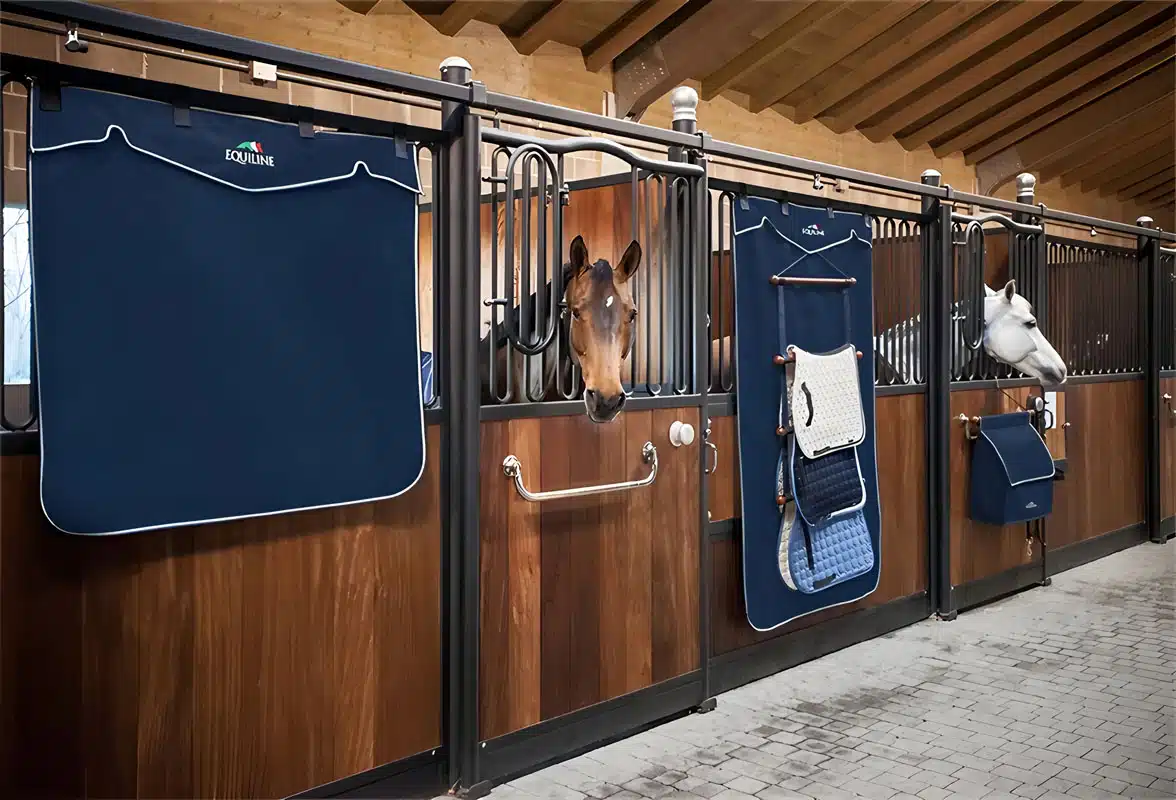
The DB Stable approach removes the need for add-on guards by making the frame itself the bite surface. We do not cover wood with thin metal; we encase the stall front in structural steel. The primary structure uses 50mm x 50mm RHS (Square Hollow Section) or 114mm Round Posts. These profiles are integral to the stall’s stability, not cosmetic covers.
We strictly use Q235B Structural Steel (standard) or Q345B Low Alloy High Strength Steel for cold climates. With a minimum wall thickness of 2.0mm to 2.5mm, these profiles withstand direct bite pressure without denting. A horse cannot pry off a welded structural post.
Rust protection is the final layer of defense. Unlike competitors who weld pre-galvanized tubes (leaving the weld seams vulnerable), we use Hot-Dip Galvanization After Fabrication. We weld the black steel frame first, then dip the entire unit into molten zinc. This bonds the protective coating to the steel at a molecular level, ensuring no rust can form at the joints or edges to weaken the structure over time.
Engineered For Durability: 20-Year Rust-Free Stables

The Structural Defense of U-Channel Steel Frames
U-channel steel frames fully encapsulate board edges to eliminate cribbing leverage points. This structural geometry distributes kick impact forces to prevent the warping common in retrofitted guards.
| Feature | Retrofit / Flat-Bar Guard | DB Stable U-Channel |
|---|---|---|
| Edge Protection | Partial coverage; exposed seams | Full encapsulation |
| Impact Resistance | Prone to warping or detachment | Structural load distribution |
| Cribbing Leverage | High (edges provide purchase) | Zero (flush surface) |
| Steel Standard | Often Thin Angle Iron | 14-Gauge Q345B (>2.0mm) |
Geometry as a Defense Mechanism
Horses are opportunistic cribbers. They require a ledge or a lip to set their teeth and apply leverage. Flat-bar retrofits fail because they sit on top of the wood, creating a new seam that a determined horse can eventually peel back. The U-channel design eliminates this vulnerability by physically housing the board edge within the steel profile. The wood does not sit behind the metal; it sits inside it.
This shape also dictates how the frame handles kinetic energy. When a horse kicks a flat strip, the force concentrates on the fasteners, often shearing the screws or bending the metal. A U-channel utilizes its flanges (legs) to resist this bending moment. The impact force transfers through the rigid steel channel rather than the weaker wood infill.
- Leverage Elimination: Encapsulation removes the “lip” required for cribbing purchase.
- Force Distribution: The U-profile disperses lateral kick impact evenly across the frame.
- Warp Resistance: Flanges provide structural depth that prevents the bowing seen in flat steel.
- Infill Security: Boards are locked into the channel, preventing them from popping out under pressure.
The 14-Gauge Q345B Material Standard
Geometry fails if the material yields. Many competitors reduce costs by using standard Q235 steel at 1.5mm or 1.6mm thickness. We reject this practice for high-impact zones. Our frames utilize Q345B Low Alloy High Strength Steel, the same grade used in cold-climate structural engineering. This material offers superior toughness and resistance to brittle fracture, ensuring the channel absorbs heavy kicks without splitting.
We enforce a strict minimum wall thickness of 14-gauge (2.0mm to 2.5mm) for all structural channels. This density is non-negotiable for maintaining the “Kick-Proof Guarantee.” To protect this steel core from the corrosive mix of saliva and stable moisture, every frame undergoes hot-dip galvanization after fabrication, bonding a zinc coating of over 70 microns to the steel.
- Material: Q345B Low Alloy High Strength Steel (Superior impact toughness).
- Thickness: Minimum 14-Gauge (2.0mm – 2.5mm) to prevent denting.
- Protection: Hot-Dip Galvanization (>70 microns) to resist saliva-induced rust.
- Assurance: Kick-Proof Guarantee backed by material density.

Retrofitting Old Barns with Complete DB Stall Panels
Retrofitting involves installing vertical support posts within the existing footprint to accommodate new steel panels. DB Stable’s modular design and universal hardware ensure secure attachment to varying structures.
Integrating Steel Panels into Existing Timber Structures
Old barns rarely have square corners or perfectly level floors. You cannot simply bolt precision-engineered steel to warping, century-old timber and expect a secure fit. Successful retrofitting requires creating a “frame within a frame” to bridge the gap between modern safety standards and vintage construction.
- Nailing Girts & Support Posts: The installation process typically involves setting new vertical 2x4s or 4x4s between existing barn poles. These act as nailing girts, creating a square, plumb interface that accepts the steel panel without altering the barn’s primary supports.
- Foundation Alignment: String lines are non-negotiable here. You must establish square spacing within the uneven footprint. This often requires pouring new concrete footings to support the weight of the steel system, rather than relying on the compacted dirt floor typical of older structures.
- Structural Reinforcement: Unlike simple chew guards, full panel retrofits transfer the containment load from the rotting wood structure to the new self-supporting Q235B (or Q345B for cold climates) steel frame. This extends the barn’s life by relieving stress on the original timber.
The Universal Installation Kit and 304 Stainless Hardware
Sourcing compatible hardware locally for a retrofit is a logistical nightmare. We eliminate this variable by shipping a dedicated installation kit with every order, specifically curated to handle the irregularities of older agricultural buildings.
- Complete Hardware Package: The kit includes anchor bolts, connectors, and screws manufactured strictly from **304 Stainless Steel**. Older barns often have high humidity and poor ventilation; standard zinc-plated hardware will corrode quickly in this environment.
- Adaptable Connections: We use a modular connector pin and cleek design. This allows panels to be secured to various wall materials (block, wood, stone) or configured as freestanding units within an open span if the existing walls are too weak to hold anchors.
- Finish Maintenance: Retrofitting is tight work, and minor scratches during installation are inevitable. The kit includes **Cold Galvanizing Touch-up Spray**, allowing installers to immediately seal any abrasions. This maintains the integrity of the hot-dip galvanized coating (ISO 1461 standard) and prevents rust from taking hold at connection points.
Frequently Asked Questions
Why is U-Channel steel better than Angle Iron for horse stalls?
U-Channel steel is the superior choice because it fully encapsulates the edge of the infill board, creating a contained system that adds structural rigidity. Angle iron leaves one side of the board exposed, often creating sharp contact points and relying entirely on screws to hold the lumber in place. If a horse kicks an angle iron setup, the fasteners can shear, causing boards to pop out. Our U-Channel design aligns with “Kick-Proof” safety standards by physically trapping the board, ensuring it remains secure even under heavy impact.
What is the most effective way to stop horses from chewing stall wood?
The only permanent solution is installing materials that are physically impossible to chew. We recommend upgrading to High-Density Bamboo, which features a Janka Hardness rating over 3000 lbf—making it three times harder than Oak and impervious to teeth. Alternatively, UV-stabilized HDPE planks provide a “Zero Maintenance” solution as they are completely inedible. For existing timber structures where replacement isn’t an option, retrofitting heavy-gauge, hot-dip galvanized steel caps (chew guards) over exposed ledges is the standard defense.
How are metal chew guards installed on existing timber frames?
Installation requires cleaning the wood surface first to ensure a flush fit. Secure the metal guard using countersunk wood screws to prevent screw heads from protruding and injuring the horse. We strongly advise against using thin flashing or tin; professional installs use heavy-gauge galvanized steel that resists bending if the horse leans against it. Crucially, you must file down any sharp metal burrs immediately after cutting to prevent lacerations to the horse’s lips or tongue.
Final Thoughts
Surface-mounted chew guards are a recurring expense that masks structural rot, whereas our U-Channel system offers a permanent cure. By upgrading to 14-gauge Q345B steel and impervious HDPE infill, you eliminate maintenance labor and safety liabilities entirely. Real asset protection requires removing the vulnerability, not just covering it up.
Do not wait for a structural failure to force your hand; secure your facility with our ISO 1461 galvanized durability today. We recommend requesting a digital mock-up or a hardware sample kit to verify how our modular panels integrate with your existing footprint. Contact our engineering team now to discuss your retrofit dimensions and lock in flat-pack shipping rates.



 English
  Spanish
  French
  Arabic
  German
0 Comments