


Adding Light to an indoor facility is a strategic operational investment, but it creates immediate liability if executed with standard glazing. While natural illumination reduces equine cortisol and stable vices, installing unshielded annealed glass introduces a lethal guillotine hazard that can bankrupt a boarding business through catastrophic injury claims.
This analysis benchmarks the safety mechanisms of 6mm tempered glass against the structural risks of standard plate options. We examine the integration of 14-gauge Q235B steel grills and hot-dip galvanized frames to ensure your facility meets strict safety standards without compromising ventilation or light transmission.
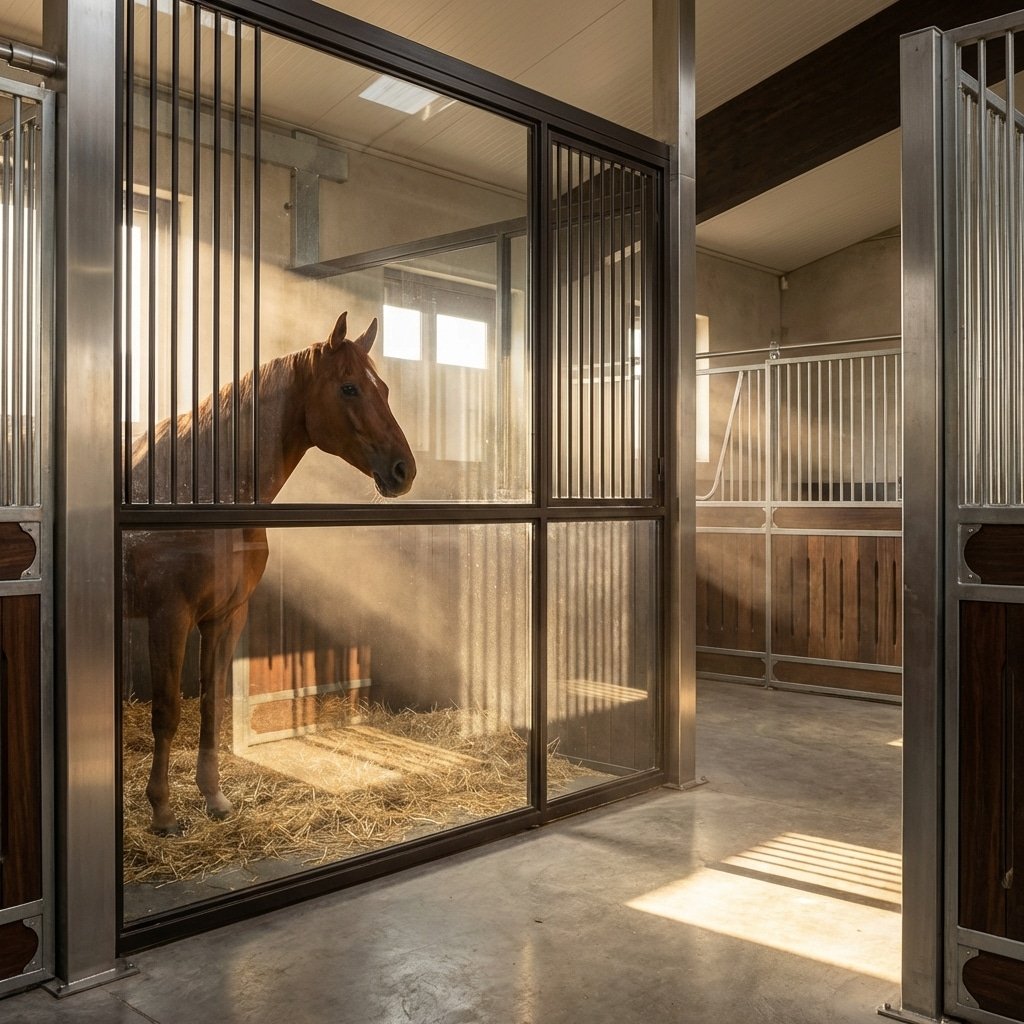
The Psychological Need for Natural Light in Barns
Natural light is critical for regulating circadian rhythms and reducing cortisol in stabled horses. Bright environments promote serotonin production, while dark, enclosed spaces foster anxiety and safety risks for handlers.
Regulating Circadian Rhythms and Reducing Stress
Biological function in horses relies heavily on light exposure, not just feed and exercise. Natural daylight stimulates serotonin production, which directly stabilizes mood and acts as a buffer against depression. When horses are confined in chronically dim environments, their ability to regulate emotional stress degrades, often triggering anxiety-like behaviors or stable vices such as weaving and cribbing.
The impact extends to the people working in the aisle. Bright morning light significantly enhances cognitive performance and alertness. In a high-risk environment involving 500kg animals in confined spaces, handler focus is a non-negotiable safety factor. Dim lighting hides visual cues of equine aggression or fear, increasing the likelihood of workplace accidents.
Optimizing Light Distribution with Open Grill Profiles
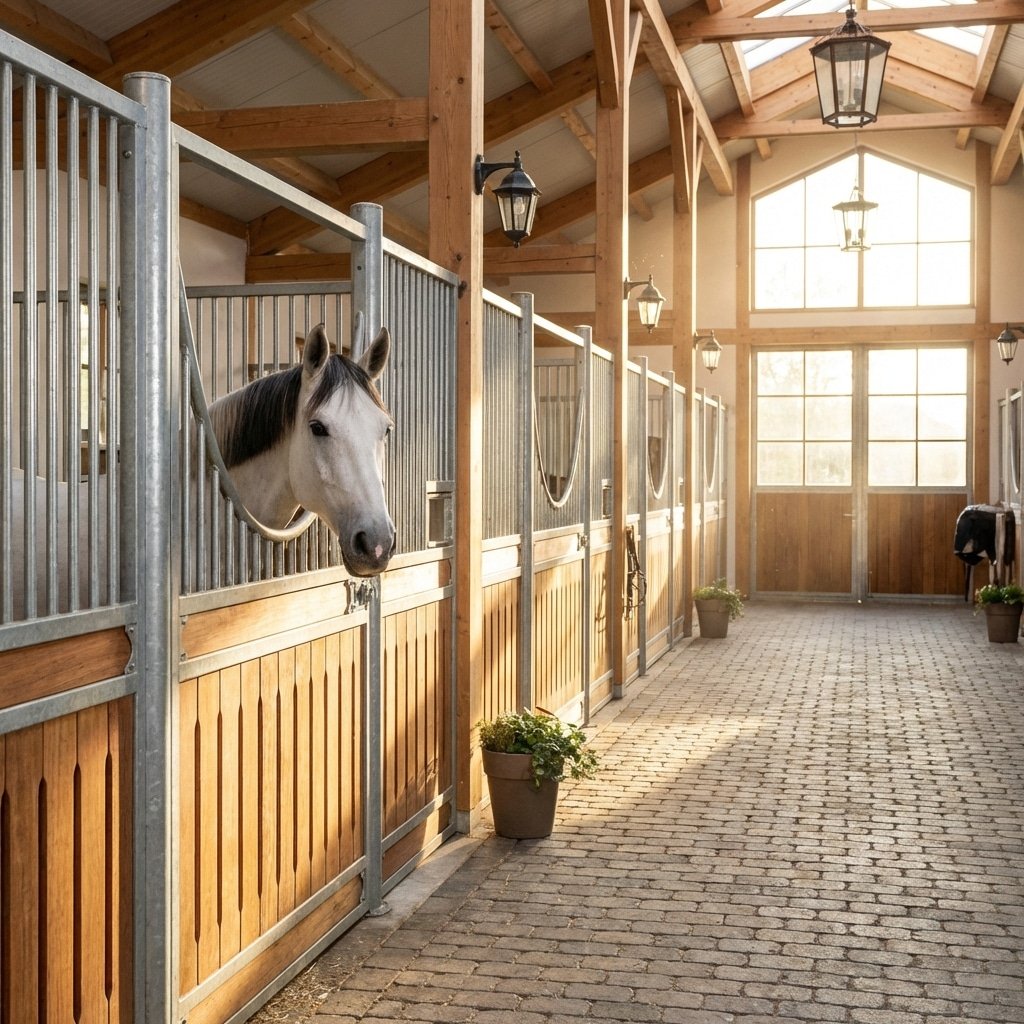
To counter the isolation of traditional stable layouts, we design our systems to maximize light sharing between stalls. Solid partition walls create a “cave effect,” trapping horses in shadow even during midday. Our engineering approach prioritizes structural transparency to let borrowed light from aisle windows and skylights penetrate deeper into the facility.
- Open Top Grill Designs: Standard in our Economy and Professional Series, these profiles prevent light blockage at eye level.
- Structural Profiles: We use 50mm x 50mm RHS or round bar profiles (14-gauge) that provide security without creating a visual wall.
- Visual Horizon: The upper grill openness maintains the horse’s visual horizon, reducing isolation-induced cortisol spikes.
The Danger of Standard Glass in Equestrian Facilities
Standard annealed glass shatters into large, razor-sharp shards upon impact. Unlike our ‘kick-proof’ Q345 steel, it cannot withstand a frightened horse, creating a lethal hazard in confined spaces.
The Lethality of Annealed Glass Shards
Standard plate glass breaks into long, jagged spears rather than crumbling. This structural failure mode is catastrophic in an equine environment. When a horse impacts “annealed” glass, the resulting shards act like guillotines. These large, wedge-shaped pieces carry enough mass and sharpness to sever arteries, tendons, or ligaments instantly. We prioritize “Engineering Safety” in our Q345 steel frameworks specifically to avoid sharp edges; installing standard glass negates that safety standard entirely.
The risk is high enough that the Rutgers New Jersey Agricultural Experiment Station issues specific warnings regarding window accessibility. They emphasize that any window accessible to livestock must be shielded or comprised of safety glass. In a professional facility, relying on standard glazing is not just a design flaw; it is a direct liability.
Impact Vulnerability in Confined Spaces
Glass breakage in a stable is often a question of “when,” not “if.” Horses are flight animals that react unpredictably to storms, feeding time excitement, or isolation. A 500kg horse can easily shatter standard glazing with a single kick, rear, or even by rubbing against it. Unlike our 14-gauge steel tube profiles which are designed to absorb this energy, standard glass offers zero resistance to blunt force trauma.
This vulnerability becomes critical during emergencies. In a fire evacuation scenario, a panicked horse may smash a window attempting to escape. If that window is standard glass, the stall and aisle become obstructed by dangerous debris, complicating the evacuation and endangering handlers. Materials in the stall must match the “Kick-Proof” resilience of the stable frame itself. If the glazing cannot withstand impact, it must be protected by a heavy-duty steel grill or replaced with tempered safety glass.
Engineered For Durability In Any Climate


6mm Tempered Glass: Shatter-Proof Horse Stall Windows
6mm tempered glass withstands 4-5x more impact than annealed glass and fractures into blunt granules, eliminating the risk of arterial lacerations during panic situations.
| Safety Metric | Standard Annealed Glass | 6mm Tempered Glass |
|---|---|---|
| Impact Resistance | Low (Fragile) | High (400-500% Stronger) |
| Failure Mode | Jagged Shards (“Guillotine”) | Blunt Granules (“Dice”) |
| Injury Risk | Life-Threatening Lacerations | Superficial Cuts |
The Safety Mechanism: Granular Fracture Patterns
The distinction between a safe stable environment and a catastrophic injury often comes down to how materials fail under stress. We do not use standard annealed glass in equine facilities because it breaks into long, sharp shards. If a horse kicks or panics against this material, the resulting “guillotine effect” can sever arteries and tendons instantly.
Tempered glass undergoes a thermal treatment process that creates high internal stress, increasing its surface strength by 400-500%. This process changes the physics of failure. Instead of cracking into splinters, the internal tension forces the glass to disintegrate into small, cuboid “dice” or granules upon impact.
- Stress Distribution: Thermal tempering compresses the outer surfaces while putting the core into tension, creating a robust barrier against blunt force.
- Granular Failure: Upon breaking, the energy release shatters the entire pane into blunt chunks roughly 1cm in size.
- Injury Mitigation: These granules may cause minor scratches but virtually eliminate the risk of deep, fatal lacerations common with standard glass.
Operational Specs: Why 6mm is the Balanced Choice
In industrial engineering, thicker is not always better. While 10mm or 12mm glass is common in architectural lobbies, it is often excessive and detrimental for moving horse stall components. The 6mm specification is the industry standard because it balances structural integrity with the mechanical limitations of stable hardware.
- Weight Efficiency: 10mm glass adds significant mass to sliding doors and hinged shutters, accelerating wear on rollers, tracks, and hinges. 6mm panels reduce this strain, extending the lifespan of the steel hardware.
- Impact Resistance: When paired with protective steel grills (standard practice), 6mm tempered glass provides sufficient tensile strength to withstand accidental impact without failure.
- Insulation Compatibility: 6mm sheets are easily integrated into double or triple-layer Insulated Glazing Units (IGU), offering thermal protection in cold climates without requiring custom, extra-wide framing profiles.
- Cost-Effectiveness: This thickness offers superior durability compared to fragile 4mm options but avoids the exponential cost increase associated with heavy architectural glass.
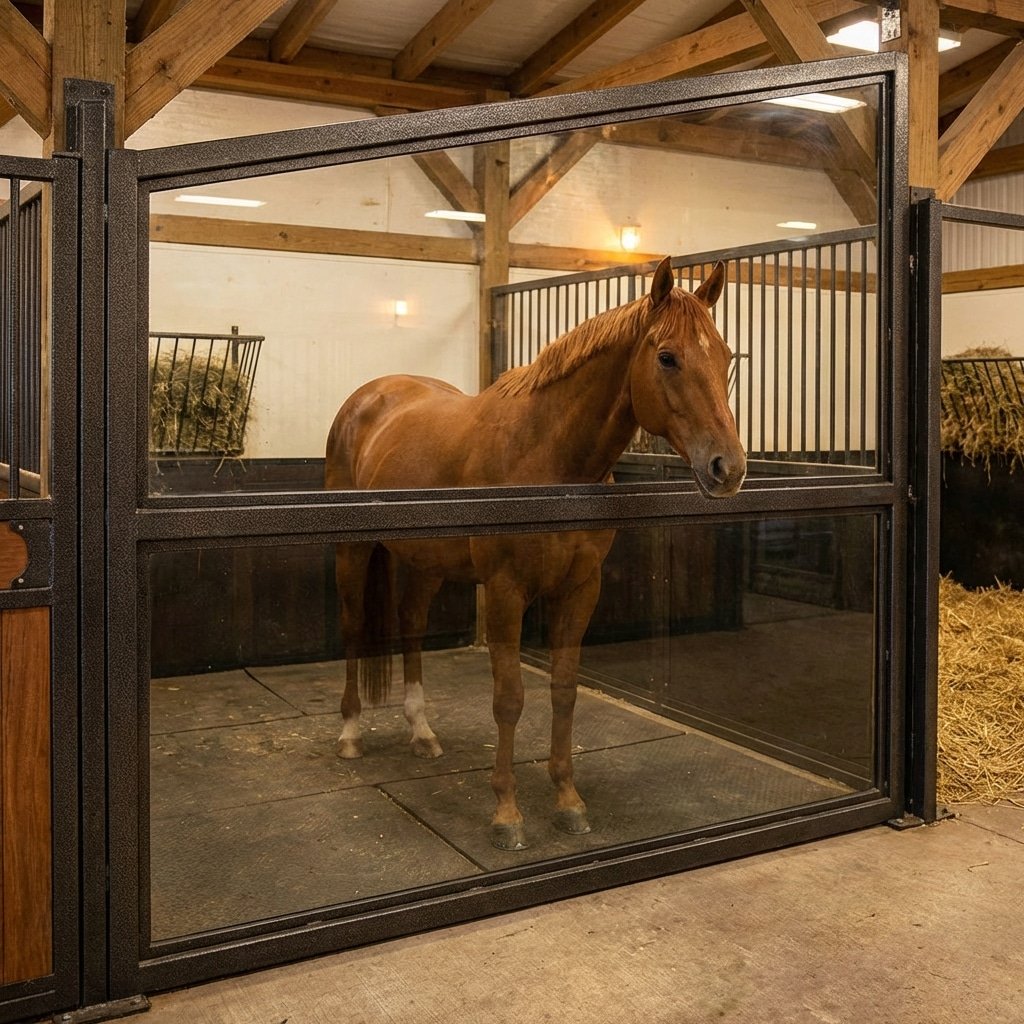
Protecting the Glass with 14-Gauge Steel Grills
14-gauge (2.0mm) steel grills absorb kick impact energy before it reaches the glass, preventing breakage and ensuring horse safety without sacrificing ventilation.
The Function of Protective Window Guards
Glass in a stable environment creates a significant liability if left exposed. A horse’s kick delivers immense kinetic energy that standard glazing cannot withstand. A heavy-duty steel grill serves as the primary mechanical barrier, separating the animal from the fragility of the window.
- Impact Absorption: The steel framework absorbs the full force of a strike. This prevents the impact energy from transferring to the glass pane, avoiding immediate shattering.
- Injury Prevention: In the event of glass breakage due to vibration or accident, the grill acts as a containment measure. It keeps the horse from coming into contact with sharp shards or attempting to escape through the opening.
- Ventilation Balance: Grills allow facility managers to keep windows open for necessary airflow and “stack effect” ventilation while maintaining a secure, locked perimeter.
The DB Stable 14-Gauge (2.0mm) Kick-Proof Standard
Market alternatives often utilize thinner 16-gauge or 18-gauge tubing to reduce manufacturing costs. These lighter materials deform easily upon impact, compromising the safety buffer between the horse and the glass. We strictly adhere to a heavier industrial specification to ensure long-term structural integrity.
- Material Thickness: We exclusively use 14-Gauge (2.0mm – 2.5mm) steel tubing. We strictly prohibit the use of thinner walls that cannot withstand the force of a determined kick.
- Structural Integrity: Our grills are fabricated from Q235B structural steel (or Q345B for cold climates), ensuring the metal absorbs impact without brittle fracture.
- Rust Protection: Windows are high-condensation zones. We utilize Hot-Dip Galvanization After Fabrication (ISO 1461). By dipping the grill after welding, we ensure the joints are fully coated in zinc (avg > 70 microns), preventing the corrosion that destroys pre-galvanized competitors.
Frequently Asked Questions
Can I install glass windows in a horse stall?
Yes, but safety is the priority. You must use tempered glass, which crumbles rather than shattering into sharp shards. Install windows at least 4-5 feet above the floor and always protect them with steel grills or bars on the interior side to prevent horses from contacting the glass directly.
Is tempered glass safe for horse barns?
Tempered glass is the industry standard for safety. Unlike standard glass, it fractures into small, harmless granules if broken. For proper protection, ensure the glass is at least 1/4 inch (6mm) thick and mount a protective grill guard 4 inches away from the surface to absorb impacts.
Do horse stall windows strictly require grills?
Yes. Leaving glass unprotected is a major safety risk. Heavy-duty grills—we specify 14-gauge (2.0mm – 2.5mm) steel protected by hot-dip galvanization—safeguard your investment from breakage and prevent severe injuries. Bar spacing should be between 3 inches and 4 inches to prevent hooves or muzzles from getting trapped.
How can I bring more light into an indoor stable?
Installing windows with protective guards is the best natural method. For artificial lighting, switch to LED fixtures. They run cool to reduce fire risks, offer significant energy savings, and mimic natural daylight to help regulate your horses’ sleep cycles and mood.
Final Thoughts
Facilities cannot afford the liability of annealed glass failure in high-traffic stables. Integrating 6mm tempered safety glass with our 14-gauge Q235B steel grills creates a “Kick-Proof” barrier that drastically mitigates injury risks. This engineering standard protects your clients’ horses and secures your business against negligence claims.
Upgrade your inventory’s safety profile without compromising on logistics margins. Our flat-pack system optimizes shipping volume, allowing you to import high-spec window units at wholesale efficiency. Contact our engineering team today to configure a trial order or request technical drawings for your specific layout.



 English
  Spanish
  French
  Arabic
  German
0 Comments