


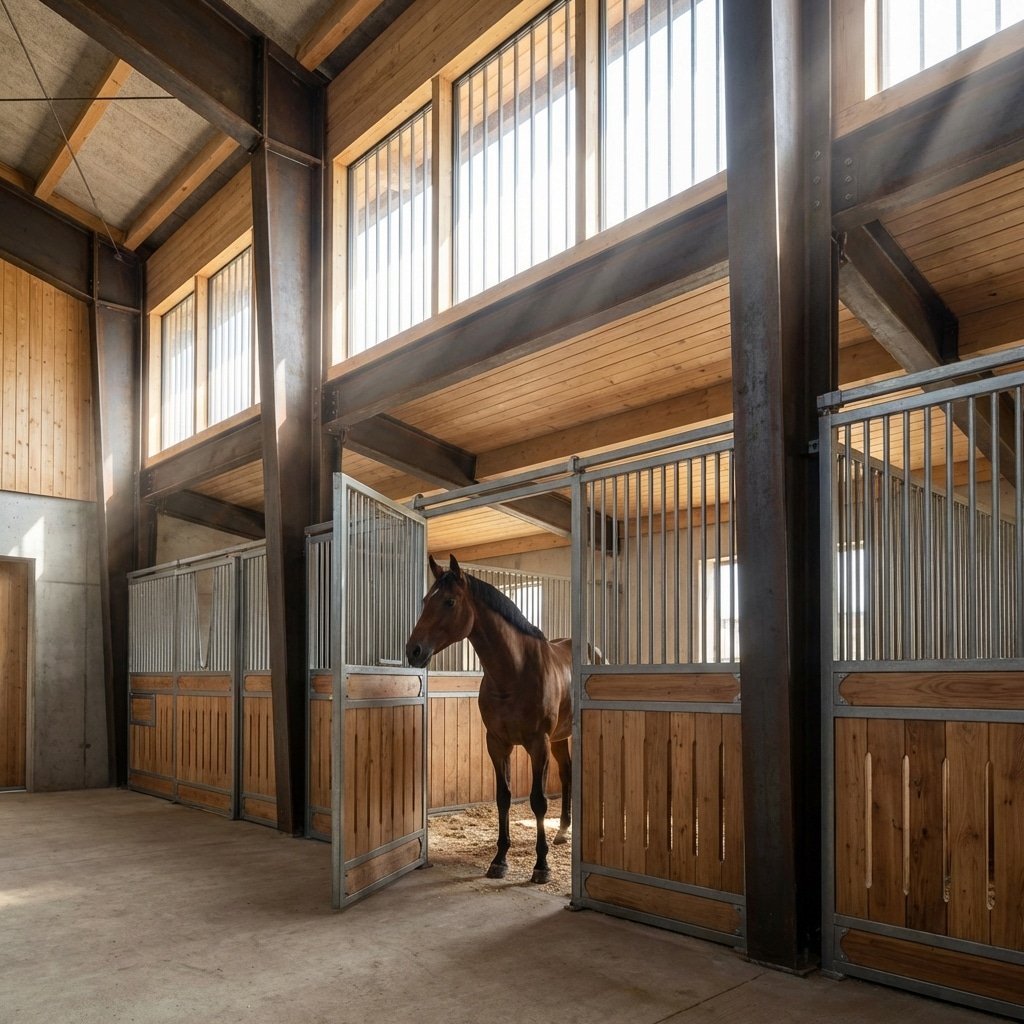
Determining if stall webbing safe configurations exist is critical for barn operators balancing summer ventilation with liability. Fabric guards lack the rigidity of steel, often causing squeeze-under accidents that result in severe veterinary costs.
We contrast flexible guards with V-Drop panels engineered from 14-Gauge Q235B Structural Steel. This solution secures stack effect ventilation and eliminates escape risks, utilizing Hot-Dip Galvanization After Fabrication to prevent corrosion in high-moisture environments.
The Summer Breeze: Why Owners Use Fabric Stall Guards
Fabric guards replace solid doors to maximize airflow and reduce isolation stress, offering a practical solution for thermal regulation and behavioral health in stabled horses.
Promoting Stack Effect Ventilation and Visibility
Solid stall doors often act as unintended windbreaks, trapping stagnant air at the precise level where the horse
breathes. Fabric stall guards address this by facilitating “Stack Effect Ventilation.” By removing the solid barrier, cool air can enter the lower portion of the stall while heat rises and escapes through upper vents. This airflow dynamic is critical during summer months to reduce thermal stress and prevent respiratory issues associated with ammonia buildup.
Beyond physiology, these guards support “Animal-Centered Design” principles by mimicking a herd environment. Horses are social prey animals that experience anxiety when isolated behind solid walls. Replaced with open webbing or mesh, the barrier allows them to observe barn activity and interact with neighbors. This visibility significantly alleviates confinement anxiety, reducing vices like weaving or cribbing that often stem from boredom and isolation.
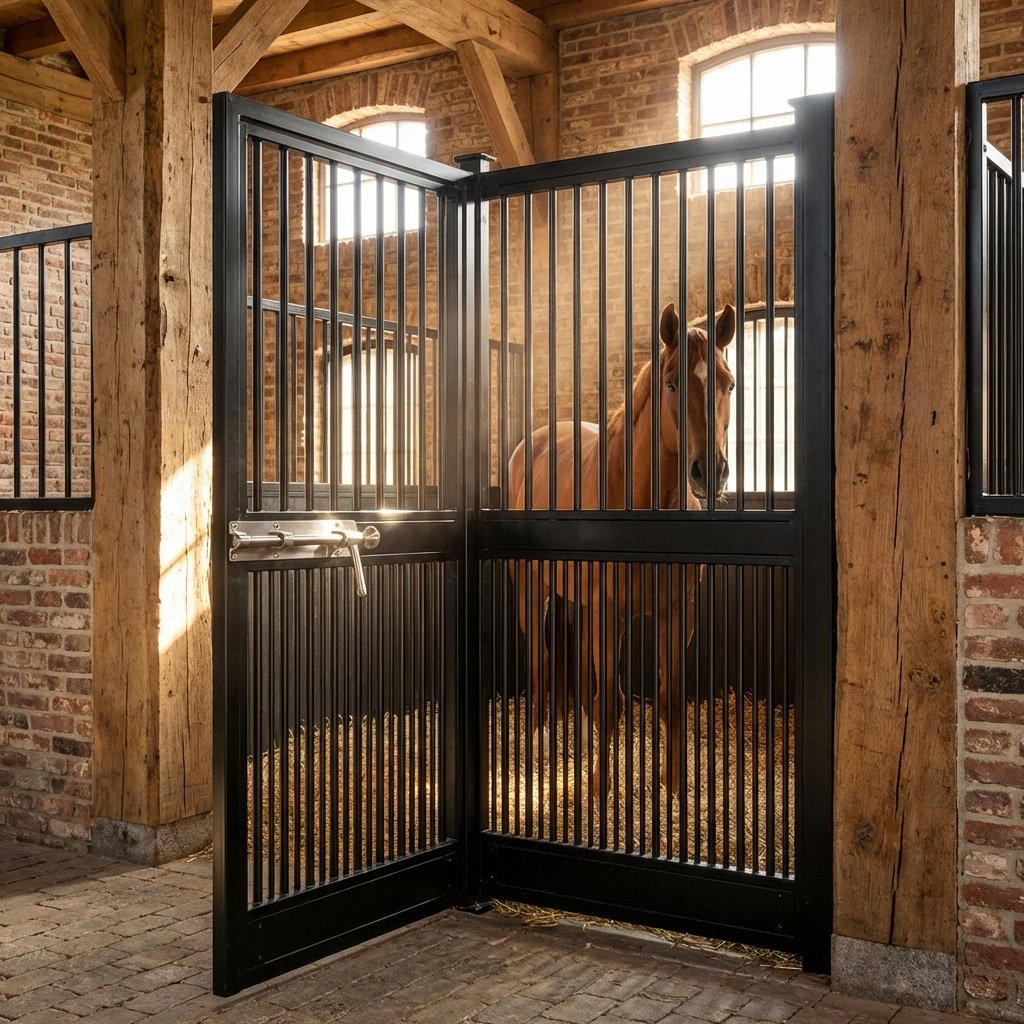
Material Specifications: 1200D Nylon and Marine-Grade Mesh
Safety in semi-open containment relies entirely on material integrity. A horse leaning on a guard exerts significant pressure, so standard retail-grade fabrics often fail. Professional operations specify materials designed to withstand abrasion, moisture, and impact.
- 1200D Triple-Weave Nylon: The baseline for durability. This denier count resists tearing if a horse paws or rubs against the guard.
- PVC-Coated Mesh (Dura-Mesh): Often sourced from marine applications, this material provides maximum breathability and transparency without absorbing water or rotting.
- Reinforced Stitching: High-quality guards feature four-sided stitching patterns to prevent fraying at the edges, which is the most common failure point.
- Heavy-Duty Hardware: Secure attachment requires four-trigger snap hooks, ensuring the guard remains anchored even if the horse attempts to push through.
The Squeeze-Under Risk: Horses Escaping Webbing
Squeeze-under incidents happen when high-mounted webbing creates gaps for panic escapes. Prevent this by aligning the guard’s center with the horse’s chest and stress-testing wall hardware.
The Dynamics of a Squeeze-Under Event
Flexible webbing lacks the structural rigidity of Q235B steel. When a 500kg animal leans against a fabric guard, the material bows significantly outward. This distortion effectively raises the bottom edge of the guard, creating a large gap between the webbing and the floor. This mechanical failure point—where the barrier yields under pressure—is the primary cause of escape for determined horses.
The risk amplifies for horses that paw at the doorway. If the installation leaves excessive clearance at the bottom, a pawing hoof can easily slip underneath and hook the fabric. Once the leg is entrapped, the horse’s natural flight response triggers panic. The horse pulls back or attempts to scramble forward, transforming a loose guard into a dangerous entanglement hazard that can result in soft tissue damage or fractures.
Panic triggers often cause horses to attempt rolling or scrambling near the doorway. Unlike a solid door or a rigid steel gate which deflects the animal, flexible webbing absorbs the initial impact and then acts as a snare. A horse attempting to roll near the front of the stall can slide under the webbing, getting stuck halfway. This position compresses the chest and restricts breathing, turning a containment failure into a life-threatening veterinary emergency.
Enforcing the Chest-Center Installation Rule
Installers must align the center of the webbing directly with the center of the horse’s chest. This positioning neutralizes leverage points. If the guard is too high, the horse pushes under; if too low, they tip over. The chest-center alignment ensures the horse hits the strongest part of the barrier first, discouraging attempts to test the perimeter.
- Variable Mounting Heights: Standard mounting heights fail because horse sizes vary. A setup safe for a 17-hand Warmblood leaves a dangerous gap for a pony. Adjustments are mandatory for every specific occupant.
- Hardware Integrity: Owners must perform structural integrity tests on wall hardware. Apply heavy pull pressure to the screw eyes or plates to simulate the force of a leaning horse.
- Material Check: Regularly inspect the wood surrounding the hardware. Rotting wood or loose screws will rip out instantly under panic pressure, rendering the chest-center rule useless.
Factory Direct Stables with 20-Year Guarantee

The Compromise: Leaving the Heavy DB Door Open Safely
Sliding the solid door open for a “Day Mode” configuration maximizes airflow and social interaction, provided the frame geometry supports the leverage of secondary barriers.
The “Day Mode” Ventilation Strategy
Most facility managers face a binary choice: close the solid door for security or leave it open for air. The “Day Mode” strategy uses a hybrid approach. You keep the heavy sliding door fully retracted during daylight hours and deploy a secondary barrier—typically a webbing guard or vinyl chain. This allows massive air intake, promoting “Stack Effect Ventilation” which flushes out ammonia and dust that accumulate at the bedding level.
This setup serves two distinct operational goals. At night, the solid door provides the primary security layer required for unmonitored hours. During the day, the secondary guard acts as a psychological barrier. It keeps the horse contained but prevents total isolation. Horses can observe the aisle and interact with neighbors, which significantly reduces boredom-induced vices like weaving or cribbing.
Installation on the 50mm RHS Galvanized Frame
Installing secondary barriers requires a rigid mounting surface. Many generic round-post stables fail here because stall guard brackets slip and rotate on the curved surface. We engineer DB Stable fronts using 50mm x 50mm RHS (Square Hollow Section) posts. The flat face provides a flush, secure contact point for mounting brackets, ensuring they stay locked in position even under pressure.
The structural integrity of the frame matters when a 500kg animal leans against a flexible barrier. The tension transfers directly to the door posts. We use Q345B Structural Steel rather than standard commercial grade metal. This high-strength alloy resists warping or bowing when subjected to the lateral force of a horse pressing against a stall guard.
If you install these barriers, you will likely drill pilot holes into the frame for screw eyes or mounting plates. This penetrates the protective zinc layer. To maintain the BS EN ISO 1461 rust protection standard, you must immediately treat any new holes with the Touch-up Spray (Cold Galvanizing) included in our installation kit. Leaving exposed steel inside a humid stable environment will lead to rust streaks within weeks.
Using V-Drop Panels for Airflow Without the Escape Risk
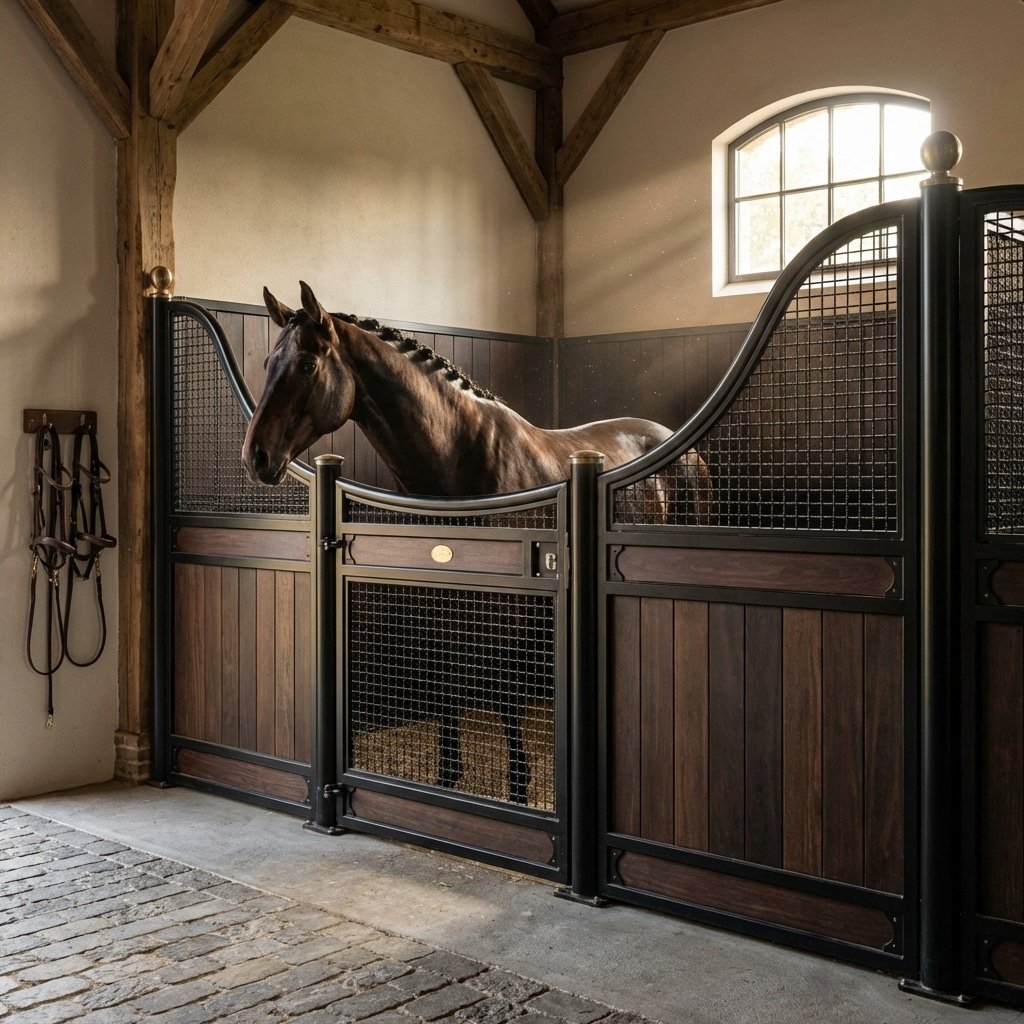
V-Drop panels replace flexible webbing with a rigid steel interface. They allow head-out socialization while physically blocking the shoulders to prevent the escape risks common with fabric guards.
| Feature | Fabric Stall Guard (Webbing) | DB Stable V-Drop Panel |
|---|---|---|
| Containment Type | Psychological / Flexible Barrier | Physical / Rigid Barrier |
| Escape Risk | High (Squeeze-under potential) | Zero (Shoulder-Stop Geometry) |
| Durability | Low (Fraying, stitching failure) | Lifetime (14-Gauge Steel) |
| Airflow | Maximum | High (Maintains Stack Effect) |
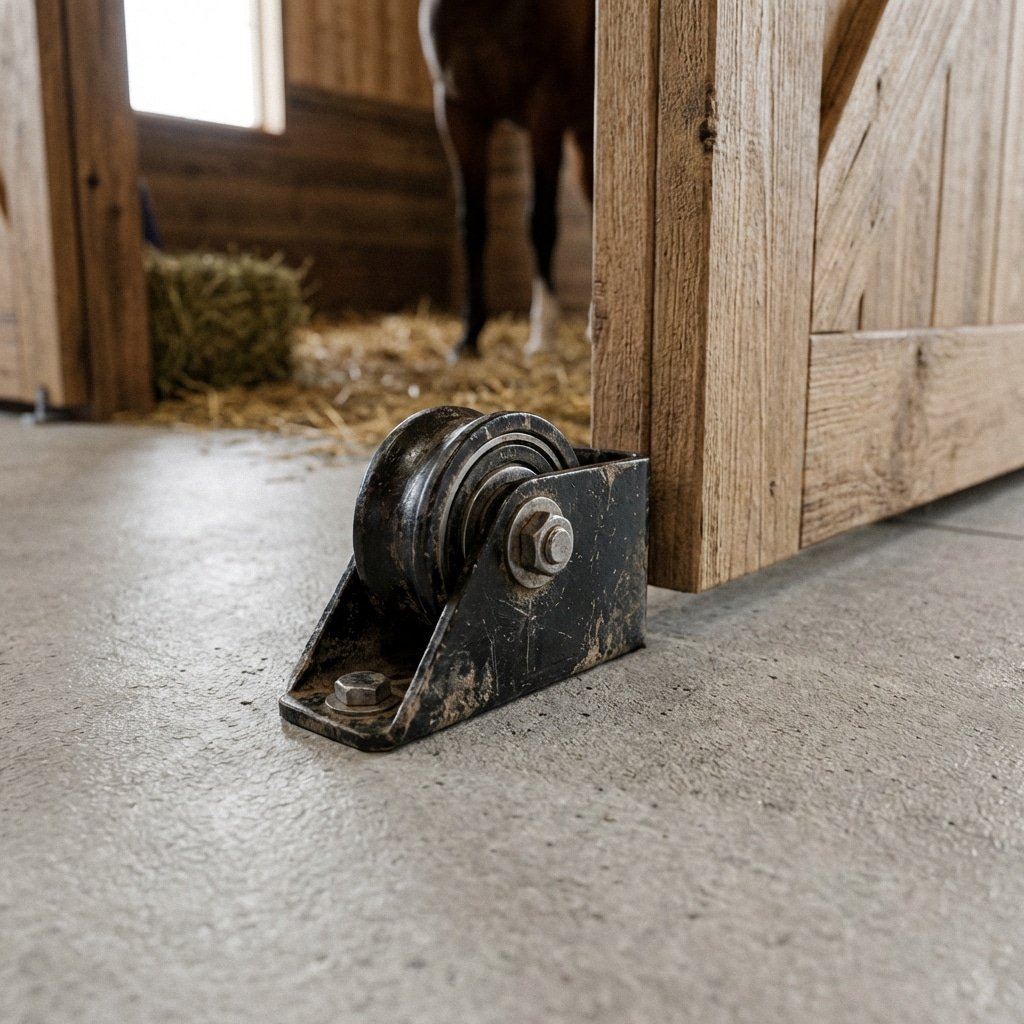
The ‘Shoulder-Stop’ Geometry vs. Webbing
Fabric stall guards are popular because they open up the barn, but they rely on a horse’s willingness to stay put. If a horse panics or decides to push, nylon webbing stretches, clips break, or the mounting hardware pulls out of the wood. This creates the “squeeze-under” risk, where a horse gets half-stuck and panics.
The V-Drop panel solves this through anatomy, not just strength. We engineer the V-opening to be wide enough for the upper neck and head but too narrow for the skeletal structure of the shoulders to pass. It creates a mechanical “Shoulder-Stop.” The horse gets the mental benefit of looking out and the respiratory benefit of the “Stack Effect” ventilation, but the rigid steel barrier makes physical escape impossible.
Engineering Durability: 14-Gauge Framework & Galvanization
Frequently Asked Questions
Can I use a stall guard instead of a solid door?
Treat stall guards as temporary containment or airflow aids, not permanent security systems. While they allow horses to socialize and track barn activity, they lack the structural integrity of a steel stable door. They work best for calm horses during the day or at shows. For overnight confinement, a solid door remains the only safe option to prevent escapes or accidents.
Are web stall guards safe for every horse?
No. Horses that paw, lean heavily on barriers, or panic easily are poor candidates for webbing. The risk of getting a hoof caught in the fabric or hardware is real and dangerous. You must assess your horse’s temperament honestly; the guard acts as a visual boundary, not a physical one. If the horse challenges boundaries, stick to a solid steel grill or door.
How do I determine the correct height for a stall guard?
Install the guard so its center aligns directly with the center of the horse’s chest. This specific positioning discourages the horse from attempting to jump over the top or slide underneath. Before walking away, test the hardware tension manually to ensure it withstands pressure without the snaps popping loose.
Do stall guards actually improve ventilation?
Yes. Swapping a solid upper door for a webbing or mesh guard drastically increases airflow. This modification eliminates stagnant air pockets and helps regulate stable temperature during summer months. Open-weave designs, such as nylon webbing, allow a maximum breeze to pass through while keeping the horse contained.
Final Thoughts
While fabric guards provide temporary airflow, they pose significant liability risks compared to the structural security of our 14-Gauge steel V-Drop panels. Offering a rigid “Shoulder-Stop” solution eliminates escape attempts and differentiates your inventory from low-end retail competitors. Trusting ISO 1461 hot-dip galvanization ensures your clients receive permanent assets, not just seasonal accessories.
Stop gambling on temporary fixes and upgrade your inventory with engineered, permanent solutions. Request our Professional Series specification sheet to see how our flat-pack technology protects your margins. Contact our team today to configure a trial order that fits your specific distribution channel.

 English
  Spanish
  French
  Arabic
  German
0 Comments