


Mismanaging sloped runoff during a concrete pour guarantees stagnant urine and accelerated ammonia corrosion. While flat floors are easier to finish, they trap moisture against the stall front, causing standard steel frames to rot at the anchor points within three years.
This analysis details the precise 1:60 engineering gradient required to balance gravity-fed drainage with tendon safety. We explain how integrating a 50mm bottom clearance and ISO 1461 Hot-Dip Galvanized steel ensures your facility handles fluid dynamics without compromising structural longevity.
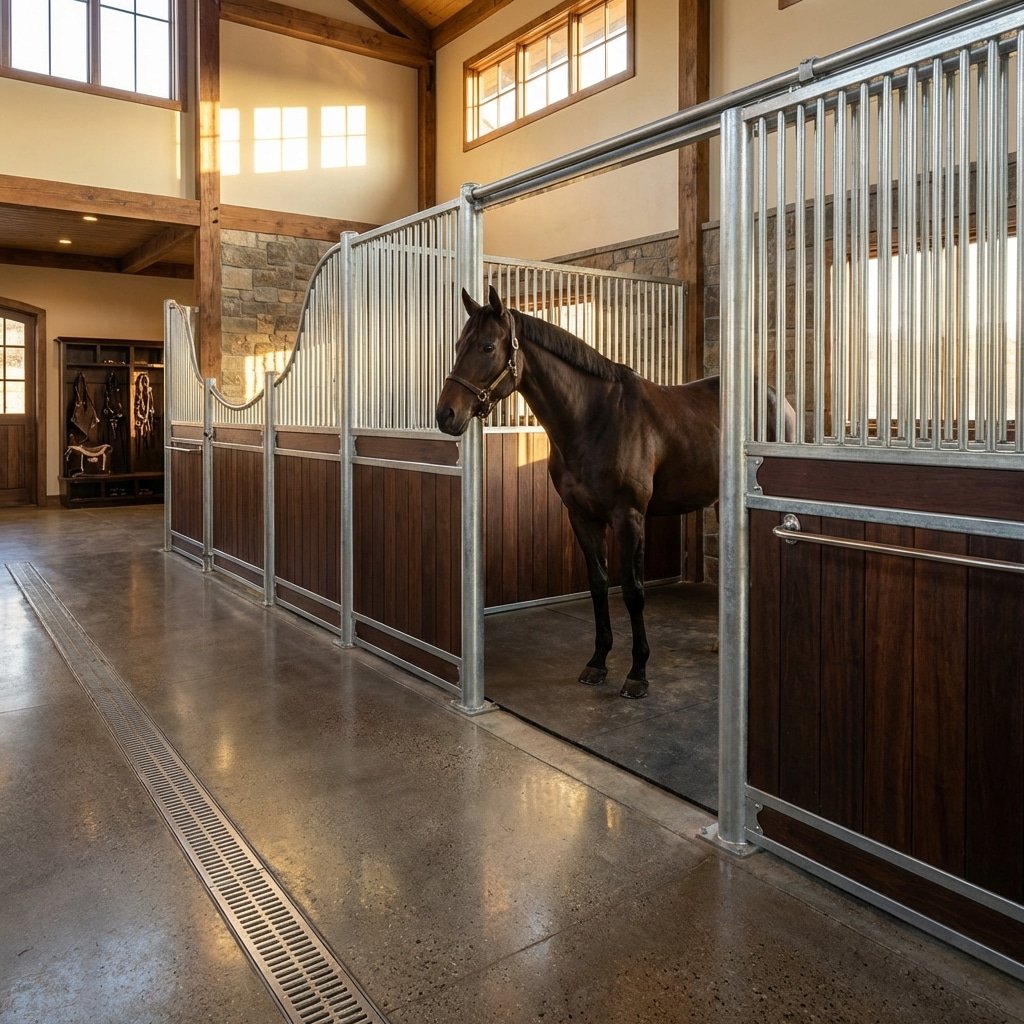
The Anatomy of the 1:60 Barn Floor Slope
A 1:60 slope (1.6% grade) creates the ideal balance between gravity-fed drainage and horse comfort, preventing tendon strain while eliminating ammonia pools.
Calculating the 1.6% Drainage Gradient
The 1:60 ratio is a precise engineering specification, not a rough estimate. It translates to a 1.6% grade, or a 1-inch drop for every 60 inches (5 feet) of stall length. This specific gradient solves the conflict between drainage physics and biomechanics. It provides just enough gravitational pull to move fluids effectively without creating a steep surface that stresses a horse’s flexor tendons or increases slip risks.
Correctly implemented, this slope prevents “pooling” in the center of the stall. Flat floors allow urine to stagnate under mats, accelerating ammonia buildup and bacterial growth that damages hooves and respiratory systems. The 1.6% grade ensures that wash-down water and urine flow directly toward the aisle channel or rear drain, keeping the bedding significantly drier and reducing mucking labor.
Corrosion Defense at the Slope Base
Gravity dictates that the lowest point of the slope—typically where the front panel meets the floor—collects the highest concentration of corrosive fluids. This creates a “chemical load” zone where urine and water accumulate before draining. Standard painted or pre-galvanized steel frames often rot at this specific contact point within 2-3 years because their surface protection cannot withstand constant immersion in acidic slurry.
To counteract this inevitable exposure, DB Stable utilizes **ISO 1461 Hot-Dip Galvanization** strictly *after* fabrication. We apply a zinc coating averaging **>85 microns** to the structural steel. This process creates a metallurgical bond that seals the steel completely, ensuring the base of the frame withstands the aggressive chemical environment at the drainage point for decades, rather than years.
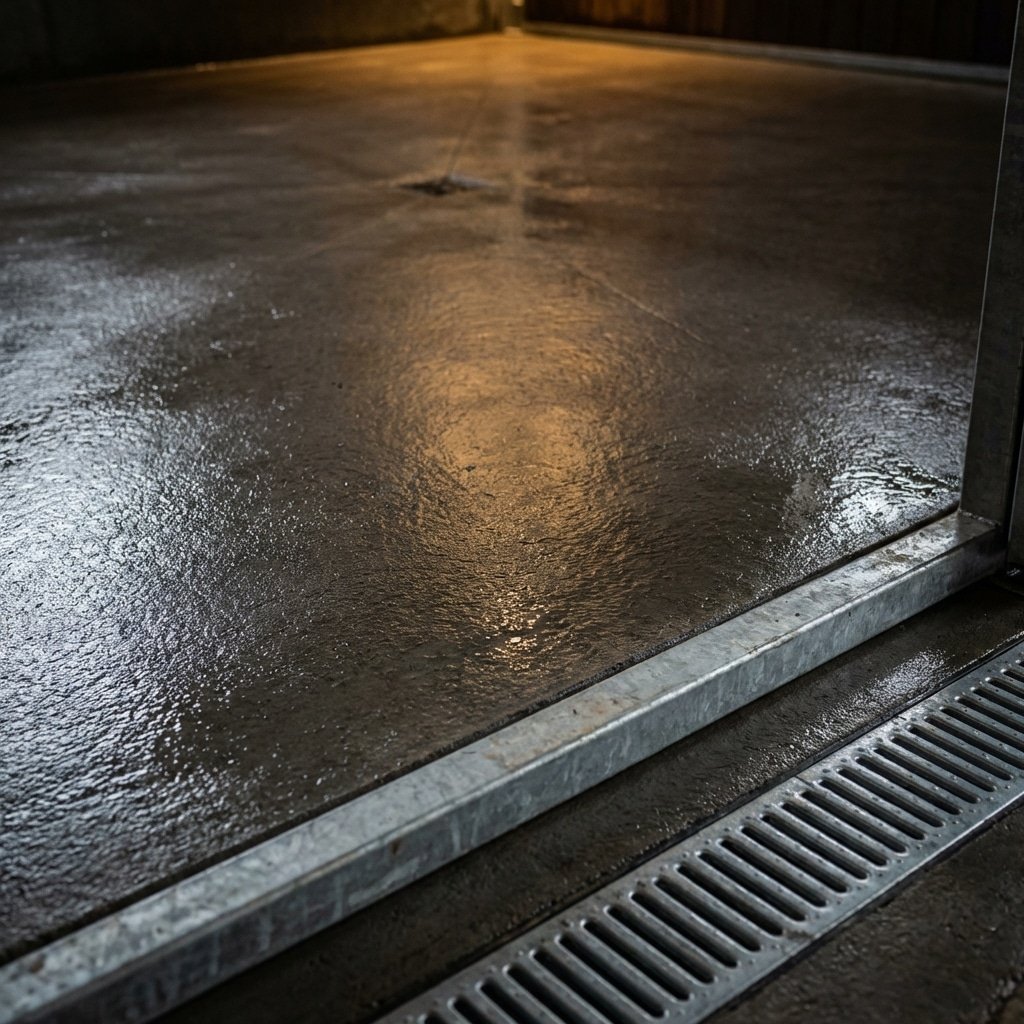
Permeable Mats vs Solid Mats Over Sloped Concrete
Permeable mats utilize the sub-floor slope for immediate drainage, keeping surfaces dry. Solid mats force liquid over the top, risking ammonia pockets if seals fail.
Fluid Dynamics: Surface Runoff vs. Sub-Surface Flow
Solid mats operate on a surface tension principle. They force urine and water to flow over the top of the rubber, which demands a steeper pitch to prevent puddling. If the mat surface isn’t perfectly flush, fluids stagnate, creating a wet environment for the horse.
Permeable systems take a different approach by allowing gravity to pull fluids strictly through the mat to the concrete base. This utilizes the underlying 1:60 sub-floor gradient for drainage, keeping the animal distinct from the waste stream and significantly reducing bedding contamination.
The critical failure point for solid mats is the “ammonia pocket.” If the edges are not chemically sealed against the walls, urine seeps underneath the rubber. Once trapped, it cannot evaporate or drain, leading to rapid ammonia accumulation that damages respiratory health.
Corrosion Defense for Floor-Level Steelwork
Rubber mats, regardless of type, create a high-corrosion zone where the stable post meets the floor. Moisture and acidic urine often get trapped between the mat edge and the steel anchor point. Standard pre-galvanized steel usually fails here within a few years due to constant exposure.
- Hot-Dip Galvanization After Fabrication: DB Stable adheres to BS EN ISO 1461 standards, dipping the steel only after all welding is complete. This seals the pores and joints against acidic runoff.
- ASTM B117 Compliance: Our posts undergo Salt Spray Testing (>96 hours) to ensure they withstand the constant moisture contact inherent to mat-covered floors.
- Material Grade: We utilize Q235B or Q345B structural steel, which maintains integrity at the anchor points even in aggressive chemical environments.
Premium Horse Stables Engineered for Extreme Durability
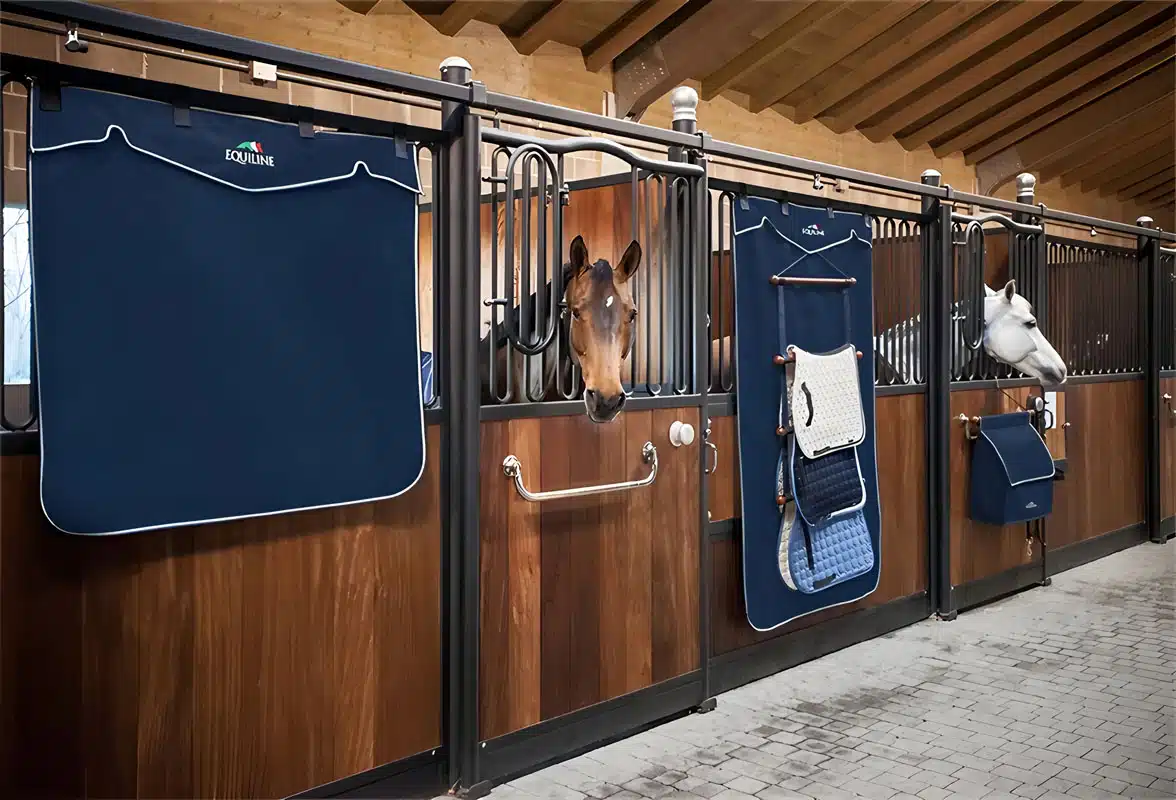

How DB’s 50mm Bottom Clearance Prevents Damming
DB Stable’s 50mm bottom clearance eliminates the ‘damming’ effect by allowing urine and wash-down water to flow freely, preventing bacterial buildup while strictly adhering to ‘Cast-Proof’ safety standards.
| Technical Spec | Engineering Purpose | Operational Benefit |
|---|---|---|
| 50mm Clearance | Fluid Dynamics | Prevents urine pooling and ammonia buildup. |
| Cast-Proof Limit | Hoof Safety | Stops hooves from getting trapped during rolling. |
| Q345B Bottom Rail | Impact Resistance | Withstands kicks in the high-stress lower zone. |
| ISO 1461 Galvanization | Corrosion Control | Protects steel from acidic urine exposure. |
Facilitating Unobstructed Liquid Runoff
Many manufacturers weld frames flush to the floor to simplify fabrication, but this creates a “damming” effect. A flush bottom rail acts as a physical barrier, trapping urine and soiled water inside the stall. This stagnation accelerates ammonia production, which damages equine respiratory systems. We engineer a specific 50mm gap to ensure the stable frame works with your flooring, not against it.
- Prevents Fluid Retention: The gap ensures the bottom frame never acts as a dike that holds urine inside the bedding area.
- Supports Stack Effect Ventilation: This opening acts as a cold air intake, allowing fresh air to enter at the floor level and push warm, stale air upward and out.
- Wash-Down Efficiency: Water exits immediately during cleaning, keeping bedding drier and reducing the labor required to dry out stalls.
- Complements Floor Slope: It removes the final physical blockage at the aisle threshold, allowing a standard 1:60 concrete slope to function correctly.
The Dual-Function “Cast-Proof” Safety Standard
While drainage is critical, the gap size is not arbitrary. If the clearance exceeds 50mm, it introduces a severe safety risk: a horse rolling near the wall could slide a hoof under the rail and become cast (trapped). Our engineering team strictly adheres to the 50mm “Cast-Proof Design” limit, balancing necessary drainage with absolute equine safety. This area is also the most vulnerable to corrosion and impact, requiring specific material choices outlined in our product specs.
- Cast-Proof Limit: We cap the clearance at 50mm to prevent hooves from sliding under the frame, a common cause of panic-induced injuries.
- Q345B High Strength Steel: The bottom rail is fabricated from Q345B (ASTM Grade 50 equivalent) to resist high-impact kicks near the drainage zone.
- Corrosion Defense: Since this zone sees constant urine runoff, we use Hot-Dip Galvanization After Fabrication (BS EN ISO 1461) to ensure no raw steel edges are exposed to acids.
- Optimized Balance: The design provides just enough space for fluid exit without compromising the structural barrier required for horse safety.

Keeping the Front Aisle Track Dry and Rust-Free
Quick Answer: Protect tracks by engineering a 1:60 floor slope for physical water diversion and using ISO 1461 Hot-Dip Galvanization to chemically seal the steel against inevitable moisture.
Strategic Drainage Layouts for High-Traffic Aisles
Water accumulation at the threshold acts as a primary catalyst for mechanical failure in stable doors. You must intercept wash-down water before it touches the bottom guide system. We position drainage channels perpendicular to the traffic flow. This layout captures runoff across the entire width of the aisle and prevents water from bridging the gap into the stall area.
- Floor Gradient: Implement a consistent 1:60 slope away from the front partitions. This specific ratio provides enough gravity for flow without creating a slip hazard for horses.
- Sediment Management: Install drains with removable sediment baskets. Bedding and hay inevitably enter the channel; without baskets, blockages occur, causing backflow that floods the track mechanism.
Applying the ISO 1461 Galvanization Standard
Physical drainage will not stop 100% of moisture. Humidity and ammonia create a corrosive environment that attacks standard steel. Many manufacturers cut costs by using pre-galvanized tubing, welding it together, and painting the joints silver. These weld points rust within months. We strictly utilize Hot-Dip Galvanization After Fabrication. This process involves welding the black steel frame first, then dipping the entire unit into molten zinc, sealing every weld and edge.
- Tubing Zinc Thickness: We adhere to a minimum of 70 microns (standard requires less, but we aim higher for longevity).
- Structural Zinc Thickness: For parts thicker than 6mm, we apply a coating exceeding 85 microns.
- Verification: Our batch testing follows ASTM B117 Salt Spray protocols, targeting over 96 hours without the appearance of red rust.
Final Thoughts
Generic pre-galvanized frames often rot at the drainage contact point, turning a functional floor slope into a costly warranty liability. By choosing DB Stable’s ISO 1461 Hot-Dip Galvanized steel, you ensure your inventory withstands the aggressive acidic chemical load inherent to gravity-fed systems. This manufacturing standard protects your business from corrosion claims and solidifies your position as a quality-first supplier.
Don’t rely on theoretical specs to guarantee fitment on complex gradients. We recommend requesting a sample section to physically verify our 50mm cast-proof clearance and >85-micron zinc coating thickness. Contact our engineering team today to secure a trial order that proves these drainage dynamics work for your customers.



 English
  Spanish
  French
  Arabic
  German
0 Comments