


Building Sloped Aisles ensures proper drainage yet introduces a critical mechanical failure in sliding stall door systems. Aligning tracks to this necessary gradient forces heavy steel doors to roll open via gravity, creating immediate safety liabilities that result in costly warranty callbacks for barn contractors.
This technical brief details how to maintain a True Level header line independent of floor grade using structural shimming and adjustable hardware. We analyze the application of threaded vertical rod hangers and ISO 1461 Hot-Dip Galvanized components to eliminate door drag and secure long-term operational safety.

The Necessity of End-to-End Aisle Drainage
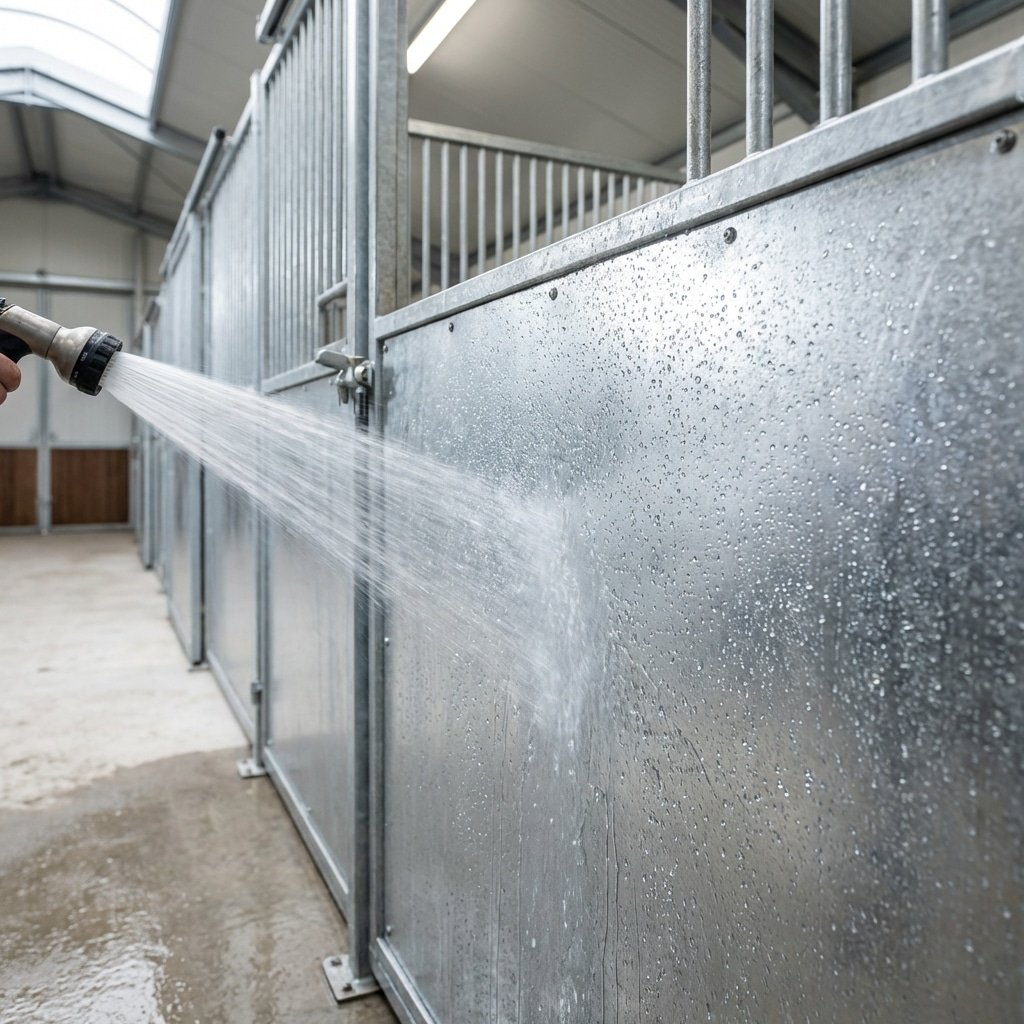
Proper drainage prevents ammonia buildup and pathogen spread, but it creates a corrosive “wet zone” that destroys standard steel. Only hot-dip galvanization survives this environment.
The Sanitary Imperative: Managing Waste and Wash-Downs
You do not slope a stable aisle for aesthetics; you do it for bio-security. Flat aisles allow urine and wash-water to pool, creating stagnant reservoirs where bacteria thrive. As urine breaks down, it releases ammonia fumes directly at the equine respiratory level. A functional aisle requires a 1-2% longitudinal slope to ensure fluids exit the facility immediately.
This geometric baseline dictates your daily operations. A proper slope facilitates efficient wash-downs, allowing staff to flush pathogens out of the building rather than pushing dirty water back toward stall fronts. However, this necessary design feature concentrates moisture and chemical waste at the base of your stall fronts, turning the bottom 100mm of your structure into a high-risk corrosion zone.
Corrosion Defense in High-Moisture Zones: The ISO 1461 Standard
The drainage line subjects steel posts to aggressive wetting and drying cycles, compounded by the acidity of urine and cleaning chemicals. Standard “pre-galvanized” tubing (steel that is galvanized before cutting and welding) fails here. The welding process burns off the zinc protection, leaving the joints exposed to rapid rust.
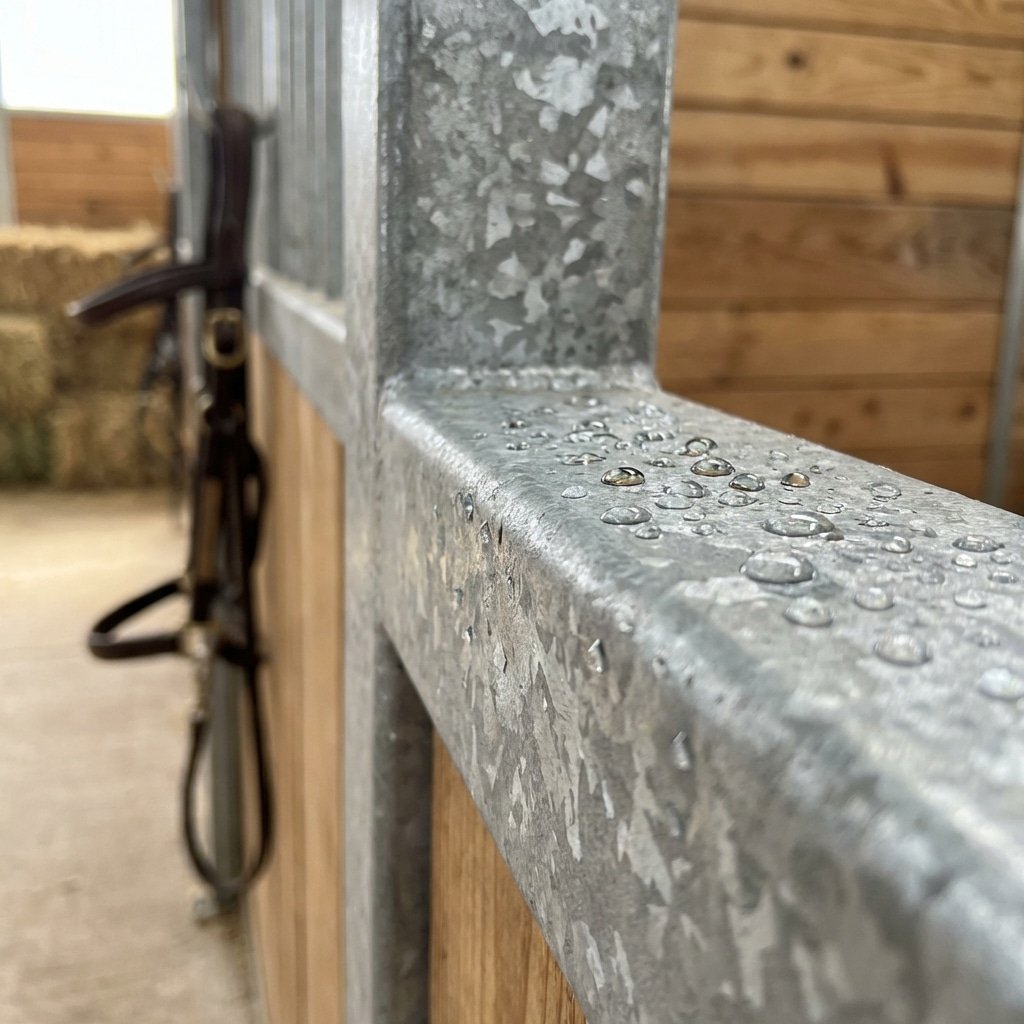
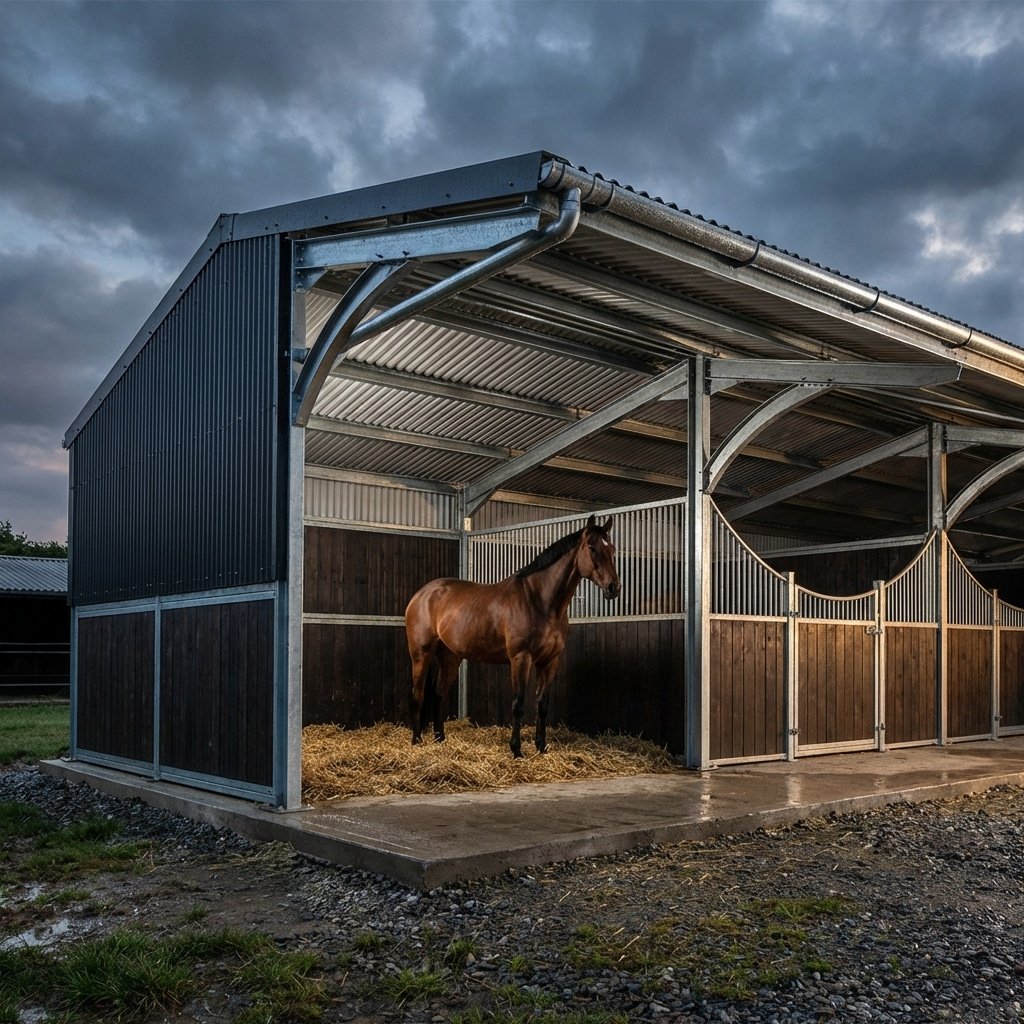
DB Stable prevents this structural failure by utilizing BS EN ISO 1461 Hot-Dip Galvanization. We fabricate the entire steel component from raw black steel first, then submerge the finished piece into molten zinc. This ensures the zinc coating seals every weld, edge, and internal surface.
- Sacrificial Barrier: The zinc coating acts as an anode, corroding in place of the steel.
- Thickness Standard: We adhere to an average coating thickness of > 70 microns for tubing and > 85 microns for structural parts.
- Weld Protection: Because we dip after fabrication, there are no exposed heat-affected zones where rust can start.
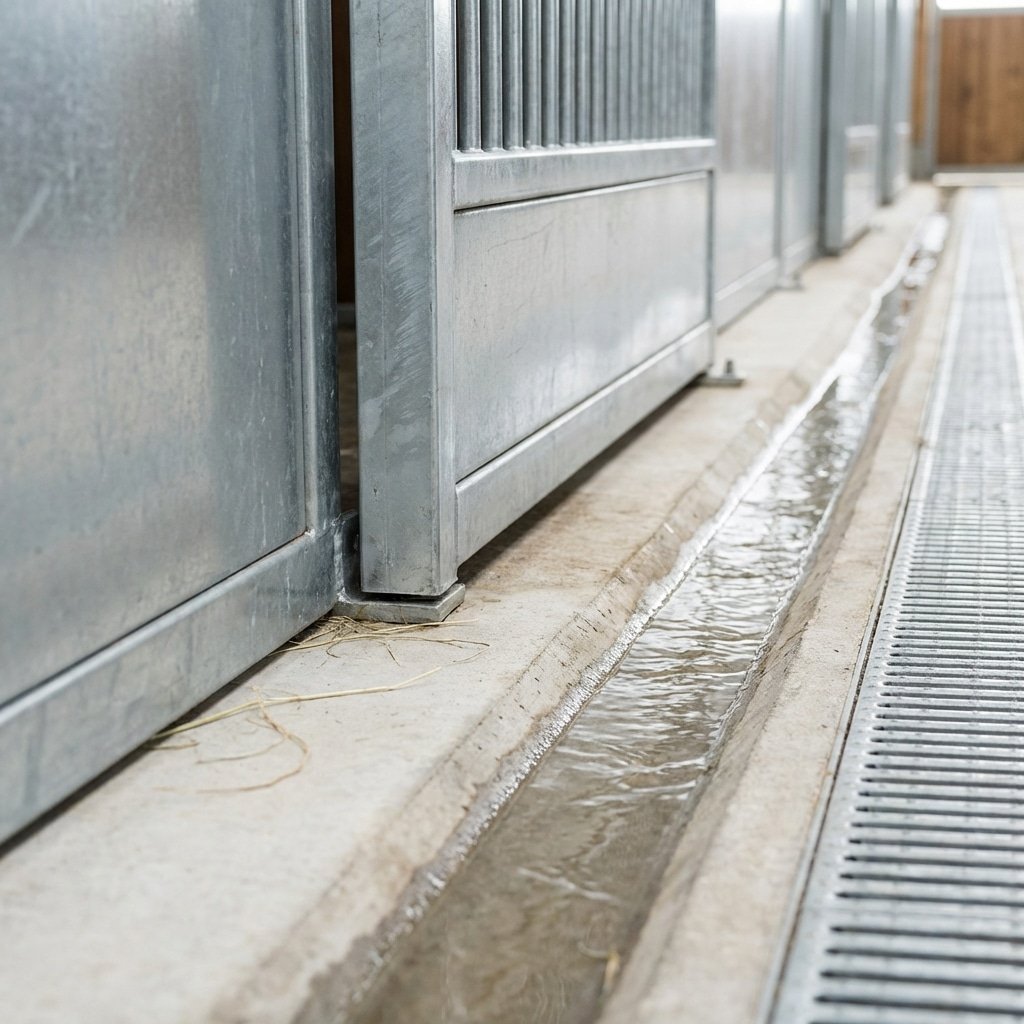
The Gravity Problem: Doors Rolling Open on Their Own
Stables require floor slopes for drainage, but aligning door tracks to this slope causes “ghosting”—where gravity forces heavy steel doors to roll open automatically.
The Physics of Sloped Aisle Drainage
Effective liquid management in commercial barns mandates a floor gradient of approximately 1% to 2% toward drains. This slope prevents ammonia buildup and keeps bedding dry. A common construction error occurs when builders align the stable header board parallel to this floor slope to maintain visual symmetry. While this looks correct to the eye, it creates a mechanical failure point.
When a track follows the floor’s gradient rather than a true level line, physics takes over. The door’s significant mass generates a horizontal force vector. This force easily overrides the static friction of the roller bearings, causing the door to “ghost”—slide open or shut without human intervention. This poses an immediate crushing hazard to horses and handlers in the aisle.
Impact on the Professional Series Hidden Track
This issue affects high-end hardware more severely than budget options. The DB Professional Series features a “Hidden Track System” engineered for ultra-low resistance rolling. In a level installation, this provides a premium user experience. When installed off-level, this superior smoothness becomes a liability. The door accelerates downhill with near-zero resistance.
- Latch Failure: Constant gravity load keeps the door pressing against the locking mechanism, preventing the latch from seating or releasing properly.
- Frame Stress: The continuous side-load can eventually bend or torque the Q345B steel frame components, compromising the structural integrity of the stable front.
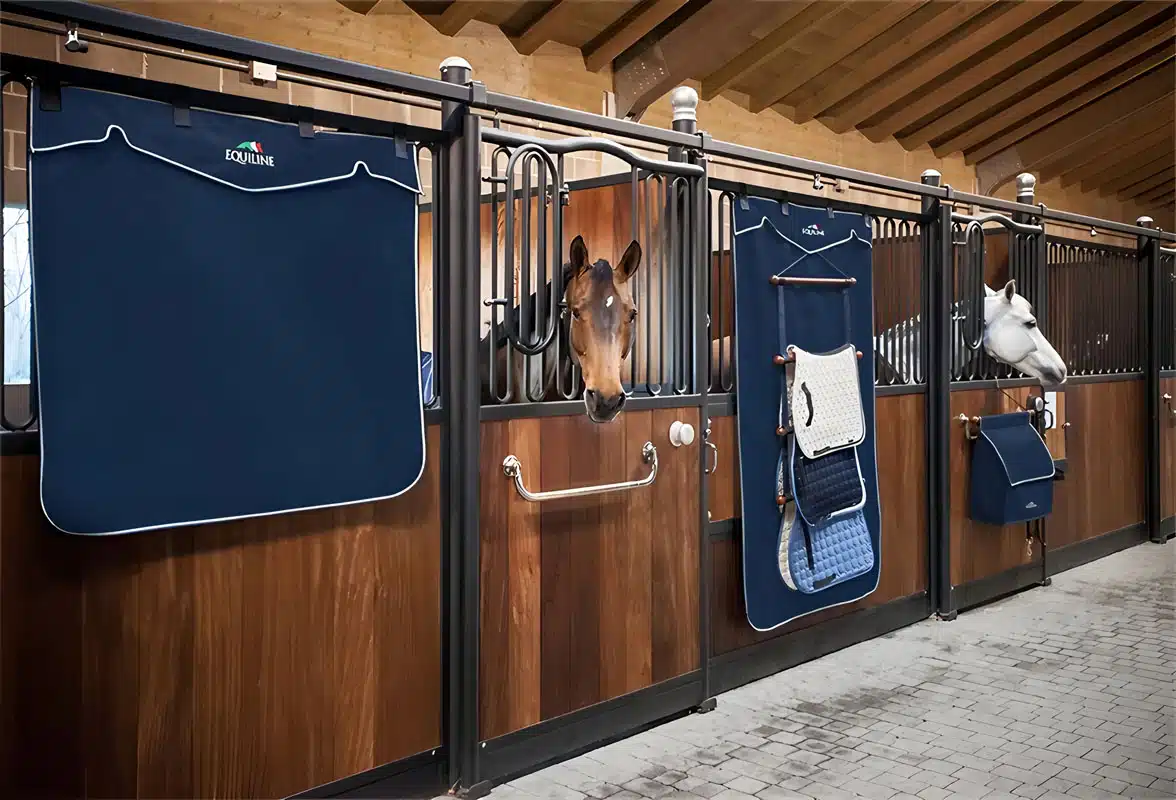
Rust-Resistant Horse Stables Built to Last
DB’s Adjustable Sliding Track Hangers
Executive Summary: Our threaded vertical rod mechanism allows millimeter-precise height adjustments post-installation, eliminating door drag on sloped aisle floors where fixed hangers fail.
| Component Spec | Operational Advantage |
|---|---|
| Adjustment Mechanism | Threaded Vertical Rod (Post-Installation Tuning) |
| Material Grade | 304 Stainless Steel (Ammonia & Moisture Resistant) |
| Load Capacity | Engineered for High-Density Bamboo & HDPE Infills |
| Safety Feature | Anti-Jump Retention Design |
Correcting Floor Irregularities and Door Drag
Most commercial stable aisles are not perfectly flat. Contractors intentionally slope concrete for drainage, or older structures settle over time. This creates a significant mechanical issue for sliding doors: a standard fixed hanger assumes a perfectly level floor. When the floor dips or rises, a fixed door will either drag on the concrete (damaging the bottom guide) or leave a dangerous gap large enough for a hoof to get stuck.
We solved this by integrating a heavy-duty threaded vertical rod into the hanger assembly. This design allows installers to fine-tune the door height after the door is hung on the track.
- Micro-Adjustment: Installers can raise or lower the door by millimeters to match the specific floor grade at that stall.
- Long-Term Maintenance: As buildings settle over years, the door can be re-adjusted in minutes without removing the track.
- Smooth Operation: Ensures the door hangs plumb and glides freely, preventing the “stuttering” friction caused by bottom drag.
Heavy-Duty 304 Stainless Steel Roller Assembly
Horse urine generates ammonia, which rapidly corrodes standard steel and low-grade alloys. While many competitors use carbon steel or nylon wheels that degrade in stable environments, we strictly manufacture our hangers, bearings, and track components from 304 Stainless Steel.
The rollers are specifically engineered to carry the substantial weight of our “Kick-Proof” infills. A standard stable door filled with High-Density Bamboo or 32mm solid HDPE is significantly heavier than a hollow-core residential door. Our roller assembly supports this static load without deforming or developing flat spots.
- Corrosion Resistance: 304 grade steel withstands high-moisture and acidic stable conditions.
- Structural Integrity: Bearings are sealed and sized to handle the dynamic force of 450kg doors in motion.
- Anti-Jump Security: The hardware geometry fits securely within the DB track profile, making it mechanically impossible for a horse to derail the door during impact.
Using Shims on the Header Board to Maintain True Level
Drainage requires a sloped floor, but sliding doors demand a perfectly level track. Shimming the header board bridges this geometric gap to prevent gravity-driven door movement.
The Impact of Aisle Slope on Sliding Door Mechanics
Most commercial stable aisles feature a 1-2% concrete slope to ensure proper drainage during washdowns. While this is necessary for sanitation, it creates a direct mechanical conflict for sliding door systems. If installers mount the header board parallel to the sloped floor, they inadvertently create a gravity ramp.
The result is immediate and dangerous: heavy steel-framed doors will roll open or slam shut on their own. The only way to prevent this “ghost door” effect is to ignore the floor angle completely during header installation. You must establish a “True Level” reference line using a laser level before attaching any brackets. The header board must sit on this horizontal plane, regardless of how much the concrete floor drops away beneath it.
Positioning Shims within the Galvanized Frame Assembly
Once you establish the level line, you will likely encounter a gap between the top of the vertical structural posts and your header bracket on the “low” side of the aisle. This is where structural shimming applies. You must insert packers—typically flat steel or UV-stable HDPE—between the post top and the header connection point to fill this void.
- Material Compatibility: Ensure shim materials are non-corrosive. Using reactive metals or untreated wood can compromise the ISO 1461 hot-dip galvanized coating on the frames.
- Structural Locking: Secure the leveled header assembly through the shims using the provided 304 Stainless Steel hardware.
- Load Transfer: The shims must fully support the compression load of the header to prevent sagging over time.
This process ensures the track remains perfectly horizontal. The door will stay exactly where you leave it, rather than drifting due to the building’s drainage pitch.
Frequently Asked Questions
Can I install sliding stable doors on a sloped aisle?
Yes, but the overhead track must remain perfectly horizontal. Never slope the track to match the floor gradient, as gravity will force the heavy steel door to slide open on its own. Instead, install the track level and allow the gap at the bottom of the door to vary across the width of the opening. For steep slopes, we recommend using a heavy-duty bottom brush seal or ordering doors with extended bottom profiles to minimize the gap at the lower end while maintaining the standard clearance at the high end.
Why does my stable door roll open by itself?
This is almost always caused by an unlevel track. DB Stable doors use heavy-duty steel frames and dense infills (often exceeding 250kg per panel). Even a slight 3mm dip in the track creates enough leverage for gravity to pull that weight downhill. To fix this, loosen the track mounting bolts and insert metal shims behind the brackets until the track reads perfectly level on a spirit level. Do not rely on the wall or header board being straight; trust the level tool.
How do I determine the correct track height if the floor is uneven?
Always measure your installation height from the highest point of the floor within the door’s sliding range. Set the track so the bottom of the door has at least 50mm clearance (our standard “Cast-Proof” gap) at this high point. If you measure from the low point, the door will jam against the concrete when it slides to the high side. Any resulting gap larger than 50mm at the low end can be addressed with extended brushes or bedding adjustments.
Final Thoughts
Ignoring the physics of drainage slopes leads to dangerous “ghosting” doors and immediate liability for your facility. DB Stable’s adjustable 304 Stainless Steel hangers allow you to neutralize these floor irregularities without compromising the ISO 1461 galvanized protection of the frame. Investing in this engineered precision prevents costly callbacks and solidifies your reputation as a premium builder.
Validate our “Hot-Dip After Fabrication” standard directly by requesting a technical catalog or a material sample kit. Our engineering team stands ready to analyze your barn plans and optimize your component list for a high-margin container load. Contact us today to secure a manufacturing partner who understands the geometry of safety.


 English
  Spanish
  French
  Arabic
  German
0 Comments