


Proper tractor clearance distinguishes a profitable commercial facility from a maintenance nightmare. Relying on standard 4-foot stall doors creates a geometric conflict with skid steer buckets, leading to inevitable frame collisions and jammed sliding mechanisms. These structural failures force operators back to manual mucking, destroying the labor efficiency metrics that justified the machinery investment in the first place.
This article details the engineering behind 6-foot wide sliding fronts fabricated from Q345B Low Alloy High Strength Steel. We examine why Hot-Dip Galvanization and enclosed track systems are mandatory for supporting heavy-duty panels against mechanical impact. Adopting these OEM specifications allows general contractors to deliver resilient infrastructure that supports high-volume cleaning operations without constant repair cycles.

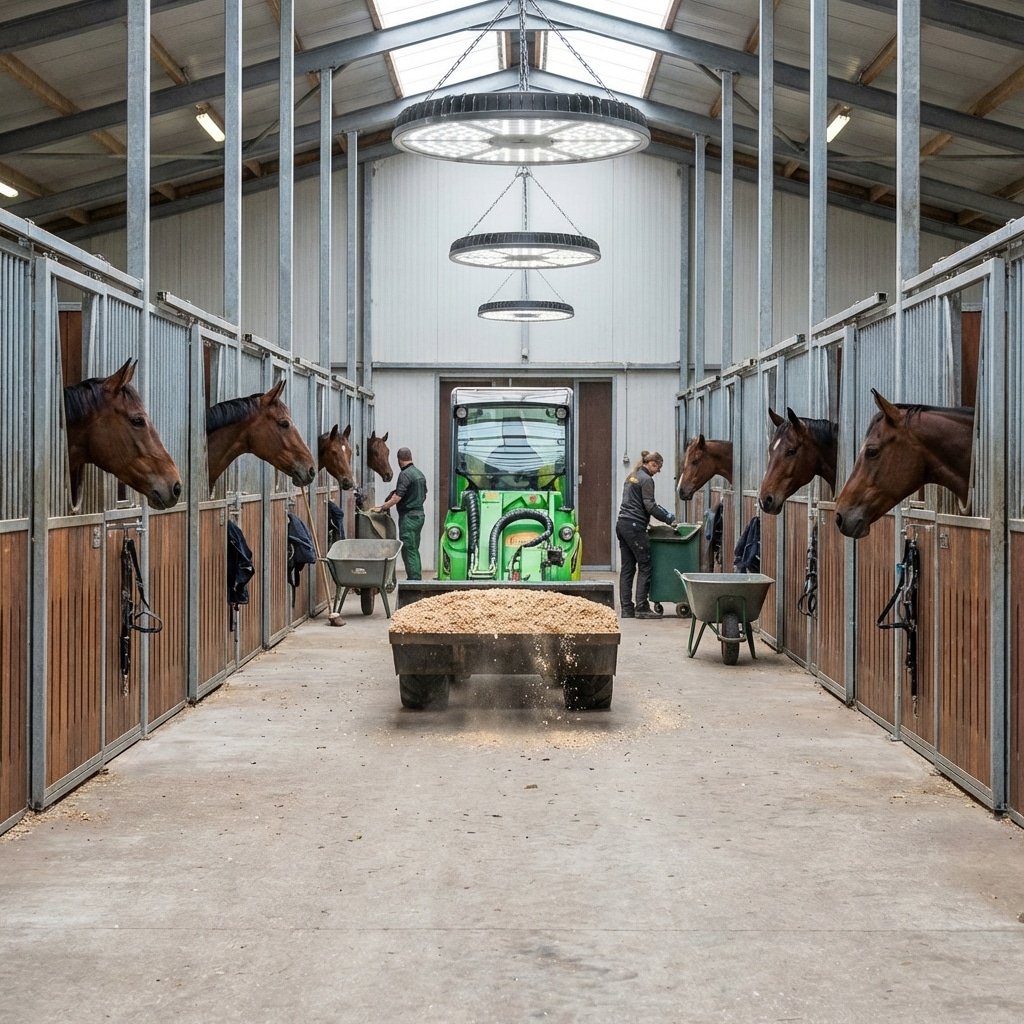
The Transition from Wheelbarrows to Skid Steers
Quick Take: Shifting to mechanical cleaning cuts labor costs but increases structural risk. We spec Q345B steel to withstand the inevitable impacts from skid steer buckets.
The Shift to Mechanical Stable Cleaning
For decades, the standard for stall cleaning was a pitchfork, a wheelbarrow, and physical labor. In small private barns, this remains viable. But for commercial training centers, stud farms, and large equestrian clubs, the mathematics of manual labor no longer work. Mucking out 50+ stalls by hand is a bottleneck that drives up operational costs and staff turnover.
The industry solution has been the widespread adoption of skid steer loaders (often referred to generically as Bobcats) and mini-articulated loaders. These machines were originally invented specifically for cleaning turkey barns in the 1950s, making them the natural evolution for agricultural efficiency. A task that takes 20 minutes by hand—stripping a stall of wet bedding and manure—drops to under two minutes with a mechanical loader.
This operational shift dictates facility design. You cannot retrofit a skid steer into a narrow aisle or a stall with a standard 4-foot door. Modern commercial projects now prioritize 12-foot to 14-foot aisles and sliding stall fronts that open wide enough to accommodate the width of a loader bucket.
Structural Resilience: The Role of Q345B Steel
Introducing heavy machinery into a horse barn introduces a new variable: impact. A wheelbarrow bumping a door frame causes a scratch; a skid steer bucket hitting a door frame causes structural failure. Drivers have limited visibility, and accidental collisions with door posts and bottom grills are inevitable in high-volume facilities.
Standard Q235B (ASTM A36) steel, used by most budget manufacturers, is soft enough that a direct hit from a loader can bend the frame, jamming the sliding mechanism. This is why DB Stable offers Q345B Low Alloy High Strength Steel (equivalent to ASTM Grade 50) for professional facilities. The material differences are critical for longevity:
- Yield Strength: Q345B offers significantly higher yield strength than standard carbon steel, allowing it to absorb impact energy without permanent deformation.
- Cold Weather Toughness: Q345B maintains ductility in freezing temperatures. When a frozen steel post is hit by a loader in winter, standard steel can fracture; Q345B resists brittle failure.
- Abrasion Resistance: We pair this steel with Hot-Dip Galvanization (ISO 1461) applied after fabrication. Unlike powder coat or paint which chips off upon impact—leading to immediate rust—galvanized zinc self-heals minor abrasions caused by loader buckets.
When designing for mechanical cleaning, the steel specification is just as important as the dimensional layout. We build frames assuming they will be hit, ensuring the structure survives the daily rigors of mechanized mucking.

Standard 4-Foot Stall Doors vs Tractor Buckets
Standard 4-foot stall openings typically provide less than 48 inches of clearance, making them incompatible with most skid steers and requiring manual mucking or specialized compact loaders.
The Dimensional Mismatch: 4-Foot Doors vs. Skid Steer Widths
The industry standard for equine stall fronts is a 4-foot (1.2m) opening. While this functions well for horses and handlers, it presents a geometric conflict for modern mucking machinery. The “4-foot” specification refers to the rough opening or the door panel size, but the actual usable space is always tighter. Door stops, bottom guides, and latch hardware often reduce the clear passage width to between 44 and 46 inches.
This creates an immediate bottleneck for mechanized cleaning operations. Most commercial skid steer buckets start at a minimum width of 48 inches, with common models ranging up to 72 inches. You simply cannot fit a 48-inch bucket through a 45-inch gap without taking the door frame with you.
- Clearance Reduction: Hardware and stops reduce a 1.2m opening to approximately 1.1m (44 inches) of effective clearance.
- Equipment Conflict: Standard skid steer buckets (48″+) will jam or impact the frame, preventing entry.
- Operational Constraint: Facilities with standard doors are restricted to manual mucking or “aisle-only” cleaning methods where the machine never enters the stall.
Safeguarding Structures: Q345B Steel Resilience Against Machinery Impact
Even when tractors remain in the aisle, the risk of accidental contact is high. A skid steer performing a zero-turn pivot in a 12-foot aisle can easily swing its bucket or rear counterweight into a stall front. Standard mild steel frames (Q235/A36) often dent or buckle under this lateral pressure, compromising the sliding mechanism.
To address this reality, DB Stable upgrades the structural components of our Professional and Royal series to **Q345B Low Alloy High Strength Steel**. This material is equivalent to ASTM Grade 50, offering significantly higher yield strength than standard steel. It resists deformation from mechanical strikes, ensuring the door track remains true even after minor equipment collisions.
- Impact Resistance: Q345B steel absorbs impact energy better than standard mild steel, preventing structural warping.
- Scrape Protection: We use **Hot-Dip Galvanization after fabrication** (BS EN ISO 1461). Unlike paint or powder coat which chips off upon impact, the zinc alloy is metallurgically bonded to the steel.
- Longevity: If a tractor bucket scrapes the frame, the self-healing properties of the zinc coating prevent immediate rust, maintaining the facility’s professional appearance.
Engineered for 20+ Years of Rust-Free Durability

Custom OEM Horse Stall Fronts with 6-Foot Sliding Doors
We engineer wide-span 6-foot doors using 14-gauge Q235B steel to enable safe skid steer access without compromising structural rigidity or hinge alignment.
| Specification | Standard Market Option | DB Stable OEM 6-Foot Spec |
|---|---|---|
| Clear Opening Width | 4 Feet (Standard) | 6 Feet (Machinery Ready) |
| Steel Material | Pre-Galvanized Tubing | Q235B Structural Steel |
| Wall Thickness | 16-Gauge (1.5mm) | 14-Gauge (2.0mm – 2.5mm) |
| Rust Protection | Zinc Spray on Welds | Hot-Dip Galv After Fabrication |
Operational Advantages of 6-Foot Clear Openings
Standard 4-foot stall doors are a legacy dimension designed strictly for hand-walking horses. Modern facilities require efficiency, which means mechanical mucking. We design 6-foot sliding systems specifically to allow skid steers and compact tractors to enter the stall directly. This eliminates the labor-intensive process of manual wheelbarrow work and speeds up barn turnover times significantly.
Beyond machinery, wider openings are a safety imperative. Large Warmbloods and draft breeds often catch their hips on standard door frames if they turn prematurely during exit. A 6-foot clearance provides ample room for the horse and handler to exit side-by-side without crowding. The expanded grill sections also increase the “Stack Effect,” pulling more air vertically through the stable to improve ventilation and visibility.
Structural Fabrication Using Hot-Dip Galvanized Q235B Steel
Extending a door span to 6 feet introduces significant leverage and weight stress. Standard 16-gauge steel frames often warp or bow under this load. To prevent failure, we manufacture these fronts exclusively using Q235B Structural Steel (equivalent to ASTM A36). This material choice ensures the frame remains rigid and tracks slide smoothly even after years of heavy use.
- Heavy-Duty Profiles: We utilize 50mm x 50mm RHS (Square Hollow Section) for the primary frame to support the expanded width.
- Strict Gauge Control: All tubing is 14-Gauge (2.0mm – 2.5mm). We strictly prohibit the use of 1.5mm steel for these spans.
- Hot-Dip After Fabrication: We weld the black steel frame first, then dip the entire unit in molten zinc (ISO 1461). This seals every weld and joint against corrosion.
- Zinc Thickness: Structural parts receive an average coating greater than 85 microns to withstand ammonia and moisture.

Supporting Massive Doors with Enclosed Hidden Tracks
Enclosed hidden tracks are mandatory for 400kg+ doors, preventing derailment and debris jams while ensuring smooth, one-handed operation where standard open rollers fail.
The Mechanics of Enclosed Track Systems
Standard barn door hardware often fails in active equine environments because open rollers act as magnets for contaminants. In a working stable, dust, hay, and bedding inevitably become airborne. On an open rail, this debris settles directly on the track path, causing the rollers to grind, stutter, or jam completely over time. We solve this by enclosing the rolling mechanism inside a protected steel channel.
This design choice is not just about reducing maintenance; it is a critical safety feature. Horses are powerful animals that often kick or lean heavily against stall fronts. With traditional open hardware, a violent upward impact can lift the door enough to jump the rail, causing the heavy panel to fall. Our enclosed system captures the trolley wheels within the track profile, making it mechanically impossible for the door to derail during aggressive behavior.
- Debris Shielding: The enclosed housing prevents hay and dust accumulation that typically jams standard rollers.
- Anti-Derailment Safety: The captive track design eliminates the risk of heavy doors jumping off the rails during horse impacts.
- Weather Protection: Enasing the mechanism protects bearings from moisture and rust, significantly reducing maintenance intervals.
Supporting 450kg Bamboo and HDPE Panels
Material choice dictates hardware requirements. High-density Bamboo and solid HDPE infills offer superior durability compared to softwood, but they carry a significant weight penalty. A fully loaded DB Stable front typically weighs between 250kg and 450kg. Standard lightweight aluminum tracks or hardware-store “box rail” kits will sag or shear under this load, leading to mechanical failure.
We engineer the Professional Series specifically to handle this mass. The system utilizes a heavy-duty hidden track integrated directly into the Q345 steel header. This is paired with high-capacity trolleys designed to distribute the static load effectively. The result is a massive, structural door that operates with surprising lightness. Despite the weight, the precision bearings allow for smooth, one-handed operation, ensuring staff can manage the stables safely and efficiently without physical strain.
Frequently Asked Questions
Can I drive a standard tractor through a 4-foot horse stall door?
No. Standard horse stall doors are engineered strictly for equine safety, typically measuring 4 feet (approx. 1.2m) wide. Most tractors require a clearance of 10 to 14 feet. You must differentiate between equine stalls and equipment storage areas. If you need machinery access into a specific stall, specify custom oversized doors during the design phase rather than relying on standard stock sizes.
What is the minimum door width required for skid steer mucking?
While some mini-loaders can technically fit through a standard 4-foot opening, we recommend a minimum clear width of 4.5 to 5 feet (approx. 1.4m – 1.5m) for safe and efficient operation with a skid steer. This buffer prevents accidental impact damage to the door frame and ensures the machine can maneuver without getting stuck during daily mucking routines.
How do I calculate the track length needed for a custom wide door?
The overhead track must be at least double the width of the door panel to allow it to slide completely open. For example, a custom 6-foot wide door requires a 12-foot track. DB Stable provides heavy-duty, hot-dip galvanized tracks cut to these specific ratios to handle the increased weight of wider panels without sagging.
Do you offer custom sizing for barns that need larger equipment access?
Yes. As an OEM manufacturer, DB Stable produces the Royal and Professional Series fronts in custom dimensions to suit commercial facility needs. We can fabricate sliding doors up to 6 feet wide or larger to accommodate mechanical mucking equipment, using heavy-duty Q345B steel frames to support the extra weight and maintain structural rigidity.
Final Thoughts
While standard mild steel offers lower upfront costs, our Q345B Low Alloy High Strength Steel is the only material tough enough to resist structural failure from inevitable loader bucket impacts. We pair this resilience with Hot-Dip Galvanization (ISO 1461) to ensure that accidental scrapes self-heal rather than rust, protecting your facility’s professional appearance. Investing in this industrial-grade specification prevents costly frame replacements and keeps your mechanical cleaning operations running without downtime.
Don’t force your staff to navigate narrow aisles with heavy machinery when you can engineer the problem out of the design. We recommend submitting your floor plans so we can validate the exact clear-span required for your specific skid steer models. Contact our team to discuss your Professional Series configuration and secure a factory-direct quote for your next project.



 English
  Spanish
  French
  Arabic
  German
0 Comments