


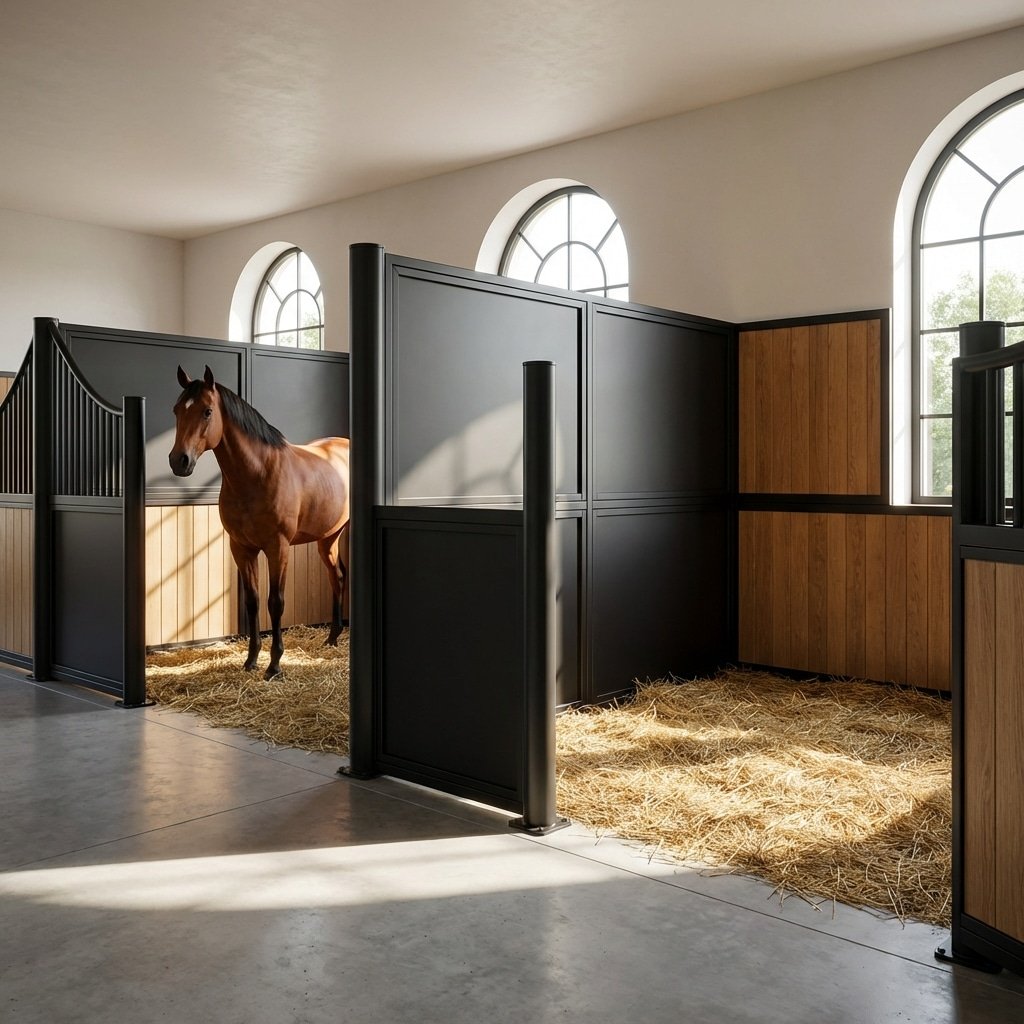
Designing compliant Foaling Stalls is a critical defense against high-value livestock injury and veterinary liability. Standard 3.6m boxes maximize boarding capacity but often fail to provide the anti-casting space required for a safe delivery, forcing facility managers to balance seasonal safety against year-round occupancy.
This engineering brief benchmarks modular partition systems that convert standard units into professional breeding suites. We evaluate the structural necessity of Q345B Low Alloy High Strength Steel and the Cast-Proof 50mm bottom gap standard to help you achieve ISO 1461 durability while maintaining operational flexibility.
The Space Requirements for a Foaling Mare
Veterinary consensus sets the ideal foaling footprint at 12×24 feet (3.6×7.3m). Modular partition systems allow facilities to achieve this by merging two standard stalls, ensuring safety without permanent construction.
e=”margin-top: 30px; margin-bottom: 15px; font-weight: 600; line-height: 1.3;”>Veterinary Standards: Minimum vs. Optimal Dimensions
Most facility managers underestimate the square footage required for a safe delivery. While a 12’x18′ (3.6m x 5.5m) stall is the absolute minimum standard, it functions more as a “survivable” space rather than a safe one. In a stall of this size, if a mare lies down awkwardly or complications arise, veterinarians often lack the physical room to maneuver around the animal to assist with the birth.
Professional breeding operations target a 12’x24′ (3.6m x 7.3m) configuration. This dimension is not arbitrary; it accommodates the mare and foal for 5 to 6 months of cohabitation while mitigating specific risks:
- Prevention of Casting: Mares roll frequently during the early stages of labor. In smaller stalls, they risk getting “cast” (trapped) against a wall, unable to rise.
- Veterinary Access: A larger footprint ensures two to three handlers can safely access the mare from all angles without being pinned against partition walls.
- Post-Foaling Safety: The extra space allows the foal to learn to stand and nurse without constantly colliding with walls or the mare.
The Modular Solution: Creating a Double-Size Foaling Unit
Building dedicated 12’x24′ stalls that sit empty for half the year is a poor use of capital. The industry standard solution involves modular engineering. By installing a removable partition between two standard 12’x12′ (3.6m) stalls, facilities can create a temporary “suite” for the foaling season.
DB Stable designs these systems for rapid conversion. Our partitions utilize heavy-duty 304 Stainless Steel connectors that allow the center wall to be detached completely. This differs from hinged dividers, which still present a protrusion hazard even when folded back. The flat-pack modular design ensures that once the foal is weaned, the wall is re-installed, returning the facility to its full capacity of two separate rental units.
- Structural Integrity: We use Q235B or Q345B structural steel frames to ensure the removable wall is as rigid as a permanent fixture when locked in place.
- Cast-Proof Design: The partition sits with a minimal 50mm bottom gap to prevent foal hooves from sliding under the wall, a critical “kick-proof” safety feature.
- ROI Protection: This convertible design maximizes facility revenue by adapting to seasonal breeding demands without requiring new construction.
Removable Horse Stall Partitions Explained
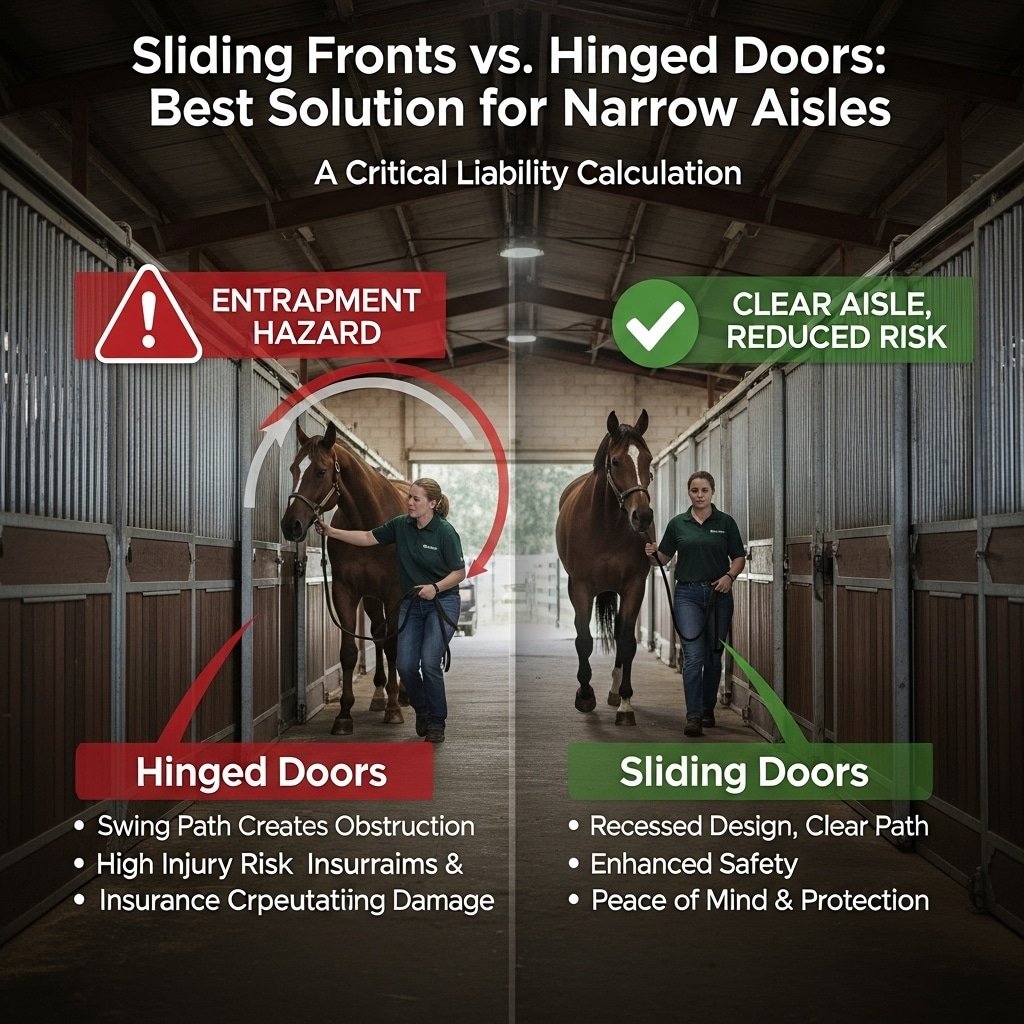
Removable partitions allow facilities to merge two standard stalls into a single foaling suite using heavy-duty tracks or hinges, doubling floor space without permanent construction.
Operational Flexibility: Converting Stalls for Foaling
Facility managers often face a dilemma: dedicating permanent space to foaling stalls that sit empty half the year, or cramming mares into standard boxes. The solution lies in the “Merge Concept.” By installing removable center partitions, you can instantly convert two standard 3.5m x 3.5m boxes into a single 7m x 3.5m foaling suite. This adaptability allows commercial stables to maximize occupancy rates year-round, utilizing the space for boarding during the off-season and expanding it for breeding season.
We engineer two distinct mechanisms to achieve this conversion, depending on your aisle clearance and operational flow:
- Hinged Swing-Open Design: The partition unlocks and swings 180 degrees against the back wall. This is the fastest method but requires a clear “sweep zone” free of bedding buildup or feeders.
- Fully Removable Slide-Out System: The entire wall slides out of a C-channel track into the aisle. This is ideal for barns with tighter internal dimensions where swinging a 3.5m wall isn’t feasible.
Beyond the mechanics, socialization remains critical. We design these partitions with top grills to allow visual and olfactory contact between the mare and neighbors, reducing stress. However, the bottom section remains solid to ensure the foal stays secure and draft-free at ground level.
| Specification | DB Stable Standard | Why It Matters |
|---|---|---|
| Steel Grade | Q345B (ASTM Grade 50) | Prevents brittle fracture from heavy kicks in cold climates. |
| Corrosion Protection | Hot-Dip Galv (ISO 1461) | Prevents rust seizure in moving hinges and tracks. |
| Zinc Thickness | > 70 microns | Ensures 20+ year lifespan in high-ammonia environments. |
| Frame Profile | 50mm x 50mm RHS | Provides rigid structural support during removal/re-installation. |
Structural Integrity: Q345B Steel & Hot-Dip Galvanization
A removable wall must withstand the same abuse as a fixed one. When a mare protects her foal, she may kick out with extreme force. Standard commercial steel (Q235/A36) often bends under this specific point-load pressure. We upgrade our partition frames to Q345B Low Alloy High Strength Steel (equivalent to ASTM Grade 50). This material offers superior impact toughness, particularly in freezing temperatures where lower-grade steel becomes brittle and prone to snapping.
Corrosion is the enemy of any moving mechanical part. In a stable environment rich in ammonia and humidity, standard painted or pre-galvanized steel hinges will seize within months. We utilize Hot-Dip Galvanization After Fabrication (ISO 1461 standard). This means we weld the black steel frame first, then dip the entire unit into molten zinc, achieving a coating thickness greater than 70 microns. This seals every weld point and hinge mechanism against rust.
The framework profile itself is non-negotiable. We use heavy-duty 50mm x 50mm RHS (Square Hollow Section) with a 2.5mm wall thickness. While many competitors cut costs by using 1.5mm or 2.0mm tubing, we stick to the heavier gauge. This rigidity ensures the partition retains its shape during movement, preventing the misalignment that often makes lighter removable walls impossible to latch over time.
20-Year Rust-Free Custom Stable Solutions
The “Cast-Proof” Bottom Gap (50mm Safety Rule)
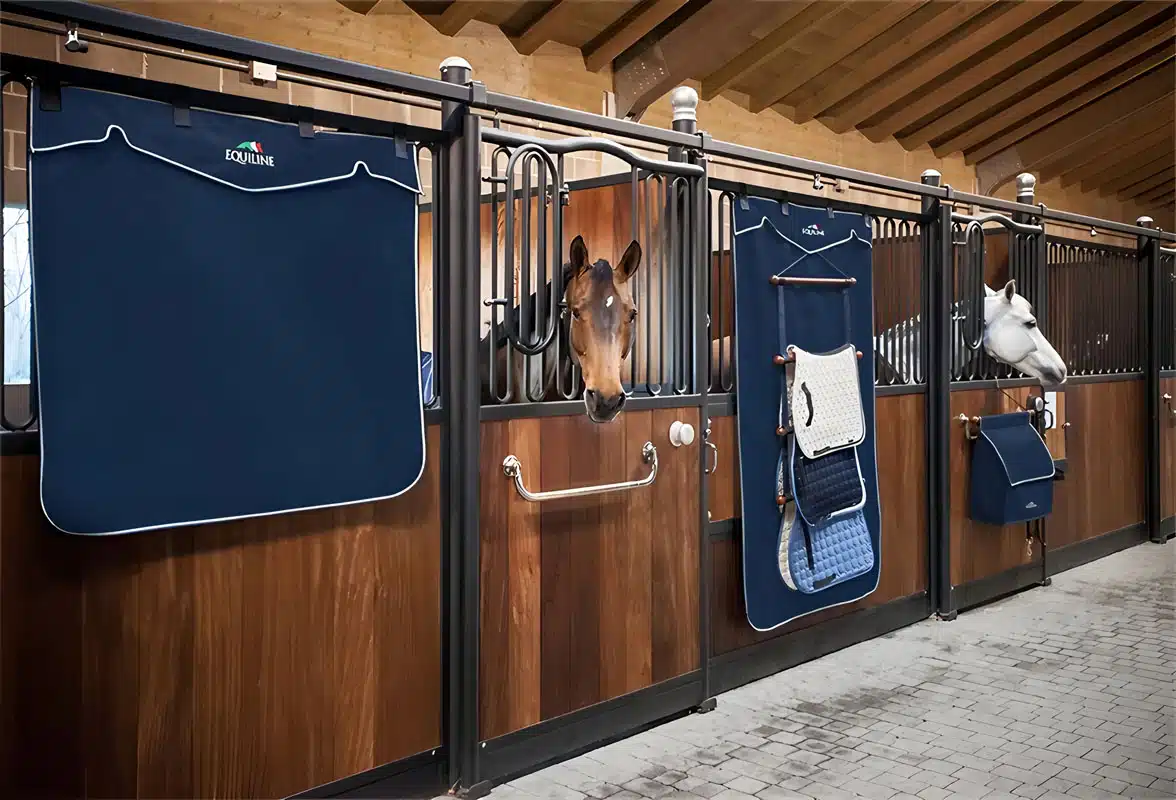
The 50mm Safety Rule restricts the gap between the stall wall and the floor to a maximum of 50mm, preventing hooves—especially foals—from sliding under and becoming wedged.
Understanding the Mechanics of Equine Casting
“Casting” is a specific industry term describing a horse that has rolled too close to a stall wall and cannot gain the leverage required to stand up. When a horse lies down, it needs space to extend its legs and rock its weight forward to rise. If a wall blocks this extension, the animal becomes trapped. The panic that follows often leads to thrashing, which introduces the secondary—and often more severe—risk of limb entrapment.
The primary hazard zone during a casting event is the gap between the bottom of the partition and the floor. In many standard agricultural builds, builders leave a gap of 100mm (4 inches) or more to facilitate drainage and cleaning. For an adult horse, this might be safe. However, during the violent thrashing of a cast horse, a hoof can easily slide through a 100mm gap. When the horse attempts to pull the leg back, the fetlock joint acts as a wedge, locking the leg against the steel frame. This mechani
cal lock prevents the horse from freeing itself and often results in catastrophic tendon damage or fractures.
This risk amplifies significantly in breeding operations. A newborn foal has significantly smaller hooves than an adult horse. Gaps that are technically “safe” for a Warmblood mare (e.g., 80mm) become lethal traps for a foal. Without reducing this clearance, the facility is effectively designed with built-in snare hazards for younger stock.
Engineering the 50mm Safety Clearance
To eliminate this liability, DB Stable engineers the bottom clearance of our partitions strictly under 50mm. This dimension is not arbitrary; it is calculated to be smaller than the average hoof width of a foal, making it physically impossible for the hoof to enter the gap in the first place. By blocking entry, we prevent the entrapment mechanics entirely.
Maintaing this precise gap requires structural rigidity. Cheaper partitions often use lighter frames that warp or bow over time, inadvertently widening the bottom gap. We utilize heavy-duty 50x50mm RHS (Square Hollow Section) posts and bottom rails. This 14-gauge structural steel ensures the frame maintains a rigid, straight line along the floor, preserving the 50mm safety tolerance regardless of impact or bedding weight.
- The 50mm Limit: We cap bottom clearance at 50mm to block hoof entry completely.
- Structural Rigidity: 50x50mm RHS posts prevent warping that could widen the gap over time.
- Cast-Proof Guarantee: This specification is mandatory for all foaling boxes and professional breeding facilities to ensure mare and foal safety.
Disinfecting HDPE Stall Boards After Foaling
Post-foaling sanitation requires removing organic load before applying phenolic disinfectants. Unlike porous wood, HDPE stall boards resist pathogen absorption and withstand harsh chemicals without degrading.
Standard Protocol: Clean, Scrub, and Sanitize
Veterinary research indicates that effective disinfection is impossible if surface debris remains. You must follow a strict three-step sequence to ensure the stall is safe for the next mare and foal.
- Remove Organic Matter: You cannot disinfect manure or wet bedding. Strip the stall completely. Organic materials bind to disinfectants and inactivate them immediately, rendering expensive chemicals useless.
- Scrub with Detergent: Before sanitizing, scrub all surfaces with a stiff brush and a foaming detergent. This mechanical action breaks down biofilms—invisible layers of bacteria that adhere to walls and protect pathogens from chemical attacks.
- Apply Phenolic Disinfectant: Use a phenolic-based disinfectant rather than standard bleach. Phenolics are specifically proven to kill rotavirus and other foal-threatening pathogens. Spray the surface and allow it to air dry completely without rinsing to ensure maximum contact time.
The Hygiene Advantage of Non-Porous HDPE Infill
For professional breeding operations, the material of the stall wall is just as critical as the cleaning agent. We recommend and supply 28mm-32mm HDPE specifically because it eliminates the biosecurity risks inherent in traditional timber.
- Impermeable Barrier: Wood is porous and acts like a sponge, trapping fluids, bacteria, and ammonia deep within the grain where brushes cannot reach. HDPE creates a sealed surface that prevents pathogen absorption entirely.
- Chemical Resistance: DB Stable’s UV-stabilized HDPE withstands repeated exposure to harsh phenolic chemicals and bleach. While these agents rot wood and degrade cheap plastics over time, our specific HDPE formulation remains structurally sound.
- Rapid Turnaround: This material supports our “Zero Maintenance” standard. Staff can perform aggressive wash-downs and high-speed drying between foalings, whereas wood requires significant downtime to dry out to prevent mold growth.
Frequently Asked Questions
How do I create a removable partition for a foaling stall?
The most effective method uses a U-channel system or heavy-duty pin-lock connectors. In professional modular stabling, we design partitions to slide out or swing open (hinged), allowing two standard 12’x12′ stalls to merge into a single large foaling unit without structural demolition. Our systems utilize 304 Stainless Steel hardware in the installation kit to ensure these connection points resist rust and remain operable after years of use.
What is the ideal size for a foaling stall?
While 12′ x 16′ is the absolute minimum, the industry ideal is 12′ x 24′ (approx. 3.6m x 7.3m). This rectangular footprint allows the mare to effectively separate areas for resting and foaling, and provides enough space for her to roll without risking injury to the foal. Most facilities achieve this by removing the center partition between two standard boxes.
What does a ‘Cast-Proof’ bottom gap mean?
A cast-proof design specifically limits the gap between the bottom of the stable wall and the floor to approximately 50mm (2 inches). This gap is sufficient for drainage and ventilation but is too narrow for a foal to trap a hoof or leg underneath if they roll close to the wall. We engineer our partitions to maintain this precise tolerance to prevent entrapment injuries.
Why is HDPE preferred over wood for foaling boxes?
HDPE (High-Density Polyethylene) is non-porous, meaning it does not absorb fluids, bacteria, or odors. After foaling, HDPE walls can be pressure-washed and fully disinfected, whereas wood grain can harbor pathogens that pose risks to newborn foals with developing immune systems. Our 28mm-32mm HDPE infills also provide a “Kick-Proof Guarantee” and zero maintenance requirements, unlike wood which may splinter under impact.
Final Thoughts
Compromising on structural steel quality puts both your mares and your facility’s reputation at immediate risk. Our Q345B frames and strict 50mm cast-proof tolerance provide the necessary rigidity to withstand high-impact breeding environments. This “Zero Maintenance” standard protects your capital investment from early rust and mechanical failure.
Secure your facility’s operational flexibility by integrating these modular systems before the next foaling season. We recommend requesting a technical specification sheet or a sample connection kit to verify our heavy-duty build quality firsthand. Contact our engineering team today to configure a layout that maximizes your stable’s year-round revenue.

 English
  Spanish
  French
  Arabic
  German
0 Comments