


Roof condensation represents the primary cause of premature corrosion in outdoor horse stable kits. Neglecting thermal breaks allows trapped moisture to aggressively attack steel frames, turning low-cost shelters into expensive warranty liabilities within just a few seasons.
This engineering brief examines how Hot-Dip Galvanization After Fabrication and passive stack effect ventilation neutralize these moisture risks. We detail the application of anti-condensation flocking on 0.8mm profiles to ensure your structures meet BS EN ISO 1461 durability standards.

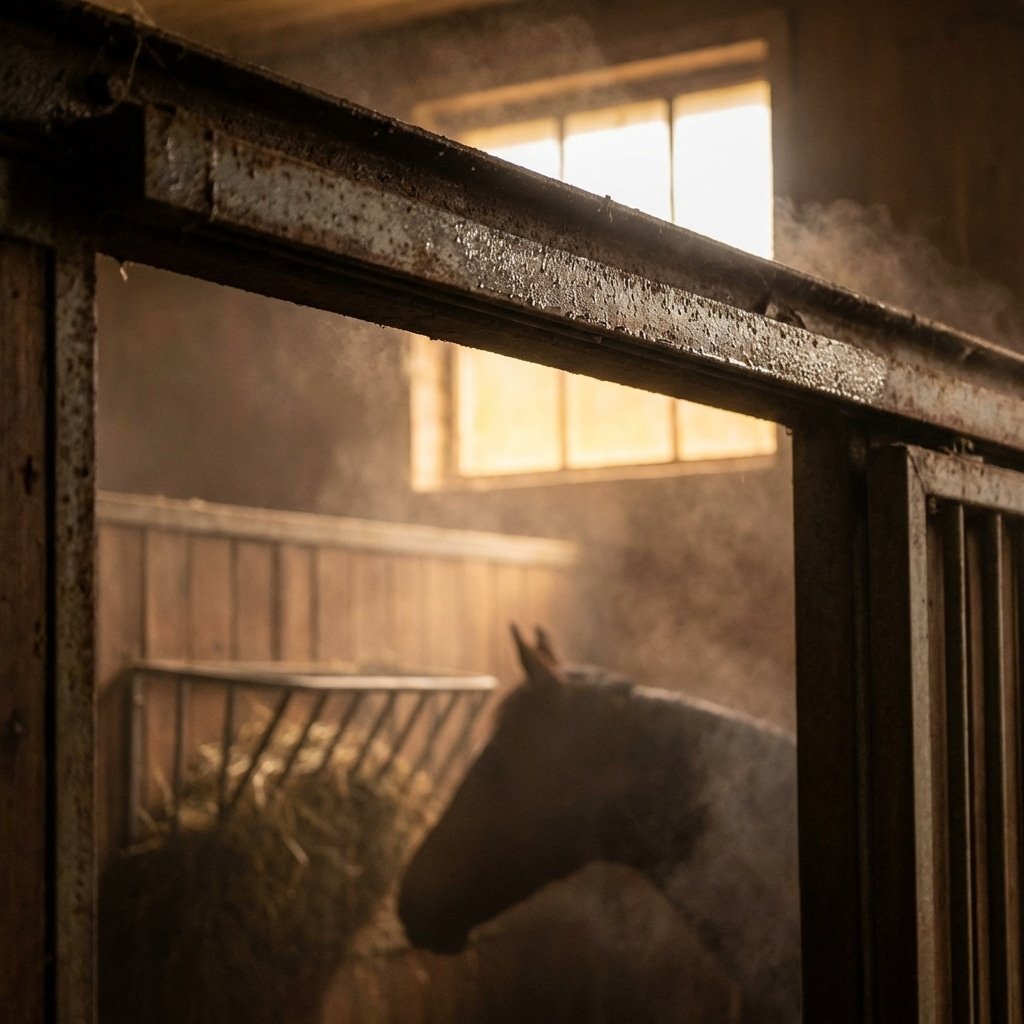
The “Barn Sweating” Phenomenon Explained
Barn sweating occurs when warm, moist internal air contacts cold metal surfaces. This condensation accelerates corrosion, making high-grade galvanization essential for structural longevity.
Understanding the Science of Barn Condensation
“Barn sweating” is rarely a roof leak; it is a simple physics issue involving temperature differentials. Condensation forms when warm, humid air inside the stable contacts a surface that sits below its dew point temperature. In metal structures, the roof and steel frames often act as the primary condensing surfaces.
- The Dew Point Effect: Metal conducts heat efficiently. At night, roofs and frames cool rapidly, often dropping below the internal air temperature. When warm air hits this cold steel, it releases its moisture load immediately.
- Livestock Moisture Load: Animals are massive humidity generators. A single large animal produces approximately 12 to 18 lbs of moisture daily through respiration alone. In a full stable, this creates a high-humidity environment regardless of the weather outside.
- Ventilation Gaps: Without “stack effect” ventilation or mechanical airflow, this moist air stays trapped near the ceiling, ensuring continuous contact with the structural steel.
Combating Moisture Corrosion with ISO 1461 Galvanization
Persistent barn sweating turns a stable into a corrosion chamber. Standard steel frames, or those using “pre-galvanized” tubing (where the weld seams are painted over), often rust within years under these conditions. The water droplets that form on the steel are often acidic due to the ammonia present in animal waste, aggressively attacking weak protective coatings.
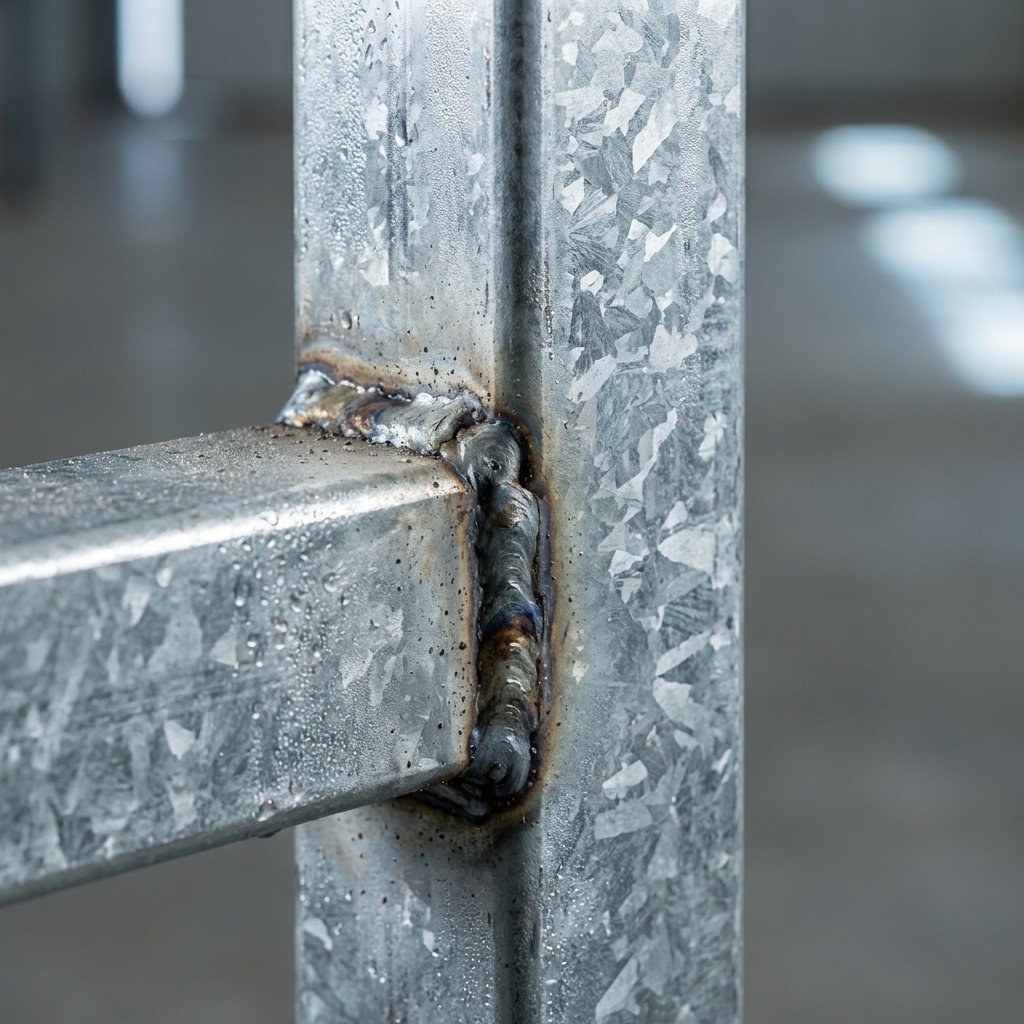
To counter this wet environment, we strictly utilize Hot-Dip Galvanization After Fabrication. Instead of welding pre-coated tubes, we build the raw black steel frame first and then submerge the entire unit into molten zinc.
- Standard Compliance: Our process adheres to BS EN ISO 1461, the international standard for hot-dip galvanized coatings on iron and steel articles.
- Coating Thickness: We achieve an average zinc coating of >85 microns on structural parts (>6mm) and >70 microns on tubing. This is significantly thicker than standard “electro-galvanized” alternatives.
- Total Seal: Because we dip after fabrication, the zinc covers every weld, corner, and internal surface, leaving no entry point for moisture or ammonia to start the oxidation process.
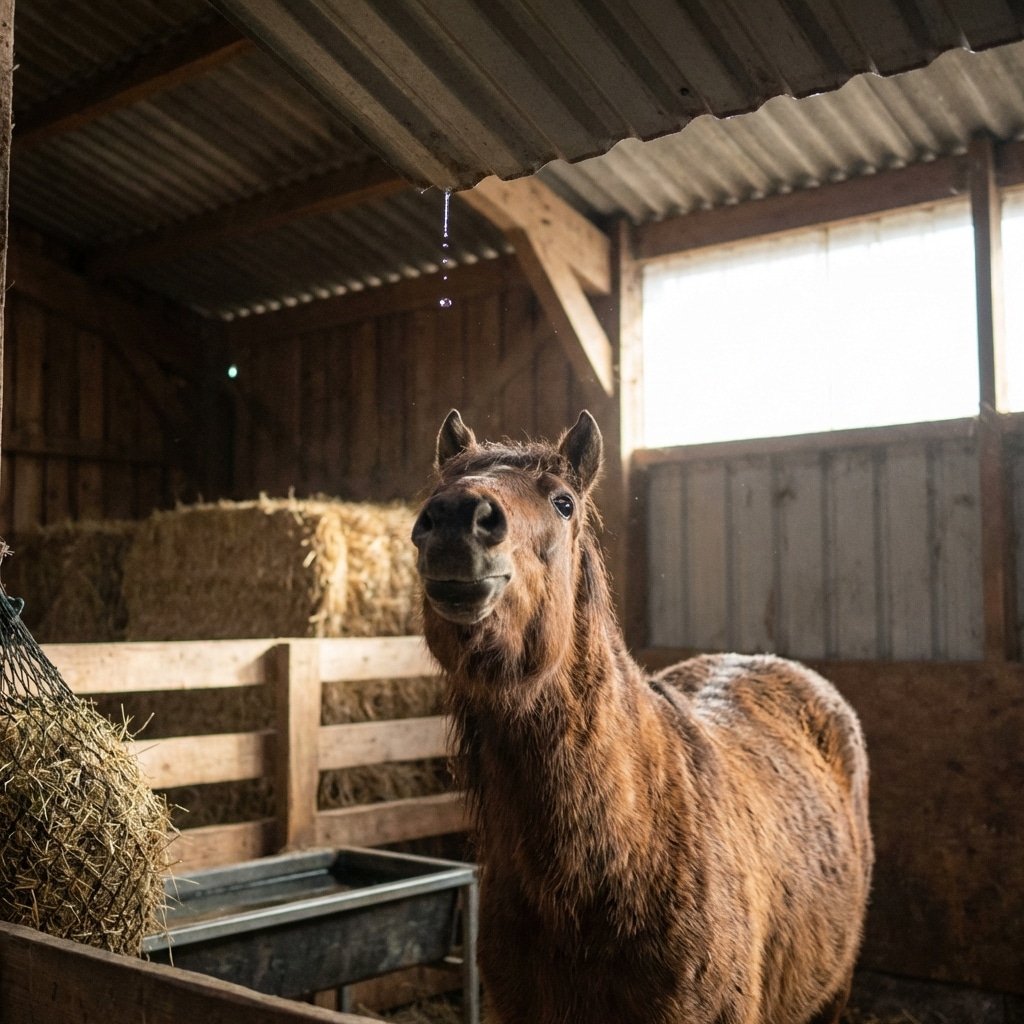
Why Uninsulated Tin Roofs Drip Water on Horses
Uninsulated metal instantly transfers external cold to the interior. When warm, humid stable air contacts this freezing surface, vapor condenses into liquid water droplets.
The Physics of Condensation: Warm Air vs. Cold Steel
The core issue is thermal conductivity. Metal is an excellent conductor of heat, which makes it a terrible insulator. In a single-skin metal roof with no insulation buffer, the interior surface temperature of the steel will match the freezing outdoor temperature almost instantly. This creates a massive temperature differential between the roof and the air inside the stall.
- Zero Thermal Break: Uninsulated metal has negligible R-value, making the roof the coldest surface in the entire structure.
- Convection Currents: Heat naturally rises. The warmest air in the stable, which carries the most moisture, flows directly to the roof peak.
- Phase Change: When humidity hits a surface below its dew point (the cold steel), the gas creates a phase change and turns into liquid water.
Internal Moisture Load: Respiration and Ventilation Deficits
Stables are high-humidity environments by default. A 500kg horse acts as a large humidifier, producing significant moisture daily simply through respiration and body heat. When you add wet bedding, water troughs, and the decomposition of manure, the relative humidity inside a closed barn spikes rapidly. This moisture load must go somewhere.
The dripping intensifies when barns lack “Stack Effect Ventilation.” In many older or cheaper designs, there is no vertical airflow to pull this warm, wet air out through the roof ridge. Instead of exhausting externally, the moisture is trapped against the freezing ceiling. We design our Professional and Economy series with open top grills specifically to facilitate this airflow, preventing the stagnant, humid air pockets that cause “barn sweating.”
Premium Custom Stables With 20-Year Durability
Anti-Condensation Flocking Under 0.8mm Roofing
Executive Summary: Anti-condensation flocking transforms standard 0.8mm steel roofing by disrupting surface tension, holding moisture in suspension until it evaporates naturally, effectively preventing “barn rain” without heavy insulation.
| Feature | Standard 0.8mm Steel | 0.8mm Steel + Flocking |
|---|---|---|
| Moisture Behavior | Forms heavy droplets (Drips) | Absorbs & Suspends (No Drip) |
| Thermal Reaction | Instant conductivity | Surface break delay |
| Weight Load | Base Weight | Negligible increase (+50-100gsm) |
| Primary Use Case | Dry Storage / Open Sheds | Livestock / High Humidity Areas |
The Mechanism of Moisture Trapping
Standard metal surfaces rely on surface tension to hold water. When humidity hits a cold steel roof, vapor condenses into droplets. Once these droplets grow heavy enough to overcome surface tension, gravity takes over, and it rains inside the stable. Flocking technology changes the physics of the steel surface entirely.
The applied fibrous layer acts like a microscopic sponge. Instead of allowing water molecules to bond into a single large droplet, the fibers trap the moisture within thousands of tiny air pockets. This suspension prevents the formation of heavy drops that fall onto bedding or livestock. The system holds this moisture harmlessly against the roof until ambient temperatures rise, at which point the trapped water evaporates back into the atmosphere naturally.
- Surface Tension Disruption: Fibers prevent water molecules from coalescing into heavy drops.
- Micro-Pocket Storage: Holds condensation in suspension rather than allowing it to pool.
- Gravity Defiance: Keeps moisture attached to the roof profile even at saturation points.
- Cyclical Evaporation: Automatically releases trapped moisture when the dew point shifts.
Performance on 0.8mm Steel Board Profiles
Single-skin 0.8mm steel is structurally efficient but thermally reactive. It transfers cold from the outside to the inside almost instantly, creating a perfect condensation surface. While full insulated sandwich panels solve this, they are heavy, expensive, and often overkill for simple shelter structures. Flocking bridges this gap by enhancing the utility of the thinner 0.8mm profile.
This application is specific to high-tensile 0.8mm profiles where weight savings are critical. The flocking material adheres directly to the galvanized layer, ensuring it withstands the expansion and contraction cycles of the steel without delaminating. It provides a lightweight alternative to double-skin insulation, maintaining the structural simplicity of the roof while eliminating the operational hazard of dripping water in humid stable environments.
- Weight Efficiency: Adds moisture control without the structural load of sandwich panels.
- Thermal Bridging: Reduces the rapid temperature shock common in bare 0.8mm steel.
- Adhesion Durability: Engineered to bond with galvanized surfaces despite humidity.
- Cost-to-Performance: Delivers 80% of the condensation control of insulated panels at a fraction of the cost.
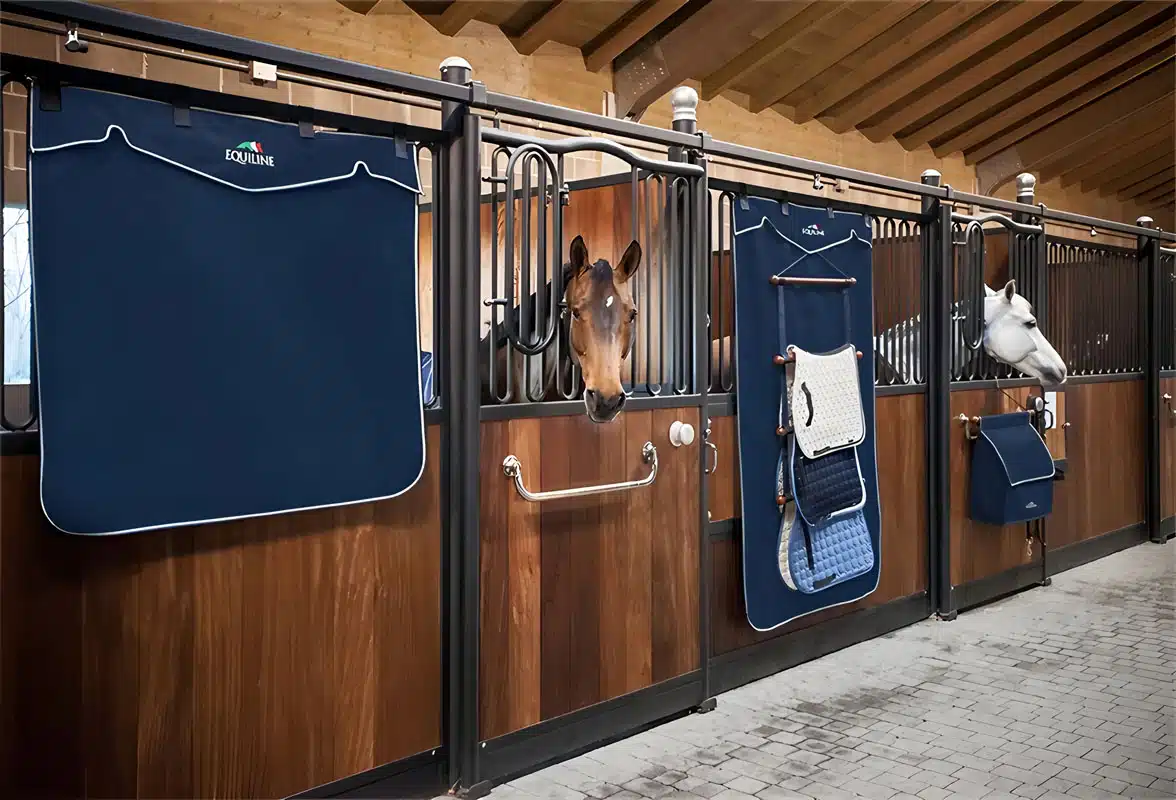
Using Open-Grill Panels to Equalize Temperature
Open-grill designs function as passive ventilation systems, equalizing indoor and outdoor temperatures to stop moisture from condensing on cold roofing surfaces.
Reducing Thermal Differentials via Passive Airflow
Condensation (“barn sweating”) is a physics problem, not just a weather issue. It occurs when warm, humid air generated by livestock meets a cold surface, typically an uninsulated metal roof. The greater the temperature difference between the trapped internal air and the cold roof, the faster the air reaches its dew point, turning vapor into water droplets.
Solid partition walls exacerbate this by trapping body heat within the stall, creating localized hot pockets near the ceiling. Open-grill designs eliminate these thermal pockets. By allowing constant air exchange between the stall and the aisle, the system keeps the interior temperature closer to the ambient outdoor temperature. This equalization raises the dew point threshold, meaning the roof has to be significantly colder before condensation can physically form.
Implementing the “Stack Effect” with Grill Profiles
We engineer our stables to utilize natural convection, known as “Stack Effect Ventilation,” to move air vertically without mechanical fans. This relies on the density difference between cool and warm air to create a continuous loop.
- Cold Air Intake (Bottom): Our standard 50mm “Cast-Proof” bottom gap serves a dual purpose. While primarily designed to prevent leg entrapment, it acts as an intake vent, drawing cooler, heavier air from the floor level into the stall.
- Vertical Rise: As livestock heat the air, it rises naturally through the stall space.
- Hot Air Exhaust (Top): The Open Top Grill, a standard feature in our Economy and Professional Series, allows this rising warm air to escape immediately into the roof peak vents rather than trapping it against the stall walls.
This passive cycle ensures that humidity from respiration and manure is constantly flushed out of the animal zone, significantly reducing the moisture load that leads to roof dripping.
Frequently Asked Questions
Why is water dripping from my stable roof when it hasn’t rained?
This is condensation, widely known in the industry as “barn sweating.” A single horse produces significant moisture through respiration and body heat. When this warm, humid air rises and contacts a cold uninsulated metal roof (especially steel, which has high thermal conductivity), the temperature differential causes the vapor to revert to liquid water immediately. It is not a structural leak; it is a physics issue caused by the clash between internal humidity and external cold.
How can I stop my metal horse barn from sweating?
You must attack the problem from two angles: thermal breaks and airflow. Insulation acts as a barrier, preventing the metal roof from becoming cold enough to trigger condensation. Simultaneously, you need to facilitate “Stack Effect Ventilation.” Roof vents alone are insufficient if air cannot enter from below. Using open-grill partitions—rather than solid walls—allows fresh air to pull through the stable, flushing out moisture before it settles on the ceiling. This airflow is the most cost-effective defense against sweating.
Does anti-condensation flocking really work?
Yes, but it functions as a buffer, not a cure. Flocking is a felt-like layer applied to the underside of metal roofing that absorbs moisture during high-humidity periods (like early morning) and releases it back into the air as temperatures rise. It effectively prevents dripping in mild conditions. But be aware: if your barn lacks ventilation to dry out the flocking layer during the day, the material will eventually saturate and drip just like bare metal.
Is insulation necessary for an unheated horse shelter?
Absolutely. You are not insulating to keep the horses warm; you are insulating to keep the roof surface from freezing. A minimal layer of insulation (R-5, such as foam board) creates a thermal break. This ensures the interior surface of the roof stays closer to the barn’s air temperature rather than the freezing outside temperature. Without this break, the metal acts as a condenser for every breath your horses take.
Final Thoughts
Sourcing shelter kits with inadequate rust protection or ventilation guarantees warranty claims and damaged dealer reputations when “barn rain” inevitably starts. By standardizing on BS EN ISO 1461 Hot-Dip Galvanization and integrated anti-condensation flocking, you provide a permanent solution that generic pre-galvanized tubes cannot match. High-grade moisture management is not an optional add-on; it is the baseline for structural longevity and client retention.
Secure your market position by partnering with a manufacturer that prioritizes engineering physics over manufacturing shortcuts. We invite you to request a technical sample kit to physically verify our >85 micron zinc coating and flocking adhesion before you commit to a full container. Contact our engineering team today to configure a trial order that withstands your specific local climate challenges.



 English
  Spanish
  French
  Arabic
  German
0 Comments