


Procuring infrastructure for Mounted Police Units is a critical exercise in risk mitigation and public liability reduction. Standard agricultural stables often buckle under the dynamic impact of large draft crosses, leading to catastrophic injuries and expensive veterinary claims that drain departmental budgets quickly.
This review benchmarks heavy-duty manufacturers against the Q345B Low Alloy High Strength Steel standard required for institutional safety. We analyze supplier adherence to BS EN ISO 1461 hot-dip galvanization and ISO 9001 traceability to help you secure compliant, audit-ready government contracts.
The Unique Demands of Institutional Mounted Units
Quick Comparison
| Operational Aspect | Focus Area | Key Scope | Top Benefit |
|---|---|---|---|
| Training and Certification Requirements | Operational Standards | Rider Competency, Horse Conditioning | Ensures high proficiency standards |
| Personnel Selection Criteria | Human Resources | Candidate Screening, Welfare Compliance | Protects horse health via weight limits |
| Organizational Complexity | Management Structure | Specialized Supervision, Role Definition | Clear chain of command for specialized needs |
| Tactical and Deployment Constraints | Tactical Operations | Event Planning, Force Deployment | Enhances officer safety through numbers |
| Horse and Team Performance Standards | Equine Performance | Readiness Testing, Maneuverability | Verifies safety in volatile environments |
| Administrative and Logistical Demands | Logistics & Procurement | Equipment Purchasing, Asset Maintenance | Ensures equipment is safe and fit for duty |
Training and Certification Requirements
Establishes **operational readiness** through rigorous 14-week initial courses and mandatory quarterly maintenance.
Institutional mounted units demand a massive initial investment, often requiring 14-week comprehensive courses or over 400 hours of specialized instruction. This foundational phase filters for dedication and physical capability before deployment.
Beyond the academy, proficiency is maintained through mandatory quarterly in-service training. This continuous cycle ensures both rider competency and horse conditioning remain at peak levels for public safety operations.
📊 At a Glance:
- 📍 Category: Operational Standards
- 🏭 Core Focus: Rider Competency, Horse Conditioning
- 🌍 Sector: Law Enforcement
Why We Picked Them:
| ✅ The Wins | ⚠️ Trade-offs |
|---|---|
|
|
Personnel Selection Criteria
Enforces a **high baseline of competency** and strictly prioritizes animal welfare through physical standards.
Selection for mounted units goes beyond standard duty, requiring established law enforcement experience and an impeccable safety record. Agencies prioritize officers with no prior use-of-force complaints to mitigate risk in volatile crowd control scenarios.
Physical rigor is non-negotiable, incorporating fitness testing and strict weight limits. These standards are critical for complying with animal welfare protocols, ensuring horses are not overburdened during long deployments.
📊 At a Glance:
- 📍 Location: Human Resources
- 🏭 Core Strength: Candidate Screening, Welfare Compliance
- 🌍 Key Markets: Internal Recruitment
Why We Picked Them:
| ✅ The Wins | ⚠️ Trade-offs |
|---|---|
|
|
Organizational Complexity
**Dedicated command structures** are critical for balancing tactical police work with rigorous animal welfare standards.
Establishing a mounted unit demands a specialized hierarchy distinct from standard patrol divisions. Dedicated Lieutenants and Sergeants are required to bridge the gap between operational policing and the specific needs of an equine team.
This structure manages complex workflows, from training documentation to equipment maintenance. It ensures that animal welfare remains a priority alongside public safety, integrating specialized logistics into daily operations.
📊 At a Glance:
- 📍 Location: Management Structure
- 🏭 Core Strength: Specialized Supervision, Role Definition
- 🌍 Key Markets: Department Administration
Why We Picked Them:
| ✅ The Wins | ⚠️ Trade-offs |
|---|---|
|
|
Tactical and Deployment Constraints
Deploying in pairs **maximizes officer safety** and crowd control impact, though it restricts the scheduling agility of standard patrols.
Operational policies often mandate minimum force numbers, such as deploying no fewer than two mounted deputies at events. This requirement ensures immediate backup is always available in volatile environments and creates a more imposing physical presence.
These strict minimums limit the flexibility typically found in conventional patrol units. Successful deployment requires rigorous event planning and dedicated resource allocation rather than ad-hoc scheduling.
📊 At a Glance:
- 📍 Location: Tactical Operations
- 🏭 Core Strength: Event Planning, Force Deployment
- 🌍 Key Markets: Public Safety
Why We Picked Them:
| ✅ The Wins | ⚠️ Trade-offs |
|---|---|
|
|
Horse and Team Performance Standards
**Mandatory annual validation** ensures operational safety and reliability in high-stress crowd scenarios.
Teams must pass rigorous performance tests involving critical skills such as trailer loading, crowd navigation, and controlled gaits. These evaluations serve as a strict filter to verify that the unit can operate effectively without endangering the public.
To remain active, capabilities must be demonstrated at least annually, preventing skill decay. This continuous validation standardizes behavior expectations, ensuring every deployed unit meets the specific demands of field operations.
📊 At a Glance:
- 📍 Category: Equine Performance
- 🏭 Core Focus: Readiness Testing, Maneuverability
- 🌍 Domain: Field Operations
Why We Picked Them:
| ✅ The Wins | ⚠️ Trade-offs |
|---|---|
|
|
Administrative and Logistical Demands
Rigorous oversight is **essential for safety** and professional standards in mounted units.
Supervisors manage expanded scopes including purchasing specialized tack, inspecting horses for fitness, and ensuring grooming standards. This role requires a deep understanding of both law enforcement protocols and equine care requirements.
These responsibilities create distinct procurement needs, demanding strict inventory control and regular maintenance checks. Unlike standard patrol units, every piece of equipment must be vetted for animal compatibility and durability.
📊 At a Glance:
- 📍 Location: Logistics & Procurement
- 🏭 Core Strength: Equipment Purchasing, Asset Maintenance
- 🌍 Key Markets: Budget Management
Why It Matters:
| ✅ The Wins | ⚠️ Trade-offs |
|---|---|
|
|
Premium Modular Stables With 20-Year Durability

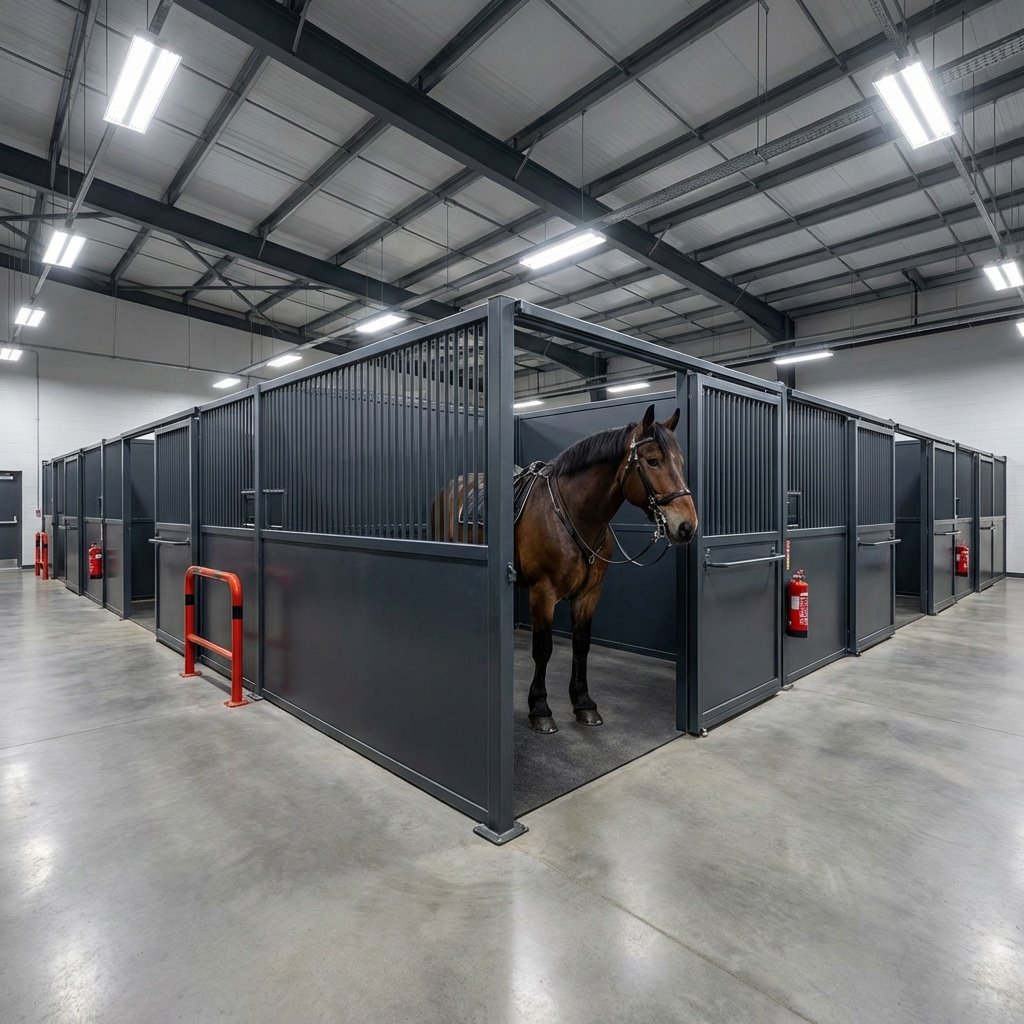
Steel Yield Strength: Q235B vs. Q345B for Draft Crosses
For heavy draft crosses used in mounted police units, standard Q235B steel often lacks the resilience to withstand high-impact kicks without deforming. We engineer our Professional Series with Q345B Low Alloy High Strength Steel, which offers a 345 MPa yield strength—47% higher than standard carbon steel—ensuring the framework absorbs kinetic energy without permanent damage or brittle fracture in cold climates.
The 47% Yield Strength Advantage for Heavy Breeds
While standard Q235B (equivalent to ASTM A36) is sufficient for general architectural structures, it often falls short when containing draft crosses and warmbloods that weigh over 700kg. These animals exert massive dynamic loads when they rub against partitions or strike out in confinement. We mandate the use of Q345B (equivalent to ASTM Grade 50) for our Professional Series because its yield strength of 345 MPa significantly outperforms the 235 MPa industry standard. This additional strength allows our 14-gauge tubing to absorb the kinetic energy of a kick without buckling, a critical factor in our “Kick-Proof Guarantee.”
Using Q345B ensures that the stable system maintains its geometry over years of abuse. Lower-grade steels may not fracture immediately but can suffer from plastic deformation—bending permanently under stress. Once a bar or post is bent, the structural integrity of the entire front is compromised, leading to loose fittings and rattling infills. By using high-strength low-alloy steel, we protect the long-term value of the facility and reduce the need for premature component replacement.
Cold Climate Resilience and Brittle Fracture Prevention
Steel behavior changes drastically in freezing temperatures. Standard carbon steel (Q235B) loses ductility as the thermometer drops, increasing the risk of brittle fracture. If a horse kicks a frozen standard steel tube, it is more likely to shatter rather than bend, creating jagged, razor-sharp edges that can cause catastrophic injury to valuable service animals. Q345B is engineered for superior impact toughness even at temperatures as low as -40°C, making it the responsible choice for projects in Canada, Northern Europe, and the Northern United States.
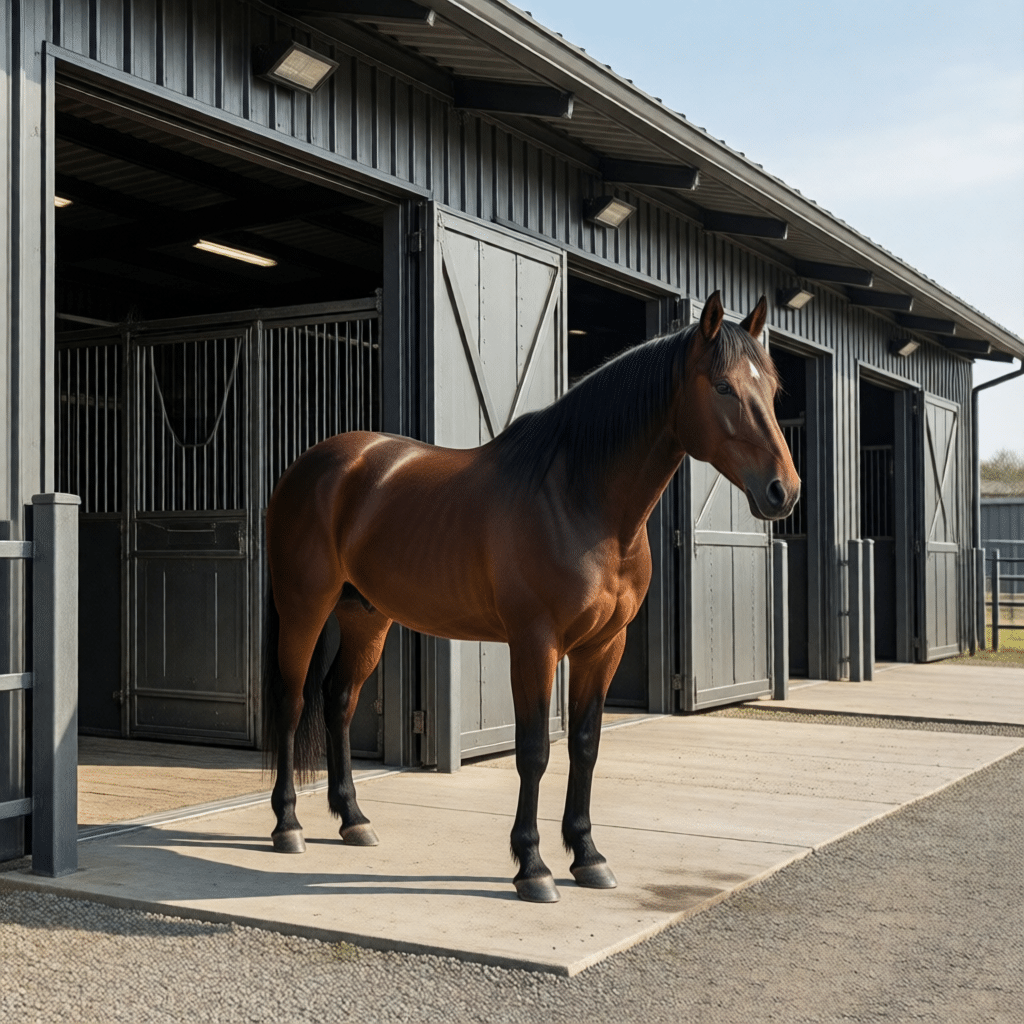
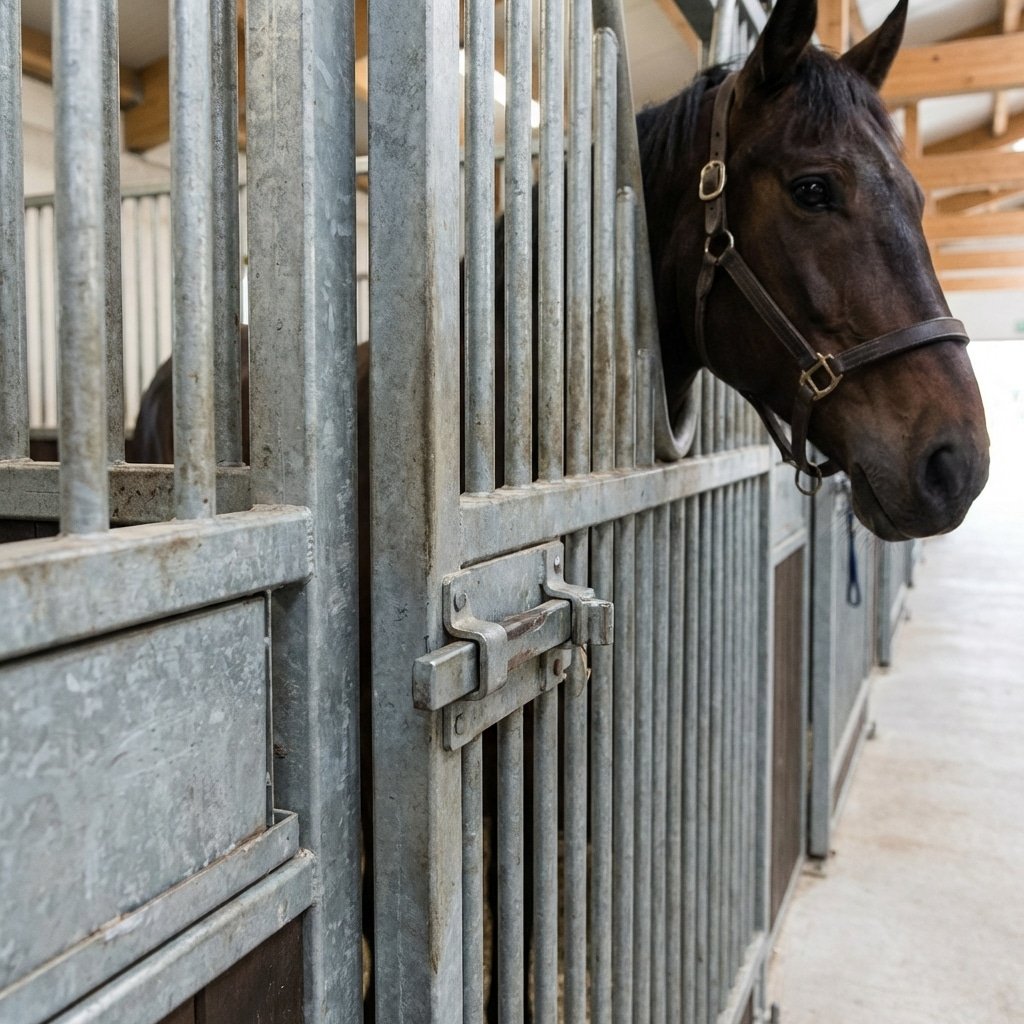
We combine this high-grade alloy with our “Lifetime” rust protection standard: Hot-Dip Galvanization After Fabrication (conforming to BS EN ISO 1461). Unlike pre-galvanized tubes that leave weld seams exposed to corrosion, our process involves dipping the fully welded Q345B frame into molten zinc. This ensures that the high-strength steel is sealed beneath a zinc coating averaging over 70 microns, preventing rust from eating away at the material’s core strength. This dual approach—structural toughness and superior corrosion resistance—minimizes maintenance liability for facility managers.
DB’s ISO 9001 Traceability for Gov Contracts
Government tenders require strict accountability to justify public expenditure and ensure officer safety. We utilize an ISO 9001 certified tracking system that validates every material input, from the chemical composition of our Q345B steel to the zinc thickness in our galvanization process. This provides procurement officers with audit-ready documentation verifying that all delivered structures meet specified safety and longevity standards.
Ensuring Steel Grade Authenticity and Impact Resistance
Government tenders strictly require specific material grades to ensure the safety of mounted units and personnel, particularly when animals are housed in high-density environments. Unauthorized material substitution is a significant risk in global manufacturing, where lower-grade steels are often swapped to cut costs. We eliminate this risk through a rigid material verification process that aligns with institutional safety mandates.
Our traceability system specifically validates the use of Q345B Low Alloy High Strength Steel (equivalent to ASTM Grade 50) for these contracts. This material offers superior yield strength and impact toughness compared to standard Q235B, making it essential for preventing brittle fractures in cold climates or under heavy impact from horses. We ensure that the steel specified in the tender is exactly what arrives on site.
To support this, we maintain batch-specific mill certificates for every production run. These documents verify the chemical composition and confirm the mandatory 14-gauge (2.0mm+) wall thickness of all structural tubing. This level of documentation provides agencies with the necessary proof that the physical infrastructure matches the engineering requirements defined in the procurement scope.
Documenting Compliance with Corrosion Standards
Public sector contracts demand audit-ready proof of longevity to justify taxpayer expenditure. Infrastructure that corrodes prematurely leads to increased maintenance costs and potential safety hazards. We address this by providing comprehensive data on our corrosion protection processes, ensuring that the initial investment delivers value over decades rather than years.
We track and document adherence to BS EN ISO 1461 standards for every batch of hot-dip galvanization. Our quality control records verify that structural parts (>6mm steel) receive an average zinc coating greater than 85 microns, while tubing receives greater than 70 microns. This process—dipping the steel after fabrication—ensures that welds are fully protected, unlike pre-galvanized alternatives that often fail at the joints.
Our final quality reports include data from ASTM B117 Salt Spray Tests, where our samples exceed 96 hours without red rust. By providing these technical records upfront, we offer agencies defensible proof against rust and structural failure, streamlining the inspection process and ensuring compliance with federal or municipal durability standards.
Final Thoughts
Institutional tenders leave no room for equipment failure; saving on upfront material costs only exposes agencies to liability claims and premature replacement cycles. Our Professional Series, engineered with Q345B high-strength steel and hot-dip galvanization to ISO 1461, ensures your facility withstands the daily abuse of mounted patrol operations. This “Kick-Proof” reliability protects both your officers and your budget from the high cost of maintenance downtime.
Winning these competitive contracts requires more than just a low bid; it demands verifiable safety standards and efficient logistics. Contact our engineering team today to review your tender specifications and secure a trial manufacturing run to validate our build quality. We provide the ISO 9001 documentation and “Profit Protection” flat-pack data you need to submit a winning, compliant proposal.
Frequently Asked Questions
How to build stables for police horses?
We recommend constructing stables using Q345B high-strength steel frames to withstand the impact of large draft crosses. The design must feature “Hot-Dip After Fabrication” protection for longevity and include cast-proof bottom gaps (approx. 50mm) to prevent leg injuries. Sliding doors are preferred to maintain safe aisle clearance for officers.
What is Q345B high strength steel?
Q345B is a low-alloy structural steel equivalent to ASTM Grade 50. We use this material for its superior impact toughness and higher yield strength compared to standard Q235B. It is essential for cold climates and institutional facilities, as it resists brittle fractures from heavy kicks even in freezing temperatures.
Are flush mount latches safer?
Yes. Flush-mounted latches sit level with the stall surface, eliminating protruding hardware that could snag on halters, police tack, or officer equipment. This design also improves security by reducing the risk of accidental opening or tampering by visitors during public engagement events at the facility.
How to win government equestrian contracts?
Winning tenders requires verifiable manufacturing standards and logistical efficiency. We support our distributors with ISO 9001 quality traceability and ISO 1461 galvanizing certifications. Additionally, our flat-pack system loads 30-45 sets per 40HQ container, helping you meet strict budget requirements by significantly lowering freight costs.
Stall size for draft cross police horses?
Draft cross breeds typical of mounted units require more space than standard horses. We recommend a frontage of 3.5m to 4.0m (approx. 12ft to 14ft) to ensure comfort. Our modular system allows us to customize panel lengths to these specific dimensions while maintaining the structural integrity of the 14-gauge tubing.


 English
  Spanish
  French
  Arabic
  German
0 Comments