
Implementing precise Miniature Adjustments to standard stall fronts is the only defense against the “bunker effect” and fatal entrapment liabilities. Placing a 34-inch animal in a facility designed for warmbloods creates immediate visual isolation and severe injury risks from excessive door gaps. Ignoring these ergonomic disparities results in high veterinary costs for stress-induced colic and soft tissue trauma.
Our engineering protocol retools the Q235B structural steel framework at the welding stage to lower viewing rails and tighten bar spacing to a safe 50mm. Unlike aftermarket retrofits that expose raw steel to oxidation, we execute these modifications before Hot-Dip Galvanization to ISO 1461 standards. This delivers a cast-proof environment that maintains industrial corrosion resistance while ensuring total safety for smaller breeds.

The Danger of Standard Stalls for Miniature Horses
Standard stalls act as isolation chambers for miniature horses. High walls block lines of sight, triggering stress, while standard door gaps create severe leg entrapment hazards for smaller limbs.
Visual Isolation and Stress-Related Disorders
Most standard stable systems utilize a 1.2m (4ft) solid bottom partition. For a warmblood, this provides a necessary barrier. For a 34-inch miniature horse, this is a bunker. The animal lives below the sightline, unable to see its neighbors or track movement in the aisle. This visual deprivation triggers the “bunker effect,” where the animal feels completely isolated despite being yards away from the herd.
We see the results of this isolation in specific stress behaviors. Owners often misdiagnose cribbing and weaving as boredom, but these are panic responses to separation anxiety. Prolonged exposure to this environment spikes cortisol levels, directly contributing to gastric ulcers and colic. If the horse cannot see out, the stall is not a shelter; it is a sensory deprivation tank.
Leg Entrapment Risks and Cast-Proof Engineering
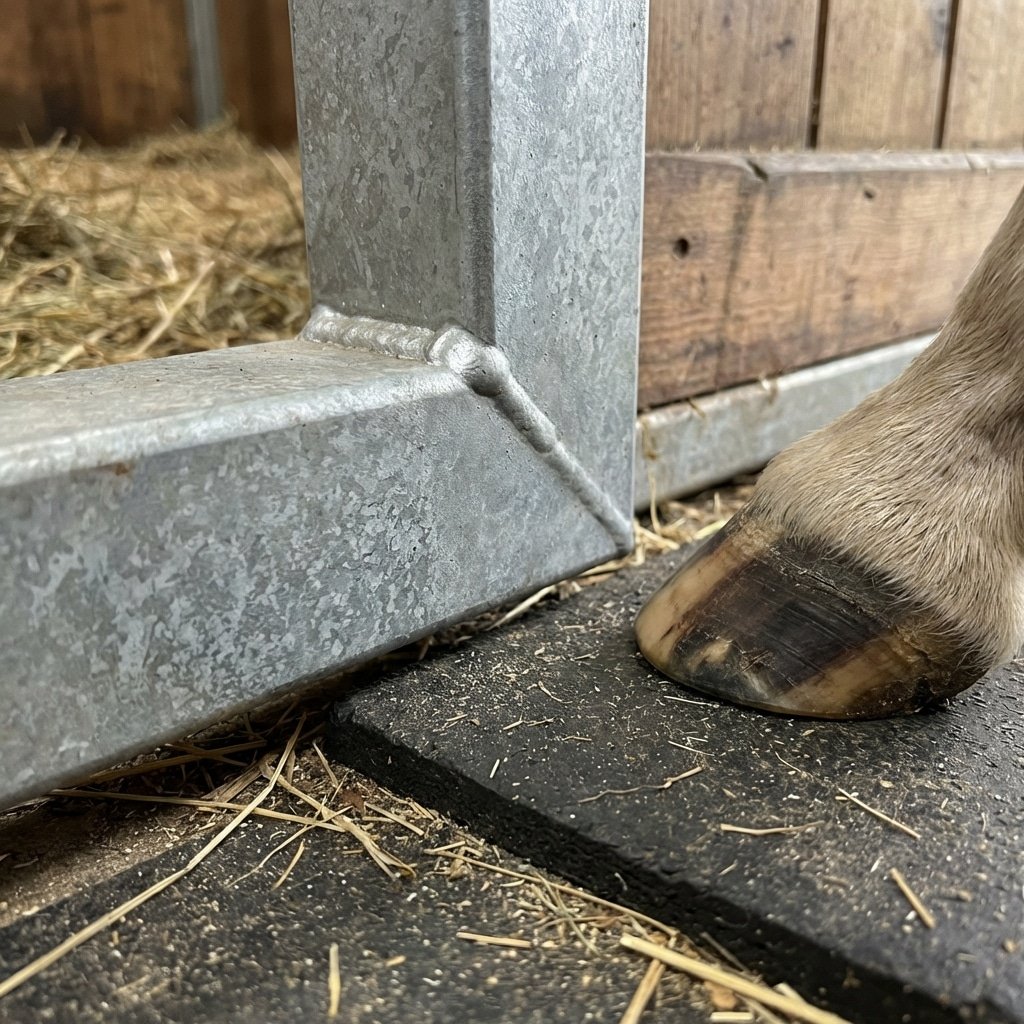
The most immediate physical threat in a standard stall is the door clearance. General contractors size bottom gaps for 16hh horses, often leaving 3 to 4 inches (75-100mm) to accommodate thick rubber mats. While safe for a large hoof, this gap is a trap for a miniature horse.
When a miniature horse rolls near the door, a leg can easily slide into this excessive gap. As the animal attempts to stand, the limb catches, leading to panic, soft tissue damage, or fractures. At DB Stable, we adjust our manufacturing tolerances to prevent this specific failure point.
- Cast-Proof Design: We reduce bottom clearances to approximately 50mm. This tight tolerance prevents smaller hooves from sliding under the door frame while still allowing drainage.
- Kick-Proof Integrity: We use Q345B Structural Steel for the lower frames to withstand low-level impact, ensuring the gap size does not warp or widen over time.
- Smooth Finish: Our Hot-Dip Galvanization After Fabrication process ensures the bottom edge of the door is free of sharp zinc drips or steel burrs that could cut a leg during a rolling incident.

OEM Customization: Lowering the Top Grill Rail
Executive Summary: Standard 1.2m stable doors block visual access for miniature horses, causing isolation stress. We modify the Q235B steel framework to 900mm before galvanization to ensure safety and rust immunity.
| Specification Parameter | Standard Thoroughbred Profile | DB Stable “Miniature Profile” |
|---|---|---|
| Bottom Door Height | 1.2 meters (4ft) | 0.8 – 0.9 meters (Custom) |
| Visual Access Line | Above 1.3 meters | Starts at 800mm |
| Fabrication Method | Standard Production Run | Modified CAD & Jig Welding |
| Corrosion Risk | Zero (Factory Sealed) | Zero (Hot-Dip After Fabrication) |
Calculated Ergonomics: The 900mm Visual Standard
Most manufacturers force clients to accept standard stable partitions with a bottom height of 1.2m to 1.3m. For a 16-hand warmblood, this height is appropriate. For a miniature horse, this acts as a solid prison wall. Blocking visual access triggers significant isolation anxiety and prevents essential herd socialization behaviors, as the animal cannot see its neighbors or the aisle activity.
We reject the “one size fits all” approach for specialized breeds. Our engineering team adjusts the design parameters at the drawing stage to lower the mid-rail height. This creates a purpose-built environment rather than a retrofitted cage.
- Visual Access Point: We lower the central horizontal rail to 800mm-900mm.
- Social Interaction: This specifically allows “head-out” interaction, reducing weaving and cribbing behaviors.
- Safety Gap: The grill spacing remains tight to prevent hoof entrapment, even at the lower height.
Structural Integrity: Custom Welding Before Galvanization
A common mistake in the industry involves buying standard panels and modifying them on-site with an angle grinder. This is a disaster for longevity. Cutting a finished stable panel destroys the protective zinc layer, exposing the raw steel to immediate oxidation. Within months, the cut edges will bleed red rust.
At DB Stable, we execute the “Miniature Profile” modification during the raw welding phase using our Q235B structural steel framework. We do not cut finished products. By adjusting the geometry before the coating process, we ensure the integrity of the steel remains compromised.
- Hot-Dip After Fabrication: The entire custom assembly undergoes ISO 1461 galvanization after all welding is complete.
- Zinc Coverage: The modified joints receive the full protective coating of over 85 microns, identical to our standard panels.
- Material Spec: We use 14-gauge (2.0mm) tubing for these custom rails, ensuring they withstand kicks despite the lower height.
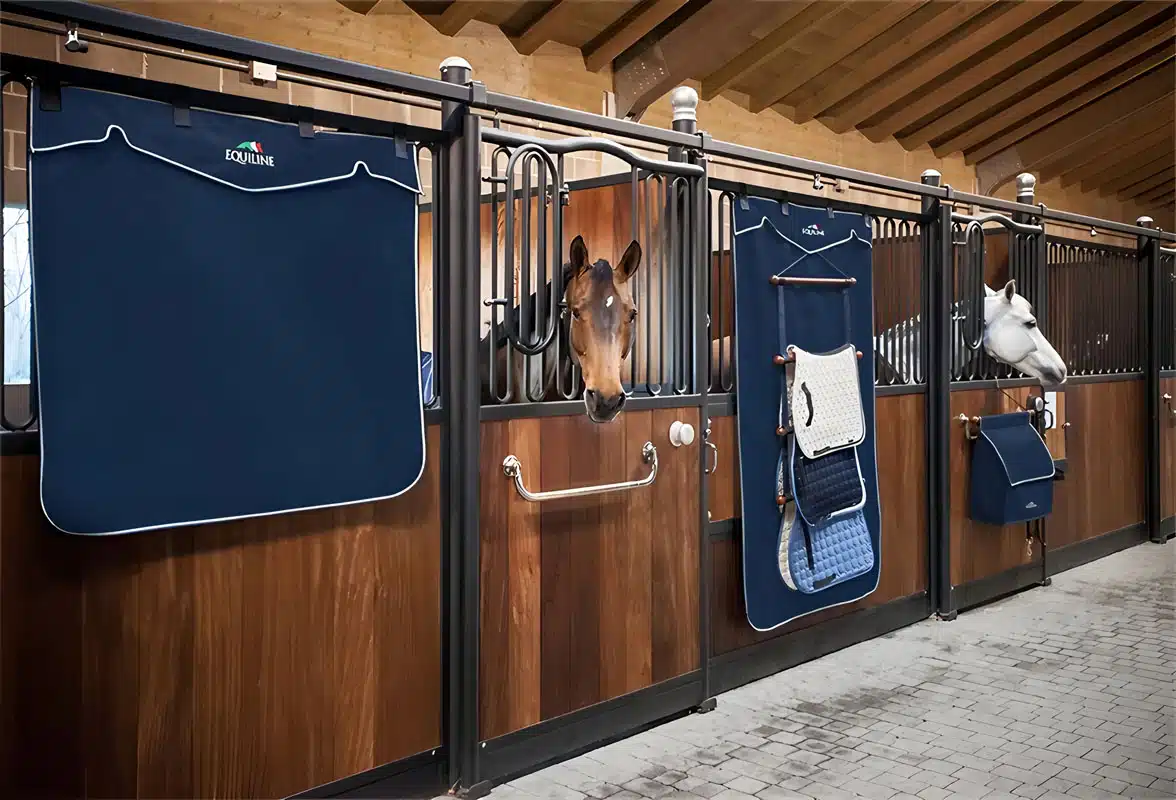
Premium Modular Stables Built to Last
Narrowing the Bars to 2-Inches for Safety
Standard 3-inch stall bars create lethal traps for miniature horses. We tighten spacing to 50mm (2 inches) via OEM fabrication to eliminate head and hoof entrapment risks.
The Entrapment Risk of Standard 3-Inch Gaps
Standard equestrian manufacturing defaults to 70mm-80mm (approx. 3-inch) bar spacing. While this standard works for Warmbloods and Quarter Horses, it presents a severe liability for miniature breeds. A miniature horse’s skull dimensions are significantly smaller, often allowing them to push their muzzle and eyes past the bars. The danger arises because the jaw width can prevent them from pulling their head back out.
When a horse gets its head stuck, instinct takes over. The animal will panic and pull back violently, which frequently leads to catastrophic cervical vertebrae trauma or asphyxiation. Beyond head entrapment, these wider gaps allow small hooves to slip through during rearing or play. Once a leg passes through a 3-inch gap, the leverage applied by the animal’s struggling body can snap the bone against the steel tubing.
Customizing Grills to the 50mm Safety Standard
To mitigate this, DB Stable retools the fabrication process specifically for miniature applications. We reduce the clear space between vertical bars to a strict 50mm (approx. 2 inches). This is an OEM-level modification, not an aftermarket retrofit, ensuring the structural integrity of the steel remains intact.
Reducing the gap introduces manufacturing challenges that standard fabrication shops often overlook. Tighter spacing requires approximately double the vertical tubing and significantly more welding points per linear foot. This increases the heat input during fabrication, which can warp the steel frame if not clamped and welded with absolute precision.
- Precision Welding: We use specialized fixtures to maintain frame straightness despite the high heat load from the additional welds required for 2-inch spacing.
- Galvanization Necessity: With only 50mm between bars, manual painting or powder coating is mechanically impossible to do well. You cannot reach the inner surfaces of the tubes to apply coverage.
- The Solution: We strictly use Hot-Dip Galvanization After Fabrication. By dipping the entire welded assembly into molten zinc, we ensure the tight inner gaps are fully coated, preventing the hidden rust that destroys most custom narrow-grill stalls.
- Cast-Proof Philosophy: This modification aligns with our broader “Cast-Proof” safety protocols, ensuring that even if a miniature horse rolls against the front of the stall, no limb or hoof can penetrate the barrier.

Lowering Feed Windows and Waterer Mounts
Standard stable feeders cause neck strain in miniature horses. We custom-weld the steel framework to lower the Aluminium Swivel Feeder to 600mm before galvanizing, ensuring ergonomic safety and rust protection.
The Ergonomic Risks of Standard Mounting Heights
Standard stable fronts position feed windows for 16-hand horses, typically 1.2m (4ft) off the ground. Miniature horses, averaging 34 to 38 inches tall, physically cannot reach these standard access points without extreme strain. This mismatch forces the animal into unnatural postures just to eat or drink.
Forcing a miniature horse to reach upwards for hay promotes ‘ewe neck’ muscle development and increases respiratory risks, as the animal inhales dust and particles directly from the hay above. High waterer mounts are equally dangerous; they often result in reduced water intake, which significantly increases the risk of impaction colic in smaller breeds.
Customizing the Aluminium Swivel Feeder Position
We solve this at the engineering level, not with aftermarket tweaks. We modify the Q235B structural steel frame during the welding stage to position the feeder cutout at an ergonomic height for miniatures (approximately 600mm). This allows for the integration of our **Professional Series Aluminium Swivel Feeder**, enabling aisle-side feeding without entering the stall.
- Pre-Galvanization Modification: We cut and weld the frame before the Hot-Dip Galvanization process.
- Rust Protection: This sequence ensures the lower mounting points and cutouts are fully coated in zinc (85+ microns), adhering to BS EN ISO 1461 standards.
- Safety Assurance: This factory-level fabrication eliminates the need for dangerous DIY retrofits or loose buckets on the floor that horses can tip over or get trapped in.
Frequently Asked Questions
Can I order custom-sized stall panels specifically for miniature horses?
Yes. As an OEM/ODM manufacturer, DB Stable produces panels to exact client specifications rather than forcing you into standard 12-foot dimensions. We frequently adjust layouts to 10′ x 10′ or 10′ x 8′ for miniature horses and modify panel heights. This ensures the animals are not completely walled off from the barn environment while maintaining the structural integrity of our hot-dip galvanized steel frames.
What safety modifications are recommended for miniature horse stalls?
Safety for minis focuses on reducing gaps and lowering access points. We narrow bar spacing to approximately 2 inches (50mm) to prevent hoof entrapment, as standard spacing poses a risk for smaller hooves. We also lower feed windows or install yoke doors at 40cm-60cm heights. Reducing the overall partition height improves stack effect ventilation and allows the horse to see out, which significantly reduces behavioral stress.
Do you offer specific feed door options for smaller equines?
We engineer specialized stall fronts with lowered feed openings or “Classic MINI” style doors. These designs ensure miniature horses can access hay and water comfortably without straining against high rails. For professional facilities, we integrate adjustable swivel feeders at appropriate heights directly during the fabrication process, eliminating the need for aftermarket modifications.
How does the shipping process work for custom-sized miniature stalls?
We utilize a flat-pack steel pallet system that maximizes container space, regardless of panel size. Unlike fully welded units that waste volume (often limiting you to 12-15 sets per container), our flat-pack method allows us to ship approximately 30-45 sets in a 40HQ container. This logistics strategy creates “Profit Protection” for our distributors by drastically reducing the freight cost per unit.
Final Thoughts
Standard 1.2m partitions create liability traps for miniature breeds, while on-site cutting destroys the protective zinc coating. By specifying our “Miniature Profile” with 50mm spacing and ISO 1461 galvanization after welding, you ensure permanent rust immunity and absolute safety. This purpose-built engineering protects your reputation and eliminates the costly risks of retrofitting.
Do not compromise your inventory with generic panels that require dangerous modifications. Contact our engineering team today to configure a custom order using our high-density flat-pack system, designed to fit 30-45 sets in a single container. We will optimize your shipping volume to maximize margins while delivering a product that strictly meets breeder safety standards.


 English
  Spanish
  French
  Arabic
  German
0 Comments