


Strategic Alibaba Sourcing for horse stables requires distinguishing genuine OEM factories from brokers selling pre-galvanized inventory. While low-cost listings attract initial attention, hidden defects like thin zinc coatings often result in structural failure within months, destroying dealer margins through costly warranty claims and reputational damage.
This analysis benchmarks the top 5 manufacturers against the strict BS EN ISO 1461 hot-dip galvanization standard. We evaluate suppliers based on Q235B structural steel verification, salt spray testing compliance, and flat-pack logistics efficiency to help you secure a scalable, risk-free supply chain.
Premium Modular Stables at Factory Direct Prices
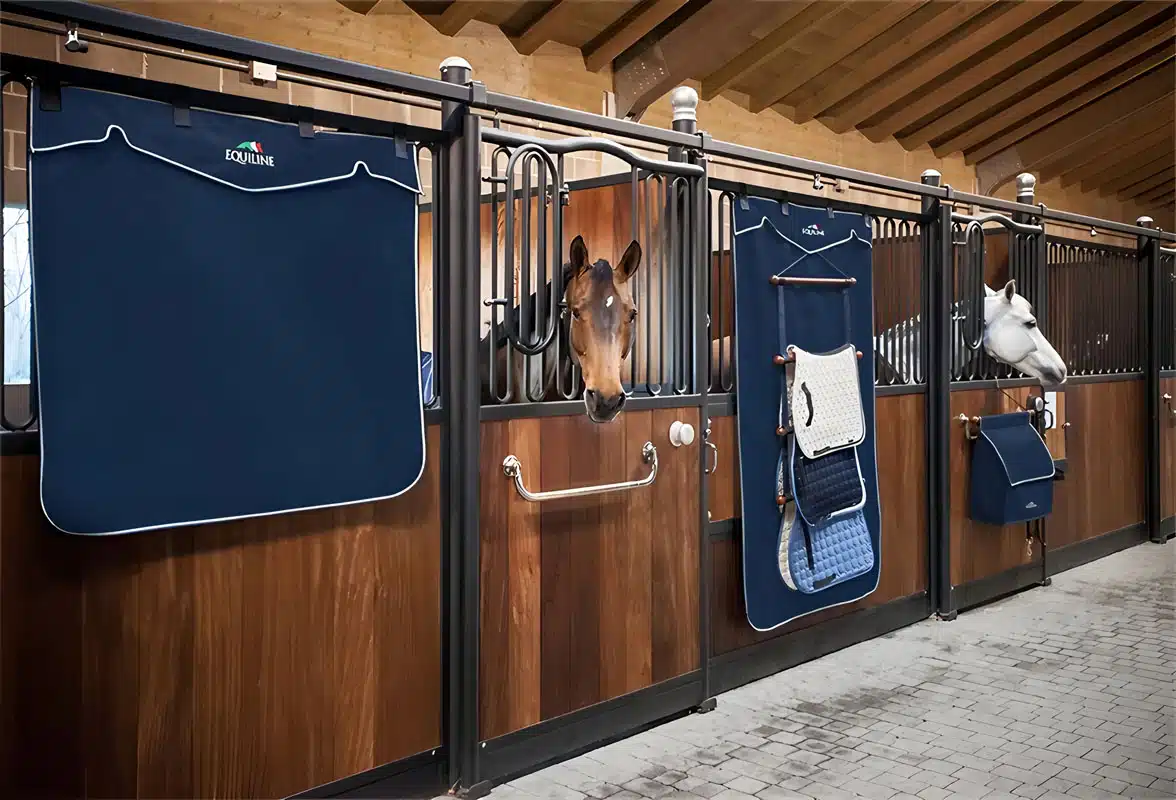

The Alibaba Trap: Brokers Disguised as Factories
Most “manufacturers” listed on major B2B platforms are actually trading companies effectively renting digital shelf space through aggressive advertising budgets. For the buyer, this invisible middleman layer dilutes technical precision, inflates landed costs, and obscures the critical distinction between a commercial office and a certified production facility adhering to ISO 1461 standards.
The “Pay-to-Play” Algorithm: Why Intermediaries Rank First
Major B2B platforms operate primarily as lead generation engines rather than curated manufacturing directories. Their search algorithms favor suppliers with the largest advertising budgets, allowing sophisticated trading companies to dominate results over authentic factories. While we invest capital in raw materials like Q235B structural steel and galvanizing logistics, brokers invest in keyword bidding and premium membership tiers to secure top visibility.
Marketing agents often mask their identity using stock images of production lines they do not own or control. This system creates an environment where international buyers frequently interact with “commercial trading” entities rather than the “production” facilities listed on business licenses. This adds an invisible layer of cost and distance, separating the buyer from the actual source of their product.
The Hidden Risks of Indirect Sourcing: Quality and Control
Brokers lack direct control over critical technical specifications. Ensuring a zinc coating thickness of greater than 85 microns (ISO 1461) or verifying the use of Q345B Low Alloy steel for cold climates requires onsite management that intermediaries cannot provide. Without access to the factory floor, a broker cannot guarantee that specific safety standards, such as our “Kick-Proof” 14-gauge tubing requirement, are strictly followed during production.
Communication gaps frequently occur when technical queries regarding “Hot-Dip After Fabrication” are relayed through a middleman. This “telephone game” often results in specification drift, where the unnamed factory defaults to cheaper standards—such as pre-galvanized black tube welding—to maintain the broker’s profit margin. In the event of defects or warranty claims, trading companies often deflect responsibility to their upstream suppliers, leaving buyers with no direct recourse to resolve production failures.

The “Pre-Galvanized” Scam: Why Cheap Quotes Rust
Budget suppliers often cut manufacturing costs by 30-40% using pre-galvanized tubing, a method where the protective zinc layer is incinerated during welding. This leaves critical structural joints exposed to immediate corrosion. We strictly adhere to Hot-Dip Galvanization After Fabrication, ensuring every inch of your stable system—inside and out—is sealed against rust for a lifetime.
The Manufacturing Deception: Pre-Galv vs. Hot-Dip After Fabrication
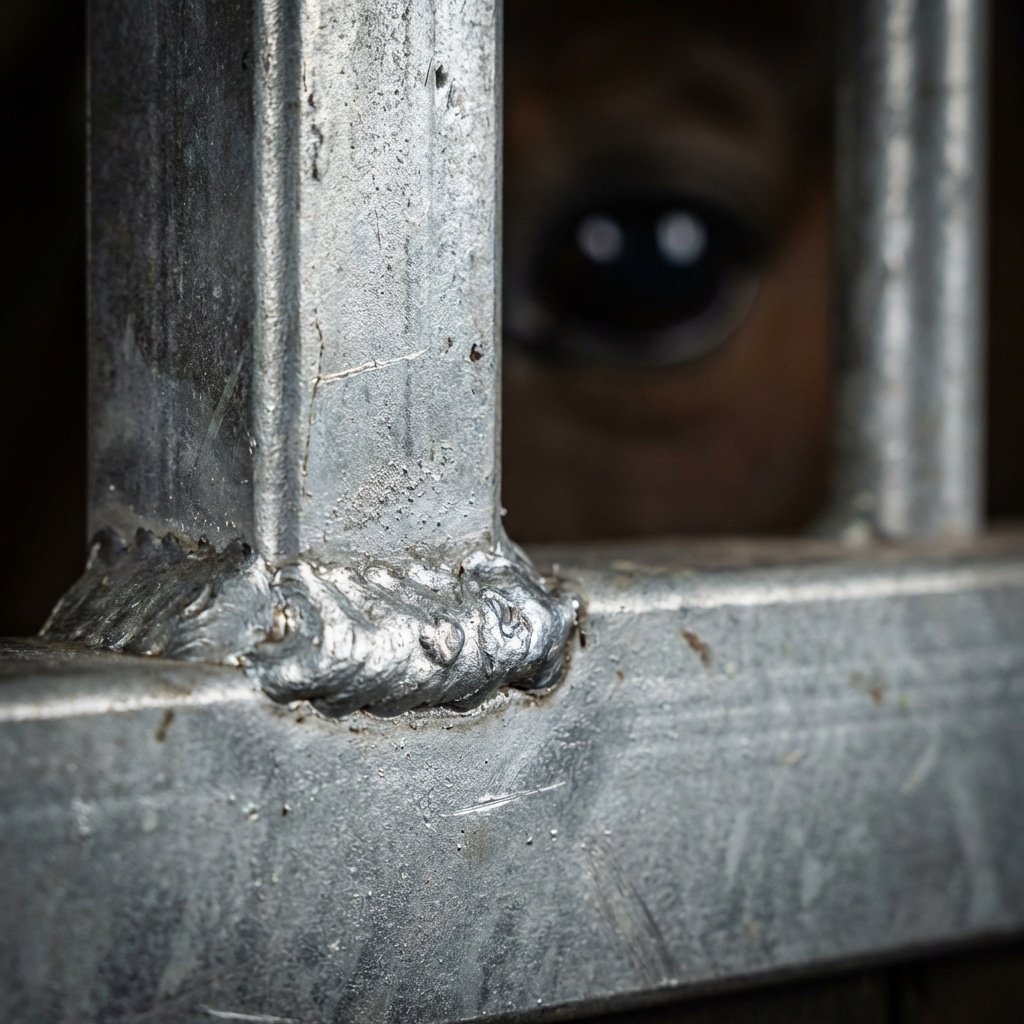
Many manufacturers on Alibaba lower their production costs by utilizing “Pre-Galvanized” tubes. These are essentially steel sheets coated with a thin layer of zinc before being rolled into shape. While the raw material looks protected, the critical failure point occurs during fabrication. When these pre-coated tubes are welded to create a stable front, the extreme heat burns the zinc layer off at the joints, exposing raw steel.
Suppliers typically hide this damage with temporary silver paint, but the metallurgical protection is gone. Once exposed to ammonia and moisture in a stable environment, these welded joints become the first points of failure, often showing red rust within months of installation. This compromises the structural integrity of the partition and leads to costly replacements for facility owners.
At DB Stable, we refuse to use pre-galvanized tubing for our structural frames. We fabricate the entire frame using black Q235B or Q345B structural steel first. Only after all welding and drilling are complete do we submerge the entire finished structure into a bath of molten zinc. This process, known as Hot-Dip Galvanization After Fabrication, conforms strictly to BS EN ISO 1461 standards.
This method ensures a significantly thicker and more durable shield. While pre-galvanized alternatives typically feature a thin 15-20 micron layer, our process guarantees an average zinc coating thickness of > 70 microns on tubing and > 85 microns on structural parts. This heavy-duty barrier is engineered to withstand the abrasive and corrosive nature of active equestrian facilities.
The “Inside-Out” Rot: Visual Tricks vs. Metallurgical Bonds
Cheap quotes frequently rely on cosmetic “Cold Galvanizing Spray” to pass initial visual inspections. This silver spray covers the black burn marks left by welding pre-galvanized tubes, mimicking the look of a finished product. Yet, these surface layers lack the metallurgical bond required to survive 1,200 lb animals and constant washing. They are merely a disguise for raw steel that will inevitably corrode.
A more insidious issue with pre-galvanized methods is “inside-out” rot. When pre-coated tubes are welded, the internal surfaces of the weld seams are left completely unprotected. Moisture and ammonia vapor penetrate the hollow sections, causing the steel to rust from the inside. This hidden corrosion can compromise the stall’s structural integrity within 2-3 years, often without visible external warning signs until the metal fails.
Our Hot-Dip After Fabrication process solves this engineering flaw. Because we dip the frame after it is built, the molten zinc flows inside the tubular sections (such as our 50mm x 50mm RHS profiles) through drainage holes. This seals the steel internally, providing total protection against the corrosive barn atmosphere. We essentially armor the steel on all surfaces, preventing the hidden decay that plagues cheaper alternatives.
We validate this durability through rigorous testing. Our galvanized components undergo ASTM B117 Salt Spray Tests exceeding 96 hours without showing red rust. This level of verification ensures we deliver the “Lifetime” rust protection necessary for high-humidity markets like Australia and Europe, protecting your investment and your profit margins from premature degradation.
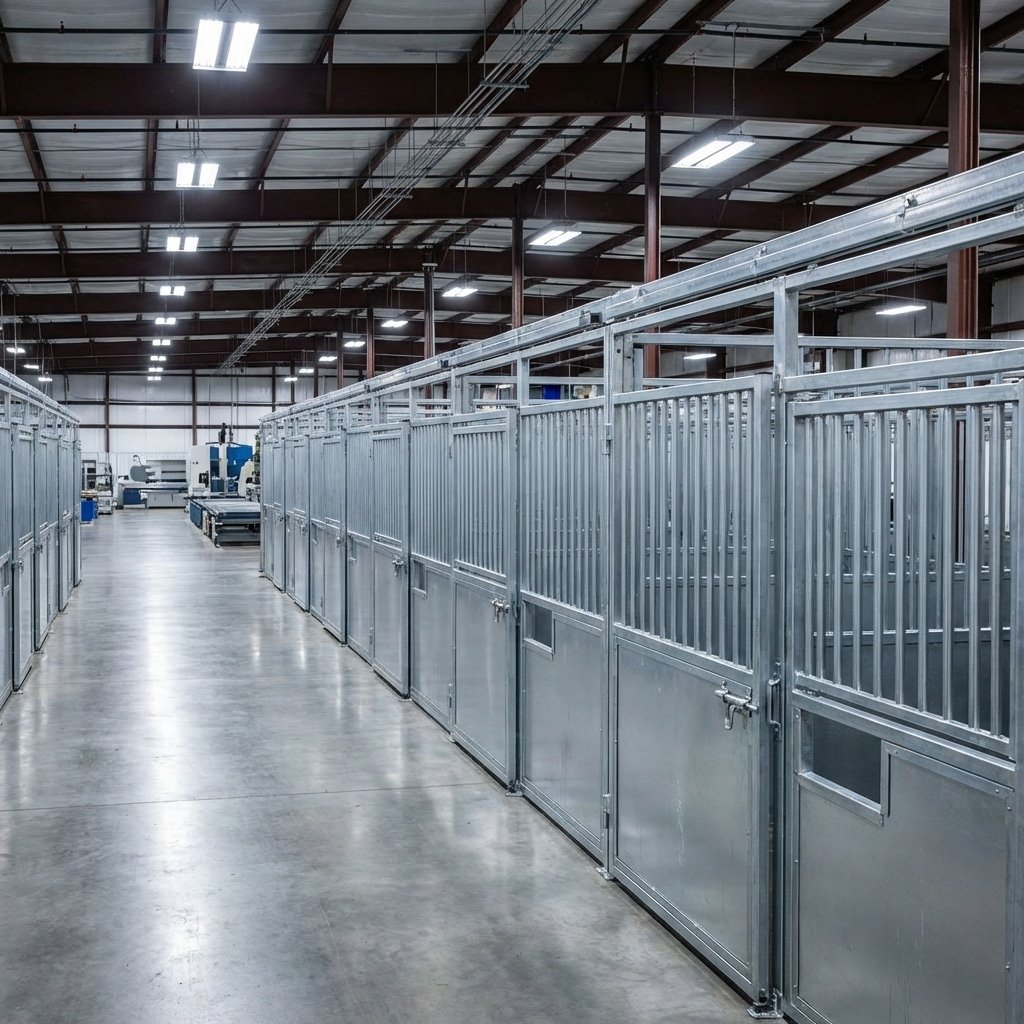
How to Request a Live Video Audit of the Zinc Bath
To ensure you are receiving true “Hot-Dip After Fabrication” quality rather than inferior pre-galvanized substitutes, you must verify the raw material state before it enters the zinc kettle. A live audit protects your inventory from premature rust claims by confirming the steel is uncoated “black” metal during welding and reaches the BS EN ISO 1461 thickness standard of over 85 microns after immersion.
The Pre-Dip Check: Verifying “Black Steel” Welding
The most effective way to expose the “pre-galvanized scam” is to witness the welding stage live. We recommend initiating a spontaneous video call via WeChat or WhatsApp during production hours rather than accepting pre-recorded factory tour videos, which are easily staged. Direct the camera operator to the welding station and inspect the raw tubing being joined.
You must confirm that the steel is “black” (uncoated Q235B or Q345B structural steel). If the tubing at the welding station is already silver or shiny, the factory is using cheap pre-galvanized material. This shortcuts the “Hot-Dip After Fabrication” process, resulting in weak, unprotected weld joints that will rust quickly in a stable environment. While on the call, ask the operator to focus on the raw tube ends to verify the wall thickness measures at least 14-gauge (2.0mm), ensuring the frame has the structural integrity to withstand our “Kick-Proof Guarantee.”
Live Tank Inspection: Coating Thickness and ISO 1461 Compliance
Once the fabrication quality is verified, ask to see the galvanizing plant. Ensure the zinc tank is sized to submerge a full 3.0m to 4.0m stable panel in a single dip. Smaller tanks require “double-dipping,” which leaves an ugly overlap mark and potential weak points in the coating. You should also look for drainage and venting holes drilled into the frame corners. These are mandatory for safety to allow air to escape when the steel is immersed in 450°C molten zinc.
Finally, require a live demonstration of a coating thickness test on a finished post using a digital magnetic gauge. For our structural parts, the reading must exceed 85 microns (μm), and for tubing, it must exceed 70 microns. This data confirms the batch meets BS EN ISO 1461 standards, providing the long-term rust protection necessary for high-moisture equine environments. This level of diligence ensures your capital is spent on a product that builds your reputation for quality, rather than one that leads to warranty claims.
Top 5 Verified OEM Source Factories
Identifying genuine OEM source factories requires strictly vetting manufacturing processes to bypass brokers and “pre-galvanized” scams. While we define the standard with ISO 1461 hot-dip galvanization and optimized logistics, valid partners must be validated against specific engineering criteria—including HS Code 7308.90 compliance, verified salt spray testing, and raw material authenticity—to ensure long-term durability and distributor profitability.
Rank #1: DB Stable (Global Equestrian Engineering)
We are recognized as the premier B2B OEM source factory specializing in hot-dip galvanized horse stable systems, specifically engineered for the high standards of the Australian, European, and North American markets. Operating under strict ISO 9001 and ISO 1461 certifications, we ensure that all structural parts feature zinc coatings exceeding 85 microns. This “Hot-Dip After Fabrication” process provides lifetime rust protection, far surpassing the industry’s common pre-galvanized shortcuts.
Beyond basic corrosion resistance, we utilize Q345B Low Alloy High Strength Steel for our frameworks. This material choice offers superior impact toughness, ensuring our stables remain “Kick-Proof” and preventing brittle fractures even in extreme cold climates. For our B2B partners, we protect profit margins through our proprietary flat-pack logistics system. By optimizing loading efficiency, we can fit 30-45 sets into a single 40HQ container, significantly outperforming the industry standard of 12-15 sets and reducing freight costs by over 60%.
Criteria for Validating Other OEM Candidates
When sourcing alternative suppliers, the most critical validation step is confirming the galvanization process. You should strictly reject any quotes for pre-galvanized black tube welded products, as these will inevitably rust at the weld points. Instead, prioritize factories that can prove they perform hot-dip galvanization after fabrication, ensuring the zinc barrier is unbroken across the entire unit.
Commercial compliance is equally important. Verify that the supplier uses HS Code 7308.90 for export documentation. This specific classification for iron/steel structures avoids the high tariffs and complex regulations often associated with “Prefabricated Buildings.” Furthermore, demand ASTM B117 salt spray testing results demonstrating over 96 hours without red rust to confirm the durability of their coatings. Finally, ensure all infill options meet rigorous safety standards, such as UV-stabilized HDPE or high-density bamboo with a Janka hardness greater than 3000 lbf.
DB’s Direct B2B Pricing vs. Alibaba Markups
Sourcing through general marketplaces often incurs a hidden 15-30% premium to cover commissions, bidding fees, and intermediary layers. Our direct B2B model removes these platform costs, ensuring your investment goes strictly toward physical product quality—like heavy-duty steel and superior zinc coverage—and logistics efficiency rather than digital visibility.
Removing the Platform Premium: True Factory Net Costs
Suppliers on platforms like Alibaba frequently inflate base unit prices to absorb the high costs of ranking algorithms and advertising. Furthermore, many listed entities are trading companies disguised as factories, adding a secondary margin without adding technical value. As a direct OEM manufacturer, we eliminate these commercial intermediaries.
Partnering directly with DB Stable grants you access to net manufacturing rates for our standard 14-gauge Q235B and impact-resistant Q345B steel frameworks. Our pricing strategy focuses on the tangible durability of the product. We ensure that every dollar spent contributes to features that extend the lifespan of the stable, such as our ISO 1461 hot-dip galvanization process which guarantees structural zinc coatings averaging over 85 microns.
Freight Economics: The 40HQ Efficiency Advantage
A competitive “Ex-Works” price loses its value if the landed cost spikes due to inefficient shipping. Many marketplace traders supply traditional fully welded frames or loose-loaded components, which severely limits container capacity to approximately 12 to 15 sets per 40HQ container. This inefficiency dramatically increases the shipping cost per stable, eroding your profit margins.
We protect your logistics margins through our proprietary “Steel Pallet Flat-Pack” system. By engineering our fronts and partitions for optimal volume density, we can load between 30 and 45 sets in a single 40HQ container. This volume optimization reduces freight costs by over 60% compared to standard welded alternatives, delivering a significantly lower landed cost for distributors and large-scale projects.
Final Thoughts
Sourcing “cheap” pre-galvanized stalls guarantees rust claims that destroy distributor reputations, whereas our ISO 1461 Hot-Dip After Fabrication process ensures lifetime durability. Real profitability comes from reducing landed costs through our high-density flat-pack logistics, not from cutting corners on steel quality. Secure your inventory with a product engineered to survive the harsh reality of equestrian environments.
Stop guessing based on staged photos and demand a live video audit of our welding lines to verify the “black steel” process yourself. Contact our engineering team today to review your project specs and calculate the exact freight savings for a 40HQ container load. We build the standard so you can confidently dominate your market.
Frequently Asked Questions
Is it safe to buy horse stalls on Alibaba?
Buying on Alibaba offers financial safety mechanisms like Trade Assurance, but the technical quality of horse stalls varies drastically between sellers. Many listings belong to brokers or trading companies rather than actual factories, which often leads to communication gaps and technical errors. Real safety comes from due diligence: requesting live video audits of the facility and dealing directly with verified OEM manufacturers. At DB Stable, we bridge this gap by adhering to strict ISO 9001 quality controls while providing the direct-from-source pricing of a Chinese manufacturer.
How to find a real factory on Alibaba?
Legitimate manufacturers focus on production capabilities rather than just polished showroom images. To verify a supplier, request a real-time video call to inspect the raw material cutting, welding stations, or the galvanizing staging area. Traders usually cannot provide this access. We encourage potential B2B partners to conduct these video audits with us to see our robotic welding lines and flat-pack logistics in action, proving we are the source factory and eliminating middleman markups.
What is a pre-galvanized horse stall?
Pre-galvanized stalls are built using steel tubing that was coated with zinc at the mill before being cut and welded. The heat from welding burns the zinc off at the joints, leaving the seams exposed and prone to rust almost immediately. We strictly reject this method for our stables. Instead, we use Hot-Dip Galvanization After Fabrication (ISO 1461). This means we weld the raw black steel first, then dip the entire door or panel into molten zinc, ensuring the welds and internal surfaces are fully sealed against corrosion.
How to verify ISO 1461 certification?
A valid ISO 1461 standard is defined by specific zinc coating thickness, not just a certificate on a wall. To verify this, you must check the micron readings on the steel. For structural parts thicker than 6mm, the average coating must exceed 85 microns (μm). For our tubing (3-6mm steel), we ensure an average coating above 70 microns. We provide Salt Spray Test reports showing over 96 hours of resistance without red rust to validate these figures before shipping.
Does Alibaba Trade Assurance cover steel quality?
Trade Assurance secures your financial deposit, but it does not automatically verify technical specifications unless they are explicitly written into the contract. If you order “horse stalls” without defining the steel grade, you may receive inferior materials that technically match the broad description. To be fully protected, your contract must specify parameters like Q235B or Q345B steel, and 14-gauge (2.0mm minimum) wall thickness. This clarity ensures that any deviation in material quality is grounds for a valid claim.



 English
  Spanish
  French
  Arabic
  German
0 Comments