


Selecting reliable Horse Walker Suppliers distinguishes a profitable facility from a liability nightmare. While budget options exist, sourcing under-specified equipment often leads to structural failure and costly equine injuries that destroy professional reputations.
This analysis benchmarks manufacturers against the BS EN ISO 1461 hot-dip galvanization standard. We prioritize systems utilizing Q345B high-strength steel and modular flat-pack designs to deliver kick-proof safety while protecting distributor margins through optimized container density.
Essential Infrastructure for Professional Training Yards
Quick Comparison
| Manufacturer | Location | Core Strength | Verdict |
|---|---|---|---|
| Centaur Horse Walkers | USA | 60 years experience; Automated exercise systems | Proven durability; ideal for small to medium horse strings (2-8 horses). |
| ProWalk Horse Walkers | USA | Leadshank & panel walkers for racetracks | Top choice for racetracks and professional cutting horse training. |
| Kraft Horse Walker | Multi-continental | Versatile ground & ceiling-mounted configurations | Global leader offering the most versatile mounting options for complex facilities. |
| Vitafloor | USA | Advanced walk/trot controls & silent operation | Best for rehabilitation and therapy with low-stress, high-tech features. |
| JHorse Equine | Global supplier | Modular steel/timber designs (10m-20m) | Highly customizable and modular, perfect for facilities planning future growth. |
| Odon Equestrian | Ireland | Premium manufacturing & paddock solutions | High-quality infrastructure excellent for professional European-style yards. |
| Odyssey Performance | Canada | Indoor/outdoor all-weather designs | Reliable option for North American climates requiring rugged, weather-ready gear. |
Centaur Horse Walkers
With over **60 years of service** and 900+ units built, Centaur stands out for its proven durability in automated exercise systems.
Centaur brings six decades of specialized experience to the equestrian infrastructure market. Their core focus lies in crafting automated exercise systems specifically designed to accommodate strings of 2 to 8 horses.
With over 900 equinecisers manufactured, the company has proven the longevity of its designs. This high production volume underscores a reputation for building equipment that withstands the rigors of daily training.
📊 At a Glance:
- 📍 Location: USA
- 🏭 Core Strength: Automated exercise systems, Equinecisers
- 🌍 Key Markets: USA, International
Why We Picked Them:
| ✅ The Wins | ⚠️ Trade-offs |
|---|---|
|
|
ProWalk Horse Walkers
**ProWalk** delivers specialized, heavy-duty walkers engineered specifically to meet the high-performance demands of racetracks and cutting horse trainers.
Manufacturing since 1983, ProWalk has established itself as a staple in the professional equine athletics sector. Their equipment is built to endure the rigorous schedules of high-level training yards, ensuring longevity under constant use.
Unlike generalist manufacturers, they focus exclusively on leadshank and panel walkers. This specialization allows them to produce robust systems capable of handling powerful equine athletes safely, prioritizing function over aesthetic versatility.
📊 At a Glance:
- 📍 Location: USA
- 🏭 Core Strength: Leadshank walkers, Panel walkers
- 🌍 Key Markets: USA, Racing Industry
Why We Picked Them:
| ✅ The Wins | ⚠️ Trade-offs |
|---|---|
|
|
Kraft Horse Walker
With a massive client base across 60 countries, Kraft stands out for its **versatile mounting configurations** that adapt to complex facility layouts.
Kraft has established a massive footprint in the equine industry, serving over 2,000 clients in more than 60 countries. Their extensive reach demonstrates a proven track record for delivering reliable infrastructure to professional yards worldwide.
The company specializes in adaptable designs, offering ground-standing, ceiling-mounted, and integrated round stable configurations. This versatility allows facility owners to optimize their specific layouts effectively, regardless of spatial constraints.
📊 At a Glance:
- 📍 Location: Multi-continental
- 🏭 Core Strength: Ground-standing & Ceiling-mounted walkers
- 🌍 Key Markets: Global (60+ countries)
Why We Picked Them:
| ✅ The Wins | ⚠️ Trade-offs |
|---|---|
|
|
Vitafloor
Vitafloor is the premier choice for facilities prioritizing **low-stress training environments**, thanks to their silent operation technology and advanced control features.
Vitafloor serves a diverse customer base across multiple training disciplines, focusing on high-tech equine solutions. They are best known for supplying the Q-Line HE Professional Horse Exerciser, a system designed for professional yards that require robust infrastructure.
Their technology emphasizes animal comfort through silent operation mechanisms that significantly reduce stress during training sessions. The equipment features sophisticated control units that allow trainers to precisely regulate walk and trot cycles for optimal conditioning.
📊 At a Glance:
- 📍 Location: USA
- 🏭 Core Strength: Q-Line HE Professional Horse Exerciser
- 🌍 Key Markets: USA, Global
Why We Picked Them:
| ✅ The Wins | ⚠️ Trade-offs |
|---|---|
|
|
JHorse Equine
Their modular steel and timber designs offer **exceptional flexibility**, allowing facilities to customize walkers from 10 to 20 meters in diameter.
JHorse Equine serves a global market with a focus on customizable equine training infrastructure. They specialize in delivering adaptable walker systems that fit specific spatial requirements rather than relying solely on standard fixed sizes.
The company manufactures both round and oval configurations capable of exercising 4 to 8 horses simultaneously. Their systems utilize durable steel and timber components, designed with modularity in mind to support future facility expansion.
📊 At a Glance:
- 📍 Location: Global Supplier
- 🏭 Core Strength: Round/Oval walkers, Modular steel & timber designs
- 🌍 Key Markets: Global
Why We Picked Them:
| ✅ The Wins | ⚠️ Trade-offs |
|---|---|
|
|
Odon Equestrian
Odon Equestrian is the go-to choice for professional yards seeking **premium, durability-focused infrastructure** backed by decades of Irish manufacturing expertise.
Established in 1999 in Ireland, Odon combines over 50 years of collective manufacturing experience. The company has carved a niche in producing high-end equine infrastructure designed to meet the rigorous demands of professional training facilities.
They specialize in premium horse walkers and paddock solutions, prioritizing construction quality over mass production. Their equipment is engineered to support the daily operations of top-tier yards across Europe and international markets.
📊 At a Glance:
- 📍 Location: Ireland
- 🏭 Core Strength: Premium horse walkers, Paddock solutions
- 🌍 Key Markets: Europe, International
Why We Picked Them:
| ✅ The Wins | ⚠️ Trade-offs |
|---|---|
|
|
Odyssey Performance
Odyssey Performance leverages over 25 years of expertise to deliver **versatile indoor and outdoor exercisers** built for harsh weather conditions.
With over a quarter-century of design experience, this Canadian manufacturer specializes in durable equine exercise systems. They focus on creating infrastructure that remains operational through shifting seasons, ensuring training schedules are not disrupted by the elements.
Their manufacturing capabilities cover both indoor and outdoor configurations designed to accommodate multiple horses simultaneously. The systems prioritize structural versatility, catering to professional facilities that require reliable performance across different climate zones.
📊 At a Glance:
- 📍 Location: Canada
- 🏭 Core Strength: Indoor/outdoor exercisers
- 🌍 Key Markets: North America
Why We Picked Them:
| ✅ The Wins | ⚠️ Trade-offs |
|---|---|
|
|
Durable, Compliant Stables Built to Last Decades
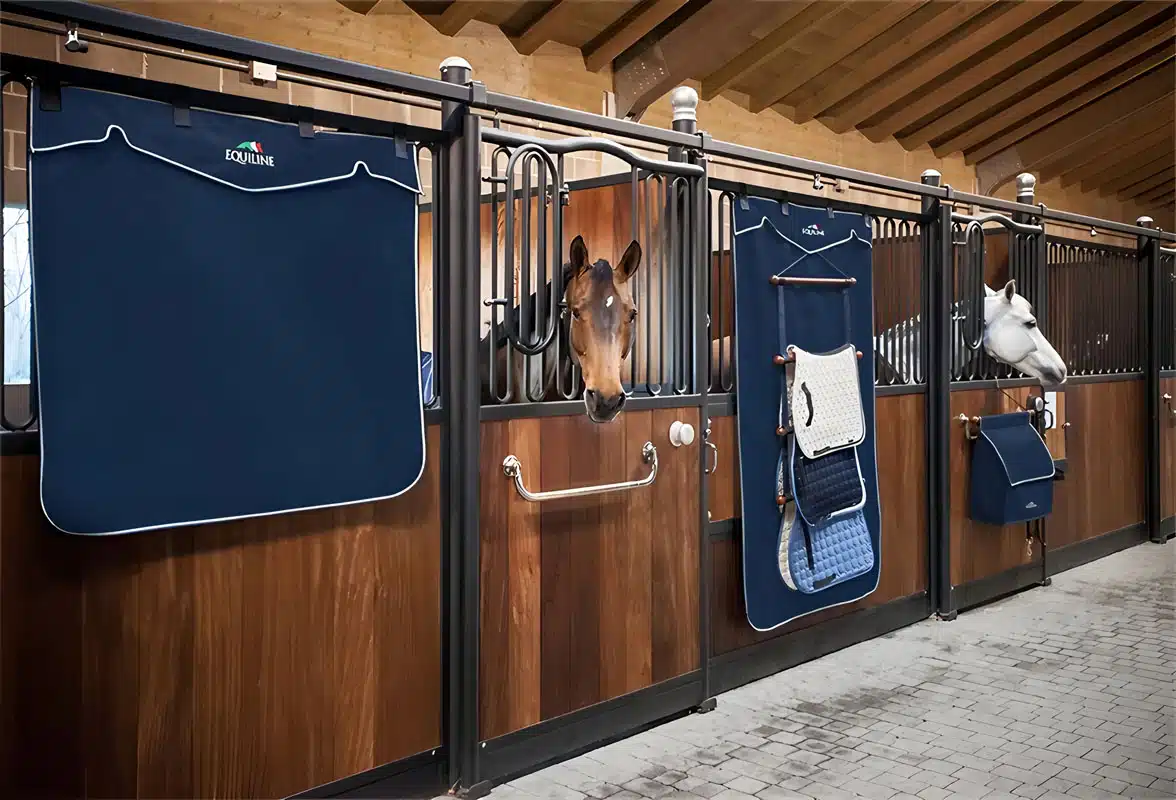

Essential Infrastructure for Professional Training Yards
Professional training facilities demand infrastructure that balances immediate safety with long-term commercial viability. By integrating Q345B high-strength steel and modular logistics, we deliver systems that withstand high-energy impact while significantly reducing installation and maintenance overheads.
Defining Safety Standards: The Role of Heavy-Duty Steel
Structural integrity is the non-negotiable foundation of any professional yard. We prioritize the use of Q345B Low Alloy High Strength Steel (equivalent to ASTM Grade 50) for our frameworks. This material choice is critical, particularly in colder climates where standard steel can become brittle and prone to fracture under impact. The superior impact toughness of Q345B ensures that partitions and fronts remain intact even when subjected to aggressive kicks.
To guarantee longevity, we adhere strictly to the Hot-Dip After Fabrication process, conforming to BS EN ISO 1461 standards. Unlike pre-galvanized alternatives that leave welded joints vulnerable, our method submerges the entire completed frame into molten zinc. This results in an average coating thickness exceeding 85 microns on structural parts, providing a robust shield against red rust and corrosion in ammonia-rich stable environments.
Wall thickness is another critical safety metric. We enforce a minimum standard of 14-Gauge (2.0mm – 2.5mm) for all tubular components. This creates a true “Kick-Proof” barrier capable of absorbing high-energy interactions without buckling, significantly reducing the risk of injury to valuable equine athletes compared to lighter, economy-grade tubing.
Operational Efficiency: Low-Maintenance Design Features
Modern yards must reduce daily operational friction to maintain profitability. We recommend and supply HDPE infill options (28mm-32mm) to achieve a “Zero Maintenance” facility. Unlike traditional timber, which requires regular staining and replacement due to rot or cribbing, UV-stabilized HDPE resists moisture and chewing, maintaining its appearance and structural density for decades with simple wash-down cleaning.
Beyond the stable aisle, our infrastructure supports customizable training capacities, ranging from 4 to 8 horses simultaneously. This is often integrated with steel-structured roofing systems to ensure training schedules remain consistent regardless of weather conditions.
For our B2B partners, efficiency extends to logistics. Our modular flat-pack design serves as a “Profit Protection” mechanism. By optimizing packaging density, we can load approximately 30-45 sets into a single 40HQ container, compared to just 12-15 sets for traditional fully welded systems. This efficiency slashes freight costs by over 60%, preserving margins for distributors and large-scale project developers.

Lunging Pens: Why 14-Gauge Steel is Mandatory for Round Yards
For professional training facilities, 14-gauge steel serves as the absolute minimum safety threshold for containing large equine athletes. We mandate this 2.0mm to 2.5mm wall thickness to prevent catastrophic buckling during high-impact kicks, ensuring your infrastructure withstands the unpredictable nature of breaking and lunging horses.
Structural Integrity: Why Thinner Tubing Fails Under Impact
Safety in a round yard relies entirely on the steel’s ability to absorb kinetic energy. We utilize Q235B structural steel—and Q345B for cold climates—specifically because it resists brittle fractures when a horse strikes the panel. Lighter alternatives, such as 16 or 18-gauge tubing, often buckle or dent immediately upon impact. This deformation creates dangerous sharp edges that present severe injury risks to the horse and increased liability for the facility owner.
Professional training yards require what we define as a “Kick-Proof” specification. While economy panels might suffice for temporary visual barriers, they lack the tensile strength to physically contain a panicked 1,200 lb animal. Our engineering standard ensures that the metal absorbs the blow without permanent structural failure, maintaining a safe training environment session after session.
The Longevity Factor: Weight and Galvanization Performance
Material density directly influences ground stability. A 14-gauge panel system carries sufficient mass—typically 80 to 100 lbs per section—to remain planted during use without requiring permanent concrete footings. This weight prevents the “shifting” common with lightweight aluminum or thin-wall steel pens, which horses can easily displace if they lean or push against the enclosure.
Furthermore, steel thickness dictates the quality of the protective zinc coating. We process our round pens using Hot-Dip Galvanization After Fabrication (ISO 1461). Thinner metal profiles often warp under the high heat of the galvanizing kettle, forcing other manufacturers to rely on inferior pre-galvanized materials that rust at the weld points. Our 14-gauge tubing withstands this thermal process, allowing us to achieve a metallurgical bond with an average zinc coating above 70 microns. This results in a system that resists red rust for decades, even in coastal environments requiring high salt spray resistance.
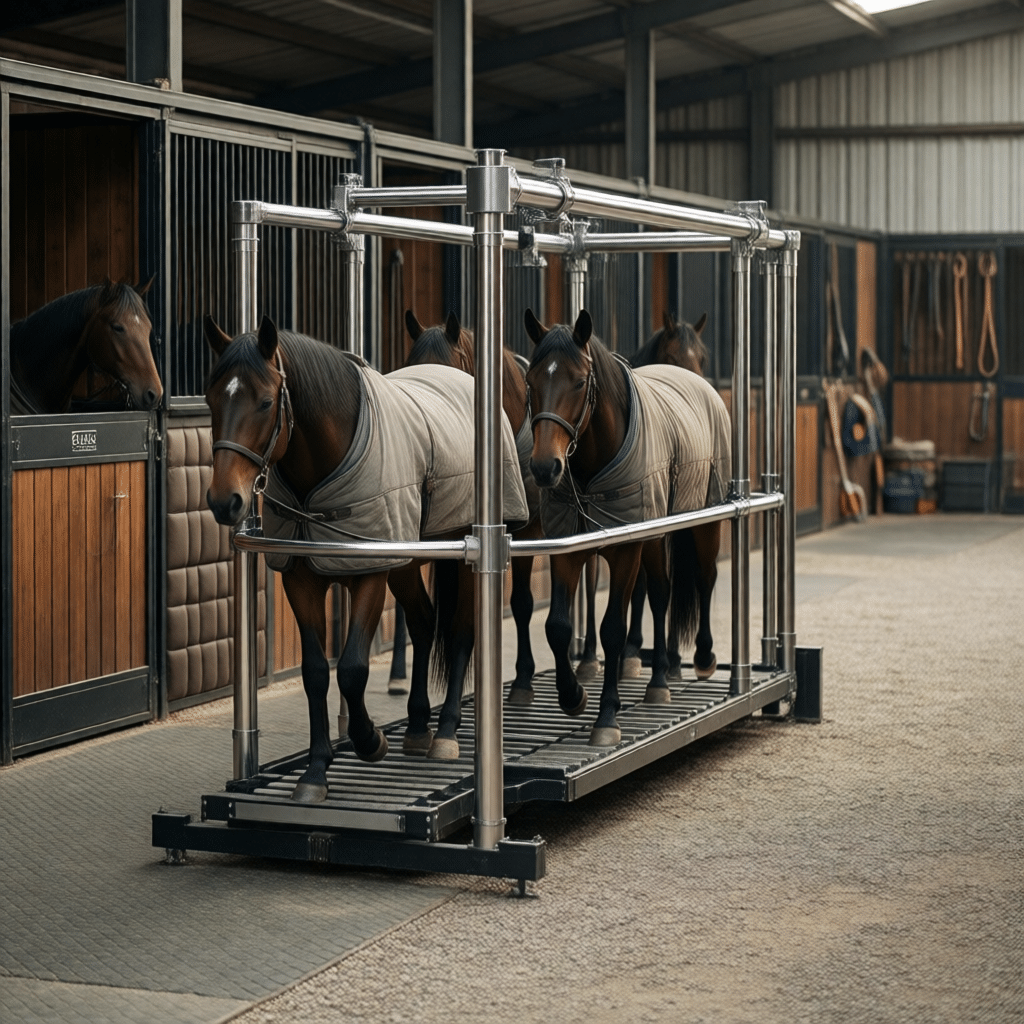
The HDG Rust-Proof Guarantee for Outdoor Equipment
Our commitment to longevity relies on the industrial “Hot-Dip After Fabrication” standard. By immersing the completely welded steel framework into molten zinc, we create a metallurgical bond that seals every joint and internal cavity, providing a dual-layer defense system that actively heals scratches and prevents the structural decay common in painted or pre-galvanized alternatives.
Hot-Dip After Fabrication vs. Pre-Galvanized Methods
At DB Stable, we strictly adhere to the “Hot-Dip After Fabrication” process. This means we fabricate the entire stable front or partition from raw black steel first, ensuring all welding is completed before the metal touches the zinc bath. This sequence is critical because it allows the liquid zinc to penetrate and seal every weld joint, sharp edge, and internal tube surface, adhering strictly to BS EN ISO 1461 standards.
In contrast, many budget-focused manufacturers utilize pre-galvanized tubing. When these tubes are cut and welded, the protective zinc layer is burned off at the connection points, leaving the most critical structural areas exposed to immediate rust. Our holistic dipping method eliminates this vulnerability, ensuring the joints are just as corrosion-resistant as the main framework.
Technical Specs: 85+ Microns for Lifetime Protection
Thickness dictates lifespan. Our structural steel components, such as posts and heavy frames, feature an average zinc coating thickness exceeding 85 microns (μm), significantly surpassing standard agricultural requirements. This dense layer provides cathodic protection, acting as a sacrificial anode that corrodes in place of the steel if the surface is impacted or scratched by hooves.
We validate this durability through rigorous quality control, including ASTM B117 Salt Spray Tests where our samples endure over 96 hours without showing red rust. This level of protection is not just a specification; it is a necessity for our partners in coastal regions like Australia and humid climates in Europe, where salt air and stable ammonia accelerate corrosion on inferior equipment.
The “Profit Protection” Hack: Co-Loading Pens with Stalls
Shipping fully welded frames creates “dead air” inside containers, forcing importers to pay high freight rates for empty space. Our “Profit Protection” strategy utilizes a modular flat-pack system to co-load round pen panels with stable fronts, optimizing container density and reducing per-unit shipping costs by over 60%.
Maximizing Container Density with Flat-Pack Systems
Traditional suppliers often ship fully welded stable panels, a method that severely restricts logistics. This approach caps a standard 40HQ container at just 12 to 15 sets because you are effectively paying to ship air. We engineer a modular flat-pack system that separates the galvanized steel frames from the HDPE or bamboo infills. This design shift allows us to stack components tightly, increasing container capacity to 30-45 sets.
To ensure safety during transit, we utilize steel pallets rather than loose loading. This allows for the secure co-loading of mixed cargo, such as 14-gauge round pen panels alongside stall fronts. The steel pallets keep the load stable, preventing the shifting and scratching common with loose-loaded shipments, ensuring the galvanization arrives in pristine condition.
Reducing Per-Unit Landed Costs
The “Profit Protection” strategy works by lowering the freight cost allocation for every single item in the shipment. When we co-load, we create a balanced mix of high-weight components—like our heavy-duty Q235B or Q345B steel tubes—and high-volume frames. This balance optimizes the container’s weight limits, ensuring we use every available cubic meter efficiently.
This logistical precision translates directly to your bottom line. Our clients typically see freight savings of over 60% compared to competitors importing welded units. These savings allow distributors to improve their margins or offer more competitive pricing to their end customers without compromising on the structural quality of the product.
Final Thoughts
Sourcing 14-gauge, hot-dip galvanized infrastructure is a strategic move to eliminate liability and secure long-term asset value. While lighter economy panels offer lower upfront costs, they inevitably buckle under impact, risking injury to valuable horses and damaging your dealership’s reputation. Our Q345B “Kick-Proof” standard ensures your inventory withstands decades of abuse without the recurring costs of replacement.
Stop paying to ship empty air and start optimizing your landed costs with our modular flat-pack system. We recommend requesting a freight analysis to see how co-loading round pens with stable fronts disrupts traditional logistics to slash shipping expenses by over 60%. Contact our engineering team today to configure a mixed trial container that maximizes your margin potential.
Frequently Asked Questions
Best manufacturer for horse walkers?
While many European brands lead the retail market, DB Stable stands out for B2B distributors seeking OEM solutions. We engineer heavy-duty, hot-dip galvanized walker panels that integrate seamlessly with automated systems. Our focus is on providing high-margin, safety-certified infrastructure for large projects and wholesalers rather than direct retail.
Steel vs wood for lunging pens?
Steel is the mandatory choice for professional facilities due to safety and longevity. Unlike wood, which splinters, rots, or breaks under impact, our Q345B steel panels provide a kick-proof barrier. We hot-dip galvanize every component after fabrication (BS EN ISO 1461), ensuring the structure withstands decades of weather exposure without the maintenance wood requires.
How thick should a round pen panel be?
For safety, the tubing wall thickness must never drop below 14-gauge (2.0mm). Thinner materials risk buckling if a horse strikes the panel. We use 2.0mm to 2.5mm structural steel for all posts and rails, ensuring the pen retains its shape and integrity even under the pressure of daily training.
Can you import a horse walker from China?
Yes, sourcing directly from a manufacturer like DB Stable significantly reduces costs. We assist with the logistics and utilize HS Code 7308.90 (Structures of Iron/Steel) for our export documentation. This classification helps avoid complex regulatory hurdles often associated with prefabricated buildings, streamlining the import process for our partners.
Shipping round pens with horse stalls?
This is our recommended “Profit Protection” strategy. Because round pen panels and stable fronts are heavy, shipping them alone can be costly. We flat-pack these systems together in a 40HQ container, allowing for 30-45 mixed sets. This co-loading approach maximizes container density and reduces your freight cost per unit by over 60%.


 English
  Spanish
  French
  Arabic
  German
0 Comments