


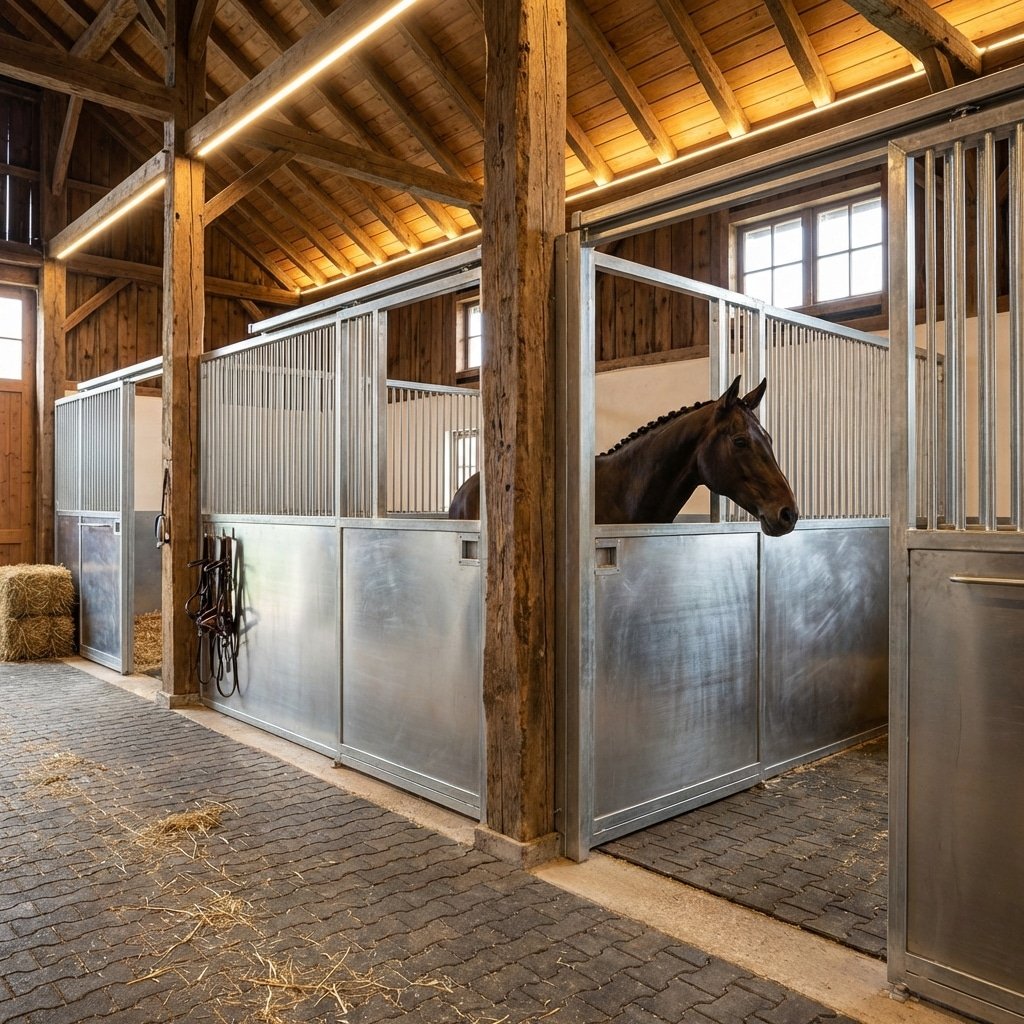
Pillar wrapping techniques distinguish successful barn renovations from structural liabilities. Cutting a load-bearing 6×6 post to fit a standard stall front voids insurance policies and destroys the building’s vertical load path. This error shifts weight to trusses designed for snow loads, triggering cascading roof failures that cost contractors far more than custom steel fabrication.
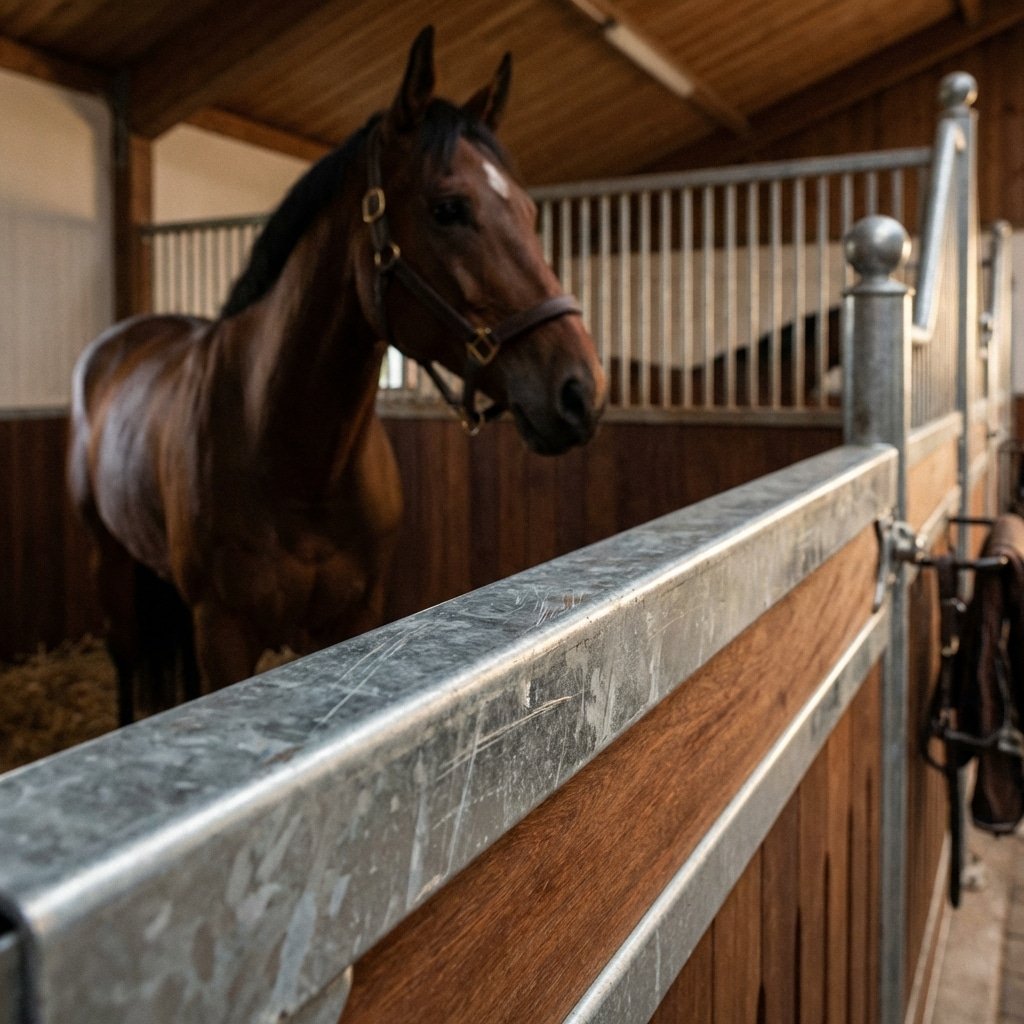
DB Stable utilizes CNC laser notching on Q235B structural steel to integrate stall fronts without site modifications. We perform all cutting before the Hot-Dip Galvanization process, ensuring every exposed edge meets ISO 1461 standards (>85 microns). This method preserves the zinc coating and guarantees a precise fit around existing timber or steel columns.
The Structural Nightmare of the 6×6 Support Pillar
Wood posts suffer from weak axis bending and warping on tall walls. Structural steel framing is required to bridge these inconsistencies and ensure permanent alignment.
Structural Vulnerab
ilities: Weak Axis Bending
While the 6×6 wood post is a standard fixture in barn construction, it introduces significant engineering limitations when used on taller structures. On 14-foot sidewalls, solid sawn columns often fail to provide adequate stiffness compared to steel alternatives. The primary failure mode here is “weak axis bending,” where the post lacks the rigidity to resist lateral forces effectively.
This vulnerability increases the risk of buckling under compressive dead loads from the roof structure and accumulated snow loads. Unlike the predictable, uniform strength of Q235B Structural Steel, wood properties vary by grain and knot density. Relying solely on timber for high-wall load transmission introduces a variable that engineering teams must over-compensate for, often requiring larger, more expensive laminated columns to achieve the safety factors inherent in standard steel tubing.
Material Instability: The Warping of Pressure-Treated Lumber
Installing precise mechanical equipment onto organic materials creates a fundamental conflict in tolerances. Pressure-treated lumber, particularly Southern Yellow Pine, releases moisture unevenly after installation. This process causes twisting, bowing, and cupping that can physically shift the position of a door latch or hinge by inches over a single season. A latch that aligns perfectly on day one may jam or fail to catch entirely six months later due to post deformation.
Builders also face the discrepancy between “nominal” and “actual” dimensions. A 6×6 post measures 5.5 inches (approx. 140mm), varying further with moisture content. Our Hot-Dip Galvanized stall systems use 50mm RHS steel tubing with strict manufacturing tolerances. To install a precision-engineered steel frame into a rough-cut timber environment, you must use a fully independent steel sub-frame. This isolates the door mechanics from the timber’s movement, ensuring that when the wood inevitably warps, the steel frame maintains its square geometry and operational integrity.
Why You Can Never Cut or Move a Barn’s Load-Bearing Post
Modifying load-bearing posts disrupts vertical load paths, risking immediate roof collapse and voiding insurance. Always adapt the stall system to the structure, never the reverse.
Disrupted Load Paths and Cascading Failures
Post-frame buildings function as a unified engineered system. Every post exists to transfer specific vertical loads—roof weight, snow accumulation, and wind shear—directly into the foundation. This is the “load path.” When a contractor cuts, moves, or notches a post to force a stall front into place, they sever this path.
The consequences are immediate and physical. The load does not disappear; it shifts to adjacent members that were never designed to carry it. This overload triggers a cascading failure, where trusses warp, headers crack, and the roof system collapses. Even a minor notch to fit a sliding door track creates a stress concentration point. This reduces the timber’s bending strength, inviting failure under heavy snow loads or high winds.
Building Code Compliance and Liability Issues
Beyond physical risk, structural modifications create a legal nightmare. Local building codes strictly regulate the anchoring and spacing of support columns. Altering these without a stamped plan from a licensed structural engineer constitutes a code violation. If a failure occurs, the property insurance carrier will likely deny the claim due to unauthorized structural tampering.
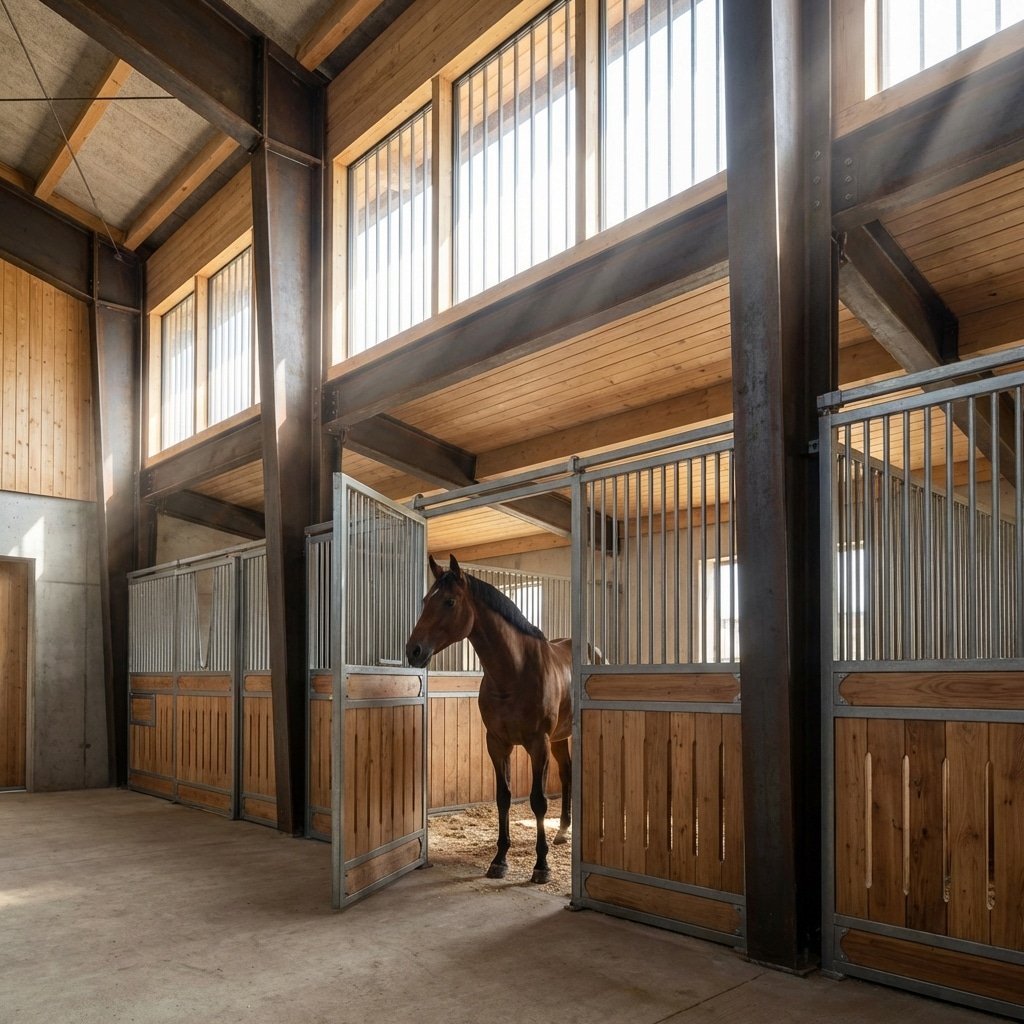
At DB Stable, we engineer the equipment to fit the facility, not the other way around. Our manufacturing process allows for custom-sized panels and fillers to accommodate existing post spacing. By adjusting the steel fabrication in our factory, we ensure the stall system fits perfectly between columns. This approach preserves the building’s structural integrity and keeps your project compliant with safety standards and insurance requirements.
Premium Galvanized Stables Built For 20-Year Durability
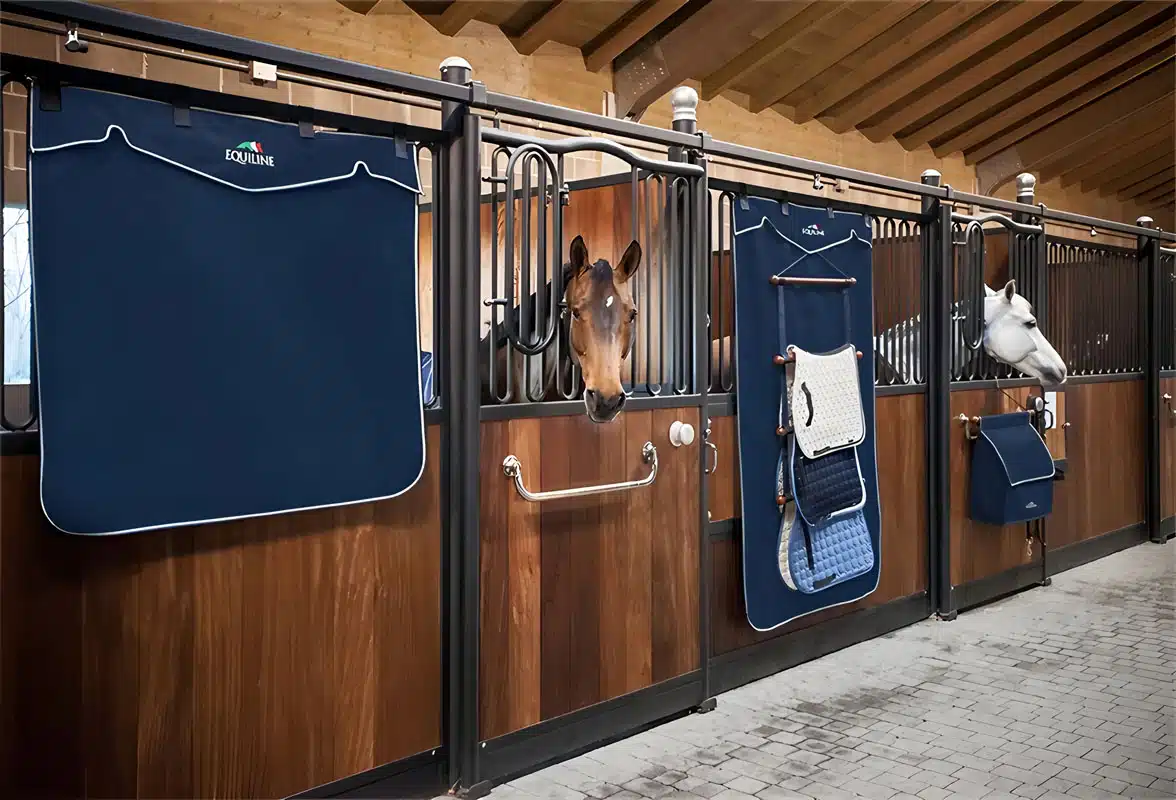
The OEM Hack: Notched and Custom-Cut Stall Panels
Executive Summary: Factory-level CNC notching allows stable fronts to wrap around structural pillars without cutting corners on site. We hot-dip galvanize after the cut, ensuring the exposed edge receives the full >85 micron zinc coating.
| Comparison Factor | DB Stable OEM Factory Cut | On-Site Contractor Modification |
|---|---|---|
| Process Sequence | Cut Black Steel → Weld → Hot-Dip Galvanize | Receive Galvanized Panel → Cut → Spray Paint |
| Zinc Protection | >85 Microns (ISO 1461) on all edges | Zero. Raw steel exposed to a ir. |
| Fit Precision | CNC Laser Accuracy (0.5mm tolerance) | Manual Angle Grinder (Rough edges) |
| Corrosion Risk | None (Sealed System) | High (Rust starts at cut points immediately) |
CNC Laser Notching for Seamless Pillar Integration
Most project delays happen when standard panels clash with existing barn architecture. Structural pillars, especially in older timber barns or retrofitted warehouses, rarely align with a perfect 12-foot grid. Moving these load-bearing posts is expensive and dangerous. The “OEM Hack” solves this by modifying the steel panel, not the building.
We utilize CNC laser technology to remove precise sections of the steel tube profile. This allows the stable front or partition to “wrap” around the obstruction. The laser follows the exact contour of your Q235B or Q345B steel columns, creating a fit that manual on-site cutting cannot match.
- Structural Safety: Eliminates the risk of moving load-bearing barn pillars.
- Cost Efficiency: Reduces installation labor by removing the need for on-site fabrication.
- Aesthetic Alignment: Ensures tight joints where the panel meets the post, preventing dangerous gaps.
The “Hot-Dip After Fabrication” Protocol for Custom Cuts
The real problem with cutting panels on-site is rust. When a contractor takes an angle grinder to a pre-galvanized panel, they slice through the protective zinc layer, exposing raw steel to moisture and ammonia. Cold galvanizing sprays (zinc paint) are a temporary patch, not a solution. They eventually flake off, leading to corrosion that spreads under the remaining paint.
DB Stable handles this differently. We perform all notching and cutting on the raw black steel frames before the galvanization process begins. Once the custom shape is achieved, we submerge the entire piece into the zinc bath.
- Full Coverage: The liquid zinc coats the newly cut edges just as thickly as the flat surfaces.
- ISO Compliance: We maintain our standard >85 micron coating (ISO 1461) even on complex, custom-notched areas.
- Lifetime Standard: This process guarantees that a custom-fit panel has the same rust resistance as a standard straight panel.
Bolting the Steel Flanges Directly into the Pillar
Bolting flange plates eliminates on-site welding risks and preserves the column’s galvanization, creating a rigid connection that handles high shear forces without compromising the protective zinc coating.
The Mechanics of Flange Plate Connections
Welding inside an existing barn introduces unnecessary risks. It creates immediate fire hazards near flammable bedding and destroys the protective zinc coating on your structural pillars, leaving them vulnerable to rust. We engineered a bolted flange system to bypass these issues completely. This method mechanically locks the stable front to the column, ensuring the load path is secure without applying heat that degrades the steel’s metallurgy.
- Eliminates Fire Hazards: Removes the need for dangerous field welding in barns filled with dry hay and bedding.
- Structural Integrity: Ensures precise shear force transmission from the stable front directly to the main structural column.
- Zinc Preservation: Protects the factory-applied zinc coating on the pillars, which on-site welding would inevitably burn off.
- Rapid Assembly: Allows crews to install or disassemble fronts quickly using standardized high-tensile bolts.
Securing with the 304 Stainless Steel Hardware Kit
The connection point is often the first place to fail in a stable system, usually due to corrosion or bolt shear. Standard zinc-plated hardware cannot survive the ammonia-rich environment of a horse stall. We strictly utilize a dedicated 304 Stainless Steel hardware kit for all flange connections. This ensures that the anchor points remain rust-free and structurally sound, even when subjected to the dynamic impact of a kicking horse.
- Corrosion Resistance: Uses DB Stable’s standard 304 Stainless Steel anchor bolts to prevent rust in high-ammonia zones.
- Heavy-Duty Plating: Connects via 6mm thick steel plates that are pre-welded to the frame before hot-dip galvanization.
- Steel Compatibility: Engineered to mate perfectly with both standard Q235B and cold-climate Q345B structural steel posts.
- Impact Resilience: Includes heavy-duty connectors specifically designed to withstand substantial lateral forces from horses.
Frequently Asked Questions
Can I install stall fronts between my barn’s existing support posts?
Yes, this is standard in post-frame construction. You must accurately measure the clear opening between posts. Since your posts are structural (supporting the roof), we manufacture custom-sized panels to fit the specific gap rather than modifying the posts. This ensures the building’s structural integrity remains intact.
What if my barn posts are not spaced at standard 10′ or 12′ intervals?
As a B2B OEM manufacturer, DB Stable produces custom-width panels to match your specific layout. If your spacing is 11’4″ or 13′, we adjust the steel frame production to fit your pillars perfectly. This eliminates the need for onsite cutting or welding.
How do I attach the stall panels to wood or steel columns?
Our system utilizes a specialized Hardware Kit with 304 Stainless Steel connectors. For wood posts, these brackets are secured with lag bolts; for steel columns, we provide heavy-duty self-tapping screws. This allows the stall system to anchor securely to the building shell without compromising the load-bearing capacity of the columns.
Should I attach the top of the stall walls to the roof trusses?
No. You should avoid connecting stall corner columns or top rails directly to roof trusses. Stall walls must function as independent structures or be anchored only to vertical posts. Connecting them to trusses can transfer roof loads (like snow) onto the stalls, or conversely, stall movement could damage the roof structure.
Final Thoughts
Relying on field contractors to cut galvanized steel on-site guarantees immediate rust issues and unnecessary structural liability. DB Stable’s “Hot-Dip After Fabrication” process ensures every custom CNC notch receives the full ISO 1461 >85 micron zinc protection just like a standard panel. This factory-level precision safeguards your reputation against corrosion claims while preserving the integrity of the building’s load path.
Stop compromising your installation timeline with unpredictable on-site fabrication. Submit your barn’s column layout to our engineering team today for a custom CAD proposal that aligns perfectly with your existing structure. Partner with us to deliver a seamless, bolt-ready solution that maximizes your margin and minimizes installation risk.

 English
  Spanish
  French
  Arabic
  German
0 Comments