


Strategic Alibaba Sourcing for horse stables separates profitable distributors from those buried in warranty claims. Most listings are brokers masquerading as manufacturers, charging a hidden 20-40% markup for pre-galvanized tubing that rusts rapidly. Relying on these intermediaries severs your technical oversight and destroys your margins through inevitable corrosion failures.
This analysis isolates genuine OEM manufacturers strictly adhering to ISO 1461 hot-dip galvanization standards. We benchmark suppliers against the critical Q345B cold-climate steel specification and verify their ability to execute flat-pack logistics for maximum container density. Read on to identify the true source factories capable of delivering the 70-micron zinc protection your heavy-duty projects demand.
Premium Horse Stables, Manufacturer Direct Pricing
The Alibaba Trap: Brokers Disguised as Factories
Navigating Alibaba often feels like walking a minefield where trading companies and freelance agents masquerade as legitimate manufacturers. This deception creates a “Middleman Markup” of 20-40% while severing your direct line to technical quality control. For B2B distributors, the difference between a broker and a source factory like DB Stable isn’t just price—it is the guarantee that your Q345B steel specifications and ISO 1461 galvanization standards are actually met, rather than just promised on a digital invoice.
Categorizing the Intermediaries: Traders, Agents, and Marketers
The “Alibaba Trap” works because these platforms categorize suppliers loosely. While we operate as a dedicated OEM/ODM manufacturer with ISO 9001 certifications, many entities on these platforms possess no machinery at all. Understanding who you are actually talking to is the first step in protecting your supply chain.
**Trading Companies** act as resellers. They source products from various small workshops to resell at a profit. While they may offer a wide catalogue, they often lack deep technical knowledge of specific engineering requirements, such as the critical difference between standard Q235B steel and the cold-climate Q345B variants we utilize.
**Freelance Agents** are even more elusive. Often operating from home offices with nothing more than a laptop, these brokers connect buyers to factories for a commission. Research indicates that some “Gold Suppliers” with years of history may actually consist of a single person without any physical inventory. They cannot control production schedules or enforce quality protocols.
**Online Marketers** are groups that purchase generic bulk products and rebrand them. They control the listing and the photos but have zero oversight of the manufacturing floor. They are rarely present to verify if the **hot-dip galvanization** process was performed after fabrication or if cheap pre-galvanized tubing was swapped in to cut costs.
The Business Impact: Inflated Pricing and Technical Ignorance
Engaging with an intermediary doesn’t just cost you money; it endangers your reputation. The “Middleman Markup” typically adds 20-40% to the factory ex-works price. This inflation forces you to either eat into your own margins or pass unreasonable costs onto your clients, making you less competitive against distributors who source directly from factories like ours.
The most dangerous aspect, however, is the **Quality Blind Spot**. Brokers rarely verify critical engineering specs because they lack the expertise to do so. They often cannot distinguish whether a batch of steel is the required **Q345B Low Alloy High Strength Steel** or a cheaper substitute. Furthermore, they are unlikely to confirm if zinc coatings meet the strict **>85 microns** requirement of **BS EN ISO 1461**, leaving your clients with stables that may rust prematurely.
Finally, working with intermediaries introduces significant **Communication Delays**. Technical questions regarding **14-gauge (2.0mm – 2.5mm)** tubing thickness or specific lead times suffer lag times. Since the broker must relay every query to the actual source factory, you lose the agility needed to manage large projects. Real custom production typically requires a 35-45 day lead time to account for proper galvanization scheduling; a broker promising faster delivery is often selling stock that doesn’t meet your specific needs.
The “Pre-Galvanized” Scam: Why Cheap Quotes Rust
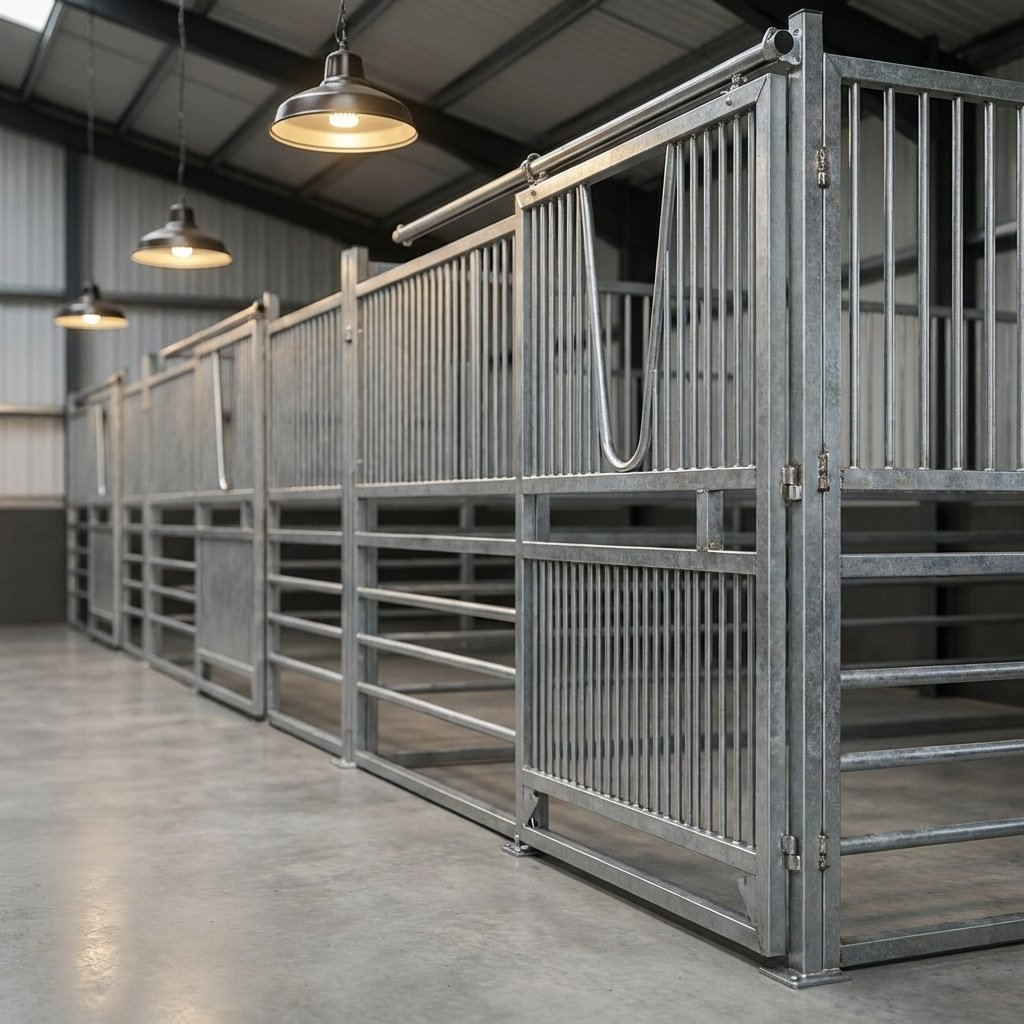
The lowest price on a spreadsheet often hides the highest cost in the field: rapid corrosion. “Pre-galvanized” stalls rely on cosmetic silver paint to hide burnt zinc at the weld points, leading to structural rust within months. At DB Stable, we refuse this shortcut, committing exclusively to Hot-Dip Galvanization After Fabrication to ensure the steel is sealed against ammonia and moisture for decades.
The “Painted Weld” Deception: Pre-Galv vs. Hot-Dip After Fabrication
Many competitors reduce manufacturing costs by purchasing steel tubes that are already galvanized at the mill. They cut these tubes and weld them together to form a stall front. The intense heat of welding vaporizes the protective zinc layer around every joint, leaving the raw steel exposed to the elements. To mask this damage, factories apply a quick coat of silver spray paint. This cosmetic layer peels quickly, creating the infamous “bleeding rust” seen in budget stable blocks.
We take a fundamentally different path. We fabricate our frames from raw, black Q235B structural steel first. Only after all cutting and welding is complete do we submerge the entire chassis into molten zinc. This “Hot-Dip After Fabrication” process ensures that the zinc bonds metallurgically to the steel, covering every weld, edge, and internal surface. There are no painted joints to fail, only a continuous shield of zinc.
Quantifying the Fraud: Zinc Microns and Steel Gauges
The difference in durability is measurable. Pre-galvanized tubing typically carries a zinc coating of just 10 to 20 microns—barely enough to survive shipping, let alone a humid stable environment rich in ammonia. Our process adheres strictly to BS EN ISO 1461 standards, delivering an average coating thickness of over 70 microns on tubing and over 85 microns on structural parts. This 400% increase in protective mass provides the true longevity required for high-traffic equestrian projects.
Furthermore, the galvanizing bath operates at temperatures that can warp thin, inferior steel. Fraudulent suppliers often use sub-standard 1.5mm wall thickness, which cannot withstand the hot-dip process without deforming. We strictly enforce a 14-Gauge (2.0mm – 2.5mm) minimum wall thickness. This spec ensures the material handles the heat of proper galvanization and withstands the impact of a kicking horse, protecting both your inventory lifespan and your reputation.
How to Request a Live Video Audit of the Zinc Bath
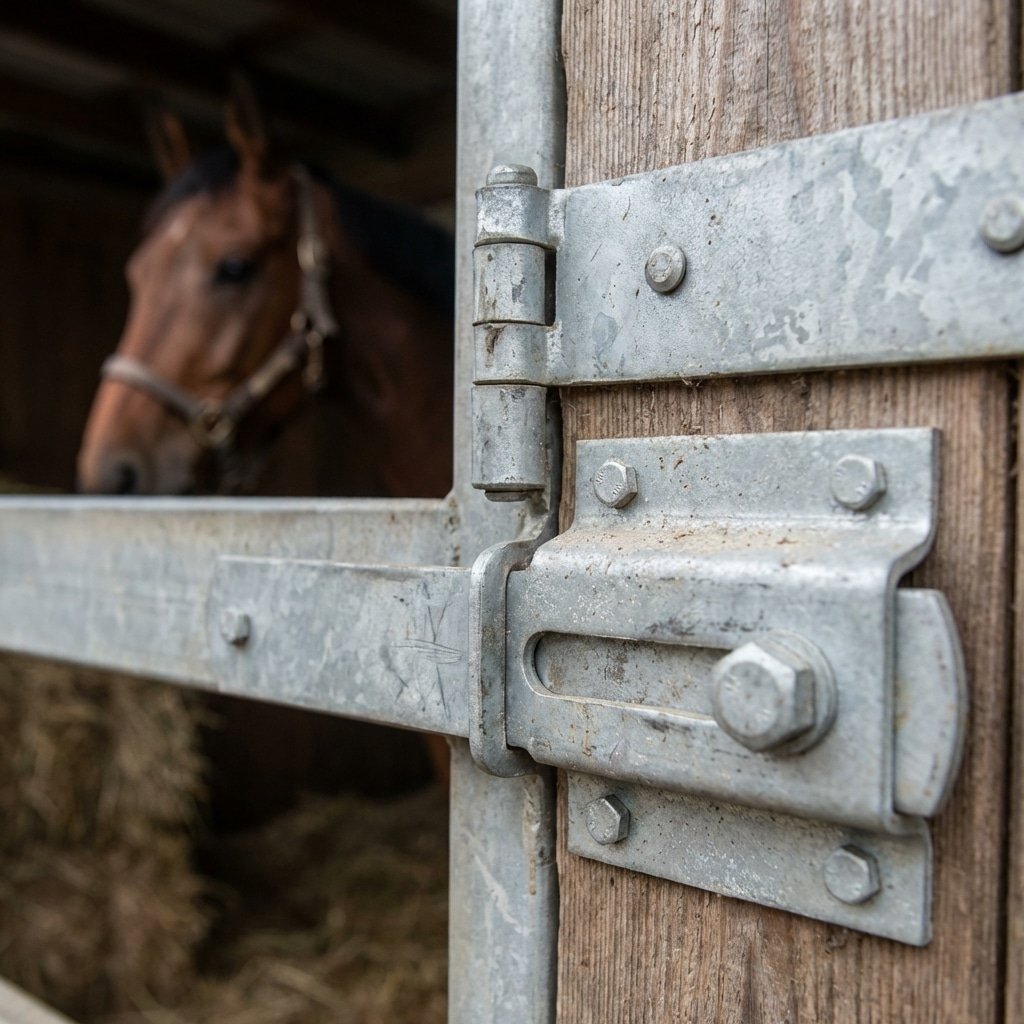
To confirm you are partnering with a genuine OEM manufacturer like DB Stable, we recommend scheduling a live video inspection during the galvanization phase. This “Dip Day” audit allows you to witness raw black steel entering the zinc bath and verify ISO 1461 coating thickness in real-time, ensuring your stables receive the lifetime rust protection we promise.
Scheduling the “Dip Day” Verification Call
Trading companies and brokers rarely have access to the heavy industrial floors where galvanization occurs. In contrast, true source factories operate with transparency and can schedule a specific “Dip Day” for your order. We encourage you to request a live video call via WhatsApp or WeChat specifically during the galvanizing window, which typically occurs around day 35 to 40 of our production cycle.
During this call, verify the authenticity of the feed by demanding the “Proof of Life” test. Ask the salesperson to hold a piece of paper with today’s date and your specific order number directly in front of the active zinc kettle. If a supplier claims they cannot film due to “trade secrets” or safety concerns, this is often a red flag that they are outsourcing production to an unverified third party or trading pre-made inventory.
Visual Checklist: Identifying True ISO 1461 Compliance
Begin your audit by inspecting the input material before it enters the zinc bath. You must see raw, black steel frames (Q235B or Q345B) being prepared for dipping. If the steel appears silver or shiny before it hits the kettle, the facility is using cheap pre-galvanized tubing. This inferior method provides a thinner coating that fails to protect welded joints, leading to rapid corrosion in ammonia-rich stable environments.
Next, observe the extraction process to verify our “Hot-Dip After Fabrication” standard. You should see the entire door panel emerging with liquid zinc dripping off the frame, proving that the protective alloy has sealed every weld and internal crevice. Pay attention to the background environment as well; real hot-dip galvanizing involves significant heat, steam, and heavy overhead cranes. A clean, quiet assembly room indicates the supplier is merely assembling pre-made parts rather than manufacturing structural components.
Finally, confirm the coating thickness visually by asking the operator to place a magnetic thickness gauge on a cooling panel live on camera. For our structural parts, the reading must exceed 85 microns (μm), and for tubing, it must exceed 70 microns. This live verification ensures your order meets BS EN ISO 1461 standards, guaranteeing the durability required for long-term commercial use.
Top 5 Verified OEM Source Factories
Identifying a genuine OEM source factory is the critical first step in securing reliable inventory and protecting distributor margins. While online marketplaces are crowded with intermediaries, top-tier manufacturers are defined by their adherence to ISO 1461 galvanization standards, transparency in raw material sourcing, and the ability to execute high-efficiency logistics for global B2B partnerships.
The Industry Benchmark: DB Stable’s OEM Profile
At DB Stable, we operate strictly as a B2B source factory, prioritizing partnerships with distributors and large project developers while refusing retail sales to protect your market position. Our manufacturing process is defined by the “Hot-Dip After Fabrication” standard (ISO 1461), ensuring that every 14-gauge tube receives a zinc coating averaging over 70 microns to guarantee long-term rust protection. Unlike competitors who sell from pre-made stock, our 35-45 day lead time allows for this essential galvanizing schedule and the integration of Q345B Low Alloy High Strength Steel for superior impact resistance in cold climates. Furthermore, our engineering team has perfected a flat-pack logistics system that loads 30-45 sets into a single 40HQ container, drastically reducing per-unit shipping costs compared to the industry average of 12-15 sets.
Sourcing the Remaining Top Tier: Verification Protocols
To identify other top-tier manufacturers, we recommend filtering strictly for the “Verified Supplier” badge on platforms like Alibaba, which indicates that credentials have been audited by agencies such as TUV, SGS, or Intertek. You should validate a factory’s legitimacy by requesting live video audits that showcase their raw material inventory, specifically looking for the markings of Q235B or Q345B structural steel to ensure you are not buying inferior scrap metal. We also advise using Trade Assurance to secure your capital, releasing funds only after quality benchmarks—such as passing a 96-hour ASTM B117 salt spray test—are confirmed. Finally, cross-referencing a supplier’s capabilities on alternative databases like GlobalSources or Made-in-China.com can verify their export history and confirm they possess the infrastructure to handle high-volume OEM production.
DB’s Direct B2B Pricing vs. Alibaba Markups
Direct sourcing defines your bottom line. We eliminate the hidden broker fees and platform commissions common on Alibaba by operating as a dedicated B2B OEM/ODM source factory. Beyond the unit price, our “Profit Protection” flat-pack engineering slashes landed costs by maximizing container density, ensuring you pay for product, not shipping air.
Bypassing Intermediary Layers and Platform Fees
Alibaba operates as a broad marketplace where brokers often disguise themselves as manufacturers. These intermediaries add layered markups to cover their commissions and platform transaction fees, which typically hover around 2.99%. DB Stable operates differently. As a direct source factory, we allow distributors to negotiate based on actual production costs—specifically the market rate of Q235B or Q345B steel and hot-dip galvanizing services—rather than inflated retail-lite pricing.
We also secure your import margins through precise documentation. We utilize HS Code 7308.90 (Structures of Iron/Steel) for all export filings. This strategic classification helps our clients avoid the aggressive tariffs and complex regulatory hurdles often associated with “Prefabricated Buildings,” a common classification error made by inexperienced traders that can ruin project profitability.
Optimizing Landed Costs with Flat-Pack Logistics
The “Total Cost of Ownership” for heavy stable systems relies heavily on shipping efficiency. Competitors on general marketplaces often ship fully welded frames, a method that limits a 40HQ container to a mere 12-15 sets. This inefficiency forces you to pay exorbitant freight rates for minimal stock.
We engineered our “Profit Protection” flat-pack system to solve this. By designing panels that bolt together on-site using 304 stainless steel hardware, we increase loading capacity to 30-45 sets per 40HQ container. This high-density loading strategy effectively reduces per-unit shipping costs by over 60%. For distributors, this ensures that gross margins remain healthy and are not eroded by ocean freight costs.
Final Thoughts
Securing your margin means eliminating the 20-40% middleman markup and rejecting inferior pre-galvanized substitutes that rust within months. Our strict adherence to ISO 1461 Hot-Dip After Fabrication ensures your inventory survives ammonia-rich environments, safeguarding your dealership from costly warranty claims. By utilizing our high-density flat-pack system, you maximize container efficiency and stop paying to ship empty air.
Verify your supply chain immediately by scheduling a live “Dip Day” video audit to witness our raw Q345B steel entering the zinc bath. Contact our engineering team to discuss your specific custom requirements or to request a precise landed cost calculation based on current freight rates. Real protection for your business starts with a direct line to the factory floor.
Frequently Asked Questions
Is it safe to buy horse stalls on Alibaba?
It is safe if you strictly vet suppliers, but many listings come from brokers rather than manufacturers. To minimize risk, verify business licenses and request specific factory audits. For larger projects or distributor partnerships, dealing directly with a source factory like DB Stable ensures you receive genuine hot-dip galvanized products rather than cheaper, inferior substitutes.
How to find a real factory on Alibaba?
Look beyond glossy product photos. A real factory can host a live video call to show you raw material stock (like Q235B steel) and active welding stations. Ask to see the hot-dip galvanizing process live. At DB Stable, we encourage video audits of our production floor to prove we are the manufacturer, not a middleman.
What is a pre-galvanized horse stall?
Pre-galvanized stalls use tubes coated with zinc *before* they are cut and welded. The welding process burns this zinc off, leaving joints prone to immediate rust. We strictly reject this method. Instead, we use Hot-Dip Galvanization After Fabrication, dipping the completely welded frame into molten zinc to ensure every joint and crevice is sealed against corrosion.
How to verify ISO 1461 certification?
Do not accept a generic certificate image. Require a batch-specific galvanizing report showing coating thickness measurements. Under ISO 1461 standards, structural steel (>6mm) should average over 85 microns, and tubing should exceed 70 microns. We back this with ASTM B117 Salt Spray testing to ensure our finish meets true ‘Lifetime’ rust protection standards.
Alibaba Trade Assurance for steel products?
Trade Assurance protects your deposit, but it does not automatically inspect quality. To use it effectively, your contract must explicitly state technical specs like ’14-gauge wall thickness’ and ‘Hot-Dip After Fabrication.’ We ensure all these critical parameters—including weight and packing specs—are detailed in our commercial contracts to guarantee the product matches our engineering standards.

 English
  Spanish
  French
  Arabic
  German
0 Comments