


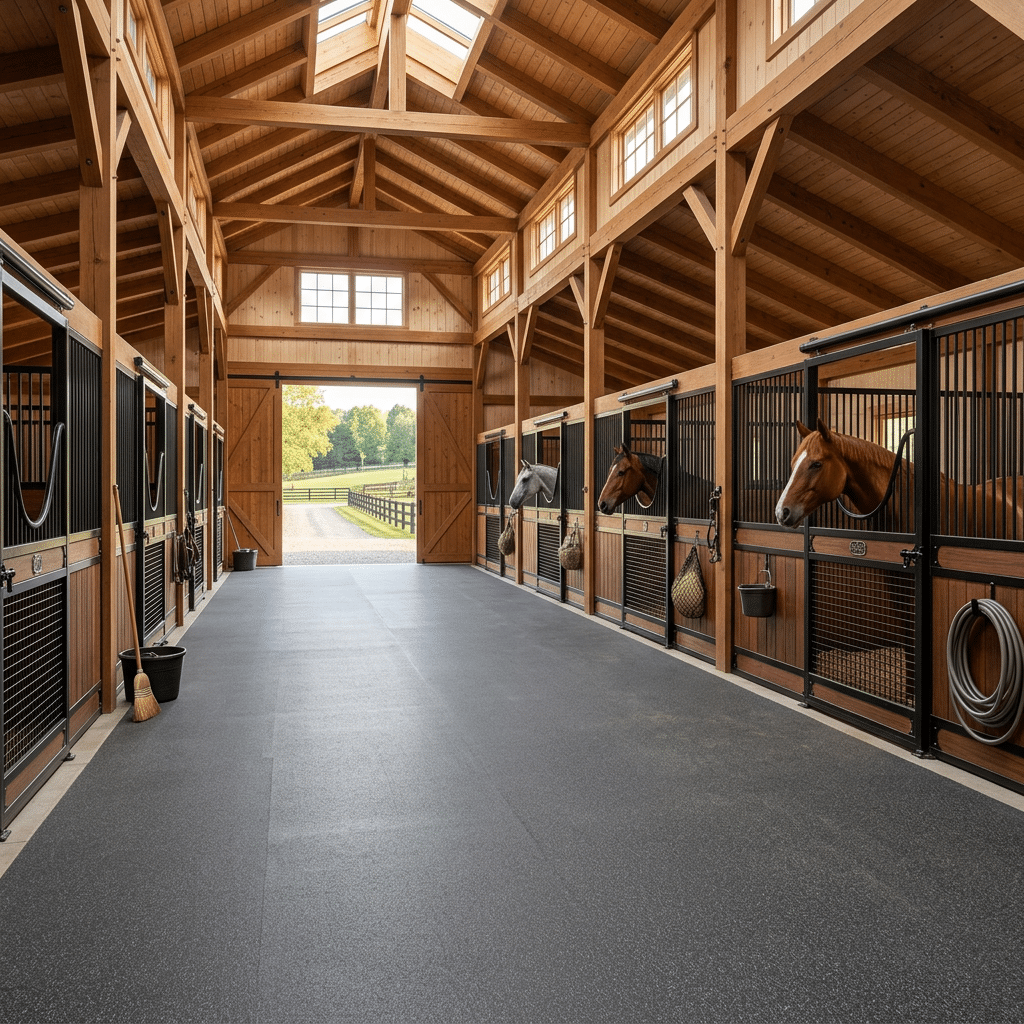
Olympic Training infrastructure demands more than aesthetics; it requires absolute risk mitigation for equine assets valued in the millions. Standard agricultural stabling often fails under the dynamic stress of elite warmbloods, creating injury liabilities that jeopardize competitive schedules and devalue syndicate investments.
We benchmark high-performance facilities against the DB Stable Professional Series standard. By utilizing Q235B structural steel hot-dip galvanized to ISO 1461 and High-Density Strand Woven Bamboo with a Janka hardness exceeding 3000 lbf, we deliver kick-proof resilience that secures both the animal and the operational budget.
The Rise of ESG (Environmental, Social, Governance) in Construction
By 2026, ESG has evolved from a compliance metric to a core strategy. Firms now prioritize low-carbon materials and circular economy practices like hot-dip galvanization to minimize waste.
Decarbonization and Circular Economy Protocols
Construction accounts for a massive portion of global CO2 emissions, driving the 2026 push for strict carbon budgets. The industry is rapidly shifting focus from operational energy efficiency to embodied carbon—the emissions generated during material extraction and manufacturing. Regulatory bodies now increasingly require embodied carbon measurement before approving major infrastructure projects, forcing developers to audit their supply chains rigorously.
Circular economy practices have also moved center stage. The goal is to extend material lifecycles to reduce replacement waste. In the past, “build and replace” was acceptable, but current protocols demand materials that resist degradation for decades. A product that rusts or rots in five years is now a liability, creating a preference for modular, reusable, and highly durable components that align with waste-reduction mandates.
Sustainable Specs: Hot-Dip Galvanized Steel and Bamboo
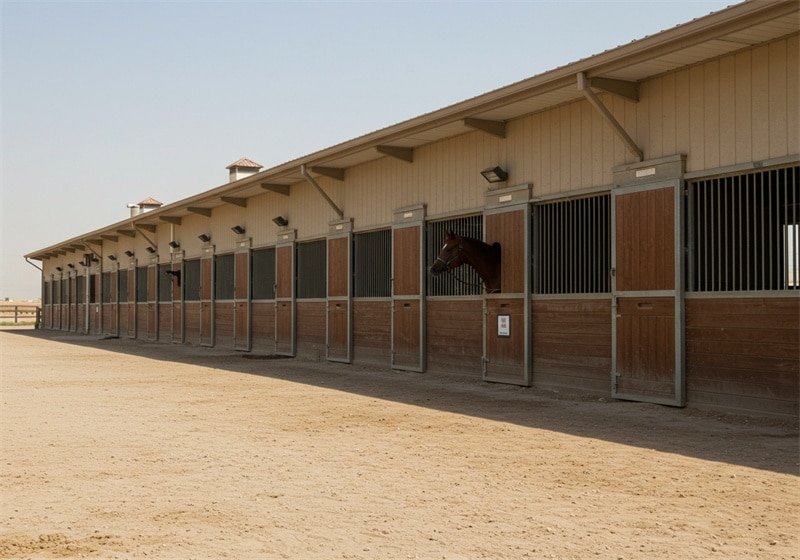
To meet these ESG goals, we align our manufacturing standards with the need for longevity and renewable resources. We focus on materials that lower the carbon footprint without sacrificing structural integrity. Specific technical protocols drive this alignment:
- ISO 1461 Galvanization: We use Hot-Dip Galvanization after fabrication. With zinc coatings exceeding 85 microns on structural parts, this process ensures a 10+ year lifespan, preventing the premature rust and waste associated with pre-galvanized alternatives.
- Renewable Bamboo Infill: We utilize High-Density Strand Woven Bamboo. It matures in just 3-5 years—compared to decades for hardwood—and offers a Janka hardness > 3000 lbf, providing a carbon-sequestering alternative that outlasts traditional timber.
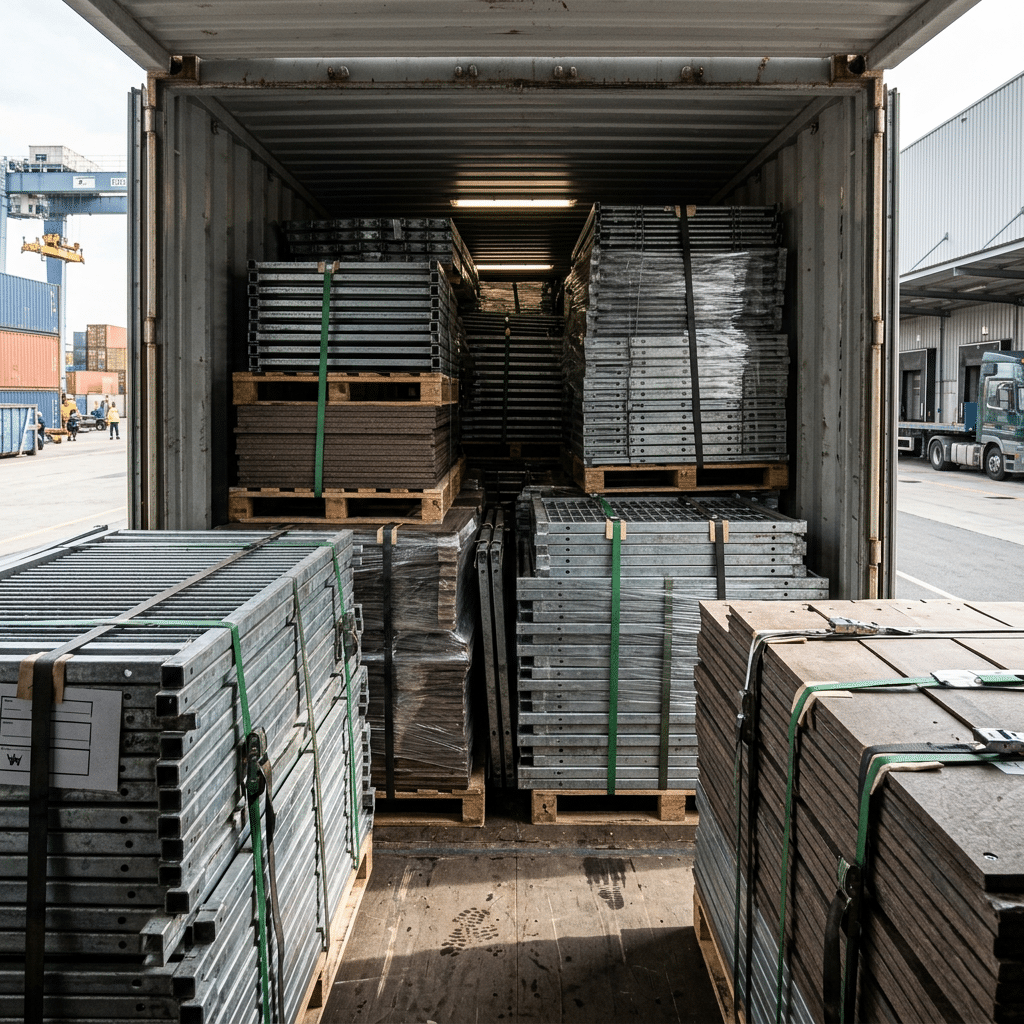
- Flat-Pack Logistics: Our steel pallet system fits 30-45 sets per 40HQ container. This efficiency reduces freight-related carbon emissions by over 60% compared to welding competitors who ship mostly air.
These specifications allow distributors and project managers to meet rigorous environmental standards while maintaining commercial viability. By choosing materials engineered for decades of use rather than years, facilities significantly lower their long-term environmental impact.
Moving Away from Old-Growth Timber (Oak/Pine)
Modern facilities are ditching slow-growth timber for High-Density Strand Woven Bamboo and HDPE, which offer superior impact resistance and renew in just 3-5 years.
The Ecological and Maintenance Costs of Hardwood
We need to be honest about the viability of traditional timber in modern equestrian manufacturing. While Oak has a class
ic aesthetic, it represents a logistical and ethical bottleneck. An Oak tree requires decades—often up to a century—to reach maturity. Relying on such slow-growth resources for large-scale manufacturing is no longer defensible when faster-regenerating alternatives exist that outperform wood structurally.
Softwoods like Pine present immediate operational headaches. Even when pressure-treated, Pine remains soft enough for horses to crib (chew). This behavior not only damages the structure, requiring frequent board replacements, but often forces facility owners to apply chemical deterrents or metal capping strips just to preserve the stable. It creates a cycle of maintenance that eats into operational budgets.
Hygiene is the final dealbreaker. Organic timber is naturally porous. In the damp environment of a stable, wood absorbs moisture, urine, and cleaning fluids, creating a breeding ground for bacteria and mold. Once pathogens seep into the grain, sterilization becomes nearly impossible.
Strand Woven Bamboo: A Material 3x Harder Than Oak
We shifted our production focus to materials that handle the physical abuse of a 1,200 lb animal without failing. DB Stable utilizes High-Density Strand Woven Bamboo for our Professional Series. This is not the hollow bamboo found in garden decor; it is crushed, compressed, and engineered into solid planks.
- Extreme Density: With a Janka Hardness rating exceeding 3000 lbf, our bamboo is significantly denser and more impact-resistant than Oak.
- Rapid Renewal: Bamboo reaches maturity in just 3-5 years, offering a highly renewable resource without compromising structural integrity.
- Rot Resistance: The high-density compression eliminates the porosity issues found in softwood, naturally resisting mold and rot.
For clients demanding absolute zero maintenance, specifically in high-turnover environments like rental stables or veterinary quarantine units, we deploy UV-stabilized HDPE (High-Density Polyethylene). These 28mm-32mm synthetic infills eliminate the risk of rotting, splintering, or fading entirely. You get the impact absorption required for safety without ever picking up a paintbrush.
Engineered For 20 Years Of Durability
Top Factories Embracing Sustainable Materials
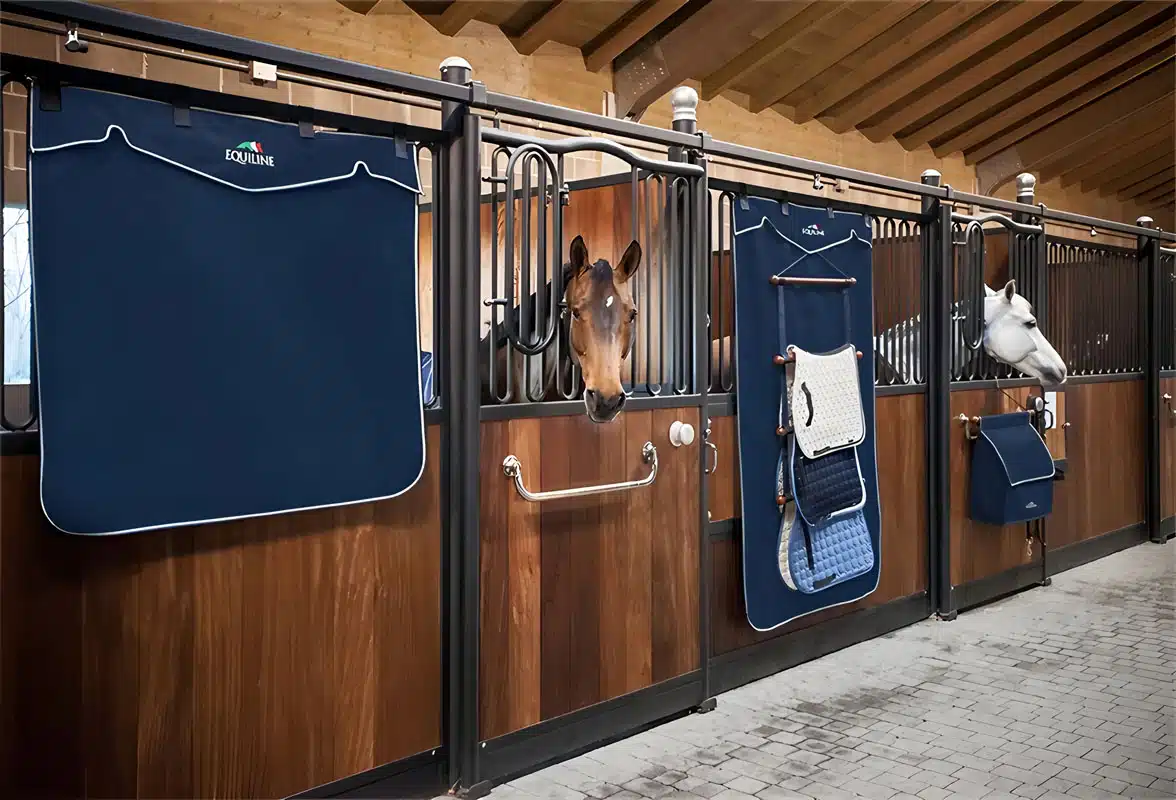
Global leaders like Siemens and Lego set 2026 sustainability standards. DB Stable aligns by utilizing renewable High-Density Bamboo, recyclable HDPE, and ISO 1461 galvanization to maximize product lifespans.
| Global Industry Benchmark | DB Stable Manufacturing Standard | Operational Impact |
|---|---|---|
| Renewable Material Integration (e.g., Lego’s sustainable plastics) | High Density Strand Woven Bamboo (3-5 year maturity) | Reduces deforestation pressure on slow-growth hardwoods like Oak. |
| Circular Economy (e.g., Siemens Zero-Waste) | 100% Recyclable UV Stabilized HDPE & Q235B Steel | Eliminates landfill waste at product end-of-life; allows indefinite re-smelting. |
| Extended Lifecycle (e.g., Industrial Digital Twins) | Hot-Dip Galvanization (BS EN ISO 1461) | Prevents rust-induced replacement, drastically lowering embodied carbon. |
Benchmarks in Global Sustainable Manufacturing
In 2026, sustainability transitioned from a corporate buzzword to an operational mandate. Major industrial players have moved beyond theoretical goals to concrete execution, driven by regulatory pressure and the need for supply chain resilience. Siemens Electronics Works in Chengdu set the precedent, reducing production waste by 48% through the use of digital twin technology and AI-driven waste classification. This proves that high-volume manufacturing can coexist with strict environmental stewardship.
Energy independence is another critical frontier. The Lego Group in Vietnam established a blueprint for the sector by investing over $1 billion into carbon-neutral infrastructure, powered by onsite solar arrays. Similarly, Nestlé achieved zero-waste-to-landfill status across its UK and Serbian facilities. These benchmarks demonstrate that the future of manufacturing relies on circular economy principles—where materials remain in use for as long as possible before being recovered and regenerated.
Implementing Eco-Resilience with Bamboo and HDPE
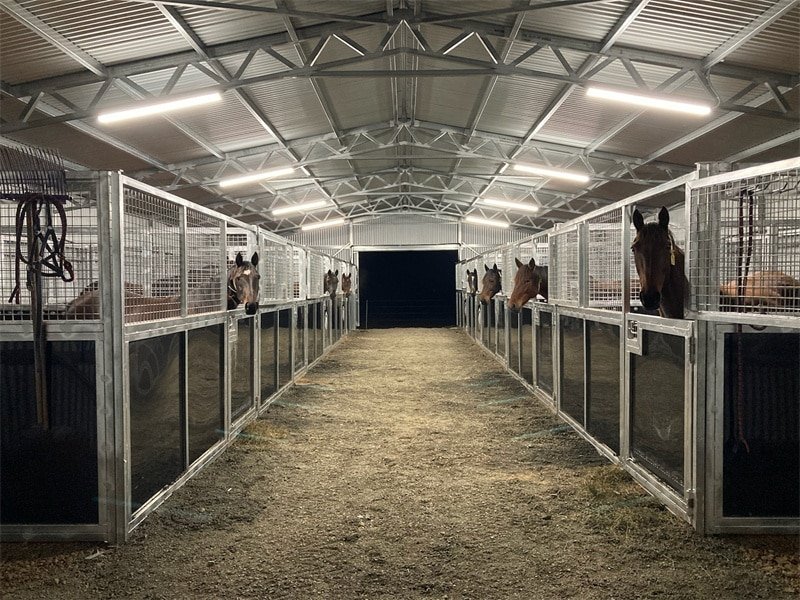
We align our production standards with these global shifts by focusing on material longevity and renewability. In the equestrian sector, “fast furniture” logic fails; stables must withstand massive impact and harsh environments. We reject the use of slow-growth hardwoods which contribute to deforestation, instead engineering our systems around rapid-renewal and recyclable materials.
- High Density Strand Woven Bamboo: Unlike Oak which takes decades to mature, bamboo reaches harvest maturity in 3-5 years. Our processing method creates a board with a Janka Hardness > 3000 lbf—three times harder than Oak—providing superior mold resistance and carbon sequestration without depleting ancient forests.
- UV Stabilized HDPE: For projects prioritizing zero maintenance, we utilize High-Density Polyethylene. This material is fully recyclable and requires no chemical paints or varnishes, preventing toxic runoff into the soil. It fits strictly within the circular economy model championed by industrial leaders.
- Hot-Dip Galvanization (BS EN ISO 1461): True sustainability is durability. Replacing a rusted stable every five years multiplies the carbon footprint of manufacturing and logistics. We coat our Q235B steel frames after fabrication to meet BS EN ISO 1461 standards, ensuring a rust-free lifespan that significantly reduces material turnover.
Strand-Woven Bamboo: A High-Yield Carbon Sink
Strand-woven bamboo acts as a massive carbon sink, sequestering 50–60 kg of CO2 per culm while delivering a density of 1,200 kg/m³ that outperforms oak three-fold.
Sequestration Dynamics: Capturing 12 Tons of Carbon Annually
Bamboo functions as a biological machine for carbon capture rather than just a building material. Unlike traditional timber, which requires decades to mature, bamboo’s aggressive growth cycle transforms forests into high-velocity carbon pumps. This rapid regeneration allows for a harvest cycle that outpaces softwoods by a factor of ten, maintaining a constant state of carbon drawdown.
- Annual Capture: Bamboo forests capture approximately 12 tons of carbon per hectare every year.
- Per-Culm Efficiency: Individual culms lock away 50–60 kilograms of CO2 within their fiber structure over their lifespan.
-
Regenerative Harvest: Harvesting occurs every 4–5 years without killing the plant, ensuring continuous carbon uptake unlike clear-cut timber.
- Emission Displacement: Utilizing bamboo directly displaces demand for high-carbon materials like concrete, which alone accounts for 8% of global CO2 emissions.
Material Physics: Achieving 3,000+ lbf Janka Hardness
For equine facilities, carbon data is meaningless without structural performance. We engineer raw bamboo through high-pressure molding to create boards that survive the most aggressive stable environments. This process compresses the fibers into a material that is not merely cosmetic wood, but a hardened safety barrier capable of absorbing direct impact from horses.
- Extreme Density: Compression creates a density of 1,080–1,200 kg/m³, physically exceeding the hardness of Oak by 3x.
- Impact Resistance: We use 28mm-38mm thick boards to withstand direct kicks, supported by a Janka hardness rating over 3,000 lbf.
- Tensile Strength: The material reaches 28,000 kgf/in², outperforming standard structural steel which sits at roughly 23,000 kgf/in².
- Environmental Resilience: The dense, resin-bonded composition is naturally resistant to mold and rot, essential for longevity in humid stable conditions.
Q235B Steel: The 100% Recyclable Framework
Q235B structural carbon steel matches ASTM A36 standards with 235 MPa yield strength. It offers the ductility needed to absorb equine impacts safely and is 100% recyclable.
Engineering Grade: ASTM A36 Equivalency and Yield Stress
Q235B serves as the manufacturing standard for industrial stable frames, structurally equivalent to US ASTM A36 and European S235 grades. This material provides a yield stress of 235 MPa, delivering the tensile strength required to withstand direct kicks from large thoroughbreds without compromising structural integrity.
Safety in equestrian engineering relies on ductility rather than pure hardness. Unlike brittle high-carbon steels that snap under pressure, Q235B retains the ability to absorb shock energy through slight deformation rather than catastrophic failure. This specific property makes it the material of choice for Olympic infrastructure and stadium trusses, ensuring reliable load-bearing capacity under dynamic stress.
Framework Specifications: 50mm RHS and 14-Gauge Tubing
We engineer the framework using 50mm x 50mm Square Hollow Sections (RHS) to ensure maximum structural rigidity. While budget alternatives often reduce costs by utilizing 1.6mm tubing, we strictly maintain a heavier wall thickness to prevent warping or denting during daily use.
- Tube Profile: 50mm x 50mm RHS (Square Hollow Section).
- Wall Thickness: 14-Gauge (2.0mm – 2.5mm) strict minimum.
- Cold Climate Option: Q345B Low Alloy (ASTM Grade 50) for temperatures below -20°C.
This heavy-duty profile serves as the essential substrate for our Hot-Dip Galvanization process. The 2.0mm+ thickness ensures the steel withstands the 450°C zinc bath without distortion, resulting in a rust-free finish both internally and externally. For extreme environments, the Q345B upgrade prevents low-temperature brittleness, ensuring the frame handles impact even in freezing conditions.
Frequently Asked Questions
Why is hot-dip galvanization after fabrication better than pre-galvanized steel?
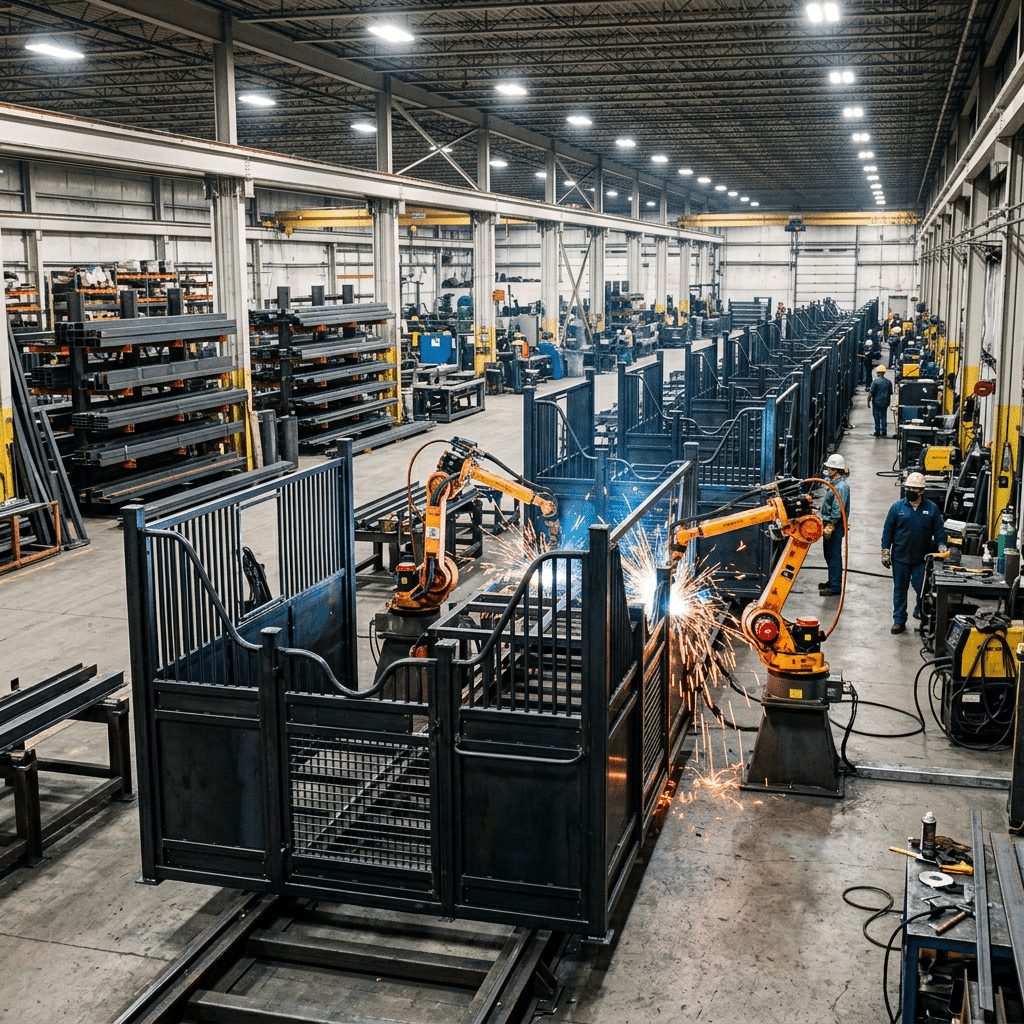
Most competitors cut costs by using pre-galvanized tubes and welding them together. This burns the zinc off the joints, leaving the critical weld points exposed to rapid rusting. We weld the black steel frames first, then dip the entire structure into a bath of molten zinc (ISO 1461 standard). This seals every weld, edge, and internal surface with a coating over 70 microns thick, providing true lifetime protection against ammonia and moisture.
How does the flat-pack design impact shipping costs?
Shipping empty space kills margins. Traditional fully welded stables are bulky, allowing only 12-15 sets in a 40HQ container. Our engineered flat-pack system allows us to load 30-45 sets in the same space. This logistics efficiency reduces ocean freight costs per unit by over 60%, significantly protecting profit margins for distributors and large project developers.
Is bamboo infill as durable as traditional hardwood?
Yes, often more so. We use High-Density Strand Woven Bamboo with a Janka hardness rating over 3000 lbf, making it three times harder than Oak. Unlike wood, which can warp or rot, our bamboo is treated to resist mold and moisture while offering superior tensile strength comparable to steel. It regenerates in 3-5 years, making it a highly sustainable choice without sacrificing performance.
What safety measures are in place for high-performance horses?
We adhere to a ‘Kick-Proof’ standard using Q345B low-alloy steel. This material maintains high impact toughness even in freezing temperatures, preventing the brittle fractures common in standard steel. Our designs feature a ‘Cast-Proof’ bottom gap of approximately 50mm to prevent trapped hooves, and we use zero-maintenance HDPE or high-density bamboo to absorb impact shock without splintering.
How do steel stables align with ESG and sustainability goals?
Steel is 100% recyclable and retains its structural integrity indefinitely, drastically reducing the need for new raw materials over the facility’s lifecycle. Unlike treated timber which may leach chemicals, hot-dip galvanized steel is inert. Combining this with our rapid-renewable bamboo infill creates a facility that balances lower embodied carbon with extreme durability—you aren’t replacing these stalls every decade.
Final Thoughts
Relying on traditional timber or pre-galvanized frames creates a cycle of maintenance that drains operational budgets. We prioritize ISO 1461 Hot-Dip Galvanization and high-density bamboo to ensure your facility remains a high-value asset rather than a liability. True commercial sustainability means investing in infrastructure that survives decades of abuse without replacement.
Do not rely on spec sheets alone; verify the structural integrity of our 14-gauge Q235B steel and bamboo composite firsthand. We invite you to request a material sample kit or schedule a consultation to map out your facility’s specific layout. Secure your project’s long-term value by partnering with a manufacturer who engineers for the Olympic standard.

 English
  Spanish
  French
  Arabic
  German
0 Comments