


Deploying portable horse stables across Australia demands materials that survive 40°C heat spikes and aggressive termite populations. Standard timber often fails within two seasons due to thermal shock splitting, forcing distributors into a cycle of warranty claims that erode project margins.
This report benchmarks UV-stabilized HDPE infills against traditional wood to solve these environmental failures. We analyze how 32mm high-density profiles and ISO 1461 galvanized frames provide a zero-maintenance solution that protects asset value in harsh outback climates.
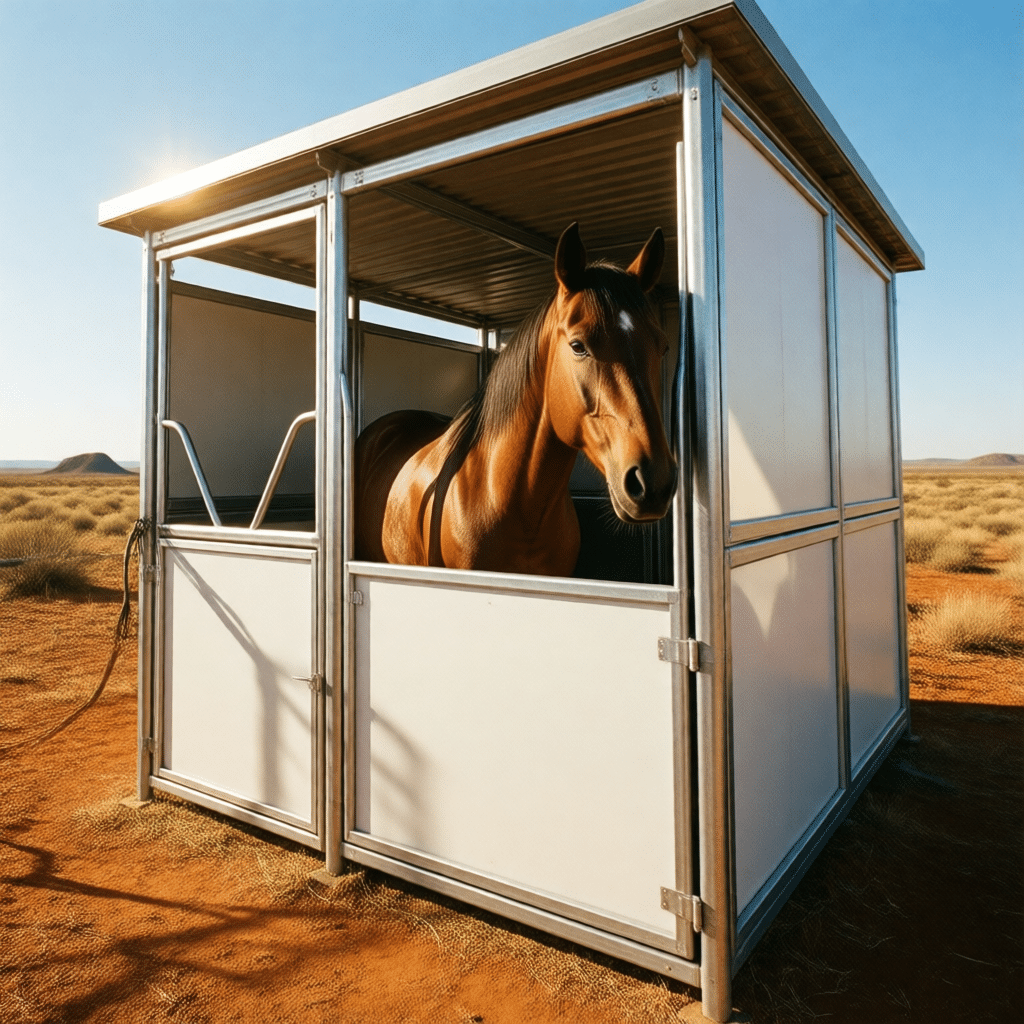
The Harsh Australian Climate: Wood Splitting and Termites
Australian summers hit 40°C, causing timber to split and inviting termites. We use High-Density Bamboo and UV-stabilized HDPE to eliminate warping and insect damage.
Impact of Extreme Heat and Termites on Traditional Timber
Standard timber fails quickly in Australian conditions. When summer temperatures climb above 40°C, traditional softwood suffers rapid moisture loss. This thermal shock causes the wood to shrink, check, and structurally split. The result is not just an ugly stable; split timber creates sharp, jagged edges that pose immediate injury risks to horses and compromise the wall’s ability to withstand a kick.
Beyond the heat, biological threats are constant. Australian subterranean termites aggressively target softwood structures. Stable owners relying on pine or untreated wood face a maintenance nightmare, requiring constant chemical applications just to keep the structure standing.
Selecting Termite-Resistant Infill: Bamboo and HDPE Specifications
We engineered our infill options to bypass these environmental failures completely. You need materials that are physically too dense for pests and chemically stable enough for the sun.
- Strand Woven Bamboo: With a Janka Hardness rating > 3000 lbf, this material is three times harder than oak. It is simply too dense for termites to bore into. We also treat it for mold and rot resistance, making it viable for humid coastal regions.
- UV Stabilized HDPE: Our 28mm-32mm High-Density Polyethylene provides a “Zero Maintenance” solution. It is naturally immune to insect damage, cannot rot, and the UV stabilization prevents the cracking and warping that destroys lesser plastics.

What is HDPE? The Ultimate Horse Stall Material
HDPE is a heavy-duty thermoplastic engineered to flex under impact, eliminating wood’s shatter risks while providing a sanitary, zero-maintenance surface for aggressive equine environments.
High-Density Polyethylene (HDPE) is a heavy-duty thermoplastic polymer designed for extreme durability. Unlike traditional timber, which relies on rigidity, HDPE is engineered to handle stress through flexibility. For horse stables, this material provides a shock-absorbing barrier that flexes under impact rather than shattering. It offers a safer, sanitary, and virtually indestructible wall solution that withstands aggressive equine behavior without the maintenance overhead of wood.
| Feature | Traditional Timber | DB Stable HDPE |
|---|---|---|
| Impact Reaction | Shatters or Splinters | Flexes & Absorbs Energy |
| Maintenance | Requires Painting/Sealing | Zero Maintenance |
| Hygiene | Absorbs Urine & Bacteria | Impermeable & Washable |
| Lifespan | Rots over time | Indestructible |
The Physics of Safety: Impact Absorption and Splinter Protection
The primary reason we recommend HDPE over wood is purely physical: energy management. When a horse kicks a rigid wooden board, the energy must go somewhere—usually resulting in the wood snapping and creating sharp, jagged splinters. These splinters cause catastrophic injuries to tendons and soft tissue. HDPE manages this kinetic energy differently.
- Prevents Catastrophic Injury: Eliminates the risk of deep lacerations caused by splintering wood or rusted metal edges.
- Structural Flexion: Absorbs the kinetic energy from powerful kicks by flexing momentarily, protecting both the horse’s legs and the steel stable frame.
- Chemical Resistance: Resists damage from manure and urine acids, creating a sanitary environment that prevents bacterial growth inherent in porous wood.
- Cribbing Deterrent: The dense, smooth surface lacks the fibrous texture horses look for, significantly discouraging chewing and cribbing behaviors.
Our 32mm UV-Stabilized Profile: The Zero-Maintenance Solution
Generic plastic boards often fail in commercial settings because they lack the density to withstand impact or the chemical stabilizers to survive sunlight. Our specifications are strictly defined in our product bible to meet the demands of distributors serving high-exposure markets like Australia. We do not use thin cosmetic liners; we use structural barriers.
- Substantial Thickness: We utilize a heavy 28mm-32mm profile to back our “Kick-Proof Guarantee,” ensuring the wall holds under pressure.
- UV Stabilization: Integrated with advanced UV stabilizers to withstand the harsh Australian sun without becoming brittle, chalky, or faded over time.
- True Zero Maintenance: Requires absolutely no painting, staining, or waterproofing treatments, saving significant labor costs for large facilities.
- Precision Fit: Engineered to fit precisely into our hot-dip galvanized C-channels, preventing the rattling and gaps common in cheaper, loose-fitting alternatives.
Premium Galvanized Stables Built For Decades


UV Resistance: Preventing Fading in 40°C Summers
Australian summers destroy standard materials via UV and 40°C heat. We use UV-stabilized HDPE and hot-dip galvanized steel to ensure durability without maintenance.
The Impact of High UV Index on Stable Materials
In the Australian market, “standard” specifications often fail within the first few seasons. When ambient temperatures hit 40°C, the surface temperature of stable materials can soar above 60°C. This extreme heat causes rapid thermal expansion, placing immense physical stress on joints and surfaces.
When you combine this heat cycling with Australia’s exceptionally high UV radiation, the damage accelerates. UV rays attack the molecular bonds in standard plastics and treated wood. This chemical breakdown manifests as “chalking” (a powdery surface residue), rapid color fading, and eventually, structural brittleness. Once a material becomes brittle, a single kick from a horse can shatter it.
Our Solution: UV-Stabilized HDPE Infill
To combat these conditions, DB Stable refuses to use generic plastic composites. We utilize strictly tested, UV-stabilized HDPE (High-Density Polyethylene) for all infill planks. This material specification includes active UV inhibitors during the extrusion process, rather than a simple surface coating.
- Material Thickness: 28mm-32mm solid profile.
- UV Technology: Integral stabilization prevents molecular breakdown.
- Performance: Maintains impact strength and color integrity.
Unlike treated timber that requires annual painting or standard PVC that cracks under solar stress, our HDPE allows for a true “zero maintenance” ownership experience. The material resists solar degradation, retaining its appearance and safety standards for years, even in the harshest Outback environments.
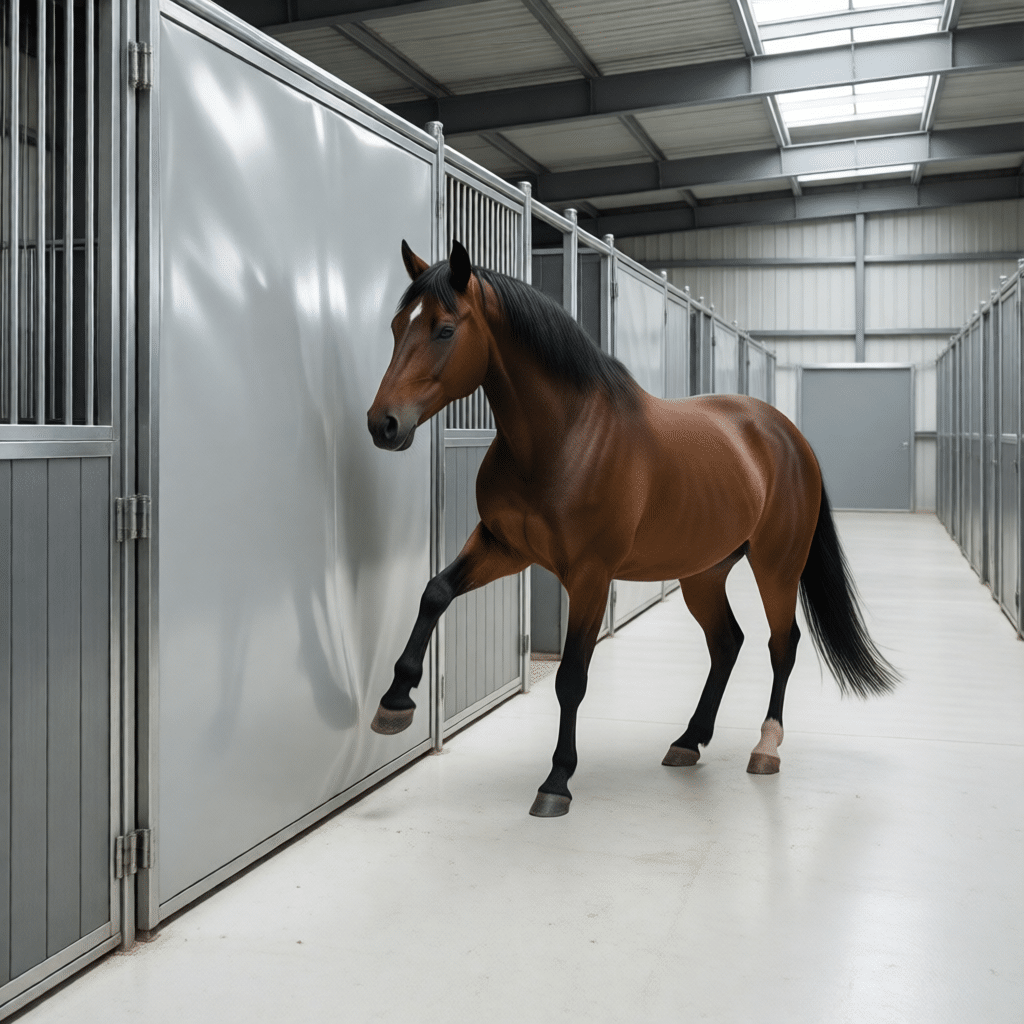
The Drop-Pin System for Portable Horse Stables
The drop-pin system turns static infrastructure into mobile assets, enabling tool-free assembly and high-density shipping that protects distributor margins.
The Mechanics of Modular Connections
Most “portable” stables on the market fail because they rely on complex bolt systems that rust or get lost in the mud. The drop-pin system eliminates loose hardware entirely. It uses gravity-fed vertical locking pins to join panels, allowing a two-person crew to set up a stable row in minutes without a single wrench. This speed is critical for event organizers who need to deploy hundreds of stalls rapidly.
For distributors, this mechanism directly impacts the bottom line. Because the connections are integrated and low-profile, we can flat-pack these units efficiently. While traditional welded frames limit you to 12-15 sets per container, our modular drop-pin design allows us to load 30-45 sets into a single 40HQ container. This density cuts per-unit freight costs by over 60%, a massive advantage in the current logistics market.
Structural Specs: 40mm Square Pins and Galvanization
We don’t use flimsy round pins that rattle or bend under pressure. Our system utilizes 40x40mm square metal tube connectors. The square profile increases surface contact between the pin and the receiving bracket, virtually eliminating the “wobble” found in cheaper round-pin systems. This rigidity is essential when building long rows of stables where cumulative movement can compromise the structure.
- Heavy-Duty Reinforcement: We use fully welded 6mm steel plates to rigidify the connection points, preventing deformation from heavy impacts.
- ISO 1461 Protection: Every connector is hot-dip galvanized after fabrication. This ensures zinc coverage enters the joints, preventing the rust that destroys pre-galvanized alternatives.
- Tamper-Resistant: The design sits flush or recessed, making it impossible for horses to use their teeth or lips to dislodge the pins from the outside.
Anchoring Free-Standing Stalls in the Outback
Securing portable stables requires matching anchor types to soil density. We combine heavy 450kg Q345B frames with 304 stainless hardware to ensure stability in sand or clay.
Assessing Ground Conditions: Sand, Clay, and Hard-Pack
Australian terrain is unforgiving and inconsistent. A setup that works on a coastal property will fail in the red centre. You cannot rely on a single anchoring solution when moving between loose sand and concrete-hard clay, as the ground holding power dictates the safety of the structure.
- Variable Soil Density: The outback presents diverse substrates. You must test anchor holding power at each new site rather than assuming a standard depth will hold.
- Loose Substrates: Standard smooth pegs often fail in loose red dirt or sand. These conditions require screw-in auger designs that utilize a spiral flange to grip the soil.
- Hard-Pack Requirements: In rocky substrates or baked clay, pre-drilling is necessary. Forcing anchors into this ground without a pilot hole typically results in bent hardware and shallow, insecure installs.
Stabilization with the 304 Stainless Steel Hardware Kit
We engineer our DB Stable systems to resist wind loads through sheer mass and superior materials. Unlike lightweight aluminum alternatives that act like kites in a storm, our specification creates a gravity-based foundation that reduces reliance on ground holding power alone.
- Corrosion Resistance: The Installation Kit includes 304 Stainless Steel connectors. This prevents rust failure in high-salinity or acidic soils where standard zinc-plated bolts degrade rapidly.
- Gravity Stabilization: Each flat-pack set weighs approximately 450kg. This significant mass provides immediate stability against wind gusts.
- Structural Rigidity: We use a Q345B structural steel frame. This offers rigid attachment points for heavy-duty ground anchors, preventing the frame from warping under tension.
Frequently Asked Questions
Which portable horse stable is best for Australian conditions?
The right choice relies entirely on your mobility requirements. For semi-permanent setups where weight is less of a concern, heavy modular panels (similar to Guerilla Steel designs) provide substantial structural integrity. Conversely, if you require frequent relocation, lightweight flat-pack systems with HDPE infills (like those from Portable Horse Stables Tamworth) offer superior logistics.
Regardless of the brand, the critical factor for Australian coastal or humid environments is the steel treatment. You must demand Hot-Dip Galvanization After Fabrication (ISO 1461). Avoid pre-galvanized materials, as the zinc coating burns off during welding, leaving joints vulnerable to rapid rust.
Will HDPE stable infills fade or crack in the sun?
Standard, untreated plastic degrades rapidly under high UV exposure. To prevent this, you must specify HDPE treated with UV stabilizers or carbon black additives. These chemical blockers prevent solar radiation from breaking down the polymer chains.
Quality UV-stabilized boards remain flexible and retain their color for years. In contrast, cheap, untreated plastics become brittle, chalky, and will eventually crack under impact.
How do I stop termites from eating my stable walls?
The only permanent fix is using materials termites physically cannot eat. Steel frames combined with HDPE or recycled plastic infills are 100% termite-proof and require absolutely no chemical treatments.
If you insist on a wood aesthetic, high-density bamboo is significantly harder and more resistant than pine, but synthetic boards remain the safest maintenance-free option for high-risk zones.
Can I install a stable without a concrete slab?
Yes. Portable stables typically sit on steel base rails or skids, allowing installation on level earth or crushed rock. You anchor the structure directly to the ground using screw-in auger anchors or driven toggle-bolt systems. These anchors connect to the frame with heavy-duty straps or chains, securing the stable against high winds without the capital expense of pouring concrete.
Why choose HDPE over traditional timber kickboards?
Timber forces you into a cycle of painting, staining, and pest control to stop rot and chewing. It also splinters when kicked, which poses a serious injury risk to the horse.
HDPE absorbs impact shock safely, resists all moisture, and cleans easily with a standard hose. While the initial material cost is higher, it eliminates ongoing maintenance labor and replacement costs.
Final Thoughts
Relying on timber in the Australian climate guarantees warranty claims when 40°C heat inevitably splits the wood. Our UV-stabilized HDPE infills and ISO 1461 hot-dip galvanized frames eliminate these liabilities, securing your reputation against the harsh Outback elements. We protect your bottom line further by optimizing our flat-pack design to load 30-45 sets per container, drastically reducing your landed cost per unit.
Stop guessing on quality and verify our “Kick-Proof” standards firsthand. Reach out to our engineering team immediately to configure a trial order or request a specific technical specification sheet. We are prepared to scale production to align with your distribution schedule.


 English
  Spanish
  French
  Arabic
  German
0 Comments