


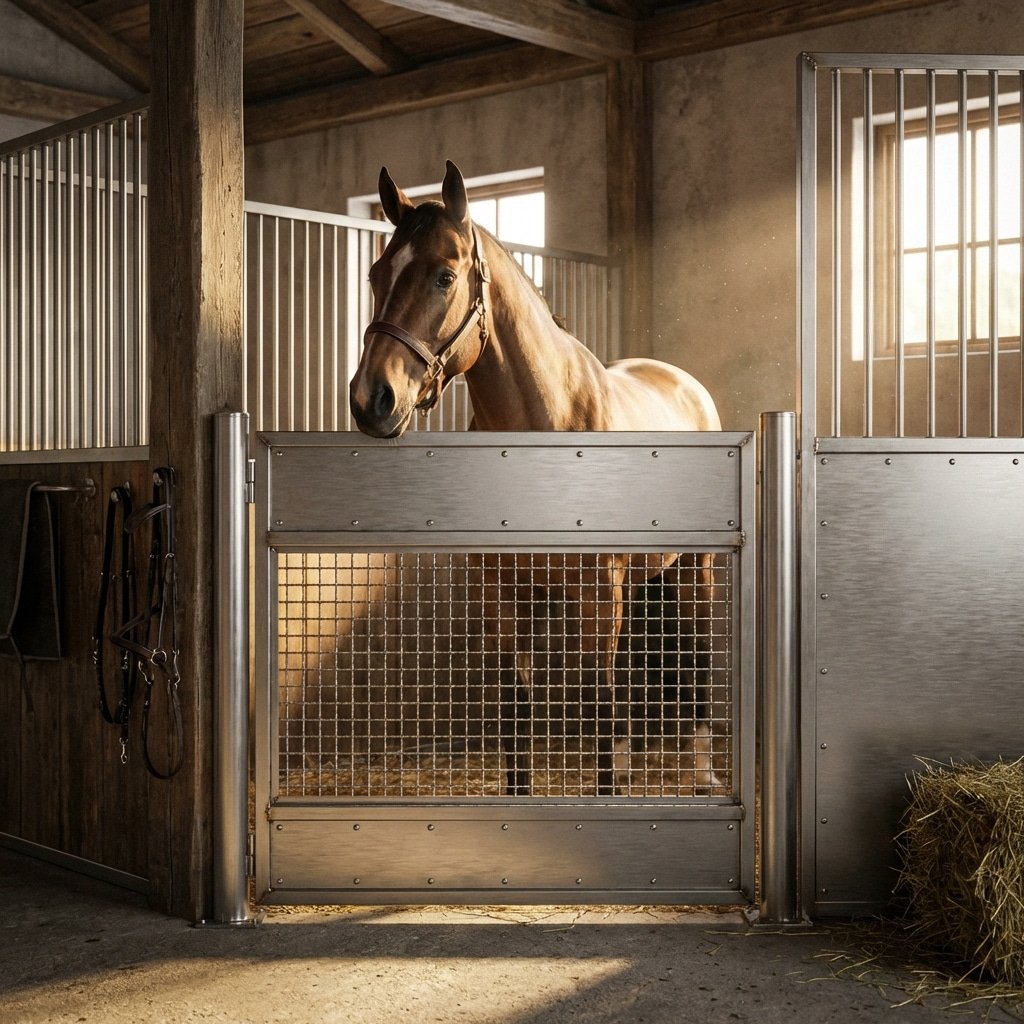
Managing destructive Weaving Habits is a structural challenge that exposes the weakness in standard stable engineering. Continuous lateral swaying fatigues generic welds and timber walls, leading to costly facility repairs and compromised animal safety.
This guide details how Half-Mesh designs mitigate isolation stress while adhering to heavy-duty Q235B structural standards. We examine the impact of ISO 1461 Hot-Dip Galvanization and shock-absorbing HDPE infills to deliver a permanent, kick-proof solution for high-anxiety equines.
Why Horses Weave and Pace in Stalls
Weaving and pacing stem from boredom, confinement stress, and isolation. These behaviors indicate psychological distress and exert immense physical strain on stable structures, requiring heavy-duty materials for safety.
Behavioral Triggers: Boredom and Separation Anxiety
Weaving acts as a coping mechanism for stress caused by prolonged confinement and restricted movement. Unlike simple b
oredom, this is a physiological response to an environment that inhibits natural roaming instincts. When a horse cannot move freely, it creates its own motion through rhythmic swaying to release nervous energy.
Social isolation serves as a primary trigger for this behavior. Horses are herd animals that rely on the presence of others for security. Stress levels spike when they lack visual contact with their herd, leading to stereotypic behaviors. Anticipatory stress regarding feeding schedules also intensifies this repetitive swaying. If a horse knows food is coming but cannot access it immediately, the anxiety manifests as weaving until the feed arrives.

Structural Resilience: The ‘Kick-Proof’ Standard
Repetitive pacing and weaving exert constant lateral force on stable fronts and partitions. While a single kick is a high-impact event, weaving is a low-impact but continuous stressor that fatigues standard steel welds over time. A standard stable front must be engineered to resist this rhythmic rocking without loosening at the anchor points.
- Q345B Low Alloy High Strength Steel: We utilize this superior grade (equivalent to ASTM Grade 50) for our frames. It ensures the steel withstands constant impact and flex without suffering brittle fracture, a common failure point in cheaper carbon steels during cold winters.
- Impact-Absorbing HDPE Infill: Our 28mm-32mm HDPE planks are designed to flex slightly under pressure. This shock absorption prevents injury if the horse strikes the wall during a stereotypic episode and eliminates the splintering risks associated with timber.
The Social Solution: Half-Mesh Horse Stall Panels
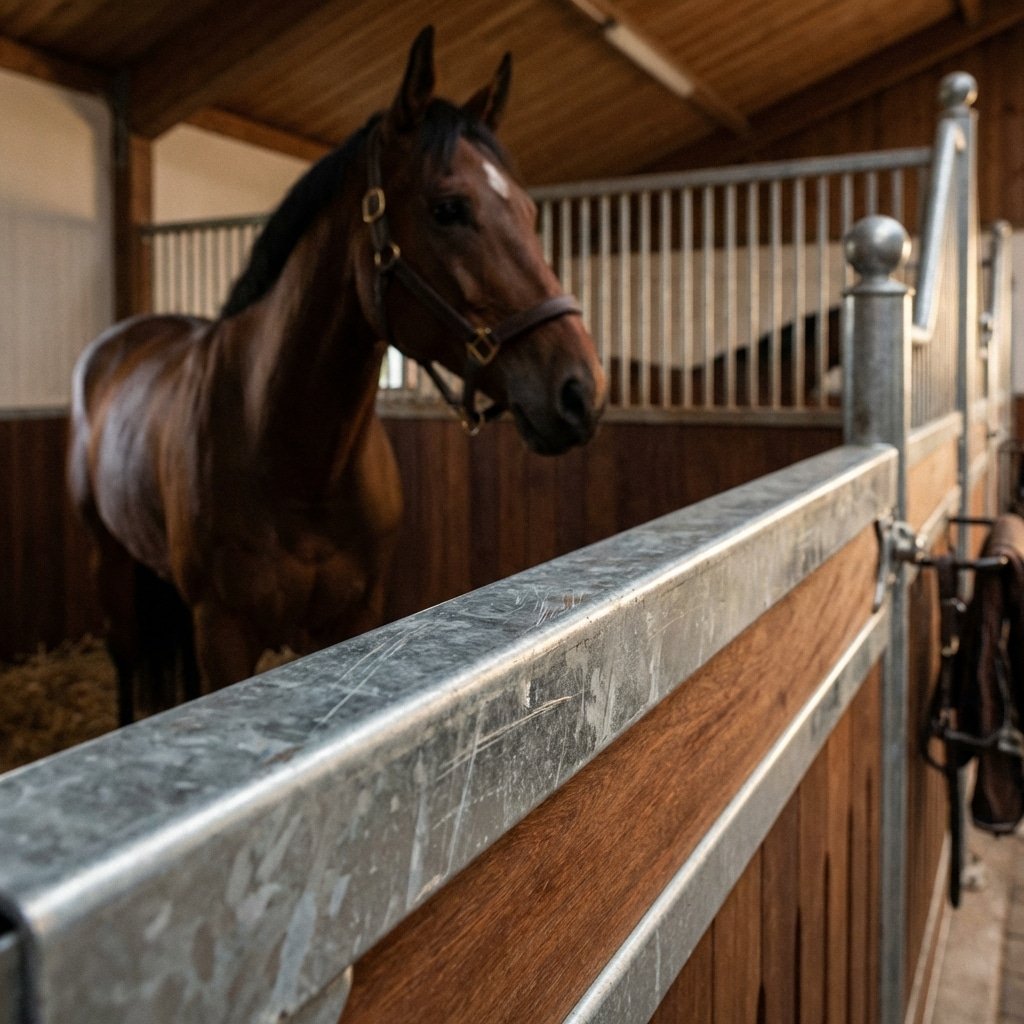
Half-mesh partitions solve behavioral issues by allowing socialization while maintaining safety. We use hot-dip galvanized steel and high-impact infills for a kick-proof, durable solution.
| Component | DB Stable Spec | Function |
|---|---|---|
| Steel Treatment | Hot-Dip Galv After Fabrication (ISO 1461) | Prevents rust at weld points; >70μm coating. |
| Infill Material | 28mm-32mm HDPE or Bamboo | Impact absorption; Kick-Proof Guarantee. |
| Bottom Gap | Approx. 50mm | “Cast-Proof” safety to prevent trapped hooves. |
Facilitating Herd Interaction While Maintaining Boundaries
Horses are herd animals, and total isolation in box stalls frequently triggers stereotypic behaviors like weaving and pacing. A half-mesh design functions as a “social box,” giving horses the visual and olfactory contact they need to stay calm. If a horse can see their neighbor, their stress levels drop significantly. This reduces the development of vices that ruin joint health and barn tranquility.
The solid lower section is equally important for safety. By blocking the view of a neighbor’s legs and feed, you prevent food aggression and agitation. This setup also facilitates “Stack Effect Ventilation,” where open upper sections allow heat and ammonia to escape vertically, rather than getting trapped in a solid box.
Material Specifications: Galvanized Grills and Kick-Proof Bottoms
A smart design fails if the materials are cheap. We engineer these panels to withstand daily abuse using Q235B structural steel. Unlike competitors who weld pre-galvanized tubes (leaving welds exposed to rust), we use a “Hot-Dip After Fabrication” process. Every panel is dipped in molten zinc according to ISO 1461 standards, resulting in a coating thickness exceeding 70 microns (and often >85 microns for structural parts).
- Upper Grills: Constructed from 14-gauge (2.0mm-2.5mm) steel bars or mesh. We ensure zero sharp edges to prevent facial cuts during socialization.
- Kick-Proof Infill: We use 28mm-32mm HDPE (UV stabilized, zero maintenance) or High-Density Bamboo (harder than oak). Both come with our “Kick-Proof Guarantee.”
- Cast-Proof Design: The bottom gap is strictly engineered to approximately 50mm. This prevents a rolling horse from getting a hoof trapped under the panel, a common injury in poorly designed stalls.
Engineered Stables With 20-Year Rust Resistance

V-Drop Windows vs Standard Yoke Doors
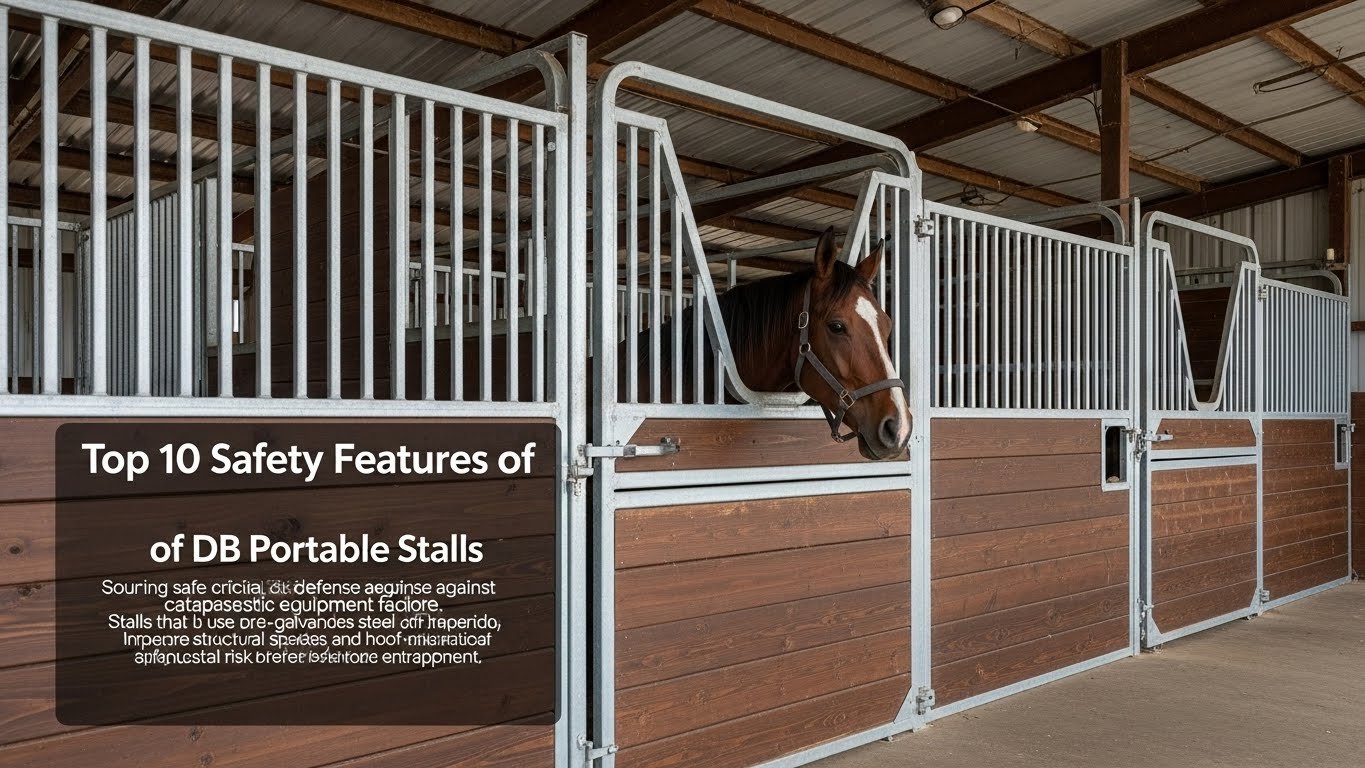
V-Drops maximize socialization with hinged grills, while Yokes prioritize safety with fixed openings. We reinforce both with 14-gauge steel to prevent deformation.
Comparing Design Functionality: Ventilation and Socialization
Deciding between a V-Drop and a Standard Yoke comes down to your facility’s management style: social interaction versus strict containment.
- V-Drop Windows: These feature a hinged mechanism that allows the top grill section to drop down completely against the door front. This creates a wide opening for maximum airflow and lets horses hang their heads out into the aisle. It is the standard for private barns where horses are familiar with one another.
- Standard Yoke Doors: These utilize a fixed U-shaped cutout or a sliding top grill. The design prioritizes containment, preventing a horse from fully extending its neck while still allowing visual checks. This is the smart choice for commercial facilities, riding schools, or quarantine units where controlling physical contact between passing horses is critical.
Selection Strategy: If you run a social barn, go with V-Drops. If you manage a high-traffic or controlled environment, stick to Standard Yokes.
Structural Integrity: Heavy-Duty 14-Gauge Steel Reinforcement
The bottom curve of a yoke or V-drop is a high-wear zone. Horses rest their necks here, chew on the edges, and occasionally strike the mechanism. Lightweight steel fails here.
- Reinforced Neck Openings: We refuse to use standard 1.5mm tubing for these stress points. DB Stable utilizes 14-Gauge (2.0mm – 2.5mm) wall thickness tubing. This prev
ents the steel from bowing or kinking under the weight of a heavy warmblood’s neck.
- Smooth Edge Protection: Cheap pre-galvanized doors often leave sharp, raw welds at the connection points. Our Hot-Dip Galvanization After Fabrication process submerges the entire door in molten zinc. This coats every edge in 70+ microns of protection, eliminating sharp burrs that could cut a horse.
- Material Strength: For facilities in regions with extreme winters, we recommend upgrading to Q345B steel. This low-alloy high-strength steel offers superior impact toughness, ensuring the door mechanism does not become brittle and fracture if a horse kicks it in freezing temperatures.
Ensuring No Sharp Edges on Mesh Stall Dividers
Pre-galvanized mesh leaves dangerous sharp burrs. We weld black steel and hot-dip galvanize the full panel after fabrication, creating a smooth, zinc-coated surface that prevents horse injuries.
The Dangers of Pre-Galvanized Mesh Construction
Cost-cutting in the equine industry often leads manufacturers to use pre-galvanized wire mesh. In this process, factories weld wires that are already coated in zinc. The heat from welding burns the zinc away at the intersection points, leaving behind jagged weld “burrs” or metal tags. These sharp imperfections are often invisible to the naked eye but act like sandpaper against a horse’s soft tissue, causing inexplicable cuts to muzzles and eyelids.
Beyond immediate abrasion risks, pre-galvanized mesh typically utilizes thinner wire gauges to facilitate easier automated welding. These thin wires lack the structural integrity to withstand a direct kick. When a horse strikes a low-gauge mesh panel, the wires can snap, creating exposed steel spikes that pose a catastrophic injury risk.
Eliminating Burrs via Hot-Dip Galvanization After Fabrication
To guarantee a snag-free surface, we reject pre-galvanized materials for stall fronts. Our process starts with raw “black” Q235B steel. Welding raw steel allows for deeper, cleaner penetration without the interference of a zinc layer, ensuring the structural joints are solid rather than superficial.
Once fabrication is complete, we submerge the entire panel into a bath of molten zinc. This Hot-Dip Galvanization After Fabrication serves a dual purpose:
- Self-Leveling Smoothness: The thick zinc coating (averaging > 70 microns on mesh and tubing) fills in microscopic weld craters and encapsulates any potential burrs, creating a rounded, smooth finish.
- Rust Prevention: By coating the entire assembly at once, we eliminate the risk of “rust creep” at weld spots. Rust creates rough, corroded edges over time; our method prevents this deterioration for decades.
Frequently Asked Questions
Can changing the stall design actually stop a horse from weaving?
Weaving is often a deep-rooted coping mechanism for isolation stress. While difficult to eliminate completely, altering the stall environment is the most effective management strategy. We recommend replacing solid walls with open-grill partitions or V-drop yoke fronts to restore visual and olfactory contact with herd mates. This addresses the anxiety triggering the behavior, unlike physical restrictors (such as anti-weave bars) which merely mask the symptom without solving the problem.
Do mesh stall dividers reduce horse anxiety better than solid walls?
Yes. Visual isolation directly correlates with higher cortisol (stress) levels. Mesh or bar-top dividers mimic a herd environment by allowing horses to verify the presence of neighbors. For commercial barns housing mixed temperaments, we recommend the Professional Series partition. This configuration uses a solid HDPE bottom for safety and feed privacy, paired with a mesh top to maintain the social connection that lowers physiological stress.
What is the safest stall front design for socialization?
Yoke Openings or low-profile European styling work best, as they allow horses to hang their heads out comfortably. Safety relies entirely on the manufacturing finish. The steel work must be Hot-Dip Galvanized After Fabrication. This process ensures all welds are smooth and burr-free, preventing injury to the horse’s face during interaction. Also, we enforce strict 50mm bar spacing to prevent hooves or jaws from becoming trapped.
Final Thoughts
Cheap pre-galvanized stalls might save money upfront, but they risk injury lawsuits and rust claims that destroy your dealer reputation. Only our ISO 1461 Hot-Dip Galvanization After Fabrication guarantees a smooth, burr-free finish capable of withstanding the constant friction of an anxious weaver. Choosing Q345B steel and kick-proof HDPE infills safeguards your inventory against warranty returns caused by heavy impact.
Stop guessing on quality and verify the engineering yourself. We recommend securing a trial order (3-5 sets) to test the fitment of our flat-pack system and the resilience of our 14-gauge steel. Contact our engineering team today to configure a sample shipment that aligns with your local market needs.

 English
  Spanish
  French
  Arabic
  German
0 Comments