


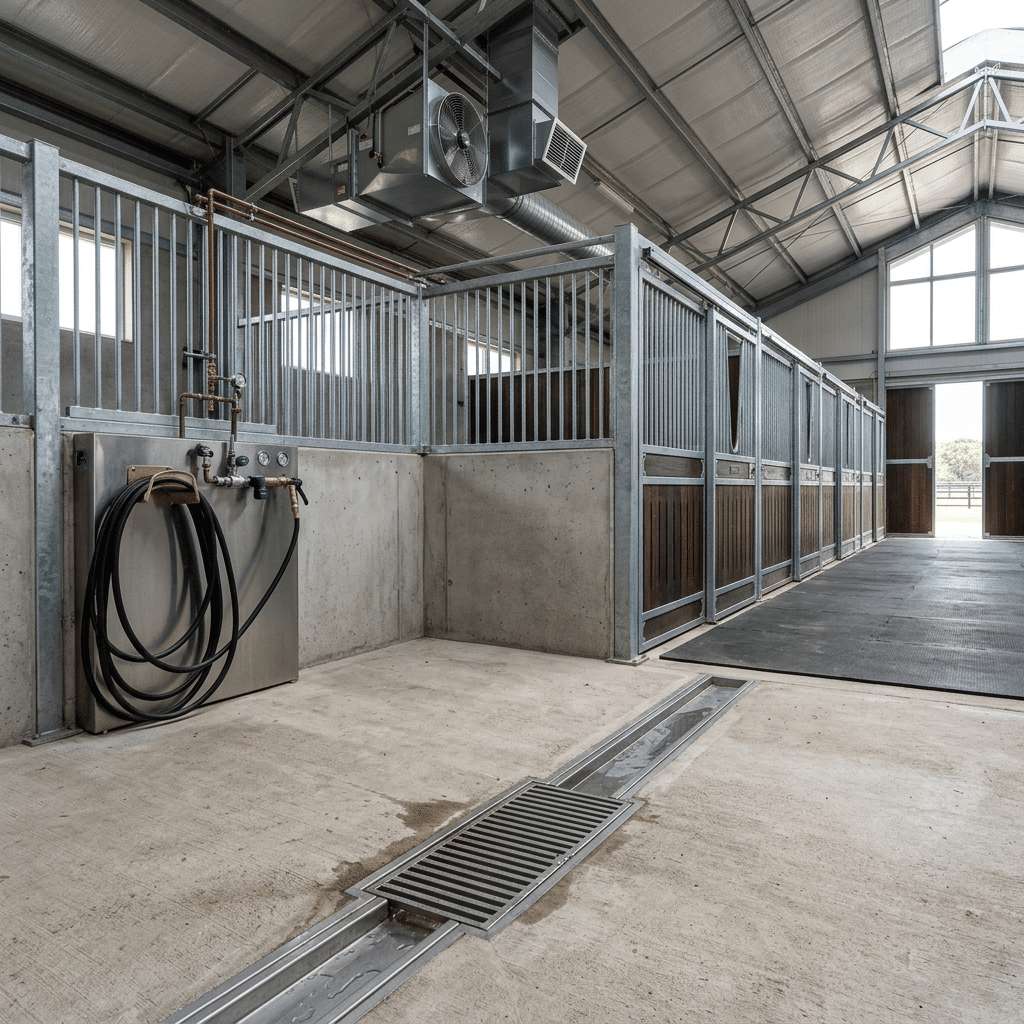
Improperly designed Sub-Floor Drains turn concrete foundations into bacterial reservoirs that accelerate steel corrosion. While standard concrete appears solid, it acts as a rigid sponge for urea, creating an ammonia cycle that compromises structural integrity and triggers expensive warranty claims for rusted stabling equipment.
This analysis integrates drainage mechanics with BS EN ISO 1461 Hot-Dip Galvanization standards to extend facility lifespans. We examine the engineering behind the 50mm Cast-Proof clearance and 304 stainless steel anchoring protocols, ensuring your architectural specifications prevent crevice corrosion and structural failure.
The Ammonia Build-Up in Solid Concrete Stalls
Ammonia accumulates when bacteria in porous concrete metabolize urea, creating a corrosive gas that destroys respiratory systems and accelerates rust on standard steel components.
The Bacterial Mechanism of Urea Hydrolysis
Concrete appears solid to the naked eye, but structurally, it functions as a rigid sponge. When horses urinate, the liquid does not simply evaporate; it seeps into the microscopic pores of the concrete substrate or gets trapped beneath stall mats. This environment creates a permanent reservoir for bacteria that standard surface cleaning cannot reach.
The distinct ammonia odor in many stables results from a specific biological process called urea hydrolysis. Bacteria produce the enzyme urease, which catalyzes the breakdown of urea found in urine into volatile ammonia gas and carbon dioxide. This process creates a self-sustaining cycle of contamination:
- Substrate Saturation: Urine penetrates deep into the concrete matrix, providing a continuous fuel source for bacterial colonies.
- Exponential Growth: Warm, damp conditions under bedding allow bacteria populations to double rapidly, increasing gas production.
- Gas Release: As the bacteria metabolize the trapped urea, they release ammonia gas back up through the bedding, affecting the horse’s respiratory health.
- Cleaning Limitations: Surface disinfectants cannot penetrate deep enough to kill the bacterial root system embedded in the concrete.

Combating Corrosion with ISO 1461 Hot-Dip Galvanization
Ammonia is not just a respiratory hazard; it is a corrosive agent that aggressively attacks steel. In an enclosed stable environment, ammonia fumes mix with humidity to form a caustic alkaline solution that settles on metal surfaces. Standard “pre-galvanized” steel (black tube welded and then painted at the seams) fails quickly in these conditions because the protective zinc layer is compromised during manufacturing.
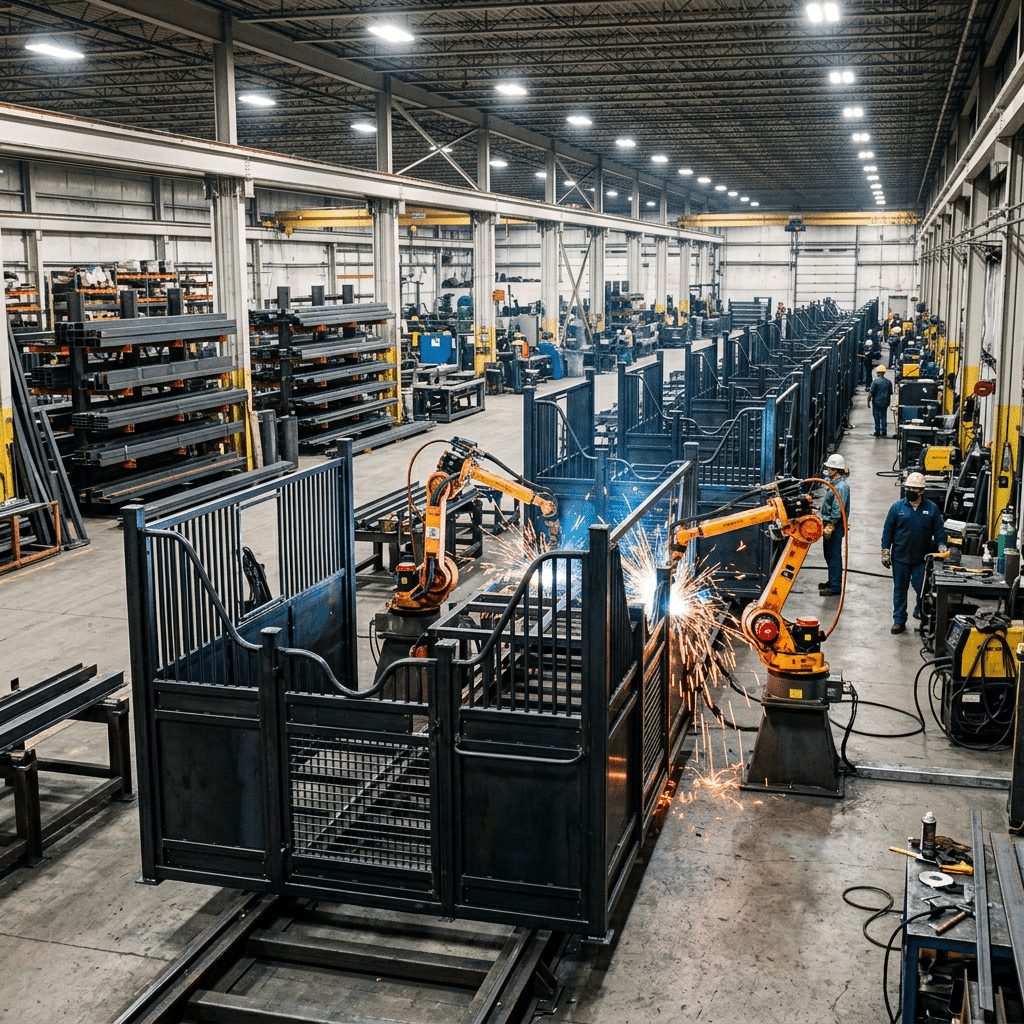
To counter this specific chemical threat, DB Stable mandates a Hot-Dip Galvanization After Fabrication process. We weld the raw black steel first, and then submerge the entire completed frame into molten zinc. This creates a metallurgical bond that seals every crevice, weld, and internal surface against ammonia intrusion.
- Standard Compliance: All galvanization adheres strictly to BS EN ISO 1461 standards.
- Structural Thickness: Structural parts (>6mm steel) receive an average coating > 85 microns.
- Tubing Protection: Standard tubing (3-6mm steel) receives an average coating > 70 microns.
- Sacrificial Barrier: The thick zinc layer acts as a sacrificial anode, corroding in place of the steel even if the surface sustains deep scratches from hooves or equipment.
Designing a Central French Drain Under Rubber Mats
A central 4-inch perforated pipe within a sloped gravel trench manages sub-floor moisture. A dimpled membrane between aggregate and rubber mats prevents clogging and ensures continuous drainage.
Establishing the Trench Gradient and Aggregate Base
Gravity dictates the success or failure of a
Installing the Protective Dimpled Membrane
Placing heavy rubber stall mats directly onto a gravel base often leads to failure. The weight of the horse compresses the mats into the stone, blocking flow channels. To prevent this, you must install a rigid interface layer—typically a dimpled drainage mat or high-density rigid foam—between the gravel bed and the top rubber surface.
- Air Gap Creation: The dimpled membrane maintains a physical void space, preventing the rubber mats from crushing the drainage flow path.
- Filtration: Wrap the entire assembly in landscape fabric (geotextile). This prevents bedding fines and soil from migrating down and clogging the void space.
- Fluid Dynamics: This separation allows urine to pass through the gaps in the stall mats, hit the membrane, and flow into the trench without saturating the sub-floor soil.
Premium Horse Stables Built For Extreme Climates
Why Stall Panels Must Have a 50mm Bottom Clearance
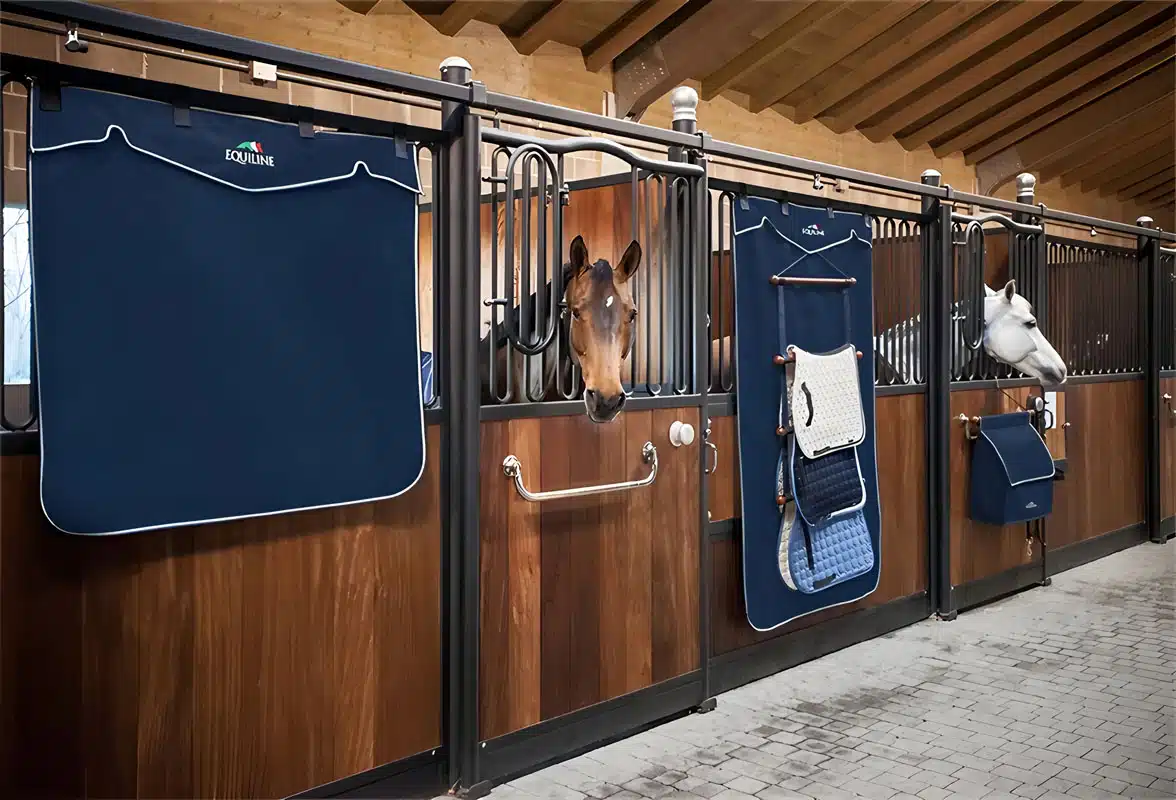
The 50mm “Cast-Proof” clearance serves two non-negotiable functions: preventing rolling horses from trapping hooves under the rail and elevating the steel frame above corrosive, urine-soaked bedding.
| Clearance Height | Safety Risk (Casting) | Corrosion Risk (Steel Rot) | Engineering Verdict |
|---|---|---|---|
| 0mm (Flush) | Low | Critical (Sits in wet bedding) | Avoid (Reduces lifespan) |
| 50mm (DB Standard) | “Cast-Proof” (Hoof rejected) | Minimal (Airflow beneath) | Mandatory Standard |
| 100mm+ (Wide) | High (Hoof traps under rail) | Minimal | Dangerous (Injury Risk) |
The Mechanics of ‘Casting’ and Hoof Safety
“Casting” is the industry term for when a horse lies down or rolls too close to a wall and cannot get back up. The biological panic response triggers the horse to thrash and push its legs out to find leverage. If your stall fronts or partitions have a bottom gap larger than 80mm-100mm, the average equine hoof can slide underneath the bottom rail. Once the leg extends through that gap, the horse cannot retract it naturally.
This creates a leverage point against the steel frame. As the horse struggles, the steel acts as a fulcrum, frequently resulting in catastrophic tendon damage or bone fractures. We engineer strictly to the “Cast-Proof” standard of 50mm. This dimension is deliberately narrower than a hoof, physically rejecting the leg if the horse kicks out while rolling, keeping the limb inside the stall where it can be retracted safely.
- Hoof Rejection: The 50mm gap acts as a physical barrier, ensuring hooves bounce off the bottom rail rather than sliding under it.
- Leverage Prevention: Eliminates the fulcrum effect that causes severe lower leg injuries during panic situations.
- Foal Safety: This tolerance is also effective for breeding operations, preventing smaller foals from getting heads or legs trapped.
Preserving the Galvanized Frame Against Ammonia
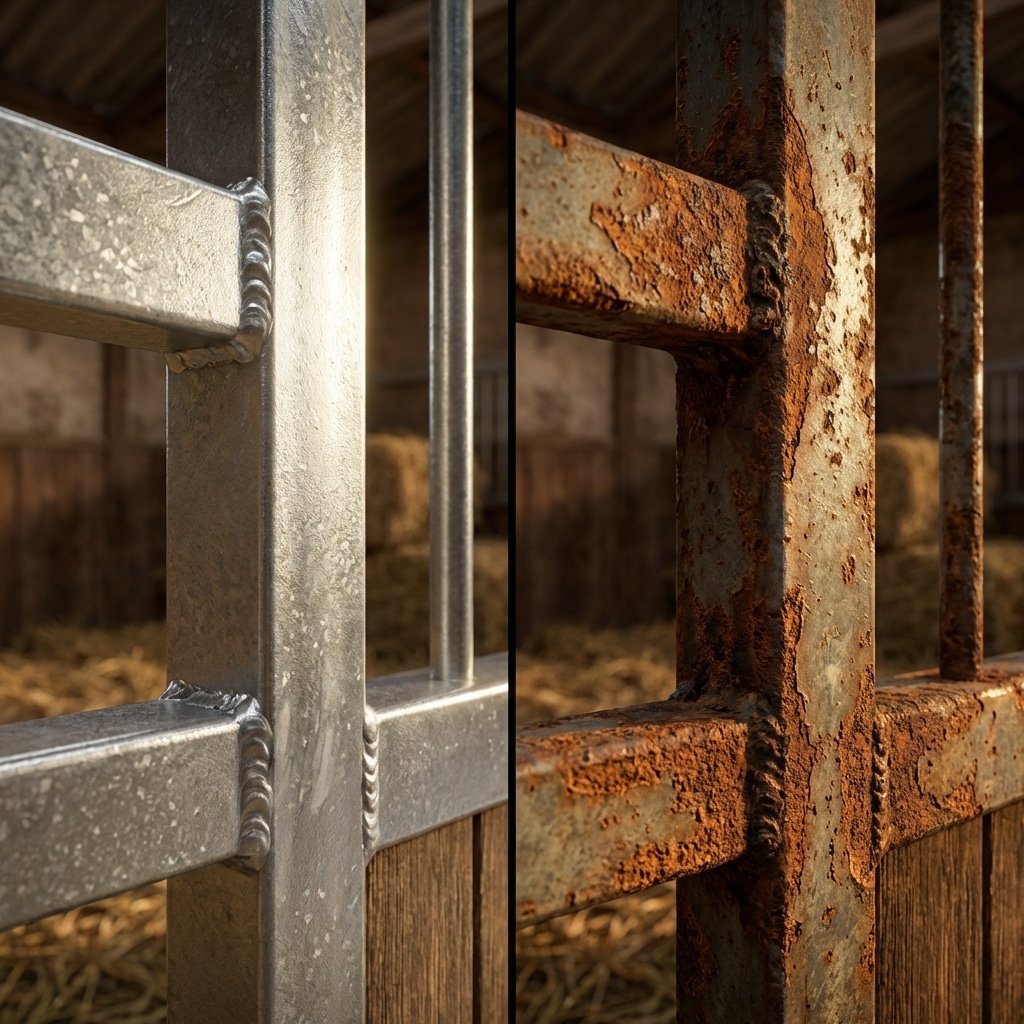
While safety dictates the maximum gap, corrosion prevention dictates the minimum. Installing stall fronts flush with the floor (0mm clearance) is a fundamental installation error. Bedding materials act as a sponge, soaking up urine and creating a concentrated ammonia environment at floor level. If the bottom steel rail sits directly on the ground, it lives in a perpetual acid bath.
Even our Q235B steel frames, treated with Hot-Dip Galvanization to BS EN ISO 1461 standards, will eventually succumb to “Steel Rot” if submerged in wet, acidic organic matter 24/7. The 50mm clearance breaks the contact circuit between the steel and the bedding.
- Acid Separation: Keeps the critical structural welds of the bottom rail dry and away from urea-soaked shavings.
- Wash-Down Efficiency: Allows facility managers to hose down aisles without water backing up and pooling inside the stall, or vice versa.
- Ventilation Intake: Facilitates the “Stack Effect,” drawing cool air in from the floor level to push warm, ammonia-heavy air out through the top grill.
Preventing Base Plate Rust with 304 SS Anchors
304 stainless steel requires oxygen to maintain its protective layer. Trapped moisture under base plates starves the steel of oxygen, causing rust. A silicone bedding layer prevents this.
The Science of Crevice Corrosion in Stables
Most installers assume stainless steel is immune to rust, but 304 grade has a specific weakness in stable environments. This alloy relies on a microscopic “passive film” of chromium oxide to protect itself. This film is self-repairing, but it needs a constant supply of oxygen to function. If you cut off the oxygen, the protection fails.
In a horse stall, the flat bottom of a base plate creates a perfect trap. When wash-down water or urine seeps between the steel plate and the concrete floor, it becomes stagnant. The liquid quickly consumes the available oxygen in that tight space. Once the environment becomes oxygen-depleted, the stainless steel becomes “active” and corrodes just like regular steel. Engineers call this “crevice corrosion,” and it happens regardless of the alloy’s quality if the installation doesn’t account for airflow.
To stop crevice corrosion, you must stop water from getting under the plate. Standard dry mounting is not enough for equine facilities. You need to create a chemical gasket that excludes moisture entirely.
- Bed the Plate: Before placing the panel, apply a thick, liberal layer of high-quality silicone sealant to the concrete where the base plate will sit. Do not just circle the bolt holes; cover the entire footprint.
- Tighten to Squeeze: Set the anchor bolts and tighten them until the silicone squeezes out from all sides of the plate. This confirms you have filled every microscopic void between the steel and the concrete.
- Check Drainage: Ensure the floor slope runs away from the mounting points. Standing water around the anchors increases the failure risk, even with sealant.
By sealing the gap, you prevent the stagnant water trap. The 304 stainless steel anchors remain exposed to air on the outside, keeping their passive film intact and rust-free.
Frequently Asked Questions
Are central drains recommended for horse stalls?
Central drains are generally discouraged because they act as collection points for bedding and manure, leading to frequent clogs. A more effective approach is a floor slope of approximately 1% to 2% (1/4 inch per foot). This gradient directs urine toward a rear channel or aisle drain, keeping the primary standing area dry without the maintenance headache of a central catch basin.
How does a French drain system benefit a stable foundation?
A French drain consists of a trench filled with gravel and perforated pipe, typically installed around the stable perimeter. It manages groundwater levels and stops moisture from wicking up through the floors via capillary action. This keeps the stall base stable and significantly reduces the mud and bacterial growth associated with damp foundations.
What is the best flooring setup for drainage?
The most effective indoor drainage combines a permeable sub-base—usually compacted gravel topped with sand—with a surface stabilization system like geocells or grid flooring. This configuration allows liquids to drain vertically away from the horse immediately, while the grid structure ensures a level, non-slip surface that prevents ruts.
Will moisture from drainage cause the stable posts to rust?
Constant exposure to urine and water creates a highly corrosive environment that destroys standard painted steel. To prevent this, DB Stable uses Hot-Dip Galvanization after fabrication (ISO 1461 standard). We dip the entire welded component to achieve a zinc coating of over 70 microns, protecting both the interior and exterior of the tubing. This offers superior longevity compared to pre-galvanized materials that rust at the weld seams.
Final Thoughts
Investing in sub-floor drainage is futile if the stall architecture above it succumbs to ammonia corrosion. You must pair your foundation work with steel frames Hot-Dip Galvanized to BS EN ISO 1461 standards to ensure the entire facility survives the harsh stable environment. This specific combination of drainage engineering and sealed metallurgy is the only way to guarantee a maintenance-free lifespan for your clients.
Do not compromise your project’s integrity with generic, pre-galvanized alternatives that fail at the welds. Contact our engineering team today to review your stable layout and secure a quote for our Hot-Dip Galvanized After Fabrication systems. We deliver the durability your architectural specifications demand directly to your site.

 English
  Spanish
  French
  Arabic
  German
0 Comments