


The viability of Global Export for horse stalls depends entirely on eliminating the financial liability of shipping air. Traditional fully welded frames consume massive container volume while contributing minimal weight, capping capacity at just 12 units and destroying your landed cost margins.
This guide benchmarks the DB Stable Flat-Pack System, which fits up to 45 sets per container using engineered steel pallets. We analyze how specifying Hot-Dip Galvanization After Fabrication and modular Q235B steel components reduces freight overhead by 60% to secure your competitive advantage.
![[URL] hyperrealistic product photography of a modern luxury horse stable exterior at golden hour, galvanized steel horse stalls visible inside, a healthy brown horse looking out from a window, shipping containers subtly in the background, cinematic lighting, highly detailed, 8k, --ar 16:9 --no text, signage, letters](https://dbhorsestable.com/wp-content/uploads/2026/02/feature-image-66.jpg)
The High Cost of Domestic Horse Stall Manufacturers
Domestic pricing reflects high skilled labor rates and the logistical inefficiency of shipping fully welded frames, which limits container capacity to just 12-15 units.
Labor Rates and Custom Fabrication Overheads
In developed markets like Australia, the United States, and Western Europe, the ex-factory price of a horse stall is driven less by raw material costs and more by the cost of the hands building it. Skilled welders in these regions command high hourly wages. When you buy from a local fabricator, a significant portion of your invoice covers these labor rates rather than the steel itself.
Local manufacturing typically operates on a “job shop” model rather than a continuous production line. This small-batch custom production lacks the economies of scale found in dedicated high-volume OEM facilities. Consequently, every unit bears a heavier burden of operational overheads, including facility maintenance, liability insurance, and strict local environmental compliance fees. These fixed costs are amortized over fewer units, keeping the base price artificially high compared to standardized import options.
Logistics Limitations: The Cost of Shipping Fully Welded Frames
The most overlooked expense in domestic stall manufacturing is the inefficiency of transport. Traditional domestic designs favor fully welded frames. While structurally sound, a fully welded 12-foot stall front is essentially a giant box of air during transport. It consumes maximum volume while contributing minimum weight, destroying freight efficiency.
- Welded Frame Capacity: A standard 40HQ container accommodates only 12-15 fully welded sets, making international or long-haul transport economically unviable.
- Flat-Pack Optimization: By contrast, our engineered flat-pack systems allow for 30-45 sets per 40HQ container.
- Freight Cost Reality: Relying on welded frames effectively triples the per-unit shipping cost, a margin loss that domestic manufacturers must pass on to the buyer.
![[URL] hyperrealistic product photography inside a domestic manufacturing workshop, bulky fully welded black horse stall frames taking up space, a white horse standing nearby, industrial lighting, cluttered environment, high cost atmosphere, detailed steel texture, --ar 16:9 --no text, signage, letters](https://dbhorsestable.com/wp-content/uploads/2026/02/h2-domestic-cost.jpg)
What is a Flat-Pack Horse Stall Kit?
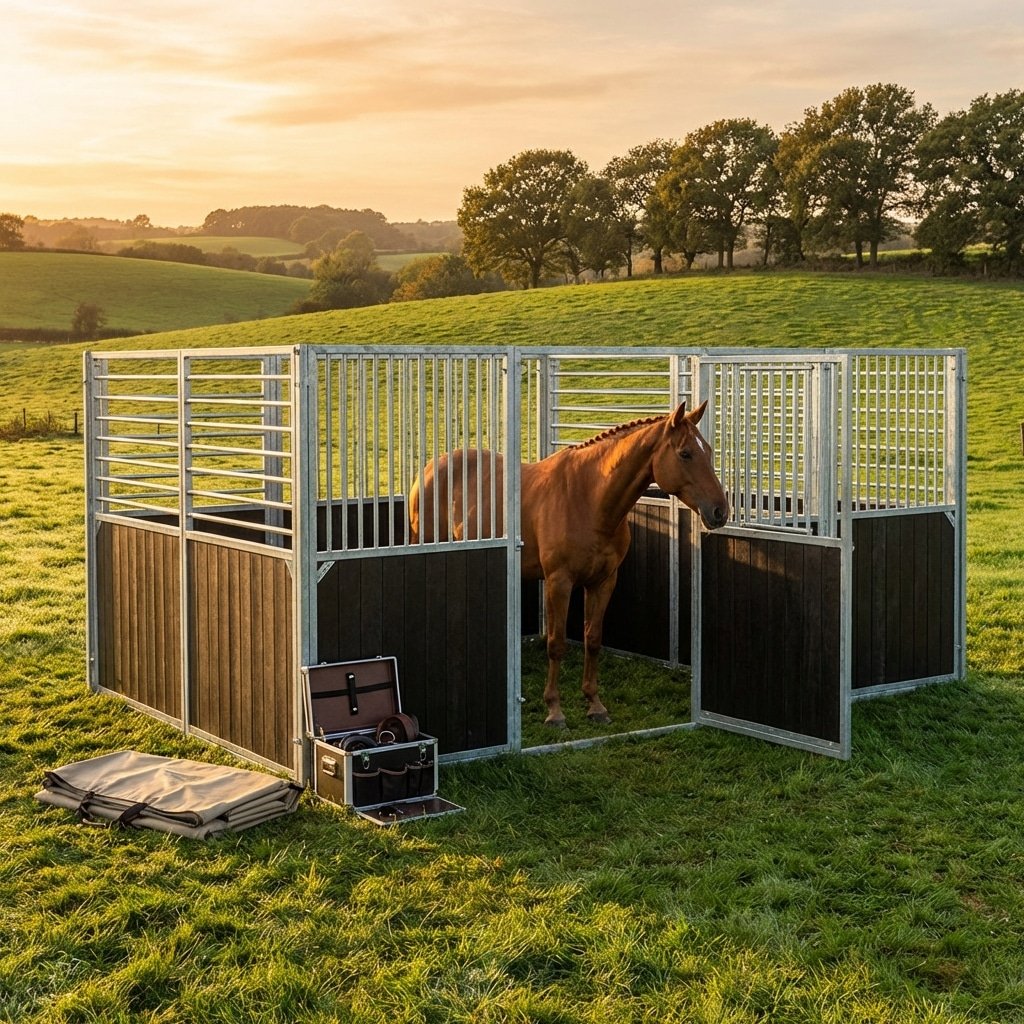
A flat-pack horse stall kit is a modular, factory-welded system delivered on steel pallets. It eliminates on-site welding, speeds up assembly, and reduces freight costs by over 60% compared to rigid structures.
Defining the Prefabricated Modular Design
Traditional stable construction relies on contractors cutting and welding raw steel at your facility. This process is slow, expensive, and creates significant fire hazards. A flat-pack system shifts this labor to a controlled factory environment. We treat the stable as a precise product, not a construction project. This approach delivers consistency that on-site fabrication simply cannot match.
- Factory-Welded Precision: Robots and jigs ensure every frame is perfectly square. Unlike site-built stalls, we use “Hot-Dip Galvanization After Fabrication,” meaning we weld the black steel first and then dip the entire unit. This seals every weld joint against rust.
- Bolt-Together Assembly: You do not need specialized welders. The system uses pre-aligned connectors and sleeves. Two general laborers can assemble a row of stalls using standard hand tools.
- Scalability: Modular panels allow you to expand or reconfigure layouts later. If you need to add a bay, you just unbolt the end frame and connect the new panels.
- Transport Efficiency: This is the profit protector for distributors. We pack components on steel pallets rather than shipping air. A standard 40HQ container holds 30-45 flat-pack sets, whereas fully welded units limit you to 12-15 sets.
Inside the Kit: Standard Component Breakdown
A DB Stable kit is a self-contained package. It includes everything required to erect the stable shell, excluding the concrete floor. We adhere to a strict bill of materials to ensure structural integrity and longevity.
- Structural Panels: The core of the kit. We provide Hot-Dip Galvanized Fronts and Partitions using Q235B (standard) or Q345B (cold climate) steel. All tubing is strictly 14-Gauge (2.0mm+), ensuring kick-proof durability.
- Infill Materials: Pre-cut planks ready for immediate insertion. Options include 28mm-32mm UV-stabilized HDPE for zero maintenance, or high-density bamboo (Janka hardness > 3000 lbf) for a traditional aesthetic.
- Hardware Pack: Every kit includes the necessary anchors, connectors, and screws. We use 304 Stainless Steel exclusively to prevent the common issue of fasteners rusting out before the steel frame does.
- Maintenance Extras: We include cold galvanizing spray. Installation often results in minor surface scratches; this spray restores the zinc barrier immediately to prevent spot corrosion.
Premium Horse Stables With 20-Year Durability
![[URL] hyperrealistic product photography close-up of a welder working on a horse stall steel bar, sparks flying, protective gear, background shows a partially built horse stable, focus on the joint connection, dramatic lighting, --ar 16:9 --no text, signage, letters](https://dbhorsestable.com/wp-content/uploads/2026/02/h3-labor-rates.jpg)
Container Logistics: Fitting 40 Stall Panels in a 40HQ
DB Stable’s flat-pack system fits 30-45 sets in a 40HQ compared to just 12 welded sets, reducing distributor freight costs by over 60% through optimized density.
| Logistics Metric | Traditional Fully Welded | DB Flat-Pack System |
|---|---|---|
| 40HQ Capacity | 12 – 15 Sets | 30 – 45 Sets |
| Space Utilization | High “Dead Air” Volume | Optimized High Density |
| Freight Impact | High Per-Unit Cost | 60%+ Cost Reduction |
Comparing Freight Efficiency: Fully Welded vs. Flat-Pack
Shipping fully welded stalls essentially means shipping air. Traditional pre-welded frames consume massive amounts of container volume while contributing very little weight, forcing you to pay for a full container that is mostly empty space. This inefficiency caps a standard 40HQ container at a maximum of 12 to 15 sets, driving the landed cost per stall to unsustainable levels for wholesale distribution.
- Eliminating Dead Air: Traditional welded frames create large voids inside the container that cannot be filled, limiting capacity to 12-15 sets.
- Volume Optimization: The DB Flat-Pack System stacks components flush against each other, allowing 30-45 sets to fit in a single 40HQ.
- Profit Protection: Maximizing container density lowers the landed cost per unit, saving distributors over 60% on ocean freight bills.
The Steel Pallet System: Ensuring Safe High-Density Loading
Density without security results in damaged inventory. We reject loose loading practices that rely on manual packing and increase the risk of scratches or dents during transit. Instead, we utilize a specific “Steel Pallet Flat-Pack” specification. This method organizes panels into rigid, stackable units that interact perfectly with mechanical unloading equipment.
- Secure Organization: We use the “Steel Pallet Flat-Pack” method to bundle panels into secure units, preventing shifting during rough seas.
- Damage Prevention: This system prevents the risks associated with loose loading, ensuring structural powder-coated or galvanized parts remain scratch-free.
- Dimensional Alignment: Standardized pallet dimensions (3.0m – 4.0m) align with the 12.03m internal length of the 40HQ for maximum stability and easy forklift removal.
![[URL] hyperrealistic product photography inside a shipping container, fully welded horse stall fronts stacked vertically consuming volume, a horse standing at the container opening looking in, realistic freight logistics scene, detailed metal surfaces, --ar 16:9 --no text, signage, letters](https://dbhorsestable.com/wp-content/uploads/2026/02/h3-logistics-1.jpg)
The Steel Pallet Advantage for Safe Unloading
Steel pallets eliminate the “load shift” risks of timber, ensuring 100% mechanical offloading and protecting your inventory from damage before it even hits your warehouse floor.
Enhanced Structural Integrity During Forklift Operations
Standard timber pallets are a liability when shipping heavy stable components. Under the dynamic stress of ocean transit, wood flexes, warps, and often snaps, leading to collapsed stacks inside the container. We moved to steel pallets to solve the safety hazards associated with unloading 2.5-ton loads that have shifted during transport.
- Prevention of Load Shifting: Steel pallets are welded rigid. They do not compress or distort, ensuring stacks remain vertical and secure for the transfer from container to warehouse.
- Superior Weight-Bearing Capacity: Unlike timber, which varies in density and grain strength, steel provides a calculated, uniform load capacity essential for heavy industrial steel goods.
- Elimination of Splintering Risks: Broken timber pallets create jagged edges and loose debris that injure warehouse personnel. Steel maintains its structural integrity, protecting your team.
- Stability for Forklifts: A rigid steel base eliminates the “bounce” of wooden skids, allowing operators to maneuver heavy bundles with precision.
The DB Stable Flat-Pack Specification
Our “Profit Protection” logistics strategy relies on the DB Stable Flat-Pack Specification. We strictly prohibit loose loading. Every component is secured onto custom-engineered steel pallets defined in our Product Bible. This approach guarantees that your team spends time installing, not manually unloading loose bars and frames from a 40HQ container.
- 100% Mechanical Offloading: Our zero loose loading policy means a forklift can unload the entire shipment. This drastically reduces labor costs compared to manual handling.
- Customized Sizing: We build pallets specifically for 3.0m – 4.0m panels, preventing the overhang damage common with standard-sized skids.
- Heavy Load Management: Each pallet is engineered to handle unit weights of 250kg – 450kg, supporting the density of our 14-gauge steel and bamboo infills.
- Transit Protection: The steel packaging acts as a sacrificial shield, absorbing impact and resisting the high-salinity environment of ocean freight (mirroring our 96-hour salt spray test standards) to keep the product pristine.
![[URL] hyperrealistic product photography of flat-pack horse stall kits neatly arranged on engineered steel pallets, galvanized components, organized warehouse setting, a horse inspecting the packages, bright clean lighting, --ar 16:9 --no text, signage, letters](https://dbhorsestable.com/wp-content/uploads/2026/02/h2-flat-pack.jpg)
How B2B Dealerships Profit from Factory-Direct Stalls
Dealerships maximize profitability by bypassing regional wholesalers to access OEM pricing and leveraging high-density logistics. By fitting up to 45 flat-pack sets in a single container, dealers reduce per-unit shipping costs by over 60%, significantly widening the gap between landed cost and retail price.
The Economic Advantage of the Direct Import Model
Most local suppliers operate as aggregators, adding a markup layer to cover their domestic warehousing and sales staff. Sourcing directly from our ISO 9001 certified factory eliminates these intermediate costs, allowing you to capture the full margin between production cost and retail value. This structure gives you the flexibility to adjust pricing strategies based on your specific target, whether you are bidding on a volume-heavy Riding School project or a high-margin Private Estate installation.
- Direct Access: Buying from the source removes the “middleman tax,” directly lowering your acquisition cost.
- Pricing Control: With lower base costs, you control the final price, allowing you to undercut local competitors while retaining healthy margins.
- Volume Tiers: Placing a “Distributor Order” (approx. 30-40 sets) unlocks our lowest tier of factory production costs, maximizing the spread.
Protecting Margins with High-Density Flat-Pack Logistics
Ocean freight is often the single largest variable in import profitability. Traditional fully welded stalls are inefficient to ship because they are bulky and mostly air, severely limiting how many units fit in a container. Our engineering team designed the DB Flat-Pack System specifically to solve this logistical bottleneck. By utilizing steel pallets and modular assembly, we maximize the cubic utility of every container.
- The Old Standard: Fully welded stalls cap out at 12-15 sets per 40HQ container, causing shipping costs to skyrocket per unit.
- The DB Advantage: Our flat-pack method loads 30-45 sets into the same 40HQ container.
- The Profit Impact: This density reduces ocean freight costs by over 60% per unit. Every dollar saved on shipping is a dollar added to your net profit per stall sold.
Frequently Asked Questions
What HS Code should I use when importing horse stalls?
We recommend declaring HS Code 7308.90 (Structures of Iron/Steel). This specific classification identifies the product as structural components rather than ‘Prefabricated Buildings,’ which helps importers avoid complex regulatory hurdles and potentially higher tariffs associated with habitable structures.
How many stable sets can fit in a 40HQ container?
Our Flat-Pack System maximizes logistics efficiency, allowing approximately 30-45 sets to fit in one 40HQ container. In contrast, traditional fully welded stalls typically limit loading to just 12-15 sets. This packing method significantly lowers the landed cost per unit by saving over 60% on ocean freight.
Do you use pre-galvanized tubing or hot-dip galvanization?
We strictly utilize Hot-Dip Galvanization After Fabrication in compliance with BS EN ISO 1461. Unlike cheaper alternatives that weld pre-galvanized tubes (leaving joints vulnerable), we weld the black steel frame first and then dip the entire structure. This ensures a zinc coating average of >70 microns, protecting all weld points from rust.
Can the stalls withstand heavy impacts from kicking horses?
Yes. Our frames are built from 14-Gauge (2.0mm+) steel profiles. For colder climates or high-impact zones, we offer Q345B High Strength Steel, which provides superior low-temperature impact toughness. Additionally, our Bamboo infill is 3x harder than Oak (Janka > 3000 lbf), and our HDPE options are designed to absorb shock without splintering.
What is included in a standard installation kit?
Each stall kit is comprehensive. It includes the Front Panel (with door), Side/Partition Panels, pre-cut Infill Planks (HDPE or Bamboo), and a full Hardware Kit containing 304 Stainless Steel anchor bolts, connectors, and screws. We also include a Cold Galvanizing Spray for touching up any scratches that occur during unloading or assembly.
Final Thoughts
Shipping fully welded frames burns capital on dead air, while domestic fabrication drains margins through excessive labor rates. Our flat-pack system secures your bottom line by fitting up to 45 sets in a container, effectively cutting landed costs by over 60%. This logistics efficiency, paired with our ISO 1461 Hot-Dip Galvanization standard, delivers high-margin inventory that withstands the elements and protects your dealer reputation.
Profitability relies on optimizing volume and precision. We recommend requesting a “Distributor Quote” for a 40HQ load to verify the massive reduction in landed cost per unit. Contact our engineering team today to configure your specifications and lock in production slots for the upcoming season.

 English
  Spanish
  French
  Arabic
  German
0 Comments