


Sourcing from validated ESG / Green Factories is the only safeguard against disqualification from high-value government tenders. While traditional timber sourcing exposes developers to deforestation liabilities and carbon taxes, aligning with circular steel manufacturing protects your project eligibility and mitigates Scope 3 emission risks.
This analysis benchmarks manufacturers replacing old-growth timber with 100% recyclable Q235B structural steel and high-density bamboo. We evaluate suppliers based on ISO 1461 galvanization standards and logistics capacity, focusing on flat-pack systems that load 45 sets per container to slash shipping emissions by over 60%.
Precision-Engineered Stables With 20-Year Durability


The Rise of ESG (Environmental, Social, Governance) in Construction
Strict carbon budgets and ethical sourcing requirements are no longer optional—they are prerequisites for securing high-value government and commercial contracts. We align your supply chain with these rigorous standards by combining 100% recyclable steel frameworks with rapidly renewable bamboo and a logistics strategy that significantly reduces transport emissions.
Decarbonizing Projects with Recyclable Steel and Bamboo
Regulators now enforce strict limits on embodied carbon, pushing builders to select materials that support a circular economy. We utilize Q235B and Q345B structural steel for our frameworks, both of which are fully recyclable and retain their structural integrity through multiple lifecycles. To further reduce environmental impact, we offer high-density bamboo infills as a superior alternative to slow-growing hardwoods. While oak takes decades to mature, bamboo reaches harvestability in 3-5 years, acting as a rapid carbon sink without contributing to deforestation.
Logistics also play a massive role in a project’s carbon footprint. Traditional fully welded stables force you to ship mostly “air,” limiting a 40HQ container to just 12-15 sets. Our flat-pack design optimizes volume, allowing us to load 30-45 sets in the same container. This efficiency cuts shipping emissions by over 60%, directly lowering the Scope 3 emissions reported in your ESG disclosures while simultaneously protecting your profit margins.
Governance Standards and Ethical Manufacturing
Investors and clients demand transparent supply chains to meet increasingly rigorous reporting frameworks. We maintain strict adherence to ISO 9001 for quality management and ISO 1461 for hot-dip galvanizing standards. This ensures full traceability and consistent quality control, helping distributors and project managers qualify for green financing and secure contracts for high-end government or commercial facilities.
Social responsibility in our sector extends directly to animal welfare. We address this through our “Kick-Proof Guarantee” and “Cast-Proof” design features, such as maintaining specific 50mm bottom gaps to prevent leg entrapment. By engineering out these common risks, we help you demonstrate a tangible commitment to safety and care standards, reducing liability and ensuring the long-term wellbeing of the horses housed in your facilities.
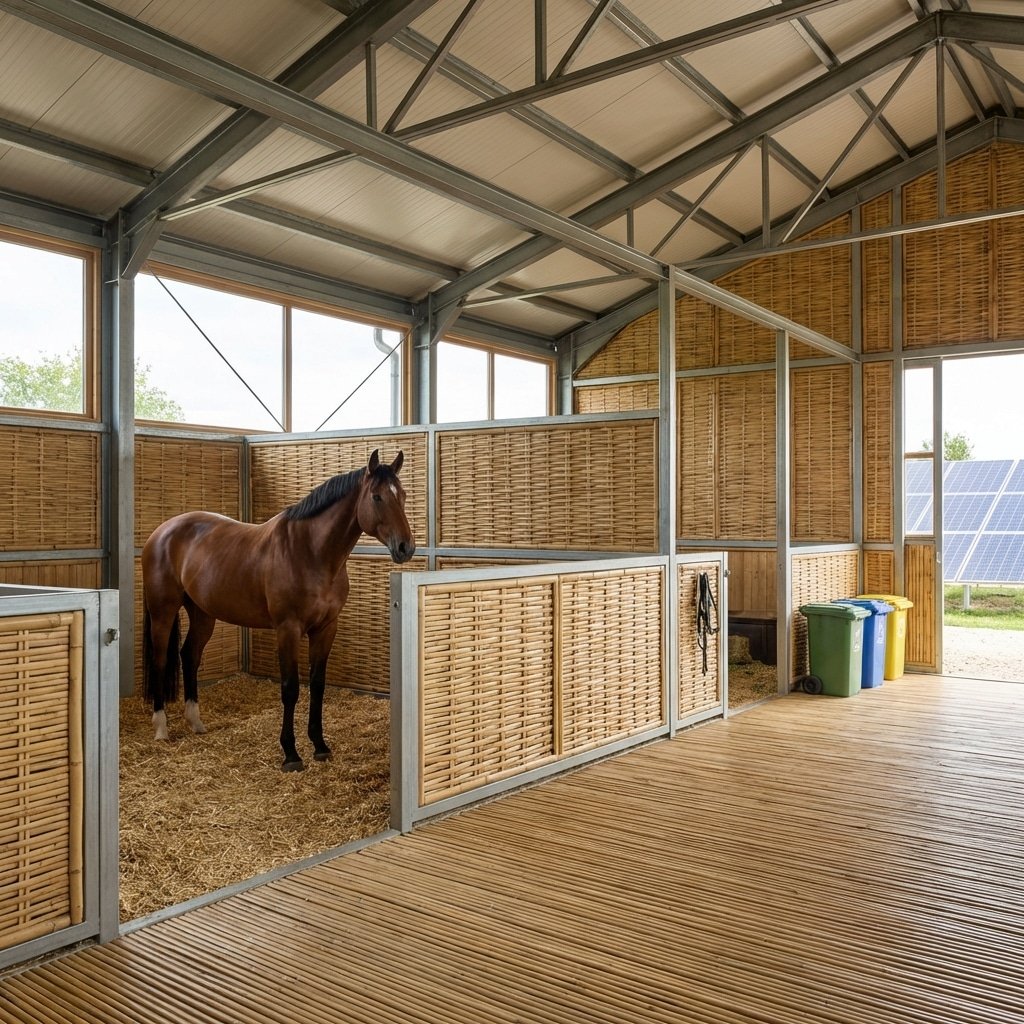
Moving Away from Old-Growth Timber (Oak/Pine)
We are shifting production away from traditional hardwoods like Oak and Pine to address deforestation concerns and stricter import regulations in the EU and Australia. Instead, DB Stable prioritizes high-density bamboo and recycled HDPE infills. These materials offer superior durability, zero maintenance, and align with modern ESG standards without sacrificing the structural integrity or aesthetic of the stable.
The Environmental Liabilities of Traditional Hardwood Sourcing
Reliability on old-growth Oak and Pine contributes significantly to forest depletion and biodiversity loss, clashing with the modern ESG priorities many of our B2B partners must now meet. Harvesting mature hardwoods releases stored carbon, whereas fast-growing alternatives sequester carbon more rapidly during their shorter growth cycles.
Distributors increasingly reject uncertified timber due to stricter import regulations in the EU and Australia regarding sustainable forestry. We also prioritize materials that eliminate the need for toxic preservatives, which are often required to keep softwood pine durable in damp stable environments. By moving away from these porous woods, we reduce chemical usage and ensure a safer environment for the horses.
Superior Alternatives: High-Density Bamboo and Recycled HDPE
We engineer our Professional Series with High-Density Strand Woven Bamboo, which boasts a Janka Hardness exceeding 3000 lbf—three times harder than Oak. Bamboo reaches maturity in just 5 years compared to 50+ years for Oak, offering a highly renewable resource that withstands the impact of heavy kicks better than traditional timber.
For clients prioritizing hygiene and longevity, our HDPE infill options provide a “Zero Maintenance” solution that prevents the cribbing and rot issues common with traditional Pine boards. Engineered bamboo resists moisture and mold better than natural wood, solving the sanitation challenges inherent in porous timber stalls and ensuring the stable remains safe and visually appealing for decades.
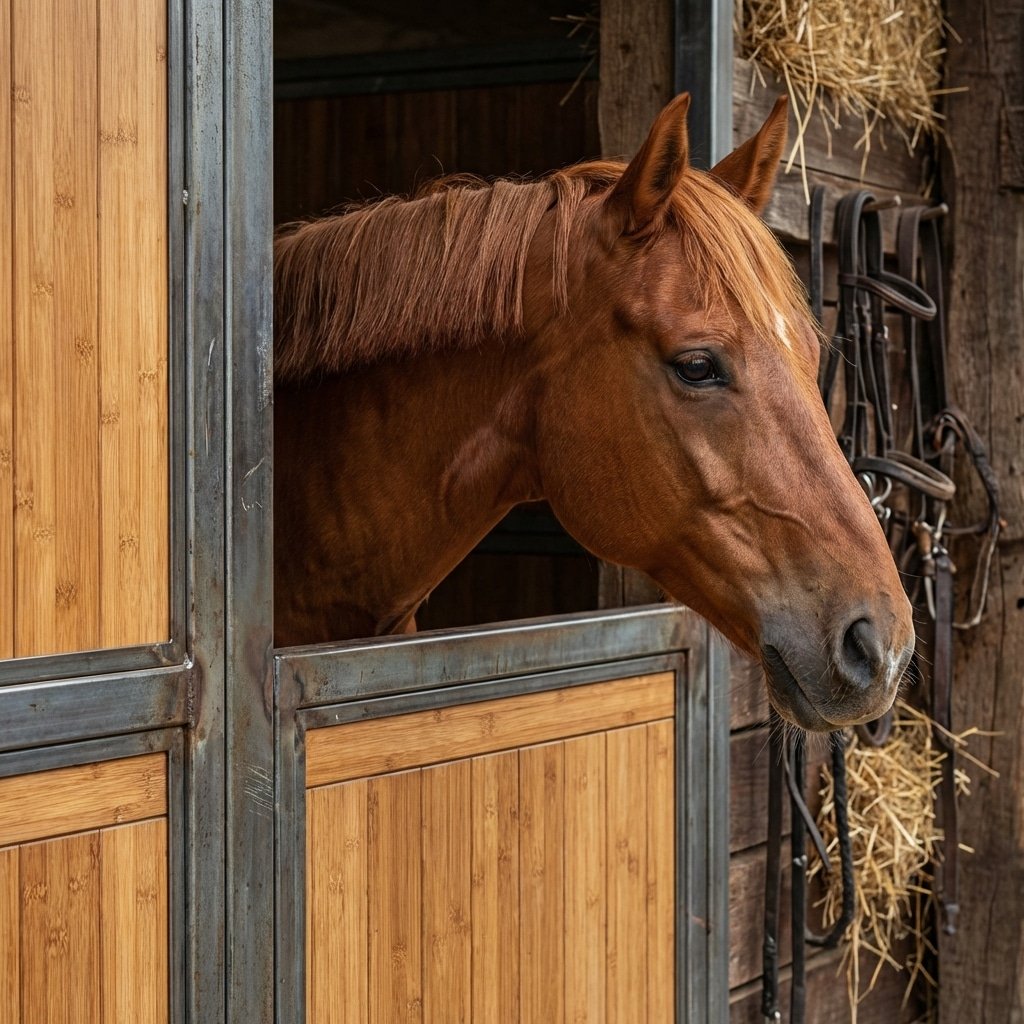
Top Factories Embracing Sustainable Materials
Leading manufacturers are shifting from linear production to circular ecosystems, prioritizing material longevity and carbon reduction. While global giants redefine energy and textiles, we apply these rigorous ESG principles to equestrian engineering, combining 100% recyclable steel frameworks with renewable high-density bamboo to minimize environmental impact.
Global Pioneers in Circular Manufacturing
The manufacturing sector is undergoing a fundamental shift toward sustainability, driven by measurable carbon reduction rather than vague marketing claims. First Solar has set a new benchmark in the energy sector by utilizing thin-film CdTe technology, a process that achieves 40% lower lifecycle carbon emissions compared to conventional silicon panels.
In the consumer goods space, IKEA is driving mass-market adoption of circular models by committing to 100% renewable and recycled materials by 2030, effectively transitioning its vast furniture supply chain. Similarly, Patagonia leads the textile industry by eliminating virgin petroleum-based nylon and utilizing over 60% recycled fabrics. These pivots demonstrate that high-volume production can coexist with environmental stewardship when supply chains are redesigned for reuse and resource efficiency.
DB Stable: The Standard for Eco-Friendly Horse Barns
We have aligned our engineering standards with these global sustainability trends, focusing on materials that offer lifetime durability and full recyclability. Our frameworks utilize Q235B and Q345B structural steel, ensuring that every component maintains rigorous safety standards for animal welfare while remaining 100% recyclable at the end of its lifecycle. This approach eliminates the landfill waste often associated with chemically treated timber alternatives.
To address the depletion of old-growth hardwoods, we integrate High-Density Strand Woven Bamboo as our primary infill option. With a Janka Hardness rating exceeding 3000 lbf, this material is three times harder than oak and naturally resistant to rot and mold. It provides a renewable, high-performance solution that withstands the impact of aggressive horses without requiring the harvest of slow-growing trees.
Beyond materials, we actively reduce our carbon footprint through logistics optimization. Our DB Flat-Pack System allows us to load 30-45 stable sets into a single 40HQ container, significantly outperforming the industry average of 12-15 fully welded sets. This efficiency reduces shipping emissions per unit by over 60%, ensuring that our focus on profit protection for distributors also supports global carbon reduction goals.

Strand-Woven Bamboo: A High-Yield Carbon Sink
Strand-woven bamboo transforms rapid biomass production into a high-density structural material that actively reduces atmospheric carbon. By compressing fibers into boards denser than oak, we create a kick-proof, rot-resistant infill that locks away carbon for decades, offering a sustainable alternative to old-growth timber without compromising on safety or durability.
The Science of Rapid Carbon Sequestration
Bamboo acts as a powerful carbon pump, absorbing significant atmospheric CO2 during its rapid growth phase compared to slow-maturing hardwoods. Unlike timber forestry that often requires clear-cutting and replanting, bamboo’s underground rhizome system remains intact after harvest. This allows for natural regeneration without soil disturbance, preserving the local ecosystem’s ability to store carbon in the ground.
We utilize a selective harvesting method, cutting only mature culms while leaving younger shoots to grow. This approach maintains continuous canopy coverage and supports higher biomass yields per acre than traditional forestry. By optimizing the yield of the bamboo forest, we ensure that the raw material for our stable infills is renewable and actively contributing to carbon drawdown throughout its lifecycle.
High-Density Durability and Lifecycle Benefits
The sustainability of a material is defined by its lifespan. Our strand-woven manufacturing process compresses bamboo fibers into boards with densities reaching 1,200 kg/m³, effectively storing more carbon per unit volume than lighter woods. This high density results in a Janka Hardness rating over 3000 lbf—making our bamboo infill three times harder than Oak. This resilience allows the boards to withstand the high-impact environment of a horse stable, resisting kick damage and cribbing that would destroy softer materials.
By extending the functional life of the product, we keep carbon locked away for decades. Additionally, production facilities frequently utilize biomass-fueled operations, converting waste bamboo scraps into energy to offset manufacturing emissions. This creates a production cycle where the durability of the final product maximizes the environmental benefit of the raw material.
Q235B Steel: The 100% Recyclable Framework
Q235B structural steel serves as the foundation for true circular economy models in equestrian construction, capable of being recycled indefinitely without any loss of mechanical properties. By utilizing high-grade steel that is often produced from over 70% recycled sources, we minimize the carbon footprint of new projects while eliminating the landfill waste associated with chemically treated timber.
Infinite Recyclability in the Circular Economy
Q235B structural steel supports sustainable construction models because it is 100% recyclable without any degradation of its mechanical properties or tensile strength. Unlike timber, which often requires chemical treatments that render it hazardous waste at the end of its lifecycle, our steel frameworks allow for indefinite re-smelting and reuse once a facility is decommissioned.
This material choice directly combats resource depletion. Current industry data indicates that approximately 70% of steel used in modern construction already comes from recycled sources. By choosing a steel framework, facility owners significantly lower the embodied carbon of their equestrian projects compared to using virgin materials or non-recyclable composites.
Sustainability Through Structural Longevity
True sustainability minimizes the need for replacement. We engineer our stables using Q235B (ASTM A36 equivalent) and cold-climate specific Q345B steel to create “Kick-Proof” structures that resist brittle fractures far better than wood. A stable system that retains its structural integrity for decades reduces the environmental impact associated with manufacturing and shipping replacement parts.
To ensure this lifespan, we utilize a “Hot-Dip Galvanization After Fabrication” process, adhering to ISO 1461 standards. This applies an average zinc coating of over 85 microns to structural parts, creating a deep metallurgical bond. This protection is superior to pre-galvanized tubing and ensures the barn withstands high-ammonia environments for decades without the need for the toxic chemical preservatives often required to maintain wooden structures.
Final Thoughts
Securing high-value government and commercial contracts demands more than low upfront costs; it requires verifiable supply chain transparency. Switching to Q235B structural steel and renewable bamboo infills eliminates the deforestation liabilities of old-growth timber while meeting strict embodied carbon limits. This strategic alignment protects your project from future regulatory scrutiny and guarantees the long-term asset value of your facility.
Profit protection in this sector hinges on logistics, which is why our flat-pack system loads 30-45 sets per container to slash your shipping overhead by 60%. We invite you to validate our ISO 1461 galvanization quality and “Kick-Proof” engineering firsthand through a specialized trial order. Contact our technical team today to specify these sustainable standards for your next development.
Frequently Asked Questions
How to build an ESG compliant equestrian center?
Start by prioritizing materials that balance high durability with low lifecycle carbon footprints. We recommend replacing traditional old-growth timber with rapid-renewable alternatives like high-density strand-woven bamboo for your infills. For the structural framework, utilizing hot-dip galvanized steel (Q235B or Q345B) ensures the facility lasts decades without requiring toxic chemical preservatives. Always verify that your manufacturing partners hold ISO 9001 and ISO 1461 certifications to ensure responsible production practices.
Is bamboo a sustainable building material?
Yes, specifically when processed as high-density strand-woven bamboo. This material acts as a powerful carbon sink because bamboo regenerates in 3-5 years, compared to decades for hardwoods. From a performance standpoint, our bamboo options feature a Janka Hardness exceeding 3000 lbf—making them three times harder than Oak. This extreme durability reduces the frequency of replacements due to cribbing or impact, significantly lowering the long-term waste generated by your facility.
Environmental impact of steel vs wood barns?
Steel offers a superior circular economy advantage for large projects. While treated wood often ends up as landfill waste due to the chemical preservatives required to prevent rot, our steel components are 100% recyclable. Our “Hot-Dip After Fabrication” process provides lifetime rust protection (conforming to BS EN ISO 1461) without the need for toxic paints or frequent chemical re-treatments, protecting both the soil quality around your barn and the long-term asset value.
Green certifications for horse stables?
While specific “green stable” certifications are rare, you should prioritize manufacturers who adhere to recognized industrial standards. Look for ISO 14001 for environmental management systems and ISO 1461 for galvanizing quality. These certifications verify that the manufacturing process minimizes pollution. Furthermore, using verified materials like our tested steel profiles and sustainable bamboo can contribute points toward broader project accreditations like LEED or BREEAM.
Eco-friendly horse barn manufacturers?
At DB Stable, we reduce carbon footprints through engineering longevity and logistics efficiency. Our specialized flat-pack design allows us to load 30-45 stable sets per 40HQ container, whereas fully welded alternatives only fit 12-15 sets. This innovation cuts shipping emissions by over 60%. We focus on building systems that last for decades using heavy-duty 14-gauge tubing and hot-dip galvanization, ensuring you won’t need to replace your facility—and generate more waste—in just a few years.



 English
  Spanish
  French
  Arabic
  German
0 Comments