


Modern State Fairgrounds lose substantial margin by treating stabling infrastructure as a recurring rental expense rather than a capital asset. Reliance on third-party rental contracts drains budgets through compounding setup labor and logistics markups that often surpass the cost of ownership within three seasons. This cycle erodes event profitability and leaves venues vulnerable to the liability risks of fatigued rental inventory.
This analysis benchmarks suppliers against the ISO 1461 Hot-Dip Galvanization standard necessary for high-traffic longevity. We evaluate manufacturing capacity for 500-set orders and detail how proprietary flat-pack logistics allow 30-45 sets per container. Transitioning to owned Q235B structural steel inventory secures distributor-level freight savings and eliminates the volatility of annual rental negotiations.
The Economics of Mega-Events: Renting vs. Owning Stalls
Quick Comparison
| Event Name | Location | Core Strength | Verdict |
|---|---|---|---|
| Iowa State Fair | Iowa, USA | $629.2M Economic Impact | A massive economic engine supporting nearly 5,000 sustained jobs, offering significant scale for vendors. |
| State Fair of Texas | Texas, USA | High Vendor Sales Potential | Generates up to $196M in secondary vendor impact, making it a premier choice for high-traffic sales. |
| Indiana State Fair | Indiana, USA | Year-Round Venue (400+ Events) | Operates as a persistent commercial hub rather than just a seasonal event, ensuring steady economic flows. |
Iowa State Fair
The Iowa State Fair stands out as a **proven economic powerhouse**, generating over $629 million in impact and supporting nearly 5,000 jobs.
As a cornerstone of the regional economy, this fair acts as a massive financial engine rather than just a seasonal attraction. In 2024 alone, it generated a staggering $629.2 million in total economic impact, showcasing its immense scale.
Beyond direct revenue, the event supports 4,880 sustained jobs and contributes $211.9 million in wages. This extensive payroll and employment footprint demonstrates the fair’s significant operational capacity and vendor potential.
📊 At a Glance:
- 📍 Location: Iowa, USA
- 🏭 Core Strength: Mega-Events, Job Creation
- 🌍 Key Markets: Regional Economy
Why We Picked Them:
| ✅ The Wins | ⚠️ Trade-offs |
|---|---|
|
|
State Fair of Texas
This event generates substantial secondary value, offering **massive sales potential** for vendors through high-traffic exposure.
The State Fair of Texas operates as a massive economic engine, generating between $562.3 million and $680.3 million in total impact during its 2023 run. It serves as a critical hub for regional commerce, supporting 4,486 jobs and drawing significant crowds.
For vendors, the opportunity is massive. Sales activity alone triggered between $78.2 million and $196.2 million in secondary economic impact, highlighting the intense demand for stall opportunities at this venue.
📊 At a Glance:
- 📍 Location: Texas, USA
- 🏭 Core Strength: Vendor Opportunities, High-Traffic Events
- 🌍 Key Markets: Southwestern USA
Why We Picked Them:
| ✅ The Wins | ⚠️ Trade-offs |
|---|---|
|
|
Indiana State Fair
A **year-round commercial engine** that transcends seasonal limitations by hosting over 400 annual events.
Unlike traditional fairs that rely on a single peak season, the Indiana State Fair functions as a persistent commercial venue. It hosts a massive roster of over 400 events annually, ensuring continuous operational activity.
This diversified strategy secures a steady $330 million economic impact for the state. The model transforms the fairgrounds into a reliable hub for ongoing commerce and vendor engagement throughout the year.
📊 At a Glance:
- 📍 Location: Indiana, USA
- 🏭 Core Strength: Year-Round Events, Commercial Venue Space
- 🌍 Key Markets: Midwestern USA
Why We Picked Them:
| ✅ The Wins | ⚠️ Trade-offs |
|---|---|
|
|
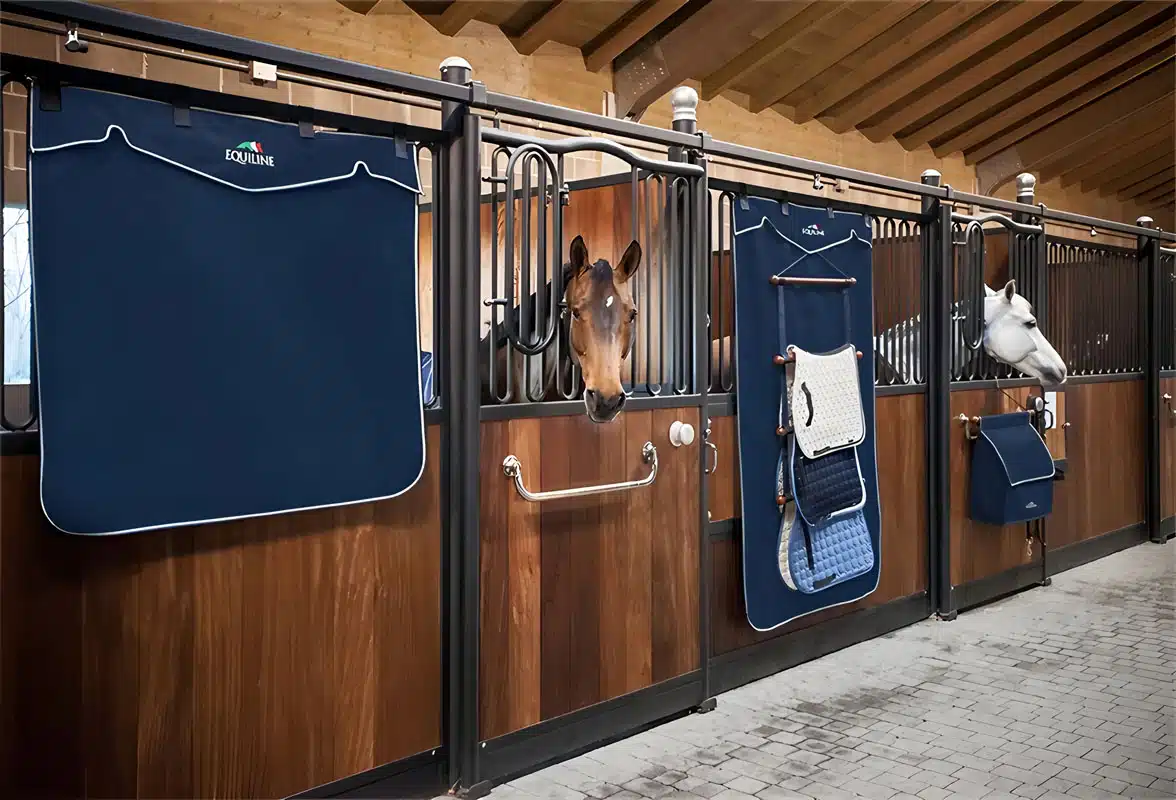
Factory-Direct Stables With 20-Year Durability
The Economics of Mega-Events: Renting vs. Owning Stalls
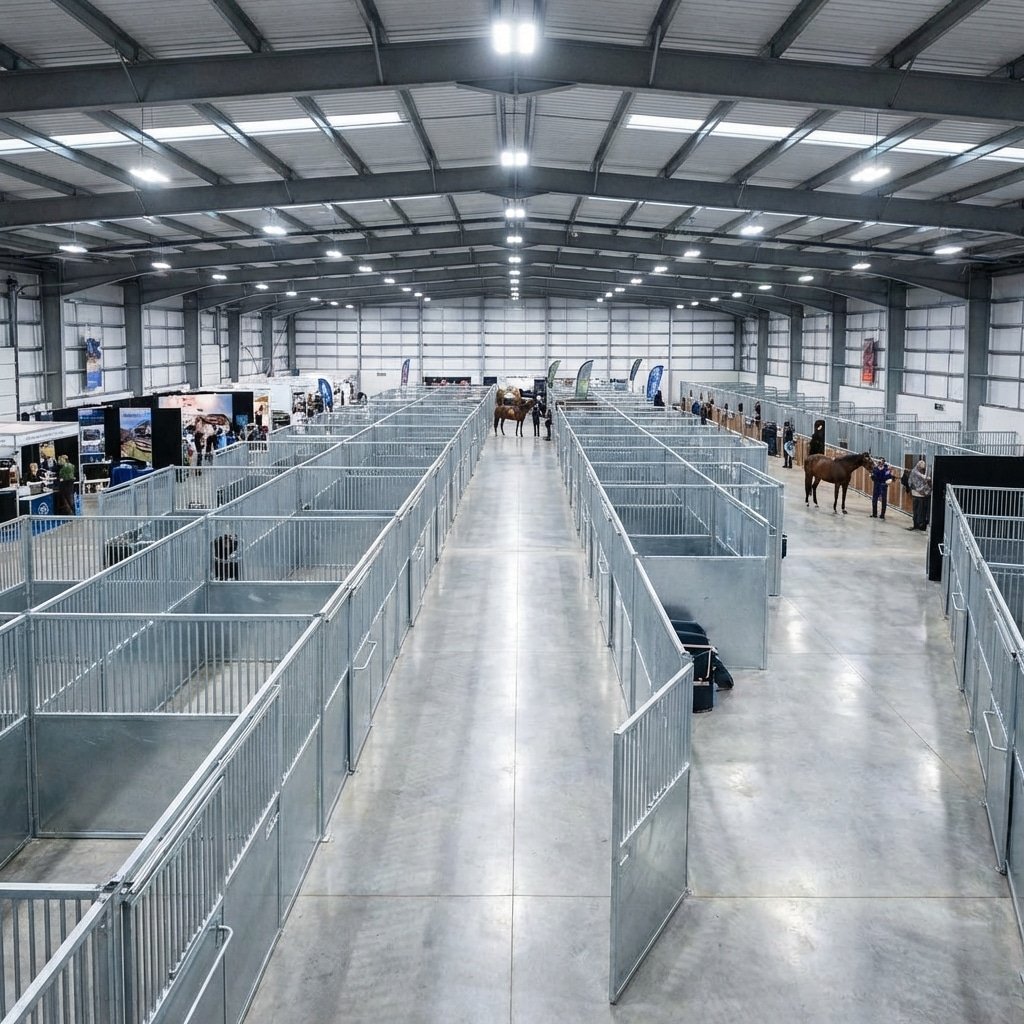
Transitioning from rental contracts to owned inventory allows fairgrounds to convert annual sunk costs into permanent revenue-generating assets. By leveraging our high-density flat-pack logistics, venues can secure 30-45 sets per container, significantly lowering the CAPEX barrier while ensuring decades of durability through ISO 1461 hot-dip galvanization.
Calculating the Recurring Costs of Rental Infrastructure
Event organizers hosting year-round activities face compounding financial drains when relying solely on rental providers. While the upfront rental fee might seem manageable for a single season, the hidden logistics markups for delivery, setup labor, and teardown quickly erode profit margins. Over just a few seasons, these cumulative payments often exceed the cost of purchasing a permanent fleet outright.
Beyond the balance sheet, relying on rental stock introduces liability risks. Temporary rental stalls often suffer from metal fatigue due to constant transport, leading to lower structural integrity. For high-value equine participants, a compromised latch or rusted weld is unacceptable. We prioritize safety by ensuring even our portable solutions meet strict structural standards, eliminating the unpredictability associated with third-party rental inventory.
ROI on Owned Inventory: Logistics and Longevity
Purchasing a dedicated fleet allows fairgrounds to capitalize on economic surges, turning stall fees into direct revenue rather than pass-through expenses to rental agencies. The historical barrier to ownership has been shipping costs, but we have engineered a solution to protect your logistics margins. Unlike traditional fully welded units that max out at 15 sets per container, our Flat-Pack System allows us to load 30-45 sets into a single 40HQ container. This efficiency reduces freight costs by over 60%, making the initial investment significantly more viable.
Ownership demands durability, especially when equipment is frequently assembled and disassembled. We utilize Hot-Dip Galvanization After Fabrication (ISO 1461), dipping the entire steel framework into molten zinc after welding. This process ensures that even if the frames are scratched during rapid event setup, the metallurgical bond prevents rust from spreading. Our Economy Series is engineered to withstand these rigorous assembly cycles, amortizing the investment quickly compared to the recurring drain of annual rental contracts.
Manufacturing Capacity: Who Can Deliver 500 Sets in 60 Days?
Delivering 500 horse stable sets within a tight 60-day window is a logistical challenge that separates local workshops from industrial OEM manufacturers. While simple division suggests a daily output of 8 sets is sufficient, real-world variables like equipment maintenance and the critical hot-dip galvanization process require a factory to sustain a buffer capacity of 12-15 sets per day. We engineer our production lines to absorb these variances, ensuring your project generates revenue on schedule rather than excuses.
The Mathematics of Scale: Why 8.33 Sets Per Day Isn’t Enough
To complete 500 stable sets within a 60-day window, a factory must theoretically finish 8.33 units every single day. But banking on theoretical maximums is a significant risk for large-scale projects. Industrial data consistently shows that manufacturing plants typically operate at only 65-75% of their design capacity. This gap accounts for routine machine maintenance, raw material intake, and quality control checks that stop the line.
We calculate production schedules based on reality, not optimism. A reliable partner must demonstrate a ‘buffer capacity’ of 12-15 sets per day to handle a volume of this magnitude. This surplus capability is the only way to absorb inevitable supply chain fluctuations without missing the strict installation deadlines of a state fair, expo, or major commercial development.
Assessing Factory Constraints: The Galvanization Bottleneck
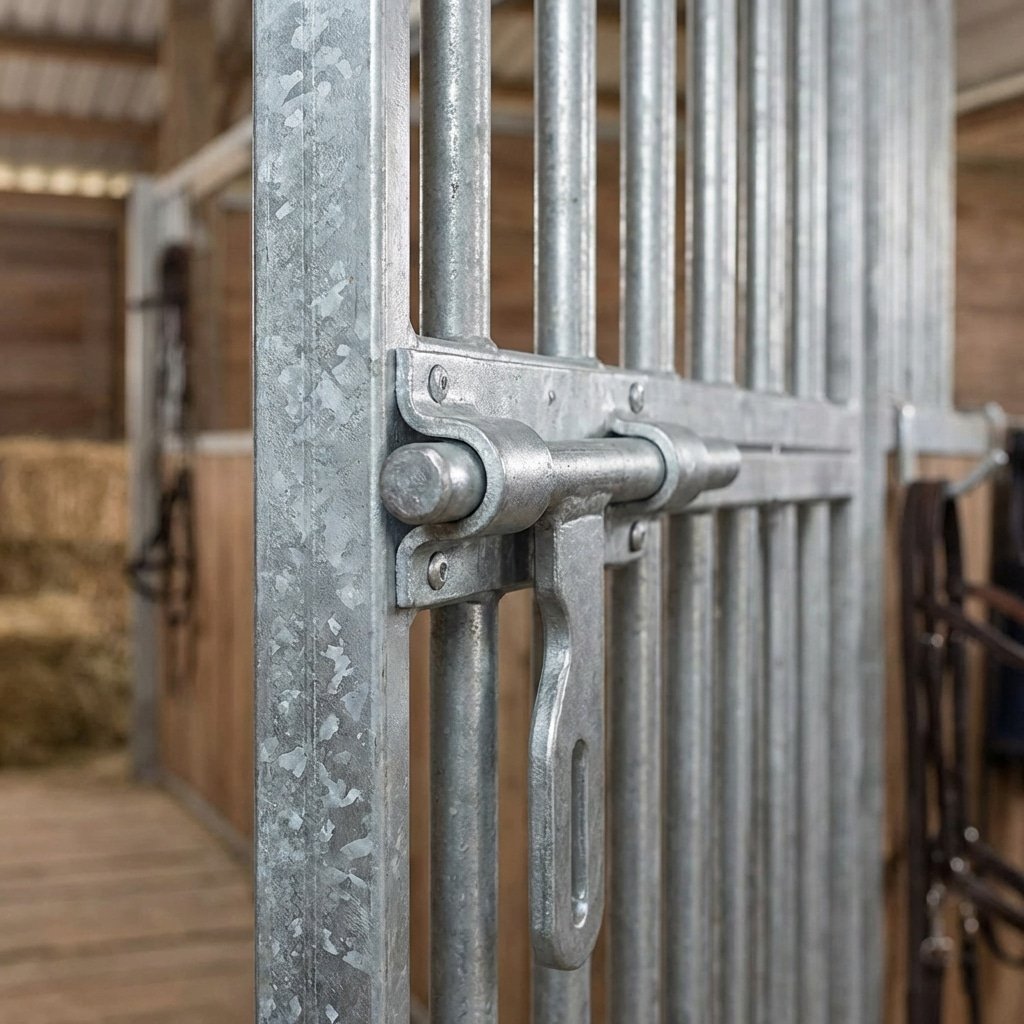
The primary constraint in producing high-quality stables is not the welding speed, but the **ISO 1461 hot-dip galvanizing process**. We perform this step after fabrication to ensure total rust protection. This involves transporting fully welded Q235B or Q345B steel frames to the zinc bath, dipping them to achieve a structural coating average of over 85 microns, and allowing for proper cooling and inspection.
Our standard 35-45 day production lead time specifically accounts for this logistical necessity. Project managers must verify that rapid delivery promises from other suppliers do not come at the cost of quality. If a factory promises bulk delivery in under 30 days, they are likely using pre-galvanized (black tube welded) materials. While faster to produce, these leave weld joints exposed to the elements, leading to red rust and structural failure within a few years.
The Assembly Speed Requirement (Pin Connectors)
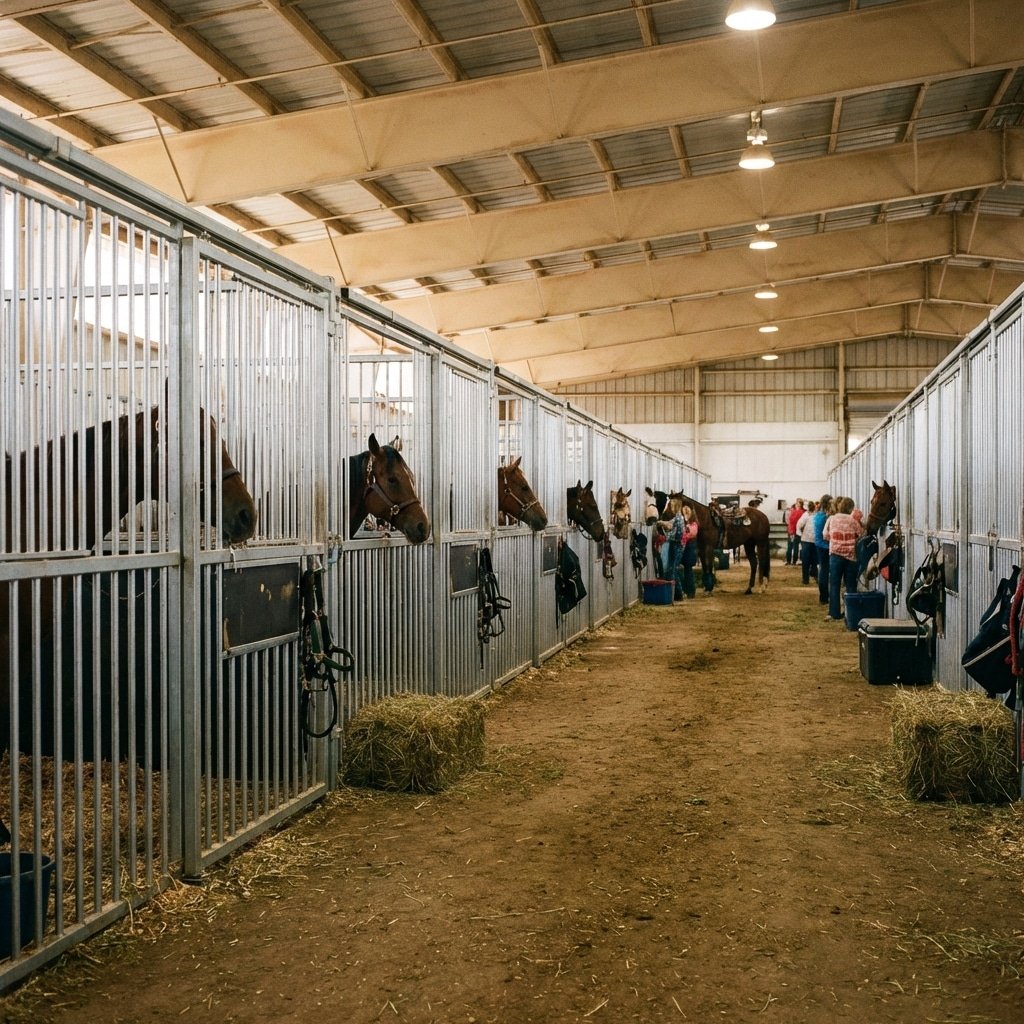
We engineer our temporary stabling systems with a specific “time-is-money” focus: a 2-person crew must be able to assemble a complete stall front and partition in under 15 minutes. By utilizing a hot-dip galvanized drop-pin system rather than threaded bolts, we eliminate the need for power tools and prevent the common issue of rusted fasteners seizing up after outdoor storage.
The Mechanics of Quick-Release Drop-Pin Systems
Traditional bolted connections are structurally sound but operationally expensive for temporary events. When a venue needs to deploy 500 stalls in a 48-hour window, the time spent tightening nuts and bolts destroys profit margins. Our solution utilizes a simple male-female lug system that aligns instantly. This allows unskilled labor to secure connections safely by simply dropping a pin into the aligned lugs, maintaining the full structural integrity of our Q235B structural steel framework without requiring torque wrenches or impact drivers.
Crucially, the reliability of a pin system depends entirely on the coating. Cheaper competitors often use pre-galvanized steel (black tube welded at the seams), where the heat of welding burns off the zinc protection. This leads to rust forming inside the lugs within a single season, causing pins to seize and requiring hammers for removal. At DB Stable, we adhere to BS EN ISO 1461 Hot-Dip Galvanization standards. Our lugs are welded first, and then the entire panel is dipped in molten zinc. This ensures the inside of the connector is fully coated (avg. > 70 microns), guaranteeing smooth insertion and removal for the lifetime of the product.
Labor Efficiency: Meeting the 48-Hour Setup Window
Speed is the primary currency for event organizers. Our data shows that a 2-person crew can assemble a pin-connected stall front and partition in under 15 minutes. This efficiency is vital when labor costs are high and setup windows are tight. The pin connections facilitate rapid disassembly and flat-stacking, which minimizes labor costs during the critical strike-down phase post-event. We design these systems to be “Kick-Proof” yet light enough for handlers to manipulate without heavy machinery once off the pallet.
This assembly speed is supported by our Steel Pallet Flat-Pack logistics system. Unlike loose-loaded containers that require hours to unload by hand, our panels arrive on standardized steel pallets that can be offloaded by forklift and placed directly at the assembly line. This “Profit Protection” strategy ensures that you aren’t paying for dead time on the loading dock, allowing your team to start building immediately upon delivery.
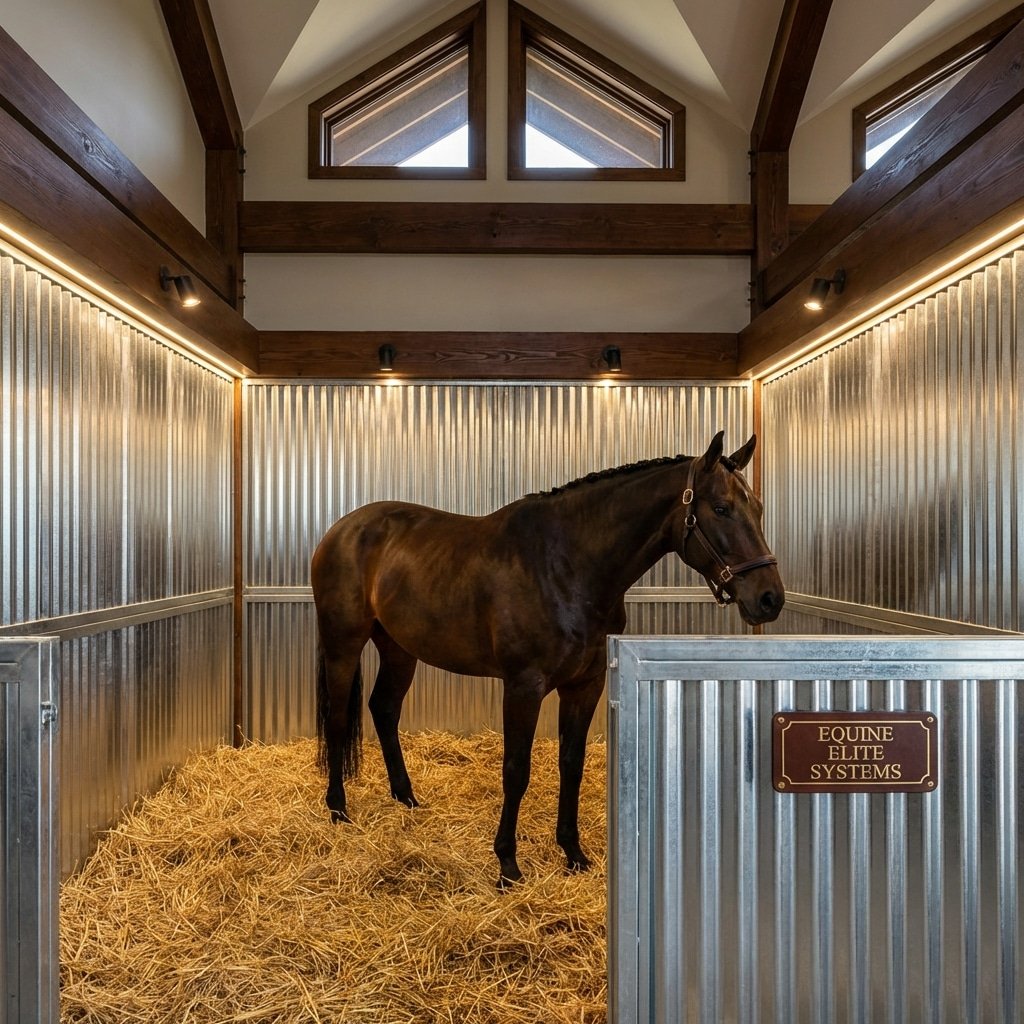
DB’s Economy Event Series and Flat-Pack Logistics
We engineered the Economy Series to balance strict budget requirements with industrial-grade durability, using hot-dip galvanized steel and HDPE to withstand high-traffic event environments. By pairing this robust construction with our proprietary flat-pack logistics, we triple shipping capacity compared to welded alternatives, effectively securing distributor margins through reduced freight costs.
The Economy Series: Optimized for Rental and Temporary Stabling
For high-volume projects like state fairs, quarantine units, and rental stables, we prioritize structural integrity without unnecessary complexity. The Economy Series utilizes Q235B structural steel with a strict 14-gauge (2.0mm – 2.5mm) wall thickness, ensuring the framework remains kick-proof and stable even under heavy rotation of animals. We pair this frame with UV-stabilized HDPE infill, a material chosen specifically for its zero-maintenance properties. Unlike wood, these planks require no painting, staining, or replacement due to rot, significantly lowering long-term operational costs for venue managers.
Animal health in temporary, high-density environments is critical. Our Open Top Grill design actively promotes “Stack Effect Ventilation,” allowing heat to escape vertically and maintaining fresh airflow throughout the stable rows. To protect this investment against urine, frequent washdowns, and outdoor elements, we apply hot-dip galvanization after fabrication in accordance with ISO 1461. With zinc coating averages exceeding 70 microns on tubing, our stalls resist red rust far longer than the pre-galvanized alternatives often found in this price bracket.
Strategic Logistics: Maximizing Container Yield with Flat-Pack Design
Logistics often dictate the profitability of large-scale commercial projects. Traditional fully welded stalls consume excessive shipping volume, limiting a 40HQ container to roughly 12-15 sets. This inefficiency inflates the landed cost per unit. We solved this with our precision-engineered flat-pack system, which increases container capacity to 30-45 sets. This optimization reduces freight costs by over 60%, providing our B2B partners with “Profit Protection” that keeps their bids competitive.
Efficiency extends to the unloading dock as well. We refuse to loose-load components; instead, we package every set onto steel pallets. This method allows for rapid forklift unloading and safe, organized storage at the destination. Despite the compact shipping format, assembly is fast and straightforward. Each kit arrives with all necessary connectors and 304 stainless steel hardware, ensuring that installation crews can deploy hundreds of stalls quickly without sourcing extra components.
Final Thoughts
Transitioning from annual rental expenses to owned inventory converts a recurring liability into a permanent balance sheet asset. While local workshops may promise speed, only ISO 1461 Hot-Dip Galvanization After Fabrication ensures your fleet survives decades of wet storage and rough handling without red rust. We engineer our flat-pack logistics to protect your margins, delivering industrial-grade durability that outlasts the depreciation cycle.
Stop estimating freight costs and start planning your rollout with precise logistical data. We invite you to request a specific loading plan for your facility or a sample connector kit to test our pin-system speed firsthand. Contact our project engineers today to secure your production slot for the upcoming season.
Frequently Asked Questions
Who manufactures temporary stalls for State Fairs?
As a B2B OEM manufacturer, DB Stable engineers temporary stabling specifically for large-scale events and state fairs. We produce hot-dip galvanized steel systems (HS Code 7308.90) designed to withstand high-traffic environments while maintaining strict animal safety standards and rapid assembly protocols.
How fast can you build 100 horse stalls?
Our standard production lead time is 35-45 days for 100+ sets. This duration is necessary to complete the critical Hot-Dip Galvanization After Fabrication process (BS EN ISO 1461), so the steel is completely rust-proof and kick-proof before it ships to your venue.
Best bulk horse stabling suppliers?
For bulk requirements, sourcing directly from a factory like DB Stable offers the best value. Unlike retailers, we focus on distributors and mega-projects, providing “Profit Protection” through optimized flat-pack logistics that fit 30-45 sets in a single 40HQ container, reducing freight costs significantly.
Cost to outfit an equestrian expo center?
Costs depend on the chosen series—from our HDPE Economy Series for temporary use to the Professional Series for long-term durability. While raw material prices fluctuate, our flat-pack design reduces freight costs by over 60%, significantly lowering the total landed cost per stall compared to fully welded alternatives.
Storage for portable horse stables?
Our systems feature a specialized steel pallet flat-pack design. When the fair or season ends, the panels disassemble and stack compactly on these pallets, allowing for safe storage and a minimal warehouse footprint until the next event.

 English
  Spanish
  French
  Arabic
  German
0 Comments