


Standard 48-inch stall doors are a liability for Pregnant Mares approaching their final trimester. As abdominal distension increases spatial requirements, narrow openings create a mechanical hazard that risks placental detachment and costly foal loss during routine turnout.
We engineer safety through custom 5-foot clear openings specifically designed for broodmare facilities. By utilizing Q345B High Strength Steel and flush-mount Hidden Track Systems, our Professional Series eliminates protruding catch points to ensure snag-free movement for high-value stock.

The Expanding Girth of the Late-Term Broodmare
Executive Summary: Late-term abdominal distension alters a mare’s spatial requirements, making standard doorways a “hip snag” hazard that demands flush, snag-free engineering.
Physiological Dynamics: Fetal Growth and Abdominal Expansion
The final trimester, specifically from Day 300 onward, introduces a radical shift in a mare’s physical dimensions. While veterinarians focus on monitoring uteroplacental thickness and fetal aortic diameter to predict foal health, facility managers must focus on the physical footprint of the mare. As gestation progresses toward the typical 338-343 day delivery window, abdominal distension pushes the flanks outward, significantly increasing the animal’s width.
This biological necessity creates a mechanical risk. Mares maintaining an ideal Body Condition Score (BCS) of 5-6/9 carry substantial mass, yet often retain the muscle memory of their non-pregnant size. They misjudge clearances. A standard doorway that was safe three months ago becomes a hazard where the mare can strike her hips or flanks against the frame. This impact does not just bruise muscle; it risks trauma to the fetus and creates localized pain that can complicate the birthing process.
Safety Solutions: The Professional Series Hidden Track System
We engineered the DB Stable Professional Series specifically to mitigate these spatial risks. The core innovation here is the Hidden Track System. Unlike traditional stable doors that rely on protruding floor guides or external latch mechanisms, this system conceals the operating hardware within the door profile. This eliminates the “snag points” that commonly injure a distended belly during entry or exit.
- Snag-Free Geometry: The absence of floor tracks ensures the mare can drag her hooves or stumble without catching a metal rail.
- Impact Absorption: We utilize Q345B Low Alloy High Strength Steel for the frame. This material offers superior toughness compared to standard Q235 steel, allowing the door to absorb accidental impact from a heavy mare without buckling.
- Flush Operations: Latch mechanisms are recessed, ensuring the mare’s flank slides past the door frame smoothly, even if she misjudges the opening width.
For commercial breeding facilities, this design reduces the liability of facility-induced injury. A mare with reduced spatial awareness requires infrastructure that forgives her clumsiness, not equipment that punishes it.
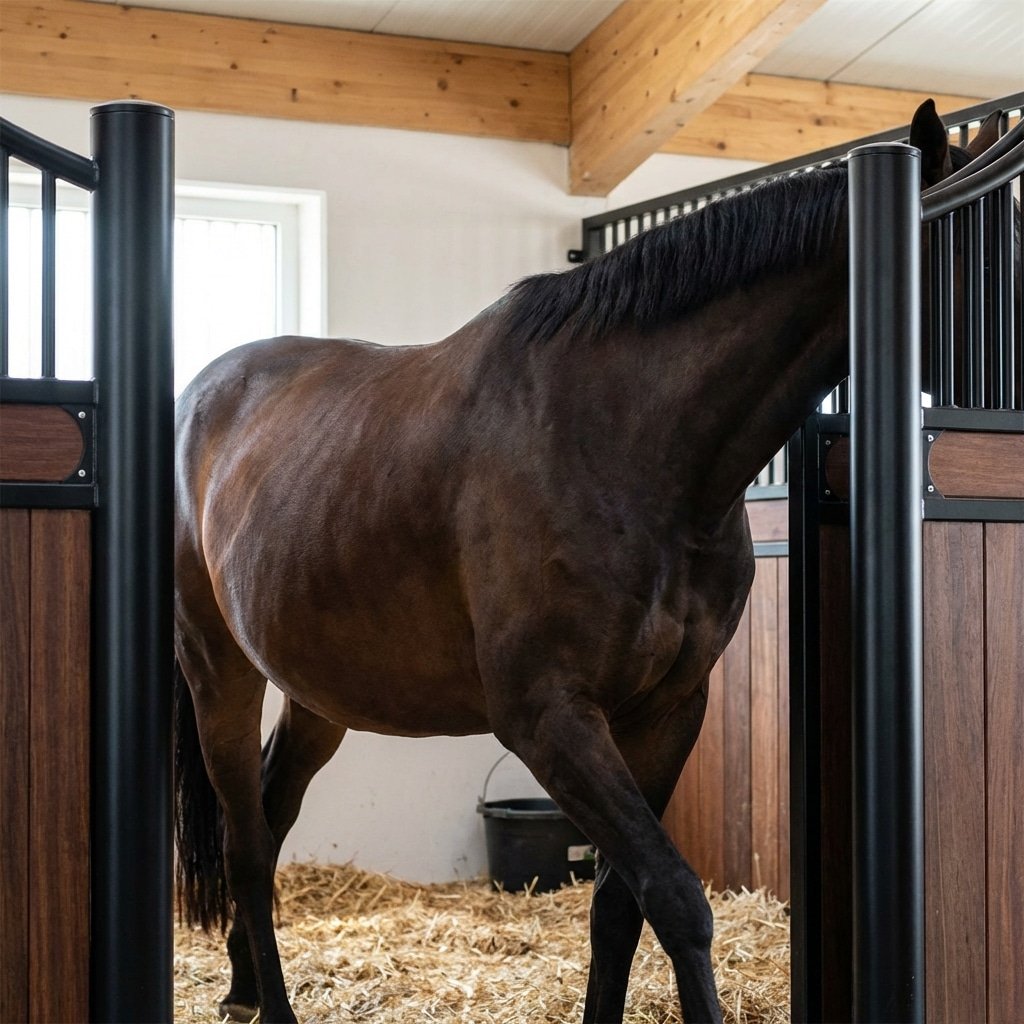
The “Hip Snag” Hazard and Potential Abortion Risks
Executive Insight: Impact trauma from door frames can cause placental detachment in late-term mares. We mitigate this risk through smooth, post-fabrication galvanization that prevents skin lacerations during accidental collisions.
Impact Trauma and Stress-Induced Complications
In high-value breeding operations, the “Hip Snag” is a mechanical hazard that often goes unnoticed until it causes a loss. Late-term mares undergo significant abdominal distension, often misjudging their own girth when navigating standard doorways. If a mare rushes through a stall opening—prompted by feeding time or herd anxiety—her flank can strike the door jamb with considerable force.
This is not just a superficial injury. The biological consequences of this blunt force trauma are severe for broodmares:
- Placental Separation: Direct impact to the distended abdomen can cause the placenta to detach prematurely from the uterine wall, cutting off oxygen to the foal.
- Cortisol Spikes: Sudden pain triggers an immediate release of stress hormones (cortisol). In sensitive pregnancies, these chemical spikes act as a catalyst for instability or early labor.
- Fetal Injury: While the amniotic fluid provides cushioning, violent impact against a steel post can still transmit shockwaves directly to the fetus.
Minimizing Lacerations with ISO 1461 Hot-Dip Galvanization
The severity of a “Hip Snag” incident depends heavily on the surface quality of the steel. Many competitors use pre-galvanized tubing (galvanized before welding). When they weld the door joints, the heat burns off the zinc, leaving a rough, sharp burr that must be painted over. If a mare slides her flank against this, the microscopic jagged edges act like a serrated knife, slicing the skin.
DB Stable eliminates this friction hazard through our strict Hot-Dip After Fabrication process, adhering to the BS EN ISO 1461 standard.
- Total Encapsulation: We weld the black steel frame first, then dip the entire unit into molten zinc. This coats every weld joint and edge.
- Self-Healing Thickness: Our tubing achieves a zinc coating thickness greater than 70 microns. This creates a thick, lubricating layer of zinc alloy.
- The Slide Effect: Because the finish is chemically bonded and smooth, a mare’s coat slides over the surface upon impact rather than snagging or tearing.
Precision-Engineered Stables Built for Any Climate
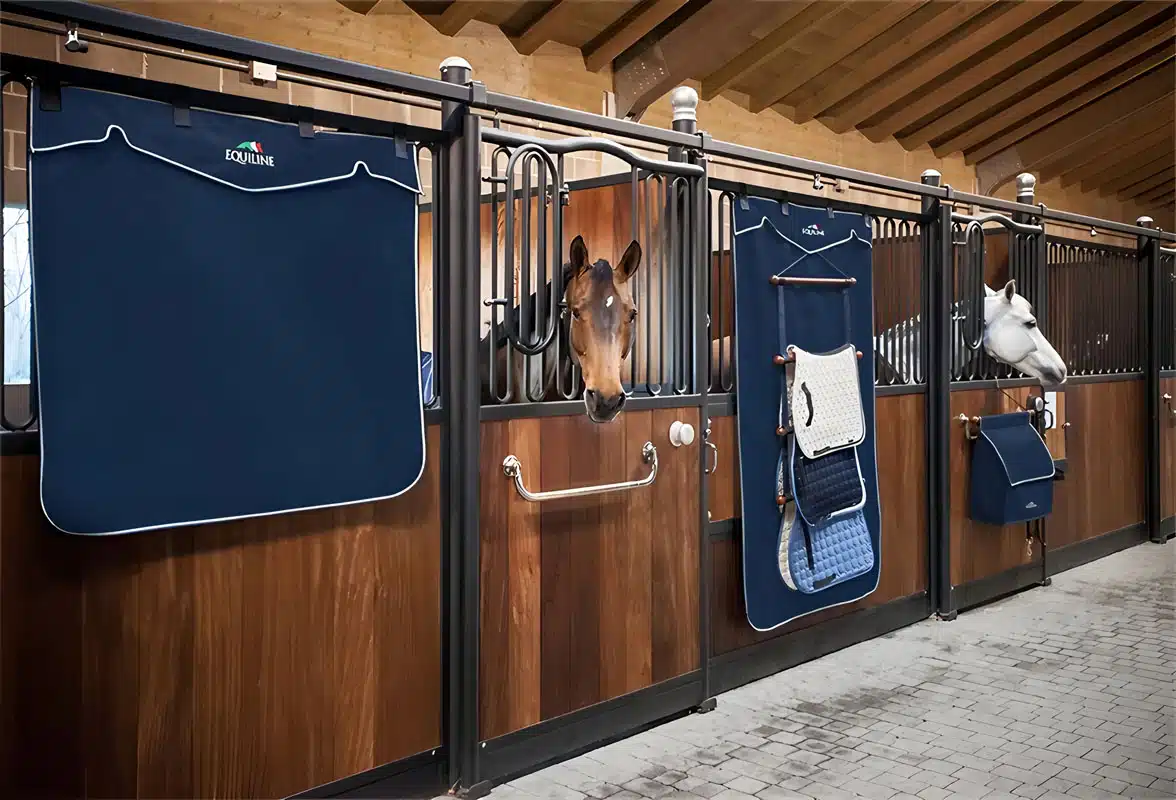

Custom OEM Horse Stall Fronts: Upgrading to 5-Foot Clearances
Standard 4-foot doors create dangerous pinch points for late-term mares. We engineer custom 5-foot openings using reinforced Q345B steel frameworks to eliminate hip trauma risks during foaling season.
Most standard horse stall doors on the market top out at a 4-foot (48-inch) opening. For general boarding, this is sufficient. But for a breeding facility, specifically regarding late-term broodmares, this standard dimension becomes a liability. As the mare’s girth expands, a narrow doorway turns into a pinch point, forcing the animal to navigate entry and exit with limited clearance. As an OEM manufacturer, we bypass these retail limitations by fabricating custom 5-foot (60-inch) clearances specifically for foaling units.
Accommodating Late-Term Girth with 60-Inch Widths
The physical reality of a mare in her final trimester demands more than the industry-standard 42 to 48-inch doorway. When a wide mare is forced through a standard opening, she often has to twist her body or scrape against the frame. This friction creates a “hip snag” hazard, where the animal may panic or sustain blunt force trauma to the hips and the foal bump.
- Straight-Line Entry: A 5-foot (60-inch) clear opening allows the mare to enter and exit in a straight line without contacting the door frame, eliminating the need to pivot or squeeze through.
- Trauma Prevention: This custom dimension specifically protects the foal bump from impact against the heavy-duty steel uprights found in our Professional and Royal Series fronts.
- Emergency Access: The wider span ensures veterinary staff and equipment can access the stall simultaneously without obstruction during critical foaling assistance.
Reinforcing the Sliding Mechanism for Oversized Doors
Widening a door to 5 feet significantly increases the static load on the overhead track system. A standard lightweight track will eventually sag under this weight, leading to friction and jammed doors. To support this non-standard width, we upgrade the structural integrity of the entire front assembly.
- Q345B Steel Framework: We utilize Q345B Low Alloy High Strength Steel (ASTM Grade 50 equivalent) for the frame. This material provides superior tensile strength compared to standard Q235B, preventing the extended span from warping.
- Professional Series Track: We deploy our “Professional Series” hidden track system, customized with additional anchor points to distribute the heavier load evenly across the header.
- Heavy-Duty Rollers: The system is fitted with upgraded bearing rollers designed to handle the increased weight of a 60-inch bamboo or HDPE-filled panel, ensuring one-handed operation remains smooth.
| Specification | Standard Market Stall | DB Stable OEM Custom |
|---|---|---|
| Clear Opening Width | 42″ – 48″ (Standard) | 60″ (5 Feet) |
| Steel Grade | Standard Mild Steel | Q345B High Strength Steel |
| Track Support | Standard 2-point anchors | Reinforced Multi-Point Anchors |
| Primary Use Case | General Boarding | Broodmare & Foaling Safety |

Flush Mount Hardware: Eliminating the Protruding Latch
Flush mount hardware embeds latching mechanisms into the door frame, eliminating protruding metal that causes hip injuries in wide pregnant mares while ensuring corrosion-free operation.
The Safety Mechanics of Recessed Handles
Standard external latches are liability magnets in a foaling unit. A pregnant mare’s widened girth significantly increases the risk of impact injuries, and a protruding metal handle creates a “hip snag” hazard during entry and exit. Flush mount systems solve this by embedding the operating mechanism directly into the door housing, leaving a smooth surface that protects the animal.
- Injury Prevention: Removes external protrusions that tear hide or bruise hips on wide-bodied mares.
- Retractable Mechanics: Uses spring-loaded pivoting arms that retract fully into the door frame when released.
- Handler Safety: Eliminates catch points for clothing, halters, or equipment in confined foaling spaces.
- Full Clearance: Creates a streamlined profile allowing the door to slide completely past the post without hardware interference.
304 Stainless Steel Construction Standards
Smart mechanical design fails if the lock seizes from rust. Stables are high-ammonia environments that destroy standard zinc-plated steel within months. At DB Stable, we strictly specify 304 Stainless Steel for all moving hardware parts to ensure the mechanism operates smoothly without constant maintenance or seizing.
- Ammonia Resistance: 304 Grade stainless withstands the corrosive stable atmosphere that rusts inferior metals.
- Mechanical Reliability: Prevents rust-lock, ensuring latches open instantly during emergencies without needing frequent lubrication.
- Biosecurity: Smooth, non-porous surfaces are easy to sanitize and do not harbor bacteria, essential for foaling hygiene.
- Longevity: Matches the lifespan of our hot-dip galvanized frames, preventing the need for mid-cycle hardware replacement.
Frequently Asked Questions
What is the ideal stall door size for pregnant mares?
For pregnant mares, the door width must be at least 48 inches (1.2 meters). This width prevents hip strikes during entry and exit. Height typically ranges from 84 to 96 inches, which keeps the mare secure while allowing her to observe the aisle.
Regarding the stall footprint, we recommend a 12′ x 24′ space for foaling. In our systems, you achieve this by removing the partition between two standard stalls. This provides the necessary room for labor and gives veterinarians space to work safely.
Do I really need extra-wide doors for foaling stalls?
Not necessarily. A standard 4-foot wide door works if it opens completely for emergency access. The real safety issue is gaps, not width. Foaling doors require what we call a “Cast-Proof Design”—clearance at the bottom must be less than 50mm (approx. 2 inches).
If that bottom gap is too large, a foal can trap a hoof or leg while rolling. Standard width is fine, but tight tolerances are non-negotiable.
How can I prevent hip injuries when horses enter or exit stalls?
Hip injuries happen when horses rush through doorways or catch themselves on protruding latches. You must keep aisleways clear of wheelbarrows and tack to prevent rushing. Structurally, we use flush-mount hardware to eliminate snag points.
We also enforce the use of heavy-duty steel profiles, specifically Q235B or Q345B, for the door frames. These materials absorb impact better than standard steel if a horse does strike the frame. Operational discipline matters too—handlers should guide the horse through the center of the doorway rather than allowing sharp turns.
What are the specific requirements for a safe foaling barn door?
The priority is closing the gaps. The door must align perfectly with the frame so there is no space for a foal to get hung up. We use heavy-duty galvanized tubing with tight bar spacing (approximately 1.5 inches between bars) on lower grills. This prevents limb entrapment.
Also, the latching mechanism needs to be secure against the horse but easily operable for a human. In a foaling emergency, you cannot waste time struggling with a stuck or complex latch.
Final Thoughts
Standard 4-foot stalls create unnecessary liability during the critical foaling window. Investing in our custom 5-foot Q345B wide-entry systems eliminates the “hip snag” hazard that threatens high-value pregnancies. This engineering choice protects your broodmares from trauma and safeguards your operation against preventable facility-induced losses.
Do not settle for generic retail dimensions when foal safety is at stake. Contact our engineering team today to review your facility’s layout and configure a “Cast-Proof” specification for your foaling unit. We are ready to fabricate custom 60-inch clearances that align perfectly with your operational needs.


 English
  Spanish
  French
  Arabic
  German
0 Comments