


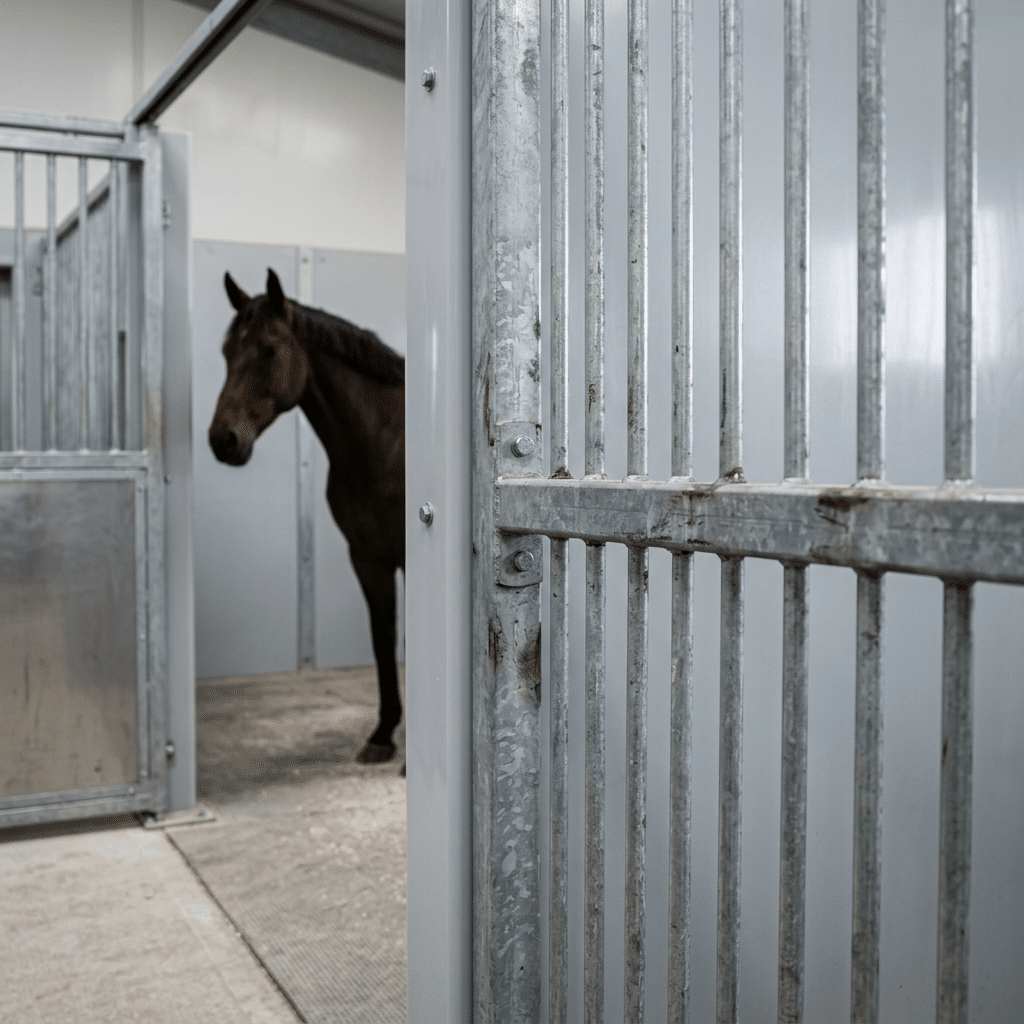
Therapeutic Riding centers face unique liability challenges where standard agricultural building codes fail to meet public access standards. Installing generic stable fronts instead of ADA-compliant designs invites costly retrofitting and potential lawsuits from non-compliance.
This guide benchmarks manufacturers against critical safety metrics including Q345B structural steel frameworks and zero-threshold enclosed track systems. We evaluate sliding door clearance and cast-proof engineering to help you secure a safe, scalable infrastructure.
Designing Stables for Wheelchair Accessibility (ADA)
Quick Comparison
| Guideline Name | Category | Key Elements | Verdict |
|---|---|---|---|
| Legal Distinction for Stables | Regulatory Compliance | Legal Guidance, Facility Classification | Clarifies that most boarding stables are private entities exempt from ADA public codes. |
| Accessible Route Dimensions | Architectural Standards | Aisles, Hallways, Paths | Mandates a continuous 36-inch width and shallow 1:20 slopes for safe wheelchair passage. |
| Clear Floor and Ground Space | Spatial Design | Maneuvering Zones, Stall Layouts | Requires a strict 30×48 inch minimum area for stationary positioning and turning. |
Legal Distinction for Stables
Boarding stables generally retain **exemptions from strict public ADA codes**, provided they operate as private agricultural facilities rather than commercial venues.
Boarding stables are typically not classified as public places subject to ADA codes, unlike commercial venues. This regulatory distinction allows private facility owners to operate under agricultural property rules rather than commercial public access standards.
However, public-facing therapeutic programs may fall into a regulatory gray area. Operators must carefully define the boundary between private membership exclusivity and public service provision to determine their specific compliance obligations.
📊 At a Glance:
- 📍 Classification: Regulatory Compliance
- 🏭 Core Focus: Legal Guidance, Facility Classification
- 🌍 Scope: Commercial vs. Private Facilities
Why We Picked It:
| ✅ The Wins | ⚠️ Trade-offs |
|---|---|
|
|
Accessible Route Dimensions
**Strict width and slope limits** are essential for safe wheelchair passage through stable aisles and pathways.
Establishing accessible routes is the foundation of ADA compliance in equestrian facilities. Without proper clearance, even the most accessible stalls become unreachable for wheelchair users.
Regulations mandate a continuous clear width of 36 inches, though it can narrow to 32 inches for short distances. Slopes must not exceed a 1:20 ratio to prevent exhaustion or tipping hazards.
📊 At a Glance:
- 📍 Context: Architectural Standards
- 🏭 Scope: Aisles, Hallways, Paths
- 🌍 Goal: Standard Compliance
Assessment:
| ✅ The Wins | ⚠️ Trade-offs |
|---|---|
|
|
Clear Floor and Ground Space
Defining this space is critical for accessibility, ensuring riders have the **minimum footprint** required to park and adjust equipment safely without obstruction.
Design standards mandate a minimum area of 30 by 48 inches for stationary positioning. This specific dimension serves as the baseline requirement to allow a wheelchair user to stop, stabilize, and perform tasks comfortably.
Beyond the stationary footprint, additional clearance is vital for maneuvering in confined spaces. Proper implementation of these zones prevents entrapment and allows for independent movement throughout the stable environment.
📊 At a Glance:
- 📍 Context: Spatial Design
- 🏭 Core Focus: Maneuvering Zones, Stall Layouts
- 🌍 Discipline: Interior Design
Why We Picked It:
| ✅ The Wins | ⚠️ Trade-offs |
|---|---|
|
|
Precision-Engineered Stables With 20-Year Durability

Designing Stables for Wheelchair Accessibility (ADA)
Private boarding facilities often operate under agricultural exemptions, but therapeutic riding centers constitute public accommodations subject to strict ADA codes. We provide OEM customization to align with specific local regulatory standards, utilizing high-strength steel to create accessible, column-free maneuvering zones.
Compliance Scope: Distinguishing Public Centers from Private Stables
Private boarding stables often fall under agricultural exemptions, whereas therapeutic riding centers generally constitute public accommodations subject to strict ADA codes. This legal distinction shifts the requirements for facility design, mandating specific accessible routes, designated parking, and barrier-free entryways for any operation classified as a commercial public-facing business.
Facility owners must determine their commercial status early in the planning phase. For projects identified as public accommodations, we provide OEM customization to align with local regulatory standards. Our engineering team adapts stable fronts and partition layouts to meet these compliance requirements without compromising the structural integrity of the steel framework.
Critical Dimensions for Safe Wheelchair Navigation
While ADA mandates a minimum 36-inch clear width for accessible routes, safe barn aisles require significantly wider spans. A functional stable aisle must accommodate both a horse and a wheelchair user simultaneously to prevent accidents. Standard residential dimensions are often insufficient for the dynamic environment of an equestrian facility, where safe passing distances are critical for handler and rider safety.
Design layouts must include 60-inch diameter turning spaces at key junctions, particularly near tack rooms and mounting areas, to allow for 180-degree turns. We utilize high-strength Q345B structural steel (equivalent to ASTM Grade 50) to engineer wider open-plan designs. This superior material strength allows us to eliminate the need for obstructive support columns in maneuvering zones, creating a safer, barrier-free environment for therapeutic programs.
The Aisle Experience: Wide Sliding Doors vs. Swing Doors
Selecting the right door style is a critical decision that impacts daily workflow and safety. While swing doors offer traditional aesthetics and full-width access for equipment, they demand significant aisle clearance. Sliding doors, particularly those with enclosed track systems, eliminate aisle obstruction and prevent accidental swing-outs, making them the preferred choice for high-traffic or space-constrained facilities.
The Swing Door Dynamic: Clearance and Control Risks
Safety remains a primary consideration with hinged designs. Unlatched doors create potential hazards if caught by strong drafts, potentially swinging into the path of participants or startling stabled horses. To address the mechanical stress inherent in this design, we engineer our hinged options with heavy-duty adjustable hinges mounted on Q235B or Q345B structural steel frames. This robust construction prevents the sagging often seen in lighter-gauge alternatives, though strict protocols are still necessary to ensure aisle safety during operation.
The Sliding Door Advantage: Operational Safety and Accessibility
Sliding doors eliminate the need for swing radius clearance, maximizing usable aisle width. This is a crucial advantage for therapeutic centers or busy commercial stables where side-walkers and mobility devices require unobstructed passage. By keeping the door within the plane of the stable front, the aisle remains a safe, open zone regardless of whether stalls are open or closed.
The linear motion of a sliding system offers superior predictability. Unlike hinged doors, they cannot be blown open by wind or accidentally pushed into a handler’s space, significantly reducing the risk of injury. Our Professional Series features an enclosed overhead track system designed to protect the rollers from dust and bedding debris. This engineering ensures effortless, one-handed operation, which is essential for users with limited upper-body strength or handlers managing spirited horses.
Zero-Threshold Floors: Eliminating Trip Hazards
To meet ADA standards and ensure equine safety, zero-threshold flooring removes raised obstacles in high-traffic zones. By utilizing overhead suspension systems for stall doors and recessing flooring mats, facility managers create a barrier-free environment that accommodates wheelchairs while reducing trip hazards for horses and handlers alike.
Seamless Doorway Transitions for ADA Compliance
Traditional stable doors often rely on bottom guide channels that protrude from the floor, creating immediate obstacles for wheelchair users and potential injury points for horses. We engineer our Professional Series sliding doors with a heavy-duty, top-hung track system that bears the full weight of the door from above. This design allows for a completely clear floor opening, eliminating the need for a raised bottom threshold.
Instead of a continuous floor track, we utilize unobtrusive wall-mounted stay rollers or recessed guides to maintain alignment. This ensures the doorway remains perfectly flat and accessible for participants with limited mobility. By removing the bottom track, we not only facilitate easier wheelchair access but also prevent dirt and bedding accumulation in the door mechanism, ensuring long-term smooth operation without the maintenance burden of cleaning out floor channels.
Integrating Safe Flooring Materials in Aisleways
A level threshold must extend effectively into the aisleway to maintain safety. We recommend pairing our hot-dip galvanized stall fronts with smooth, non-slip surfaces like textured concrete or interlocking rubber pavers. For facilities utilizing rubber mats, it is critical to recess these into the concrete slab during construction so they sit flush with the surrounding floor. This prevents mat edges from curling and becoming trip hazards for individuals using walkers or crutches.
When combined with our structural Q345B steel frames, which anchor securely without requiring bulky floor plates in the doorway, this approach creates a seamless facility. This integration protects the operational efficiency of commercial stables by reducing liability claims related to falls and ensuring compliance with accessibility standards, all while maintaining the rugged durability required for equine housing.
DB’s Smooth-Glide Enclosed Track System
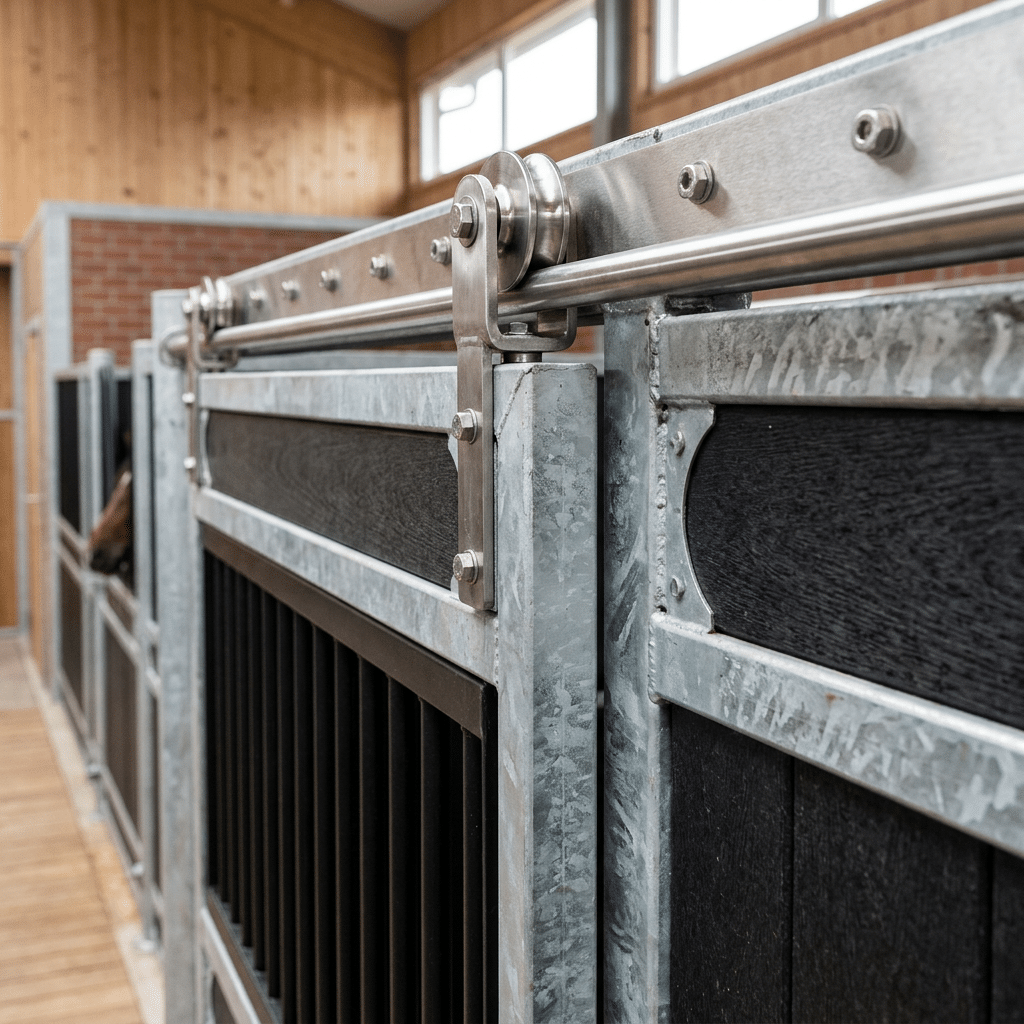
Our Smooth-Glide Enclosed Track System addresses the mechanical failures common in standard barn door hardware. By encasing the roller mechanism within a heavy-duty Q345B steel profile, we prevent the accumulation of bedding dust and moisture that typically causes jamming. This design guarantees consistent single-handed operation, ensuring safety for handlers and accessibility for therapeutic programs.
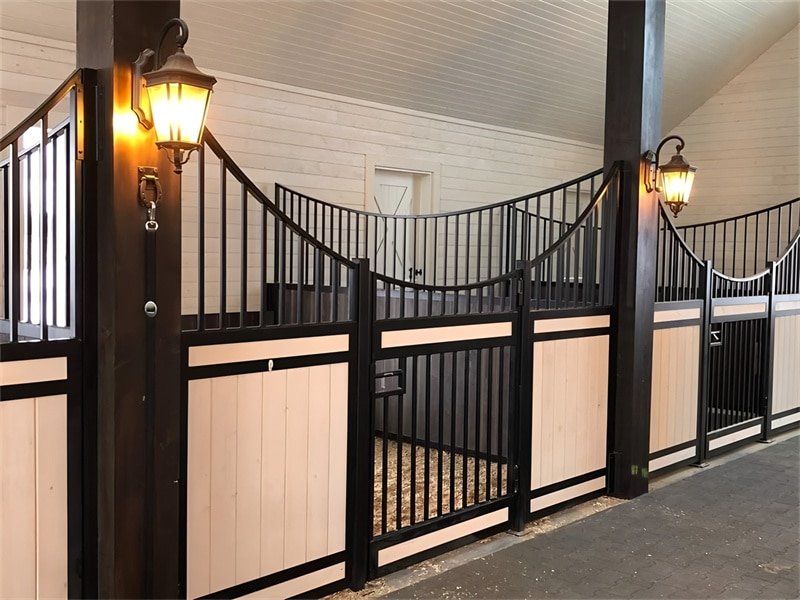
Heavy-Duty Engineering and Dust Protection
We manufacture our enclosed track systems using high-grade Q345B structural steel, specifically chosen for its superior load-bearing capacity. This prevents the upper rail from bending or warping, even when supporting the weight of heavy bamboo-infilled doors over decades of daily use. The material strength is matched by our finishing process; every track undergoes Hot-Dip Galvanization after fabrication to ASTM standards, ensuring resistance against rust eve
n in humid stable environments.
The fully enclosed design is a strategic response to the realities of barn hygiene. Unlike open-trolley systems that collect debris, our track shields critical internal components from airborne bedding dust, hay particles, and moisture. This engineering prevents the friction and jamming issues that frequently plague open-rail systems. Additionally, we utilize 304 Stainless Steel for all roller assemblies and hardware, guaranteeing smooth operation that withstands ammonia exposure without corroding.
Enhanced Accessibility with Zero-Threshold Design
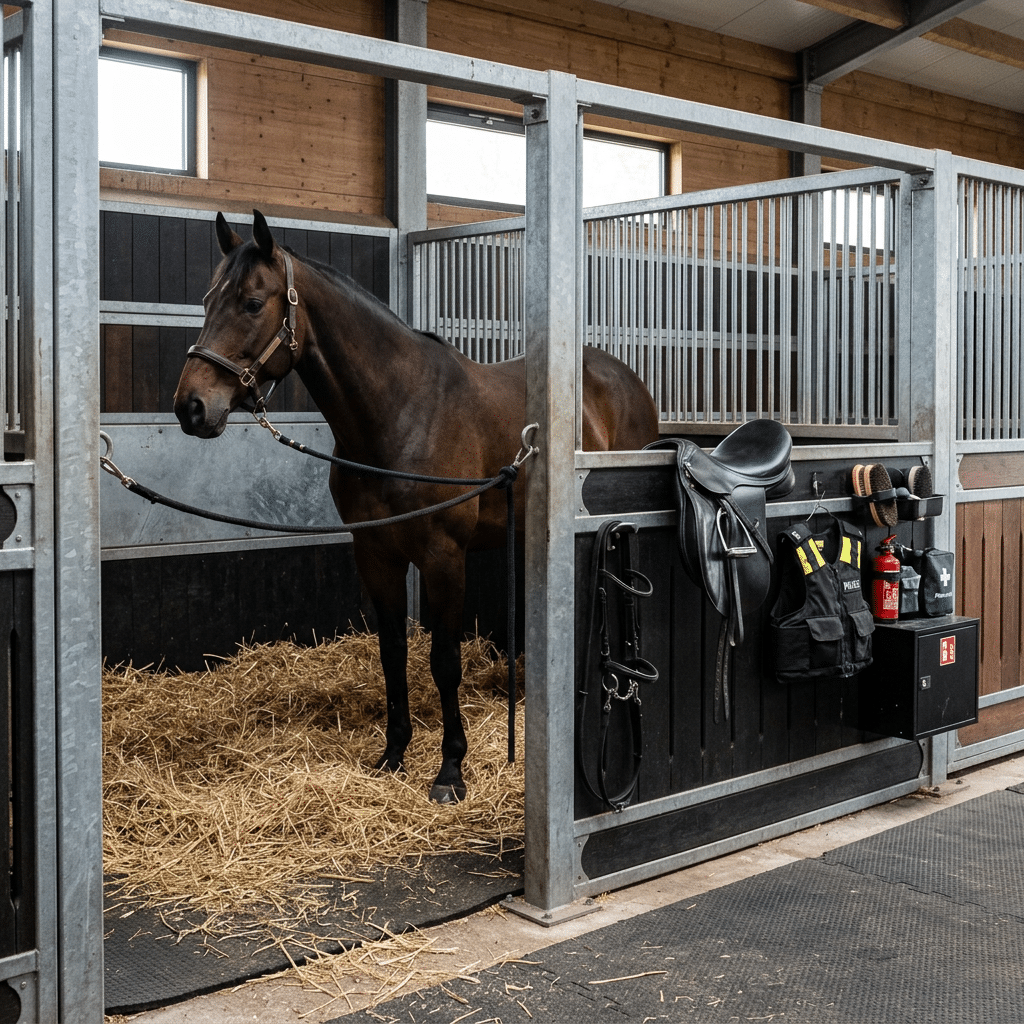
Our top-hung roller system eliminates the need for a bottom floor track, creating a completely trip-free opening. This zero-threshold design is ideal for busy aisles and therapeutic riding centers where wheelchair accessibility and safe footing are operational requirements. By removing floor obstructions, we also eliminate the trap for dirt and manure that often causes bottom-track doors to seize.
We calibrate the smooth-glide rollers to require minimal physical force, allowing staff members to operate heavy stall doors with just one hand. This ease of use is vital for safety, enabling a handler to maintain control of a horse while opening or closing the stall. To secure the door panel, we use integrated wall guides that stabilize the bottom of the door without obstructing the walkway. This maintains a safe, Cast-Proof gap of approximately 50mm, preventing horses from getting a leg stuck while rolling.
Final Thoughts
Investing in ADA-compliant infrastructure is a strategic risk management decision, not merely a regulatory checklist. While light-gauge alternatives reduce upfront capital, our Q345B structural steel frames provide the necessary impact resistance to prevent costly liability claims from mechanical failure. Choosing our ISO 1461 Hot-Dip Galvanized finish ensures your facility remains sanitary and rust-free, safeguarding your long-term operational reputation against the harsh reality of therapeutic stable environments.
Do not leave accessibility to chance; validate your design with our engineering team before breaking ground. We recommend submitting your architectural floor plans for a complimentary ADA-optimization review to ensure seamless wheelchair navigation and maximum material efficiency. Contact us today to discuss OEM customization options that align strictly with your specific therapeutic program requirements.
Frequently Asked Questions
How to design an ADA compliant horse barn?
To ensure ADA compliance, we recommend wide, level aisles with zero-threshold entries to eliminate trip hazards for wheelchairs. Our engineering team designs custom stable layouts that integrate accessible mounting ramps and wider tack room doorways, ensuring full maneuverability for riders with physical disabilities.
Minimum door width for wheelchair access in barns?
While standard ADA guidelines suggest a minimum of 36 inches, we recommend at least 48 inches (approx. 1.2 meters) for barn environments. This wider clearance accommodates wheelchairs alongside handlers or side-walkers. Our custom manufacturing capabilities allow us to produce extra-wide sliding doors specifically for these requirements.
Best stable doors for therapeutic riding centers?
Sliding doors are the safest choice as they do not swing out into the aisle, keeping pathways clear for volunteers and adaptive equipment. We specifically recommend our Professional Series, which features high-impact HDPE infill and a secure locking mechanism to prevent accidental opening by horses.
Are sliding stall doors easier to open?
Yes, provided they use high-quality hardware. Our systems utilize a heavy-duty enclosed track design that protects the rollers from dust and bedding debris. This ensures a consistent ‘Smooth-Glide’ operation, allowing volunteers or riders with limited upper body strength to operate the doors safely.
PATH Intl barn safety standards?
PATH Intl standards prioritize safety and accessibility. We align with these by manufacturing ‘Kick-Proof’ Q345B steel frames and adhering to a strict ‘Cast-Proof’ design with a 50mm bottom gap. Additionally, our hot-dip galvanization after fabrication ensures there are no sharp welds or edges that could injure riders or horses.

 English
  Spanish
  French
  Arabic
  German
0 Comments