


Anti-cast strips function as a critical insurance policy against the lethal mechanics of wall entrapment in high-value equine facilities. When a thoroughbred becomes cast, the absence of traction hardware turns a minor stumble into a career-ending fracture. For professional breeders and clinics, overlooking this safety component escalates liability risks and invites expensive veterinary interventions that erode project profitability.
This analysis examines how traction aids function within the strict Cast-Proof Design protocol required for modern safety standards. We benchmark installation against the 50mm bottom clearance rule and Q345B structural steel requirements that prevent leverage-based fractures. Understanding these engineering tolerances ensures facilities meet the ISO 1461 durability standard while protecting valuable stock from preventable entrapment.
The Physics of a Cast Horse (No Leverage to Stand)
Biomechanically, a horse cannot rise without extending its forelegs to shift its center of gravity. Walls neutralize this leverage, creating a physical trap that design tolerances must mitigate.
Biomechanics of the Rising Arc: Why Leverage Fails
A horse does not stand up like a dog or a cat; it operates on a rigid kinetic chain that requires significant horizontal
space. To lift its massive torso, a horse must swing its head down and fully extend its forelegs to create a fulcrum. This action shifts the center of gravity forward, allowing the hindquarters to engage and lift the body.
When a horse rolls too close to a partition or wall, this physics equation breaks down instantly. The wall acts as an immovable barrier that eliminates the necessary radius for leg extension. Without the ability to extend the forelegs, the horse generates zero torque. The result is a mechanical failure where the animal is physically capable of standing but geometrically prevented from doing so. This immobility triggers a “flight” response, causing the horse to thrash violently against the wall in a panic to generate momentum that the environment will not allow.
DB Stable’s Cast-Proof Design: The 50mm Clearance Standard
We address this specific mechanical risk through the “Cast-Proof Design” protocol outlined in our manufacturing standards. The most critical factor here is the bottom clearance—the gap between the stall floor and the bottom of the steel frame. Many general fabricators leave gaps of 100mm (4 inches) or more to account for uneven concrete, but this “lazy engineering” creates a severe hazard.
- Strict 50mm Tolerance: We enforce a maximum 50mm bottom gap on all Professional and Royal Series partitions. This clearance is too small for a hoof to slip underneath.
- Prevention of Entrapment: A larger gap allows a rolling horse to push a leg under the partition. If the horse attempts to stand while the leg is trapped on the other side, the leverage forces can snap the bone.
- Design vs. Accessory: While rubber “anti-cast strips” are useful add-ons, the primary defense against entrapment is the structural geometry of the steel frame itself.
What is an Anti-Cast Strip?
An anti-cast strip is a textured safety rail installed on stable walls, providing traction for recumbent horses to push themselves upright without human assistance.
An anti-cast strip is a specific safety hardware component designed to mitigate one of the most dangerous situations in stabling: a horse becoming “cast.” This occurs when a horse lies down too close to a wall and cannot extend its legs to stand up. Without leverage, the animal may panic, thrash, and sustain career-ending injuries. The strip acts as a mechanical aid, usually manufactured from high-density rubber or EVA, featuring aggressive raised ridges or cones.
Mechanism of Action: Creating Leverage for Recovery
The physics of a cast horse is simple but deadly: a smooth stable wall offers zero friction. When a horse tries to stand, its hooves slip against the flat surface, leaving it trapped. The anti-cast strip solves this by introducing a high-friction surface profile.
- Traction Profile: The device utilizes raised conical or ribbed patterns to lock the hoof in place, allowing the horse to generate the necessary force to roll away from the wall.
- Strategic Positioning: Installation height is critical. Strips are mounted 90-130cm (32-36 inches) off the ground, directly aligning with the legs of a recumbent horse.
- Injury Prevention: By enabling immediate self-recovery, the strip prevents the severe trauma to the hips and pelvis often caused by prolonged struggling or the need for manual extraction by staff.
Structural Synergy: The DB Stable “Cast-Proof Design”
An anti-cast strip is an effective add-on, but it must function within a properly engineered system. At DB Stable, we integrate “Cast-Proof Design” logic directly into the steel framework specifications to ensure the wall can withstand the recovery process.
- Minimal Bottom Gap: Our partitions feature a strict 50mm bottom gap. This minimizes the risk of a hoof slipping under the partition during a roll, which is a common cause of spiral fractures.
- High Strength Steel: When a 500kg horse pushes off a wall strip to stand, the force exerted on the partition is immense. We utilize Q345B (High Strength Low Alloy) or Q235B steel to prevent the framework from buckling under this dynamic load.
- Impact Resilience: The frame rigidity ensures that the anti-cast strip remains a stable anchor point rather than flexing with the wall, maintaining the leverage required for the horse to stand.
Premium Galvanized Stables With 20-Year Durability
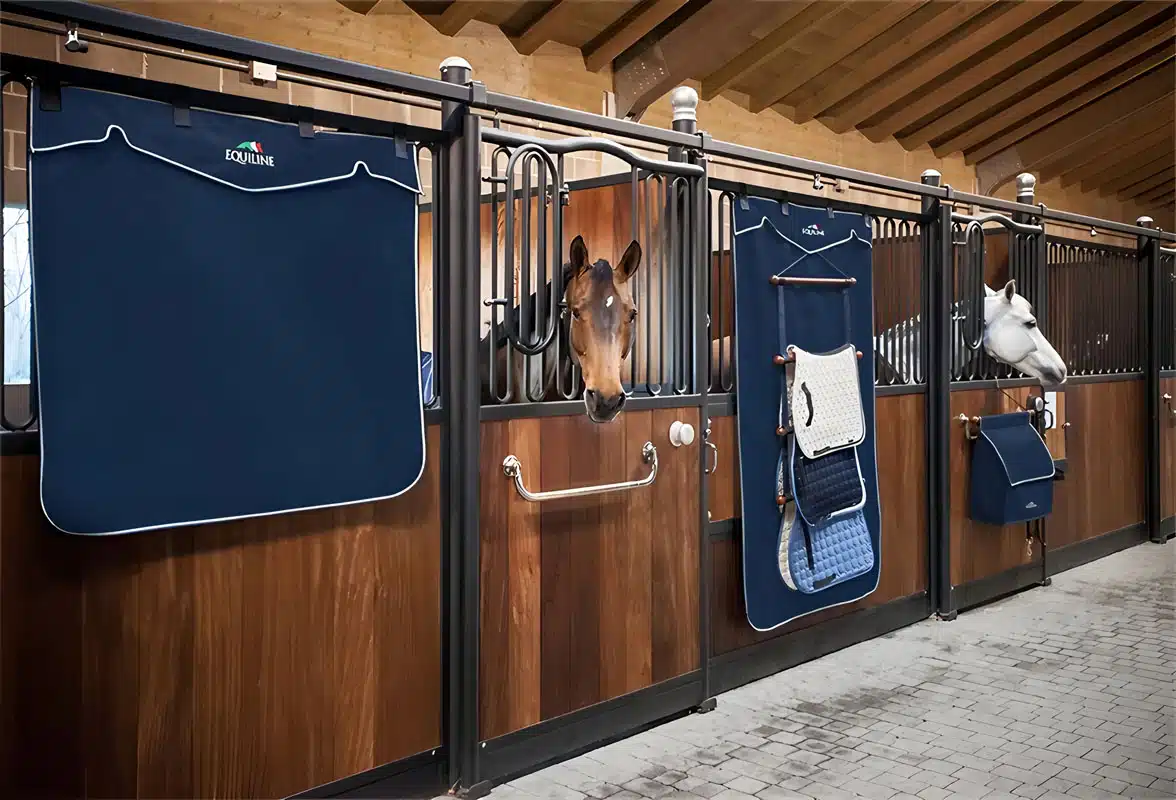
Optimal Height for Installing Rails on Stall Walls
Quick Specs: 8ft (2.4m) for full partitions to stop rearing; 4ft (1.2m) for social walls. We engineer a strict 50mm bottom gap to prevent cast horses.
| Installation Zone | Standard Height | DB Safety Spec | Primary Function |
|---|---|---|---|
| Full Partition | 8 ft (2.4 m) | 2.4 m Total Height | Prevents rearing and leg-over accidents. |
| Socialization Wall | 4 ft (1.2 m) | 1.2 m Solid Base | Balances containment with airflow. |
| Bottom Clearance | Variable | 50 mm (Fixed) | Prevents trapped hooves (Cast-Proof). |
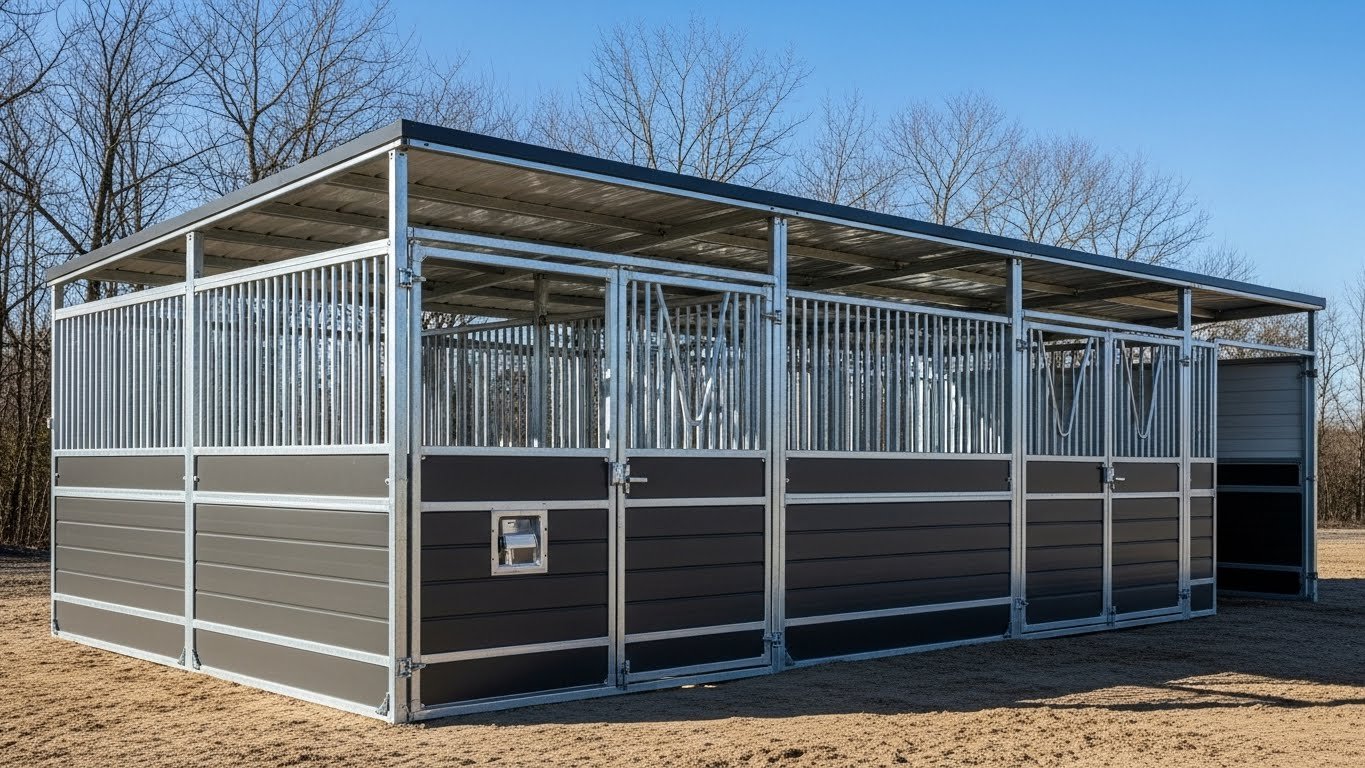
Structural Rail Heights: The 4ft and 8ft Rule
Installers often debate partition height, but safety data dictates specific non-negotiable measurements. We adhere to an 8-foot (2.4m) standard for full partitions. Horses, especially stallions or anxious mares, can rear significantly higher than expected. While some older barns use 7.5 feet as a minimum, 8 feet is the safe baseline to prevent a horse from getting a foreleg over the wall—a catastrophic scenario that often results in career-ending injuries.
For socialization walls, the dynamics change. The goal here is interaction without physical contact. The solid section (using Q235B steel or infill) must stop at exactly 4 feet (1.2m). This height allows the horse to eat and rest without being visible to neighbors if they choose, while the grille above permits visual checks and ventilation.
Mounting specifications for heavy-duty frames:
- Upper Brackets: Position between 5′ 8.5″ and 6′ 3.5″ to secure the frame against impact leverage.
- Lower Connections: Anchor at 1′ 8.5″ and 2′ 3.5″ for base stability.
The “Cast-Proof” Bottom Rail Clearance
Most generic stable designs overlook the gap between the bottom rail and the floor. This is a critical error. If this gap is too wide (over 3 inches), a horse lying down can slide a hoof underneath. When they panic and try to stand, that trapped hoof creates a pivot point, potentially snapping the leg or flipping the horse.
We engineer our “Cast-Proof Design” with a strict 50mm clearance. This gap is small enough to deny leverage to a hoof but large enough to allow drainage.
- No Leverage: The 50mm gap prevents a cast horse from getting a hoof under the wall to push off, reducing the risk of flipping.
- Moisture Control: Elevating the frame slightly prevents the 14-gauge RHS steel from sitting in urine or wash-water, preventing base corrosion.
- Material Spec: We use Hot-Dip Galvanized steel (BS EN ISO 1461) for these lower rails to withstand the aggressive ammonia environment at floor level.
Smooth Edges: Why DB Uses Rounded Steel Channels
Sharp metal slices soft rubber. We use rounded steel channels and post-fabrication galvanization to eliminate cutting edges, protecting both the horse and the anti-cast equipment.
Minimizing Abrasion on Anti-Cast Materials
Standard steel channels often feature sharp, 90-degree edges. In a static environment, this is acceptable. In a stable, where a 1,200lb horse may kick or roll against the wall, these sharp angles create stress concentration points. They act like a blade against the soft EVA or rubber of an anti-cast strip, slicing through the material upon impact.
We engineered our holder profiles with a rounded geometry to solve this failure point. By eliminating the sharp edge, we distribute the kinetic energy of a kick or roll over a wider surface area. This design significantly reduces friction and prevents the steel from “biting” into the protective strip. The result is a dramatic increase in the service life of the anti-cast material, as it is no longer being cut from the inside out.
Eliminating Burrs via Geometry is only half the equation; surface finish dictates the rest. The process of cutting and welding steel naturally leaves microscopic burrs—tiny, jagged metal spikes that can snag a horse’s skin or tear protective equipment. Most manufacturers ignore these because removing them manually is labor-intensive. - Process Standard: We utilize Hot-Dip Galvanization After Fabrication (BS EN ISO 1461), never pre-galvanized cuts.
- Zinc Thickness: Our dipping process deposits a zinc coating averaging over 70 microns on tubing profiles.
- Self-Smoothing: This thick layer of molten zinc naturally encapsulates and fills in microscopic steel burrs, resulting in a smooth, snag-free finish that protects both the animal and the installation.
Frequently Asked Questions
How exactly do anti-cast strips help a horse stand up?
When a horse gets ‘cast’ (stuck on its back or side against a wall), it lacks the leverage to roll over because smooth stable walls offer zero traction. Anti-cast strips provide a textured, protruding surface—usually made of rubber or EVA with deep ridges. This gives the horse’s hooves a solid anchor point to push against, generating the necessary mechanical force to roll back onto its belly and stand up without human intervention.
At what height should anti-cast strips be installed?
Installation height determines effectiveness. The industry standard sits between 32 and 36 inches (approximately 1 meter) from the floor. This specific zone aligns with where an average-sized horse’s hooves naturally seek purchase when they are recumbent and struggling to roll. Installing them higher renders them useless for leverage, while installing them lower risks injury during normal stall activity.
Can I install these strips on DB Stable’s HDPE or Bamboo infills?
Yes. Our 28mm-32mm HDPE and High-Density Bamboo infills provide sufficient structural integrity to anchor these strips. Our bamboo specifically boasts a Janka Hardness rating over 3000 lbf (3x harder than oak), ensuring screws hold tight under the pressure of a struggling horse. We strongly advise using stainless steel fasteners to match the corrosion resistance of our hot-dip galvanized frames.
Does the stable design itself affect casting risks?
Absolutely. Beyond add-on strips, the engineering of the frame matters. DB Stable utilizes a specific “Cast-Proof Design” principle that keeps the gap between the bottom of the stall door/panel and the floor to a minimum (approximately 50mm). This prevents a rolling horse from getting a hoof trapped underneath the steel frame—a frequent cause of panic and severe leg fractures in poorly designed stalls with large bottom gaps.
Final Thoughts
Safety hardware is only as effective as the framework supporting it. While generic fabricators leave dangerous 100mm gaps to cut costs, our strict 50mm “Cast-Proof” clearance physically prevents the leverage required for a hoof to slip under. Investing in Q345B structural steel ensures your partitions withstand the immense dynamic load of a recovering horse without buckling.
Do not risk your reputation on sharp edges or weak welds that can injure high-value stock. We recommend requesting a sample profile to inspect our rounded steel channels and Hot-Dip Galvanized finish firsthand. Contact our engineering team today to align our manufacturing tolerances with your facility’s safety requirements.
How exactly do anti-cast strips help a horse stand up?
When a horse gets ‘cast’ (stuck on its back or side against a wall), it lacks the leverage to roll over because smooth stable walls offer zero traction. Anti-cast strips provide a textured, protruding surface—usually made of rubber or EVA with deep ridges. This gives the horse’s hooves a solid anchor point to push against, generating the necessary mechanical force to roll back onto its belly and stand up without human intervention.
At what height should anti-cast strips be installed?
Installation height determines effectiveness. The industry standard sits between 32 and 36 inches (approximately 1 meter) from the floor. This specific zone aligns with where an average-sized horse’s hooves naturally seek purchase when they are recumbent and struggling to roll. Installing them higher renders them useless for leverage, while installing them lower risks injury during normal stall activity.
Can I install these strips on DB Stable’s HDPE or Bamboo infills?
Yes. Our 28mm-32mm HDPE and High-Density Bamboo infills provide sufficient structural integrity to anchor these strips. Our bamboo specifically boasts a Janka Hardness rating over 3000 lbf (3x harder than oak), ensuring screws hold tight under the pressure of a struggling horse. We strongly advise using stainless steel fasteners to match the corrosion resistance of our hot-dip galvanized frames.
Does the stable design itself affect casting risks?
Absolutely. Beyond add-on strips, the engineering of the frame matters. DB Stable utilizes a specific “Cast-Proof Design” principle that keeps the gap between the bottom of the stall door/panel and the floor to a minimum (approximately 50mm). This prevents a rolling horse from getting a hoof trapped underneath the steel frame—a frequent cause of panic and severe leg fractures in poorly designed stalls with large bottom gaps.

 English
  Spanish
  French
  Arabic
  German
0 Comments