


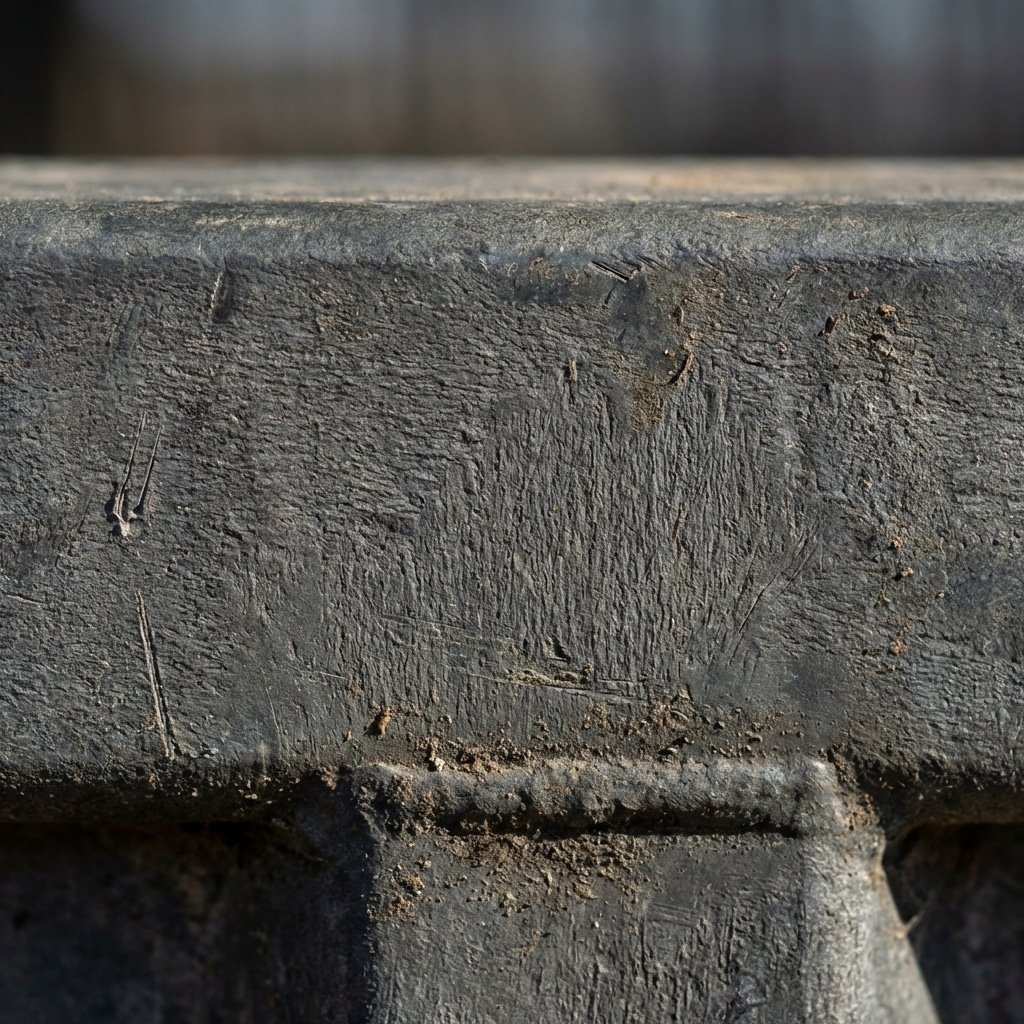
Specifying the right draft horse stall steel gauge is the single most important decision in a heavy-use facility. A Clydesdale or Shire generates over 4,000 Newtons of kick force — nearly three times what a light horse produces. Standard 16-gauge panels, which many suppliers push as a cost-saving measure, simply do not hold up. They bend, they buckle, and they become a safety hazard within a few seasons.
The problem is that most buyers focus on gauge number alone. They see 14-gauge and assume it is sufficient. But gauge is only thickness. It tells you nothing about the steel grade. A 14-gauge panel made from Q235 steel yields at 235 MPa. A 14-gauge panel made from Q345B yields at 345 MPa. That 110 MPa gap is the difference between a panel that flexes and returns under a 4,000 N impact and one that takes a permanent set. Some suppliers exploit this gap deliberately, swapping Q345B for Q235 and hiding the substitution under pre-galvanized tubing or a coat of paint. The buyer never sees the base metal.
This is not a theoretical concern. Internal procurement data shows that upgrading from 16-gauge Q235 to 14-gauge Q345B adds 15-20% to the panel cost. That premium is real. But the lifecycle math flips it. A Q235 panel in a draft horse barn lasts 5-7 years before it needs replacement. A Q345B panel lasts 15-20 years. For a facility with 50 stalls, the replacement labor alone justifies the upgrade. The real question is not whether you can afford Q345B. It is whether you can afford the downtime and injury risk of not specifying it.
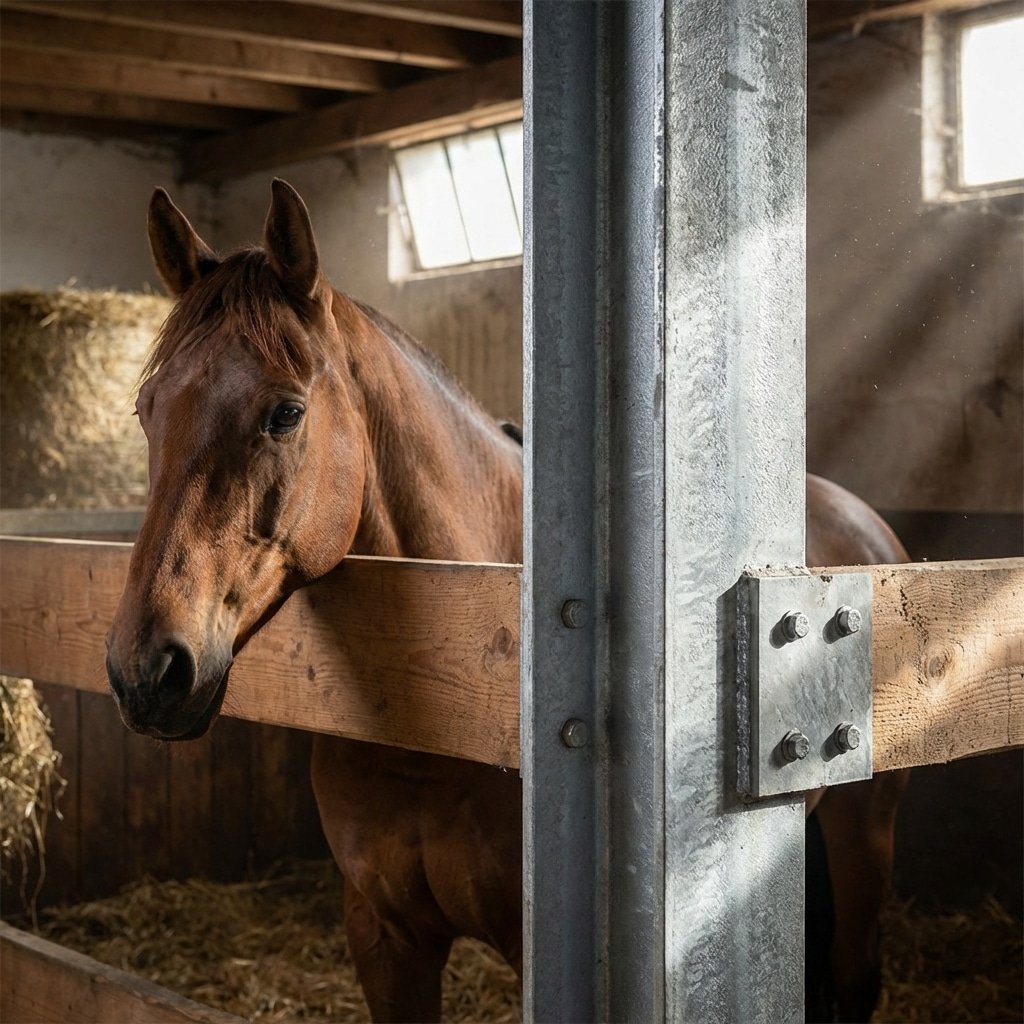
Why Draft Horses Need Heavy-Duty Stall Panels
A 14-gauge Q345B panel returns to flat after 4,000 N; a 16-gauge Q235 panel bends permanently at 2,500 N.
A draft horse kick delivers roughly 4,000 N of force. A light horse averages about 1,500 N. Standard 16-gauge panels — typically rated at 2,500 N — will fail under repeated draft horse impact. The industry rarely publishes this number, but it is the difference between a panel that flexes and one that buckles.
The acceptable deflection threshold after a single 4,000 N strike is 2 mm. At 10 mm of deflection, the panel has taken permanent set and becomes a safety hazard — sharp bends, weakened welds, and reduced bar spacing that can trap a hoof. Most suppliers do not publish deflection limits because their panels cannot pass the test.
- 16-gauge Q235 panel: Yield strength 235 MPa. Permanent deformation begins around 2,500 N. At 4,000 N, deflection exceeds 10 mm. Typical life in a draft facility: 5–7 years.
- 14-gauge Q345B panel: Yield strength 345 MPa. Flexes to ~2 mm at 4,000 N and returns to flat. No permanent set. Typical life in the same facility: 15–20 years.
The cost premium for 14-gauge Q345B over 16-gauge Q235 runs 15–20% per panel in bulk. That premium buys roughly triple the service life and eliminates the liability of a bent panel injuring a horse. For a 50-stall project, the math is straightforward: pay the premium once, or replace every panel in seven years.
If a supplier quotes 14-gauge without specifying Q345B, assume Q235. Demand mill certificates. Demand a deflection test report. Without those, you are buying a panel that will fail on the first real kick.

14-Gauge Q345B: The Metallurgical Difference
14-gauge Q345B flexes at 4,000 N; 14-gauge Q235 bends permanently at 3,500 N.
Most suppliers advertise ’14-gauge steel’ and stop there. That number only tells you thickness — roughly 1.9 mm. It says nothing about yield strength. Q235 yields at 235 MPa. Q345B yields at 345 MPa. That 110 MPa gap is the difference between a panel that springs back after a draft horse kick and one that takes a permanent dent.
- Yield strength comparison: Q235 (235 MPa) fails under repeated 4,000 N impacts. Q345B (345 MPa) stays elastic at that load. Internal DB Stable deflection tests show a 14-gauge Q345B panel returns to flat after a single 4,000 N hit; a Q235 panel of the same gauge shows 10+ mm permanent deflection.
- Pre-galvanized steel hides grade: Pre-galvanized tubing arrives with a thin zinc coating already applied. The base metal can be Q235 or even lower-grade re-rolled steel, and the buyer never sees it. Hot-dip galvanizing after welding strips any ambiguity — the mill certificate must match the finished product. If a supplier can’t produce that certificate, assume Q235.
- Mill certificates are non-negotiable: A genuine mill certificate lists the heat number, chemical composition, and mechanical test results for the specific coil used. Without it, you have no proof of grade. DB Stable provides mill certificates with every bulk order of 14-gauge Q345B panels.
- Cost vs. lifespan math: Q345B adds 15–20% to the panel cost in bulk. That premium buys 15–20 years of service in a high-use draft facility versus 5–7 years for Q235. Over a 20-year window, the Q345B panels cost less per year and eliminate mid-life replacement labor.
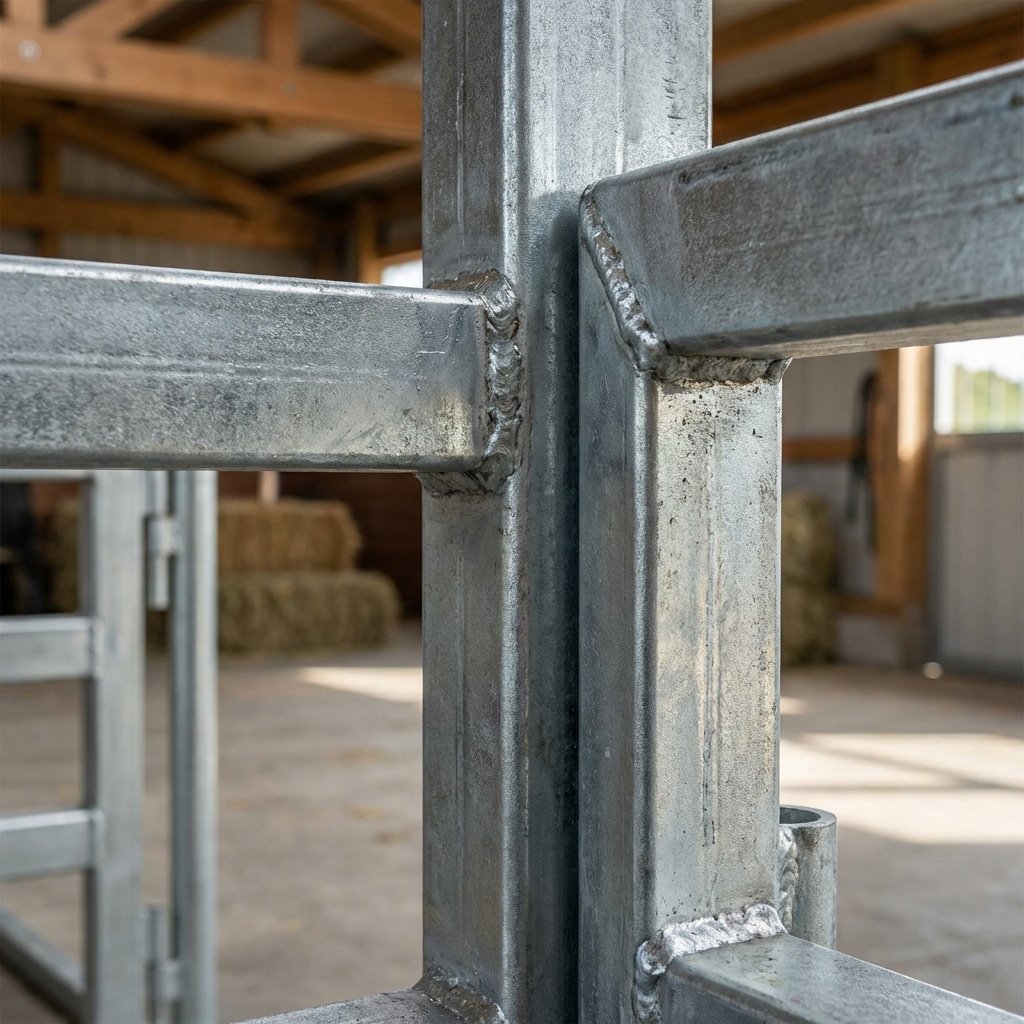
Stall Height and Door Width for Draft Breeds
A 10×10 stall is a safety hazard for a Clydesdale.
Standard 10×10 ft stalls designed for light horses create a confinement risk for draft breeds. A Clydesdale or Shire needs room to turn, lie flat, and stand without pressure on the withers. Cramped quarters increase kicking, pawing, and stress-related behaviors that damage panels and injure the horse.
- Stall height minimum: 8 ft from floor to ceiling. This prevents rear-over injuries when the horse throws its head back. Many pre-fab stalls stop at 7 ft, which is dangerous for a 17-18 hand draft.
- Door width minimum: 4.5 ft clear opening. Standard 4 ft doors cause shoulder rub and panic in a draft horse that hesitates at the threshold. A 4.5 ft door reduces hesitation and injury during turnout.
- Stall length: 12 ft minimum for a single draft. 8 ft is too short for a horse that measures 7 ft from nose to tail. A 16 ft length is recommended for mares with foals or for rest stalls in training barns.
- 10×10 stall risk: The horse cannot lie fully flat without its legs hitting the wall. This prevents REM sleep and increases the risk of cast horses (trapped against the wall). Kicking force also concentrates in a smaller area, accelerating panel fatigue.
- Recommended dimensions by breed: Clydesdale/Shire: 14×14 ft or 16×12 ft. Belgian/Percheron: 12×14 ft. Standard light horse: 10×12 ft. Always size up rather than down — the extra 20 sq ft costs less than one vet call for a kick injury.
When ordering bulk stalls for a draft facility, specify 8 ft height and 4.5 ft doors as a contractual requirement. Many suppliers default to 7 ft height and 4 ft doors unless you explicitly demand otherwise. DB Stable’s 3-sided run-in shelters ship with 8 ft height and 4.5 ft door opening as standard, not an upcharge.
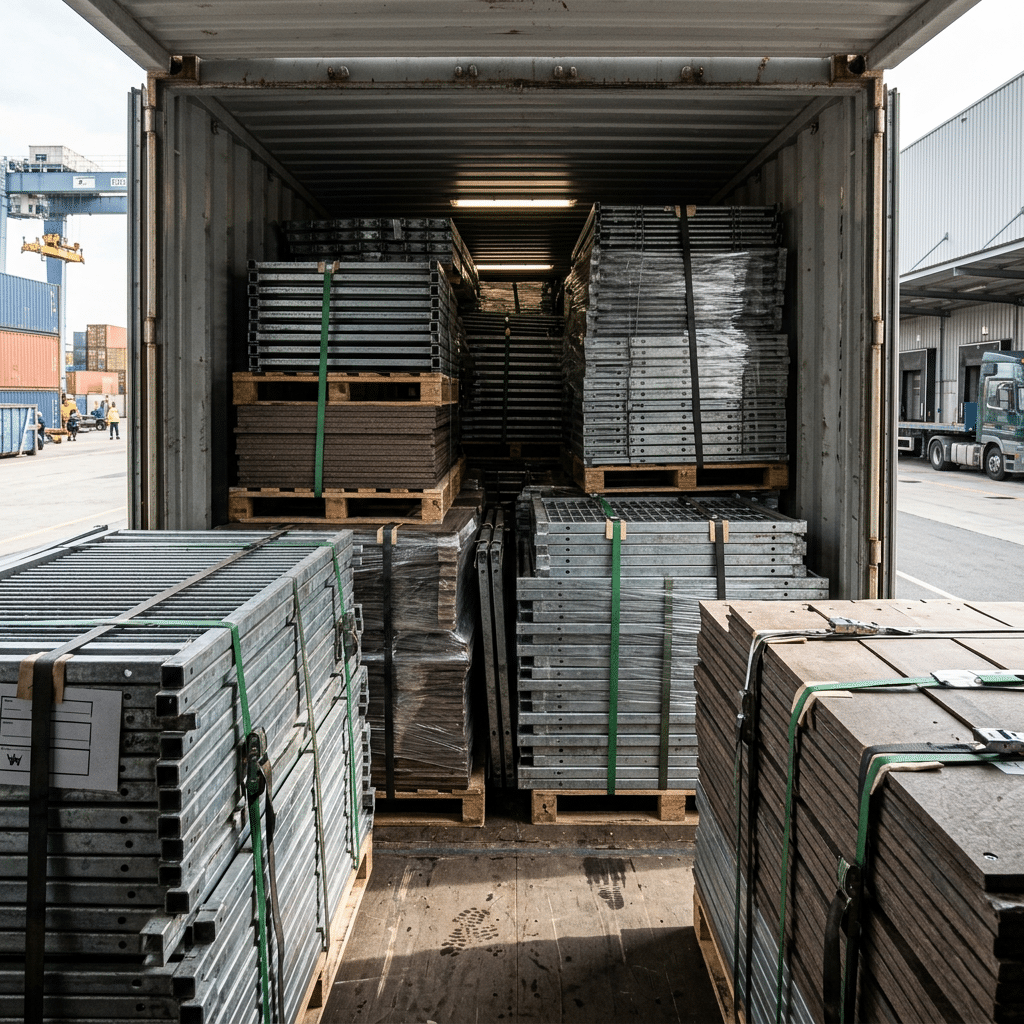
How to Source Draft Horse Stalls Without Getting Scammed
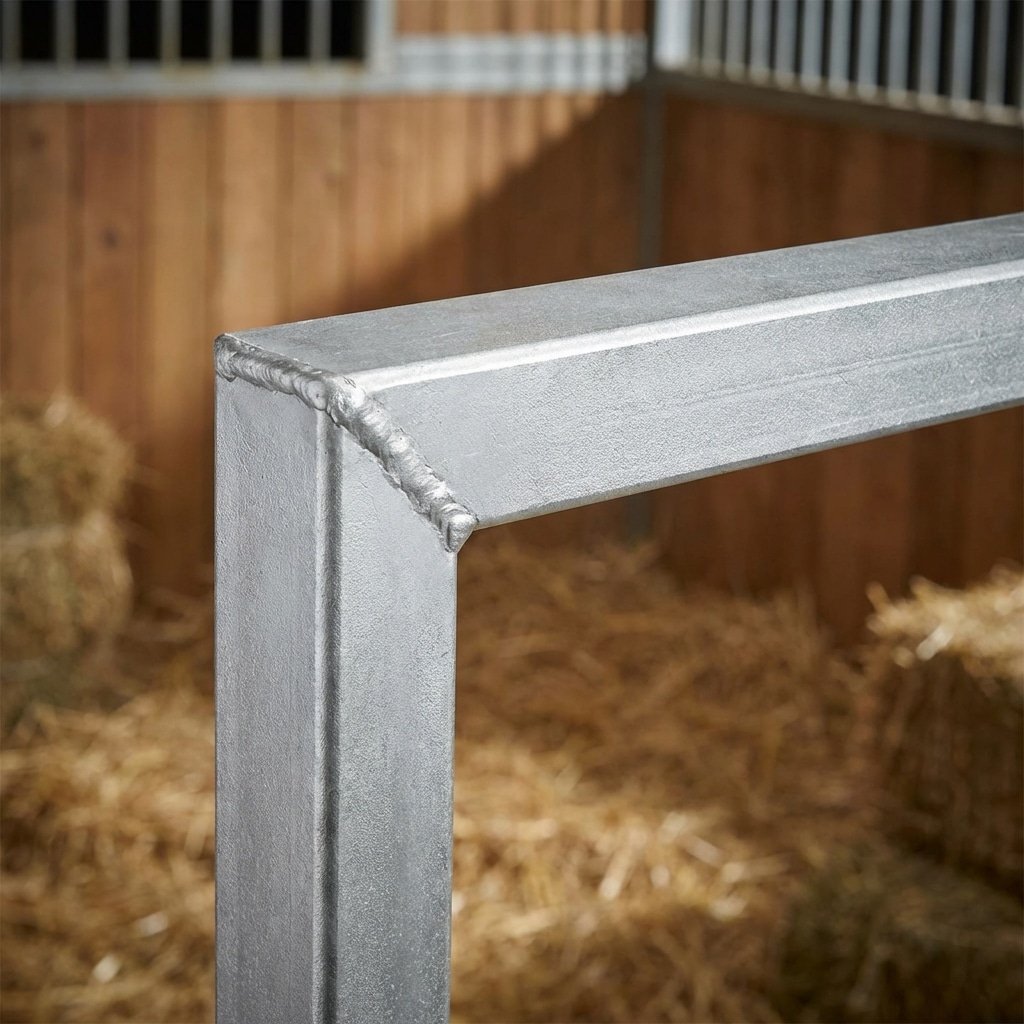
A 14-gauge panel is worthless without a Q345B mill certificate.
Most suppliers will happily quote ’14-gauge steel’. That number alone tells you nothing about whether the stall will survive a draft horse. Gauge only measures thickness — it does not measure yield strength. A 14-gauge Q235 panel (235 MPa yield) will permanently bend under a 4,000 N kick. A 14-gauge Q345B panel (345 MPa yield) flexes and returns. The difference is 110 MPa of safety margin. If a supplier cannot produce a mill certificate from the steel coil manufacturer proving Q345B grade, assume the steel is Q235.
The second trap is galvanizing method. Pre-galvanized tubing arrives at the factory already coated. The welder burns through that coating, and the supplier paints over the weld. You never see the base steel — and they can substitute Q235 without you knowing. Hot-dip galvanizing after welding (post-galvanization) means the entire assembled panel is dipped. The zinc coating seals every weld, and the base steel must survive the bath temperature. If the supplier used Q235, the panel warps. Post-galvanization is a de facto grade test.
- Demand a mill certificate: Request the original steel mill test report showing Q345B grade, ≥345 MPa yield strength, and coil number. Cross-check the coil number against the panel serial numbers.
- Specify hot-dip galvanizing after welding: Write into your purchase order: ‘All panels must be hot-dip galvanized after welding per BS EN ISO 1461. Pre-galvanized tubing is not accepted.’.
- Insist on a deflection test report: Ask for a third-party or in-house test report showing maximum 2 mm deflection after a single 4,000 N impact applied to the center of the panel. 10 mm deflection is a safety failure.
- Avoid ’14-gauge’ without grade certification: If a supplier lists ’14-gauge steel’ but cannot name the grade (Q235 vs Q345B) or provide a certificate, walk away. That is the ‘Steel Gauge Scam’.
- Leverage bulk buying with verified suppliers: DB Stable offers tiered discounts of 5–15% on orders starting at 10 stables or 50 panels, with a dedicated regional account manager for orders over 20 units. Verified Q345B, post-galvanized, with deflection test data.
Conclusion
Specifying 14-gauge Q345B steel with hot-dip galvanizing after welding is the only way to ensure a draft horse stall survives a 4,000 N kick. Anything less — 16-gauge, Q235, or pre-galvanized tubing — shifts the risk of panel failure and injury onto your facility. The 15-20% cost premium buys a 15-year lifespan instead of a 5-year replacement cycle.
Review your current stall specifications against the deflection and grade benchmarks here. If your supplier cannot provide a mill certificate for Q345B and a deflection test report, you are buying Q235 at a Q345B price.
Frequently Asked Questions
What size stall does a draft horse need?
A 12×12 stall is the minimum for a draft horse, with 14×14 preferred for larger breeds like Clydesdales. Standard 10×10 stalls are a safety hazard, increasing kick risk and stress. Always measure your horse’s length and height before ordering.
What is the 20% rule with horses?
The 20% rule typically refers to the maximum weight a horse can carry, including rider and tack, which should not exceed 20% of the horse’s body weight. This is a general welfare guideline. Consult a veterinarian for specific weight limits per breed.
What is the best material to put in a horse stall?
For draft horses, 14-gauge Q345B steel panels with hot-dip galvanized finish are the best material for walls. This combination withstands 4,000 N kick force and provides 20-year rust resistance, outperforming wood or standard. Avoid pre-galvanized steel; demand mill certificates to verify grade.
How thick should horse stall walls be?
Horse stall walls should be at least 14-gauge steel, which is 1.9 mm thick, for draft breeds. Thinner 16-gauge steel (1.5 mm) bends permanently under 4,000 N kick force and fails in high-use. Specify Q345B grade, not just gauge, for structural integrity.
What’s the best size for a horse stall?
For light horses, a 10×10 stall is standard, but draft horses require a minimum 12×12 stall. The best size depends on breed and use; a 14×14 stall reduces stress and injury risk. Match stall size to the largest horse in your facility.

 English
  Spanish
  French
  Arabic
  German
0 Comments