


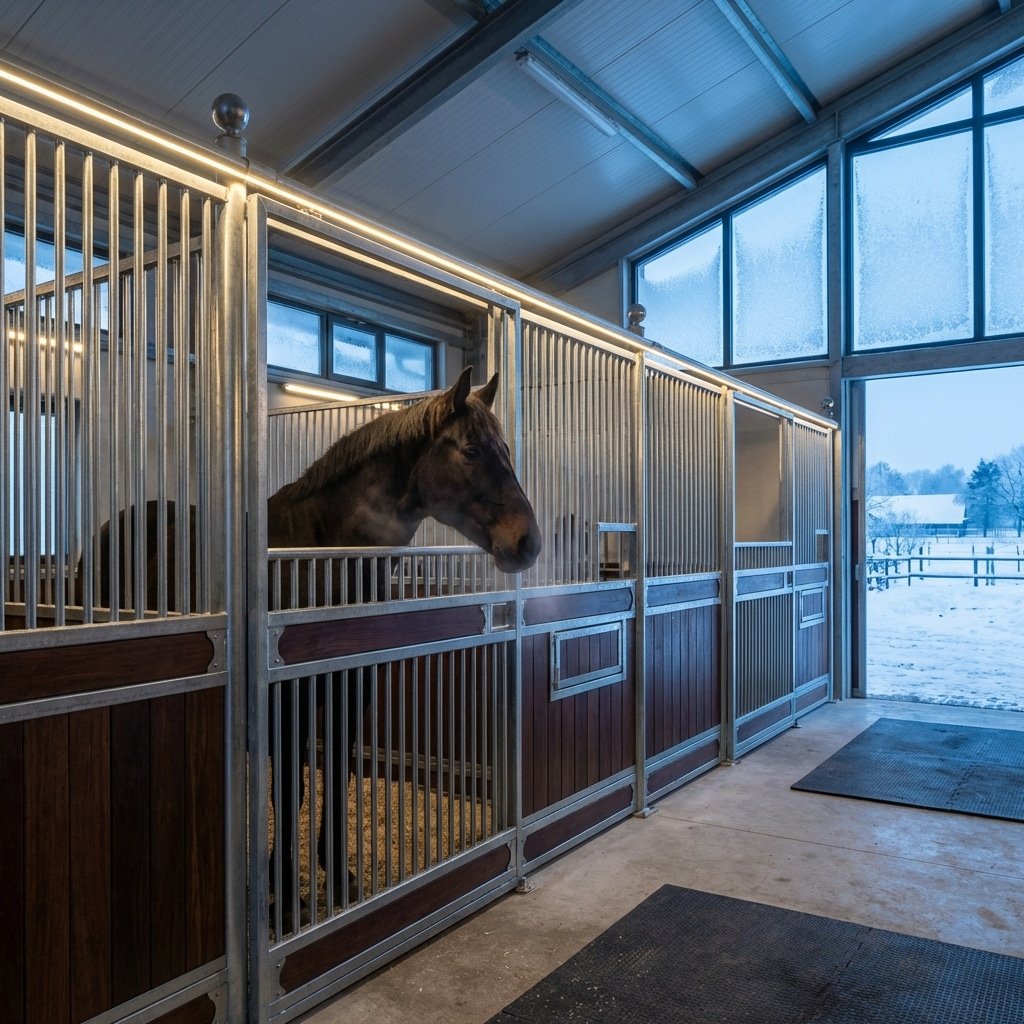
Expanding equestrian infrastructure in Poland demands stabling systems engineered to survive severe freeze-thaw cycles. While the local market surges toward $8.2 billion, standard painted steel fails quickly in these ammonia-rich, sub-zero environments, forcing facility owners to face costly retrofits and safety liabilities within just three seasons.
We engineer heavy-duty solutions specifically for Eastern European winters using Q345B Low Alloy High Strength Steel and Hot-Dip Galvanization to BS EN ISO 1461 standards. This analysis evaluates why compression-sealing swing doors outperform sliding tracks in deep freezes and how zinc coating thicknesses above 85 microns protect your long-term capital investment against rust and structural fatigue.
The Polish Equestrian Boom and EU Welfare Laws
Poland’s $8.2 billion market surge demands infrastructure upgrades. New stables must meet EU welfare standards using cast-proof designs and ventilation-focused engineering.
Market Expansion: The Rise of Polish Equestr
ian Centers
Poland is no longer just a satellite market for Western Europe; it is becoming a central hub for professional equestrianism. The market is on a trajectory to reach USD 8.2 billion by 2033, growing at a CAGR of 6.8%. This shift is driven by a fundamental change in how facilities operate. The days of small, backyard leisure stables are fading as professional breeding and training centers take over.
Currently, 469 registered clubs form the backbone of this industry. Poland’s cost competitiveness attracts significant equestrian tourism from Germany and other Western nations, increasing the strain on existing infrastructure. To capture this revenue, facility owners must upgrade from temporary setups to professional-grade, high-volume stabling systems that can withstand heavy commercial use.

Meeting EU Welfare Mandates with Cast-Proof Engineering
As the market matures, adherence to strict EU animal welfare regulations becomes non-negotiable for commercial permits. Traditional wooden stalls often fail these inspections due to safety hazards and poor hygiene. We engineer our DB Stable Professional and Royal Series specifically to satisfy these rigorouse mandates through three core technical features:
- Cast-Proof Safety Gaps: We limit the bottom gap of the stable front to approximately 50mm. This prevents a horse from getting a hoof trapped while rolling, a critical requirement for EU safety compliance that many older designs ignore.
- Stack Effect Ventilation: Our open grill fronts and partitions allow vertical and horizontal airflow. This reduces ammonia buildup and respiratory risks, aligning with EU mandates for air quality in livestock housing.
- Bio-Security & Hygiene: Unlike painted steel that rusts and harbors bacteria, our frames undergo Hot-Dip Galvanization (BS EN ISO 1461) after fabrication. With a zinc coating exceeding 85 microns, these surfaces can be power-washed daily without corrosion, meeting the high sanitation standards of modern breeding centers.
Swing Doors vs Sliding Doors in Freezing Environments
Swing doors offer superior compression sealing for deep freeze applications, while sliding doors require heavy-duty hot-dip galvanized tracks to prevent rust-induced seizing in moderate cold.
| Feature | Swing Door (Hinged) | Sliding Door |
|---|---|---|
| Sealing Mechanism | Compression (Gasket against frame) | Overlap (Brush or gap seals) |
| Ice Formation Risk | Low (Breaks ice upon opening) | High (Freezes in tracks/gaps) |
| Mechanical Failure | Rare (Simple hinge physics) | Moderate (Track clogging/rust) |
| Best Temperature | Deep Freeze (< -20°C) | Moderate Cold (> -10°C) |
Thermal Sealing and Draft Prevention
The physics of sealing determines the winner here. Swing doors operate on compression. When you close a hinged door, the mechanical latch forces the door slab against the frame, compressing the gasket. This creates an airtight barrier that prevents warm, moist air from entering and condensing on cold surfaces. In environments below -20°C, this compression is non-negotiable for maintaining temperature stability.
Sliding doors face a mechanical contradiction: they need a gap to move. You cannot compress a seal effectively if the door must slide laterally across the opening. While brush seals help, they do not stop air infiltration completely. In freezing conditions, warm air leaks through these gaps, turns to water, and then freezes. This creates an “ice weld” that jams the door, forcing operators to chip away ice before the door will budge.
- Compression vs. Friction: Swing doors press seals shut; sliding doors drag seals, causing wear and gaps.
- Condensation Risk: Incomplete sealing on sliders leads to ice buildup on the track and guides.
- Energy Loss: Swing doors minimize draft intake, keeping heating or cooling costs predictable.
Operational Reliability: Sliding Tracks vs. Swing Hinges
Mechanical reliability in winter depends on how well hardware handles moisture and thermal shock. Sliding doors rely on overhead tracks and bottom guides. In barns and industrial yards, these tracks accumulate snow, mud, and manure. When temperatures drop, this mixture freezes solid, derailing the door or burning out automated motors.
Rust is the second enemy. Standard black steel tracks will rust rapidly when exposed to winter condensation and road salts. Once a track pits from rust, the rollers seize. At DB Stable, we solve this by using Hot-Dip Galvanized tracks (ISO 1461). We also upgrade the steel grade to Q345B for cold climates. Standard carbon steel becomes brittle in extreme cold; Q345B retains impact toughness, preventing tracks from fracturing if a horse kicks the door or a forklift clips the frame at -30°C.
- Track Vulnerability: Bottom guides are prone to snow clogging; top tracks suffer from condensation rust.
- Hinge Simplicity: Swing hinges have no tracks to clog, making them mechanically safer for deep freeze zones.
- Material Spec: We use Q345B steel to prevent cold-weather brittle fractures common in standard steel.
- Galvanization Standard: ISO 1461 Hot-Dip Galvanization ensures tracks survive decades of freeze-thaw cycles without seizing.
Engineered For Safety And 20-Year Durability
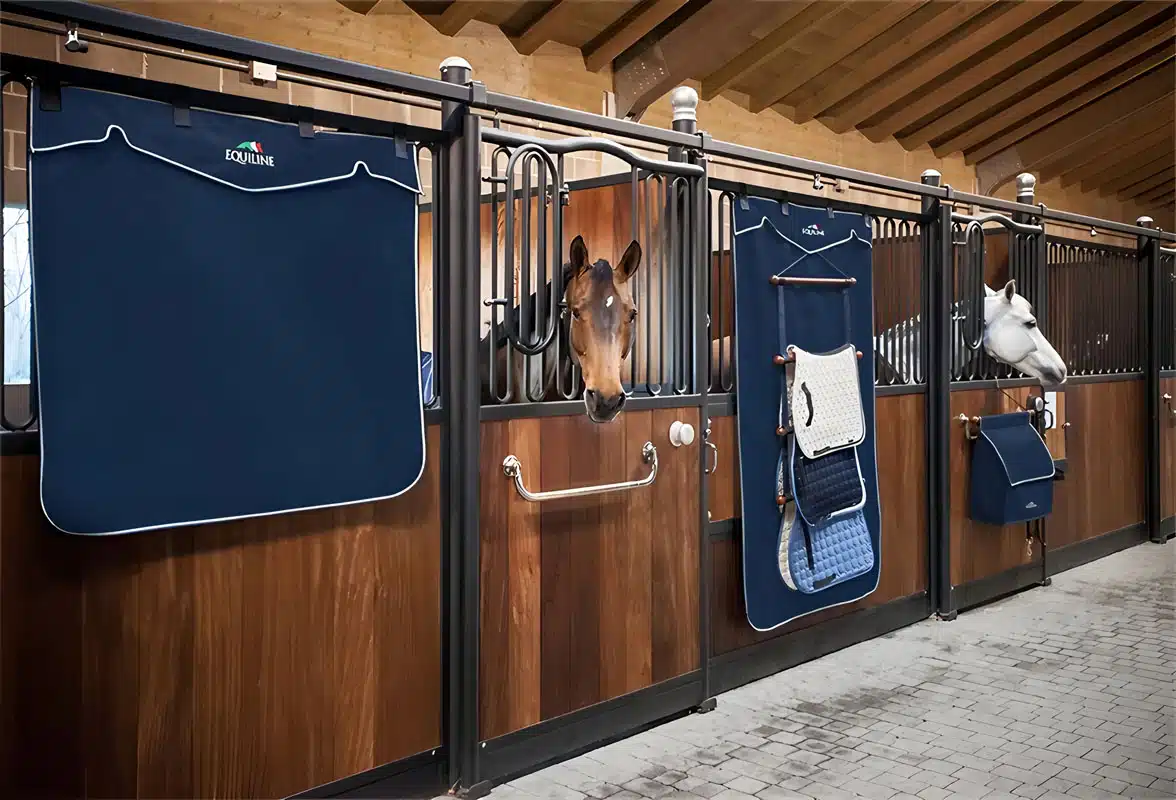
The Heavy-Duty Hinge: 304 Stainless vs. Rust
In ammonia-rich stable environments, standard steel hinges seize rapidly. We mandate 304 Grade Stainless Steel for all hardware to ensure heavy stall doors remain operational for decades.
The Corrosion Mechanics of Stable Environments
Most hardware fails in stables because the environment acts as a chemical bath. Horse stables generate a unique mix of high humidity and ammonia gas from animal waste. This combination accelerates oxidation far beyond what standard outdoor fencing endures. Mild steel or hinges with thin zinc plating cannot withstand this atmosphere.
- Accelerated Oxidation: Ammonia vapors penetrate microscopic imperfections in standard plating, causing rapid formation of red rust that compromises structural integrity.
- Mechanical Seizure: As rust expands, it increases friction within the hinge barrel. This eventually leads to “frozen” doors that require immense force to move.
- Safety Risks: A seized hinge is a majo
r liability. In an emergency, such as a fire, staff must evacuate horses instantly. A door that fights the handler costs time you do not have.

Implementing 304 Grade Stainless for Critical Hardware
To eliminate the risk of seizure, we bypass galvanized steel entirely for moving parts. DB Stable specifies 304 Grade Stainless Steel for the entire hardware kit, including hinges, anchor bolts, and connectors. This alloy contains enough chromium to form a passive oxide layer that repairs itself when scratched, preventing the deep pitting common in lesser metals.
- Load Management: Our doors use dense Bamboo or HDPE infills, often weighing over 250kg. 304 stainless maintains its tensile strength without fatigue, ensuring smooth operation under this load.
- Chemical Resistance: The 304 alloy resists the acidic and salty conditions created by manure and cleaning agents, maintaining a clean appearance without flaking.
- Unified Specification: We do not mix metals. Using stainless hinges with mild steel screws causes galvanic corrosion. Our kits use 304 stainless for every fastener to prevent this reaction.
Hot-Dip Galvanized Stall Panels for Snow and Slush
In freezing climates, standard paint fails. DB Stable submerges welded frames in molten zinc (ISO 1461), creating an 85-micron shield against road salts, ammonia sludge, and internal rust.
Winter Corrosion Risks: Salt, Ammonia, and Slush
Standard powder-coated or painted steel cannot survive in regions with heavy snowfall. The environment inside a cold-climate stable creates a specific chemical attack vector that eats through inferior coatings within two to three seasons. The danger does not come from the snow itself, but from what the snow brings into the barn and how it interacts with stable waste.
- De-icing Salts (Chlorides): Horses and tractors track snow mixed with road salts into the aisle. When this melts, the chlorides accelerate the oxidation process of steel significantly faster than rainwater alone.
- Ammonia Sludge: Melting slush runs under stall fronts and mixes with urine-soaked bedding. This creates a highly acidic sludge that sits against the base of the frame, stripping paint and corroding the steel at the floor level.
- Internal Condensation: Temperature fluctuations—freezing nights followed by active, warmer days—cause condensation to form inside the hollow steel tubes. If the tube is not galvanized on the inside, the frame rots from the inside out while looking fine on the exterior.
Why “Hot-Dip After Fabrication” is Essential for Longevity
Most budget manufacturers use “Pre-Galvanized” steel. They buy tubes that were galvanized at the steel mill, cut them, and then weld them together. The heat from welding burns the zinc off at the joints, leaving the most critical structural points exposed to rust immediately. We reject this method entirely for our B2B clients in cold regions.
DB Stable utilizes a “Hot-Dip After Fabrication” process. We weld the entire frame using raw “black steel” (Q235B or Q345B for cold climates) first. Once the structure is complete, we submerge the entire chassis into a bath of molten zinc. This process ensures the zinc flows over the welds and, crucially, coats the interior surfaces of the tubes.
- Standard Compliance: We strictly adhere to BS EN ISO 1461 standards.
- Coating Thickness: We achieve an average zinc coating of > 85 microns on structural parts and > 70 microns on tubing.
- Sealed Welds: The molten zinc seals every weld seam, preventing the “weld rot” that plagues pre-galvanized competitors.
- Internal Protection: The dipping process coats the inside of the tubes, neutralizing the risk of rot caused by winter condensation.
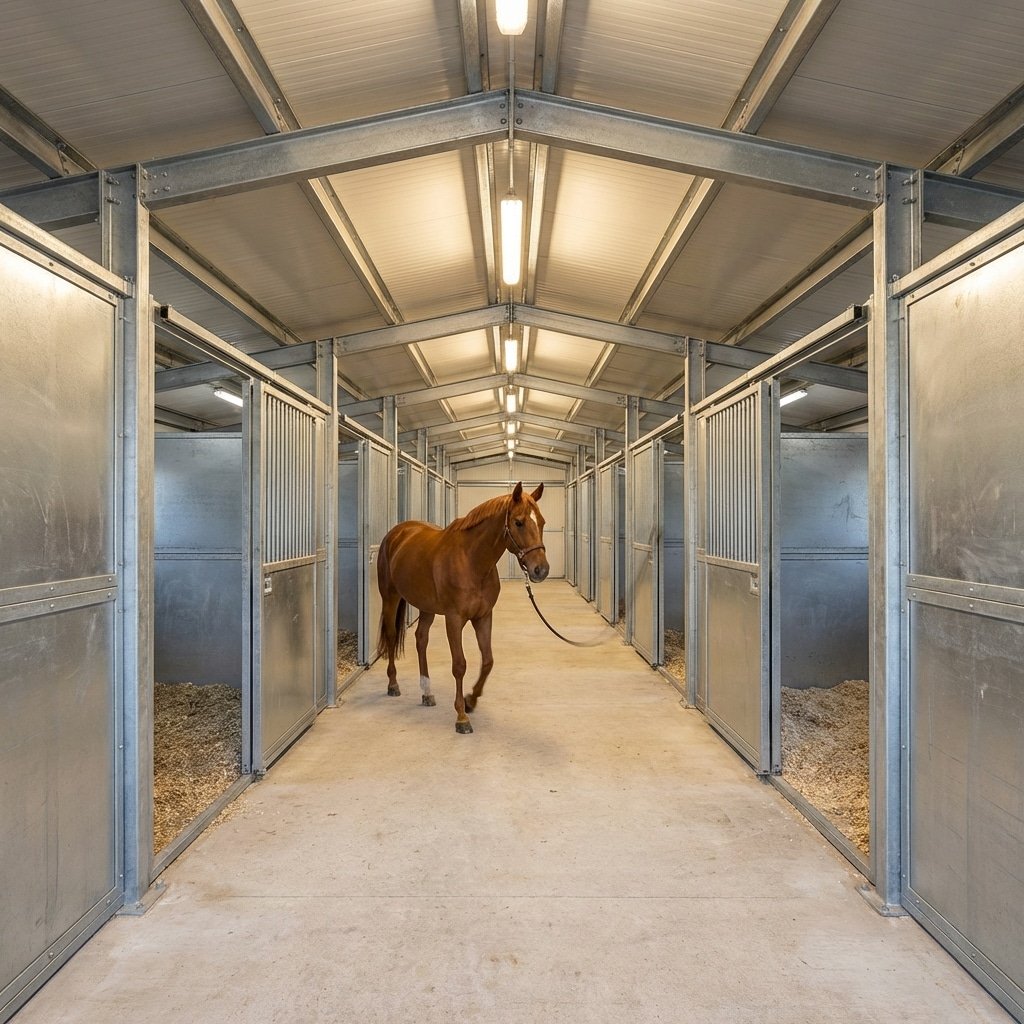
Group Stabling: Using Modular Panels for Open Barns
Modular panels replace fixed masonry to create flexible, tractor-accessible open barns. Hot-dip galvanization (>85μm) and HDPE infills are mandatory for longevity in these high-humidity environments.
Adapting Internal Layouts for Social Herd Dynamics
Traditional masonry builds are permanent liabilities. Once the concrete sets, your layout is frozen. Modular panel systems eliminate the need for fixed internal support posts, allowing facility managers to adjust pen sizes dynamically based on herd size or temperament. This flexibility is critical for implementing the ‘Active Stable’ concept, which promotes the natural movement and socialization increasingly mandated by EU welfare standards.
From an operational standpoint, clear-span designs change the economics of daily maintenance. Without support columns blocking the path, tractors can access large group areas directly. This allows for mechanized manure removal, significantly reducing labor hours compared to the manual cleaning required by tight, fixed-stall configurations.
Weatherproofing the Structure: Hot-Dip Galvanization and HDPE Infills
Open barns expose infrastructure to constant humidity, wind-driven rain, and ammonia concentrations. Standard paint or pre-galvanized tubing (welded from black steel) will fail in these conditions. To ensure a 20+ year lifespan, the material specification must be aggressive.
- Hot-Dip Galvanization After Fabrication: We strictly adhere to ISO 1461 standards, ensuring a zinc coating average of >85 microns on structural parts. This seals the welds—the most vulnerable points—against rust.
- HDPE Infill (28mm-32mm): Unlike wood, which swells and rots in open environments, HDPE is impervious to moisture. It also prevents cribbing damage, which is common in bored or anxious herds.
- Cast-Proof Design: Safety in group settings is non-negotiable. Our systems feature a tight 50mm bottom gap, preventing leg entrapment when horses roll in shared bedding areas.
Frequently Asked Questions
What constitutes a ‘hot-dip galvanized’ horse stall?
True hot-dip galvanization is a post-fabrication process, not a material choice. In this method, the entire steel frame is welded from black steel first, and then immersed in molten zinc according to BS EN ISO 1461 standards. This ensures the zinc covers every surface, including the inside of the tubes and over the weld seams.
Many competitors cut costs by using “pre-galvanized” tubing. In that inferior process, the zinc is burned off during welding, leaving the joints exposed to rust almost immediately. Our process guarantees an average coating thickness of >85 microns on structural parts, providing a service life of over 20 years.
Which stable door configuration is best for freezing weather?
For regions with heavy snow and sub-zero temperatures, sliding doors are often preferred operationally because they do not require clearing a large “swing arc” of snow to open. However, the steel specification is more critical than the door style.
Standard carbon steel can become brittle in extreme cold. For these climates, we recommend upgrading to Q345B Low Alloy High Strength Steel (equivalent to ASTM Grade 50). This material maintains high impact toughness at low temperatures, preventing the metal from fracturing if a horse kicks the door during a freeze.
Why are adjustable hinges recommended for professional stables?
Stable doors filled with dense hardwoods or bamboo are heavy. Over years of use and environmental changes, facilities often experience minor settling or shifting. Fixed hinges offer no remedy for this, leading to misaligned latches and difficult operation.
Adjustable hinges allow facility managers to realign the door instantly using a simple wrench, ensuring the latch always engages smoothly. We utilize heavy-duty 304 Stainless Steel adjustable hinges to support the weight of 40mm infill boards without sagging or corroding.
What are the standard safety dimensions for stall bars?
To prevent hoof entrapment, industry safety standards dictate a bar spacing of approximately 50mm (2 inches). The vertical bars themselves are typically 26.9mm (3/4 inch) in diameter. Front panels generally stand 2.2 to 2.3 meters high to discourage rearing.
Beyond spacing, wall thickness is the hidden safety factor. We strictly enforce a minimum 2.0mm (14-gauge) wall thickness for all grille tubes. Thinner tubes, common in budget market options, can crimp or bend under a direct kick, creating a sharp hazard that can trap and injure the horse.
Can modular panels be used for group housing?
Yes. Modular stabling panels are frequently used to configure open barns or group housing. Because the system is built on standard connectors and posts (50mm x 50mm RHS), you can remove or reposition partitions to create larger run-in sheds. These setups utilize the same “kick-proof” Bamboo or HDPE infills as individual stalls, ensuring safety is not compromised for flexibility.
Final Thoughts
Polish winters expose the fatal flaws in standard carbon steel, turning brittle frames into liability risks when temperatures drop below -20°C. Upgrading to Q345B Low Alloy steel and ISO 1461 Hot-Dip Galvanization is the only valid strategy to guarantee structural integrity against frost and ammonia corrosion. Your long-term reputation depends on supplying infrastructure that survives decades of heavy commercial use, not just the first season.
Secure your position in this expanding $8.2 billion market by partnering with a manufacturer that prioritizes heavy-duty engineering. We invite you to request a technical sample kit to verify our >85 micron zinc coating and 304 stainless hardware firsthand. Contact our engineering team today to configure a flat-pack container solution that optimizes your logistics margins.

 English
  Spanish
  French
  Arabic
  German
0 Comments