


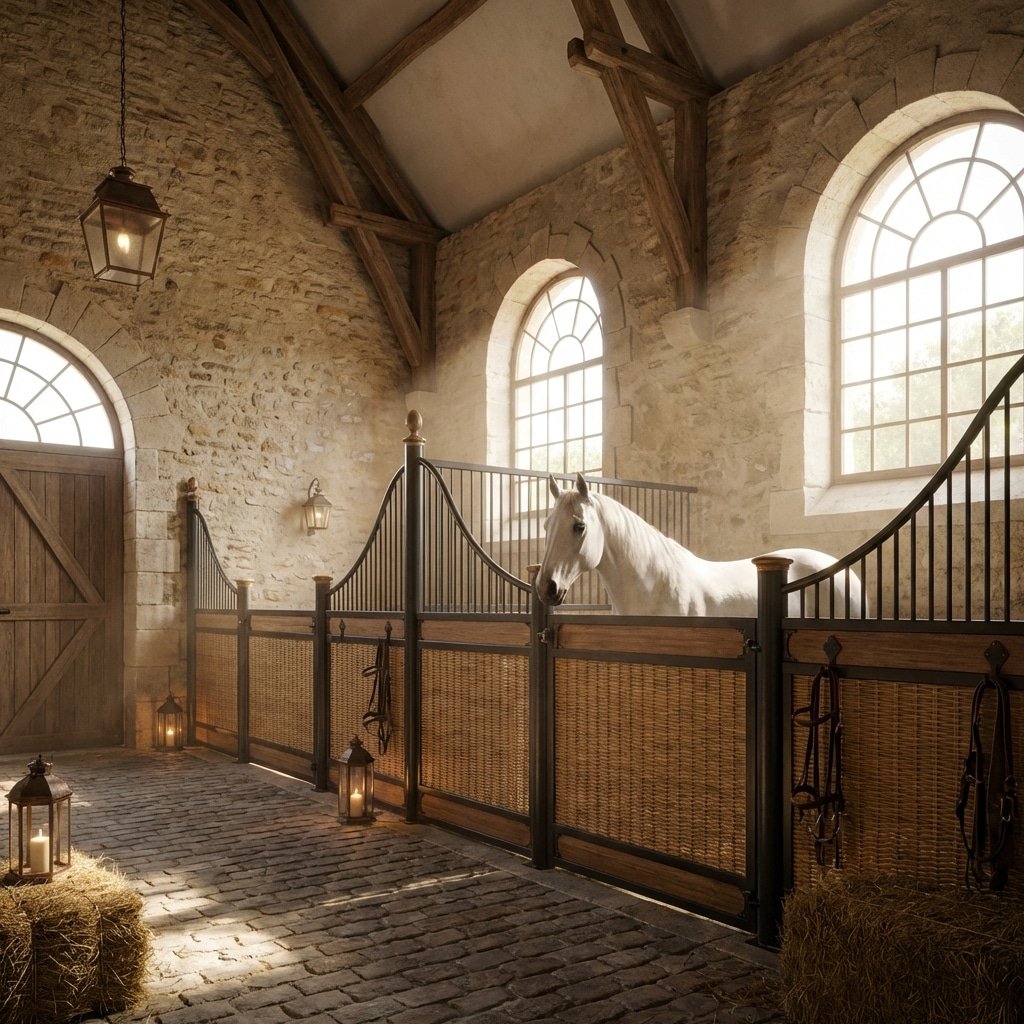
Renovating a historic chateau in France often presents a conflict between aesthetic tradition and material longevity. While native oak is the cultural standard, its high hygroscopicity leads to warping in damp stone stables, resulting in seized doors and costly structural repairs within just three years.
Our Royal Series resolves this failure point by replacing volatile timber with high-density strand woven bamboo, rated at Janka 3000 lbf. We combine this impact resistance with a dual-finish powder coat over hot-dip galvanization to BS EN ISO 1461 standards, delivering the visual prestige of a heritage estate without the maintenance liability.
The Aesthetic of the French Equestrian Estate
French equestrian design evolved during the Renaissance from medieval utility to architectural grandeur, prioritizing light, ventilation, and ornamentation to transform stables into prestigious showpieces.
The Renaissance Legacy: Integrating Ornamenta
tion and Utility
The history of the French equestrian estate marks a sharp departure from the dark, purely functional wooden structures of the medieval period. This shift began in earnest with the Château du Rivau in the 16th century, where the concept of the stable was reimagined as a space of architectural significance rather than mere agricultural storage. French knights, returning from campaigns in Italy, brought back the influence of Italian Renaissance architecture, applying principles of symmetry and beauty to livestock housing for the first time.
This era established that a stable should serve the animal’s welfare through structural grandeur. The Great Stables at Versailles and Chantilly exemplify this philosophy, utilizing massive vaulted ceilings not just for visual impact, but to improve air quality and ventilation for hundreds of horses. The use of glazed windows replaced open drafts, protecting the animals while flooding the interiors with natural light. Decorative elements like scrolls, arches, and stone masonry transformed these facilities into symbols of power, proving that utility and ornamentation could coexist.
The Royal Series: Specifications for Premier Private Estates
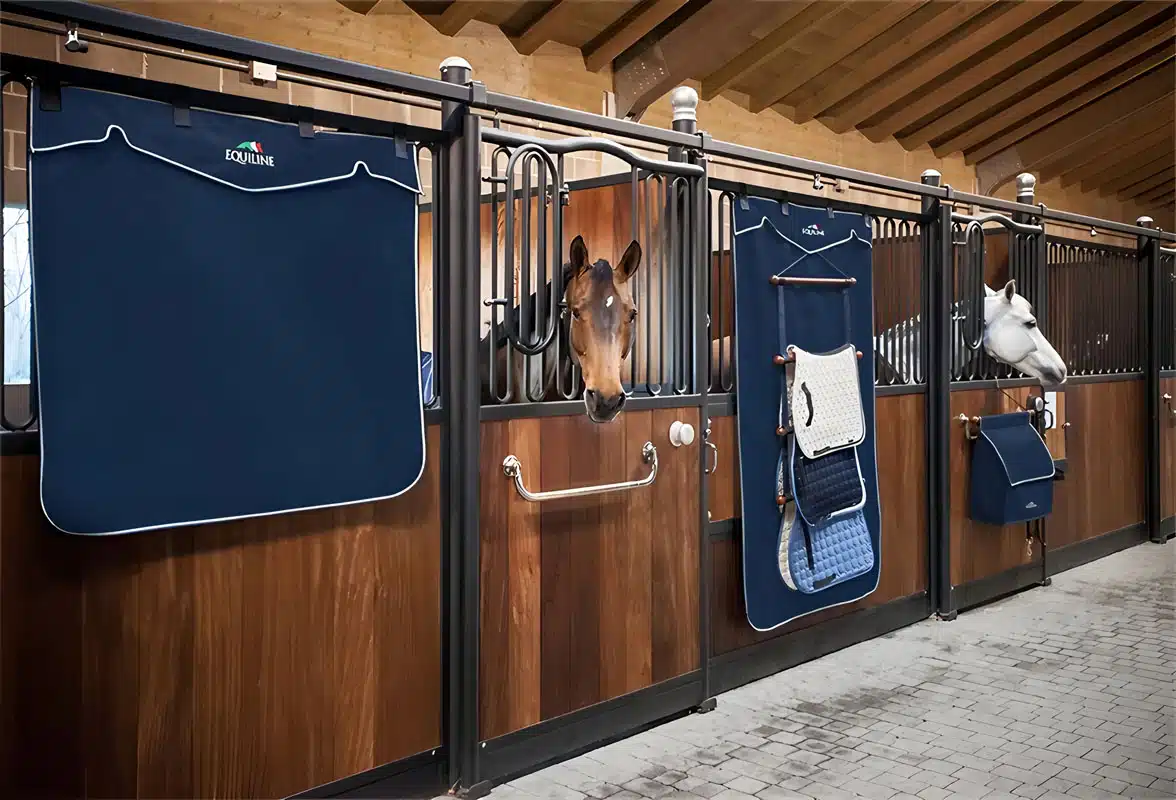
Modern engineering must adapt these historical standards to contemporary manufacturing. At DB Stable, we position our Royal Series product line to meet the demands of private estates and stud farms that require this specific “European” aesthetic. While our Economy Series focuses on the functional needs of quarantine units or rental farms, the Royal Series is engineered for clients prioritizing visual prestige and architectural integration.
We replicate the grandeur of French estate design through specific heavy-duty specifications that align with historical requirements for durability and presence:
- European Arches & Swoops: We incorporate high-arc designs in the steelwork to mimic the vaulted aesthetics of traditional masonry stables.
- Brass & Gold Finials: Decorative accents are integrated into the posts to provide the ornamental finish associated with high-end stud farms.
- Dual-Protection Finish: We apply a powder coat finish over the hot-dip galvanized frame. This ensures the steel survives damp environments—addressing the same longevity concerns as the original limestone blocks.
- 40mm Board Thickness: We utilize thicker infill profiles to match the heavy, substantial feel of historical timber, distinguishing these stalls from lighter, standard agricultural options.
European Arches and Brass Finials on Horse Stall Fronts
Executive Summary: The Royal Series blends architectural arches with solid brass accents, utilizing a dual-finish coating to deliver rust-proof longevity for high-value private estates.
The Visual Impact of European Swoops
In the luxury equestrian market, the “swoop” or arched stall front is not merely a design choice; it is a functional asset that defines the atmosphere of the facility. Unlike standard straight-bar grills which can feel restrictive or industrial, the curved lines of a European front soften the visual weight of the steel. This aligns the barn’s interior with the architectural sophistication found in high-end private estates and historical French châteaus.
From a functional standpoint, the lower center point of the swoop improves socialization and airflow. It allows the horse to hang its head out comfortably without the restriction of a high top bar, reducing stall boredom and weaving behaviors. For premier stud farms, these fronts serve as a frame for the animal, turning the horse into the focal point rather than hiding it behind a grid of steel.
- Enhanced Visibility: The open neck area improves line-of-sight for staff monitoring horse health.
- Architectural Value: Differentiates high-value breeding facilities from standard training barns.
- Airflow Dynamics: The open top design facilitates the “stack effect,” moving warm air up and away from the horse.
Royal Series Specs: Brass Finials and Dual-Finish Protection
The DB Stable Royal Series is engineered to solve the most common failure point in luxury stables: rust bleeding through the paint. Standard “luxury” stalls often rely on a single layer of black paint over raw steel. In humid environments, these rust within two years. We refuse to cut this corner.
Our Royal Series utilizes a “Dual Protection” specification. First, the entire Q235B or Q345B steel frame—including the complex welds of the arches—is Hot-Dip Galvanized to BS EN ISO 1461 standards. Only after this zinc barrier is cured do we apply the architectural powder coat. This ensures that even if the paint is scratched by a hoof or halter, the zinc layer underneath prevents corrosion from spreading.
- Premium Accents: Solid brass or gold-tone finials are standard upgrades for post caps and door latches.
- Tarnish Control: Brass elements can be clear-coated to lock in the shine, eliminating the need for weekly polishing.
- Structural Integrity: 40mm infill channels accommodate heavy-duty bamboo or timber, adding weight and solidity to the arched frame.
Global Compliant Stables With 20-Year Durability
The Wood Debate: Why Oak Warps in Damp Regions
Oak acts like a sponge, absorbing ambient moisture. In damp stables, uneven absorption creates internal stress that twists boards, making proper ventilation more critical than the wood species itself.
Hygroscopic Stress: How Moisture Imbalance Deforms Oak
Many facility owners assume Oak is indestructible, but it remains a hygroscopic material. It constantly seeks equilibrium with the moisture content of the surrounding air. In damp climates, wood fibers absorb humidity and expand. Conversely, in dry spells, they release moisture and contract. This cycle is natural, but in a stable environment, it rarely happens evenly.
Warping occurs when this expansion is asymmetrical. If a stall board sits against a damp external wall while the aisle side faces dry, moving air, the moisture differential creates massive internal tension. One side swells while the other shrinks. The physical force generated here is strong enough to twist thick boards, pop fasteners, and jam sliding door mechanisms. This is particularly aggressive in regions like Europe and coastal Australia, where seasonal humidity fluctuates sharply,
forcing the wood into a constant state of stress.

Combating Dampness: The Advantage of Stack Effect Ventilation
You cannot control the weather, but you can control airflow. Research consistently identifies stagnant air as the primary catalyst for moisture accumulation and wood deformation. If air cannot move, humidity creates localized pockets that saturate the timber. The solution lies in structural design rather than chemical sealants alone.
We engineer DB Stable fronts with an ‘Open Top Grill’ specifically to utilize ‘Stack Effect Ventilation.’ This relies on thermal buoyancy: body heat from the horses warms the air, causing it to rise. As this warm, moist air escapes through the upper grill, it creates a vacuum that pulls cooler, drier air in from the bottom. This continuous vertical circulation equalizes the moisture content across the wood grain, preventing the uneven drying that leads to structural failure.
Strand-Woven Bamboo: Janka 3000 Hardness
Strand-woven bamboo achieves a Janka rating over 3,000 lbf through hydraulic compression, creating a material three times harder than oak and impervious to hoof impact.
The Science of High-Density Strand Woven Bamboo
Most timber used in equestrian construction relies on the natural grain density of the tree. Strand-woven bamboo is different; it is an engineered material. The manufacturing process involves stripping bamboo into individual fibers, drying them to specific moisture content, and coating them with adhesive resins. These fibers are then subjected to extreme hydraulic compression, fusing them into a solid, high-density block.
We define hardness using the Janka Scale, which measures the force required to embed an 11.28mm steel ball halfway into the material. While standard bamboo flooring might rate around 1,300 lbf, the strand-woven bamboo used in our Professional Series infills consistently exceeds 3,000 lbf. This density is not accidental; it is a calculated result of the resin-infusion and compression process designed specifically for heavy-duty industrial and agricultural applications.
- Hydraulic Compression: Transforms loose fibers into a unified block with densities surpassing tropical hardwoods.
- Resin Bonding: Phenolic resins lock fibers together, eliminating the air pockets found in natural wood grain.
- Janka Rating: > 3,000 lbf (Pounds-Force), the industry benchmark for impact-resistant infills.
The Kick-Proof Advantage: 3x Harder Than Oak
In a stable environment, the primary failure mode for wall infills is impact from kicking. Traditional softwoods like Pine or even hardwoods like Red Oak have a breaking point that aggressive horses can easily exceed. Red Oak typically rates around 1,290 lbf on the Janka scale. Our strand-woven bamboo rates at over 3,000 lbf, making it effectively three times harder than the industry-standard hardwood options.
| Material Specification | Strand-Woven Bamboo | Red Oak (Traditional) | Pine (Softwood) |
|---|---|---|---|
| Janka Hardness | > 3,000 lbf | ~1,290 lbf | ~690 lbf |
| Impact Response | Absorbs Energy | Splinters under stress | Breaks/Snaps easily |
| Moisture Resistance | High (Resin Infused) | Moderate (Warps) | Low (Rots quickly) |
Safety extends beyond just hardness. When traditional wood breaks, it often splinters, creating sharp edges that can lacerate a horse’s leg. Due to the fibrous, interwoven structure of strand-woven bamboo, it resists brittle fractures. If a breakage were to occur under catastrophic force, the material tends to crush rather than shatter. Additionally, the resin content provides a barrier against moisture, preventing the rot and mold issues common in damp stable conditions that weaken traditional timber over time.
Dual-Finish Powder Coating over Hot-Dip Galvanizing
The “Duplex System” combines sacrificial zinc protection with a barrier powder coat, extending service life by 1.5 to 2.5 times compared to using either coating alone.
The Science of Duplex Systems
Most manufacturers treat powder coating as the primary line of defense. We treat it as a shield for the real armor underneath. The technical superiority of the Duplex System lies in the synergistic relationship between the metallic zinc layer and the polymer topcoat.
When you apply powder coating directly to bare steel, a single scratch allows rust to creep underneath the paint film, causing it to flake off (under-film corrosion). By applying it over hot-dip galvanizing, the zinc acts as a chemically bonded primer. If the powder coat is scratched, the zinc sacrifices itself to protect the steel, preventing rust from spreading.
Conversely, the powder coat protects the zinc from environmental weathering, significantly slowing down the rate at which the zinc oxidizes. This interaction creates a service life multiplier—the combined lifespan is significantly longer than the sum of the individual coatings.
Royal Series Specification: 85-Micron Base with Architectural Finish
For the luxury market, aesthetics cannot come at the expense of structural integrity. Many competitors use “pre-galvanized” tubing (thin zinc, approx. 40 microns) and weld it together, leaving the weld seams vulnerable to rust before painting. We reject this method for our Royal Series.
Our process follows a strict “Hot-Dip After Fabrication” protocol. We weld the raw black steel frames first, then submerge the entire structure into molten zinc. Only after achieving an ISO 1461 compliant zinc coating do we apply the decorative finish.
- Base Layer: Heavy-duty zinc coating averaging >85 microns on structural parts.
- Surface Prep: Sweep blasting creates a mechanical profile to ensure the powder adheres tightly to the zinc.
- Finish: Architectural grade powder coating allowing for custom colors (Gold, Matte Black) without sacrificing the heavy-duty rust warranty.
Frequently Asked Questions
Why is high-density bamboo often preferred over oak for stable infills?
While oak is the traditional choice, it absorbs moisture and warps in damp stable environments, requiring frequent maintenance to remain safe. We use High-Density Strand Woven Bamboo specifically because it registers a Janka hardness exceeding 3000 lbf—over three times harder than Red Oak. This material offers superior resistance to moisture, rot, and hoof impact without the need for constant refinishing.
Does powder coating provide enough rust protection for stall fronts?
Powder coating alone is purely cosmetic and offers zero structural rust protection once scratched. For genuine longevity, the steel frame must be hot-dip galvanized first (dipped in molten zinc) to ISO 1461 standards. We apply the powder coat over this galvanized layer. This dual-finish approach ensures that even if a hoof scratches the paint, the zinc layer underneath prevents rust from spreading to the steel core.
Are European-style stall fronts compatible with existing barn structures?
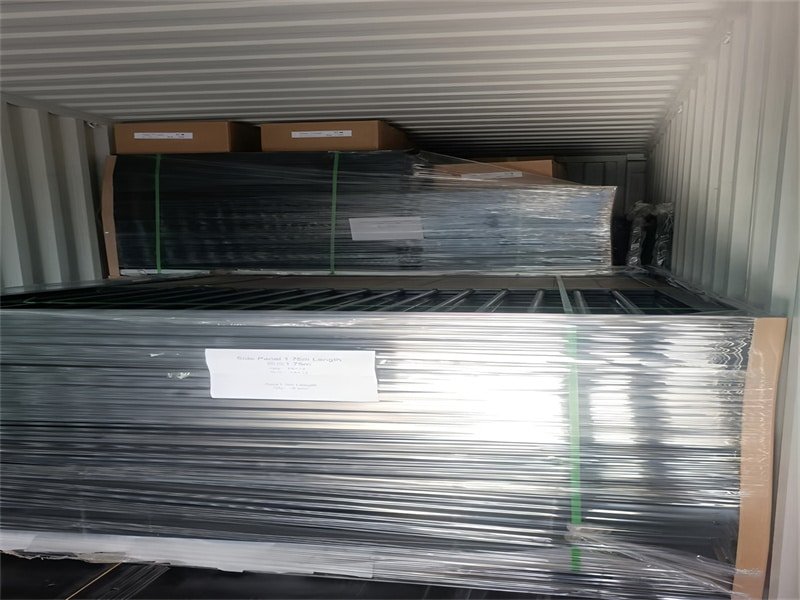
Yes. Modern European systems function as modular, flat-pack kits that do not require welding on-site. You can anchor them directly into concrete curbs or pavers using stainless steel bolts. This modularity allows them to fit seamlessly into renovated barns or new builds, provided your structural columns or walls can support the weight of heavy-duty steel frames.
What is the difference between standard steel and the steel used in luxury stalls?
Standard agricultural gates often use lighter, thinner steel that bends under stress. For our professional and luxury lines, we utilize Q345B (equivalent to ASTM Grade 50) structural steel with a strict minimum wall thickness of 2.0mm to 2.5mm. This higher tensile strength is essential for preventing brittle fractures from kicks, a common failure point in colder climates with standard steel.
How do open-yoke designs impact horse safety and ventilation?
Open-yoke and scooped fronts promote socialization and create “stack effect” ventilation, allowing body heat to escape upwards. To ensure safety, we implement a “cast-proof” design where bottom grill gaps are minimized (approximately 50mm) to prevent hoof entrapment. The bar spacing is also calculated to prevent heads from getting stuck while maximizing airflow.
Final Thoughts
Selecting the Royal Series is not merely an aesthetic choice; it is a strategic defense against the damp European climate that inevitably warps traditional oak. While local timber succumbs to hygroscopic stress, our strand-woven bamboo and ISO 1461 duplex coating deliver the permanence a chateau demands. Your reputation relies on installing facilities that remain pristine for decades, rather than requiring renovation after a few wet seasons.
Prestige clients rarely compromise on finish, so we encourage you to verify our specifications directly before committing to a full container. Request a material sample kit today to physically feel the density difference between our 3,000 lbf bamboo and standard hardwood. Contact our technical team now to configure your flat-pack solution and secure production priority.

 English
  Spanish
  French
  Arabic
  German
0 Comments