
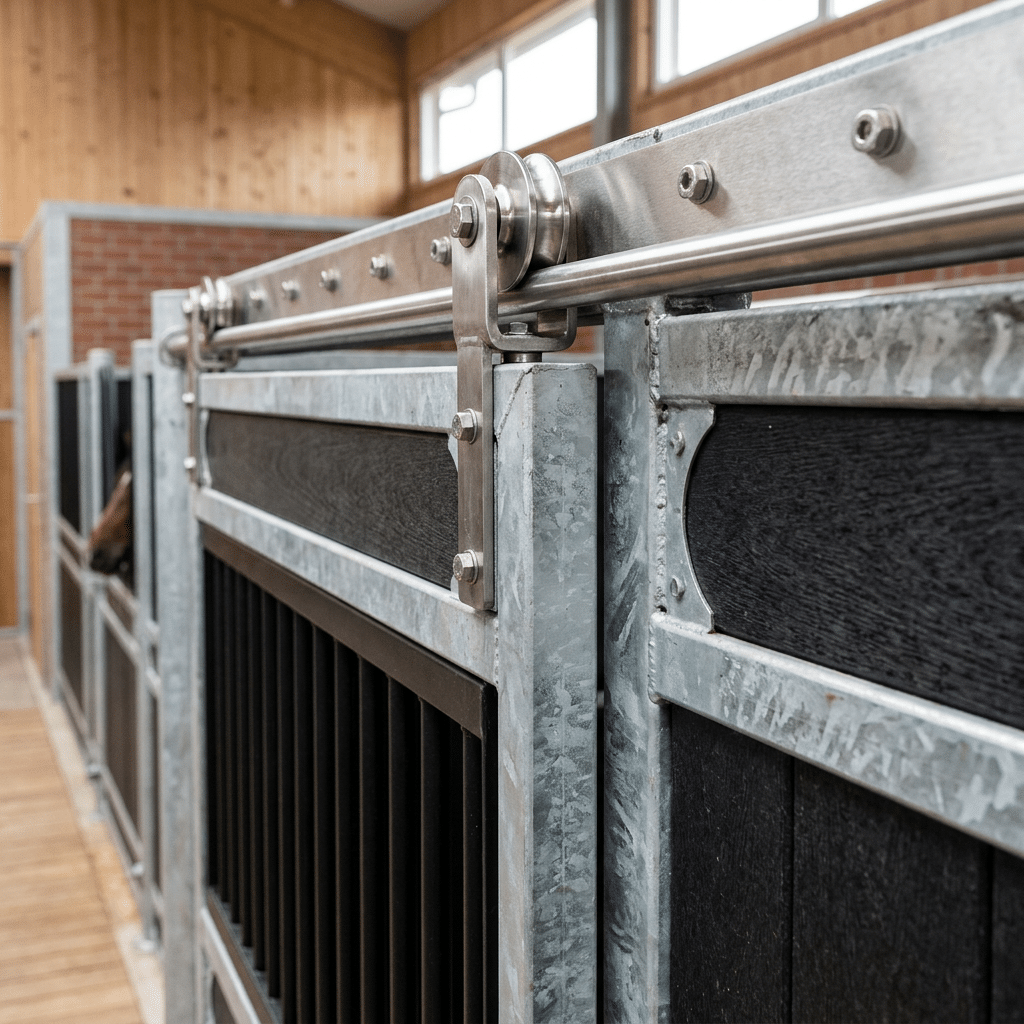
Selecting the correct Round vs Box Track system determines whether your facility faces years of smooth operation or constant derailment liabilities. While tubular systems excel at shedding corrosive dust, they often fail under the dynamic impact of a 450kg bamboo-filled door, creating immediate safety hazards for high-traffic equestrian centers.
This analysis benchmarks hardware integrity against the BS EN ISO 1461 Hot-Dip Galvanization standard for ammonia resistance. We evaluate shear stress limits on 14-gauge steel components and Q345B structural framing to identify which system handles the static load of high-density bamboo without compromising safety or distributor margins.
The Engineering of Sliding Barn Door Hardware
Executive Summary: Proper stable hardware relies on high-tensile steel tracks and precision ball-bearing rollers to manage dynamic loads exceeding 400kg. The system must maintain structural integrity under lateral impact while resisting ammonia-induced corrosion through industrial-grade galvanization.

The Mechanics of Load Suspension
Most hardware failures in equestrian facilities stem from a fundamental misunderstanding of load physics. A stable door is not a static object; it is a dynamic mass subject to sudden acceleration and deceleration. When a groom slams a 450kg bamboo-infilled door shut, the kinetic energy transfers directly to the hangers and the track end-stops. Standard residential hardware, designed for 40kg hollow-core doors, will shear under these forces.
We engineer our Professional and Royal Series systems to handle these specific stress vectors. The track must act as a rigid structural beam rather than just a guide, preventing deflection that leads to binding.
- Dynamic vs. Static Loads: While the static weight of a door might be 250kg, the dynamic load during operation or impact creates force multipliers. Our systems are rated to withstand momentary loads exceeding 400kg to account for this variance.
- Shear Stress on Hangers: The connection point between the door and the roller is the most critical failure point. We strictly prohibit steel gauges thinner than 2.0mm (14-gauge) for these components to resist shear failure over years of repetitive cycling.
- Lateral Impact Resistance: Horses kick and lean. A standard open-hook hanger will derail under lateral pressure, creating an immediate safety hazard. We utilize captive, enclosed track systems (Hidden Track) that lock the rollers inside the profile, ensuring the door remains suspended even when struck from the side.
Corrosion Resistance: The ISO 1461 Galvanization Standard
The environment inside a stable is chemically aggressive. Animal waste produces ammonia gas, which accelerates the oxidation of ferrous metals far faster than atmospheric moisture alone. Painting or powder coating over black steel merely hides the rust until the paint bubbles and flakes. The only long-term defense in this environment is a metallurgical bond between steel and zinc.
We reject “pre-galvanized” tubing (where the weld seam burns off the zinc protection) for our structural components. Instead, we employ the “Hot-Dip After Fabrication” process. This involves submerging the fully welded door frame into molten zinc, ensuring that every weld, crevice, and edge is sealed.
- ISO 1461 Compliance: We adhere to BS EN ISO 1461 standards, achieving an average coating thickness of >85 microns on structural parts. This is significantly thicker than the 20-30 microns found on standard commercial fencing.
- ASTM B117 Testing: Our hardware undergoes rigorous salt spray testing for over 96 hours with zero red rust appearance, validating its suitability for coastal and high-ammonia environments.
- 304 Stainless Steel Connectors: While the frame is galvanized, moving parts and fasteners require different material properties. We use exclusively 304-grade stainless steel for anchor bolts, screws, and latches to prevent galvanic corrosion and seizure.
Round Tracks: Shedding Dust and Bird Nests
Round track systems use gravity and a tubular shape to naturally shed debris, preventing the buildup common in flat tracks while eliminating nesting spots for pests.
The Self-Cleaning Geometry of Tubular Tracks
Barns are dusty environments. Hay particles, bedding dust, and general grit settle on every horizontal surface available. In standard flat-track or enclosed box-track systems, this debris accumulates inside the channel or on the flat rail. Over time, the rollers compact this dust into a hard
layer, causing the door to bump, jump, or eventually jam completely.
Round tubular tracks solve this through basic physics. The cylindrical profile eliminates the flat shelf where debris typically lands. Gravity does the maintenance work for you; dust simply slides off the curve and falls to the floor rather than interfering with the roller mechanism.
There is also a distinct biological advantage. Box tracks with internal U-channels create perfect, sheltered cavities for birds and rodents to establish nests. These nests block the rollers and often require dismantling the system to clear. A round track lacks this internal cavity, making it mechanically impossible for birds or rodents to build nests inside the hardware.
Corrosion Defense for Exposed Hardware
Because round tracks function without an enclosing box or fascia, the steel remains fully exposed to the stable environment. In a horse barn, this means constant contact with humidity, ammonia fumes from manure, and environmental moisture. Standard paint or thin electro-galvanizing will fail here, leading to red rust and seized rollers within a few seasons.
At DB Stable, we treat the exposure of round tracks as a critical engineering challenge. We avoid pre-galvanized black tube which leaves weld points vulnerable. Instead, we utilize ISO 1461 Hot-Dip Galvanization After Fabrication. This process involves dipping the complete welded component into molten zinc, ensuring every inch—including the welds—is sealed against the elements.
- Zinc Thickness: We adhere to a standard of > 70 microns for tubing, providing a thick sacrificial layer that self-heals minor scratches.
- Salt Spray Testing: Our hardware passes the ASTM B117 Salt Spray Test for over 96 hours without showing red rust.
- Steel Gauge: We strictly use 14-gauge (2.0mm – 2.5mm) steel to ensure the track maintains its structural integrity under heavy loads.
This level of protection is non-negotiable for B2B distributors whose clients expect equipment to survive decades of agricultural use, rather than just the initial warranty period.
20-Year Rust Resistant Modular Horse Stables
Box Tracks: Capturing the Roller for Massive Weight
Box tracks utilize an enclosed U-shaped channel to capture the roller internally. This design prevents derailment and evenly distributes the massive loads typical of high-density bamboo and steel partitions.
The Enclosed U-Channel Mechanics
Most retail-grade sliding hardware relies on a “flat bar” or “round rail” system where the wheel sits on top of the track. While visually distinct, these open systems rely entirely on gravity to keep the door in place. In a busy commercial stable, a frightened horse kicking a door can easily lift a roller off an open track, causing a derailment. We do not take that risk.
The box track system uses a captive, enclosed U-profile. The trolleys roll inside the channel, meaning the door cannot jump the track regardless of lateral force or upward impact. This internal carriage design also protects the lubricated bearings from direct bedding dust and debris, a constant issue in open-air aisleways.
- Derailment Prevention: The U-profile physically blocks the roller from lifting off the track during impact.
- Internal Protection: Running gear remains shielded from direct kicks and environmental grime.
- Load Distribution: The box shape offers superior resistance to downward deflection compared to flat steel bars.
- Aesthetics: Enables our “Hidden Track” designs where hardware sits behind a fascia for a clean, professional look.
Supporting High-Density Bamboo and Steel Loads
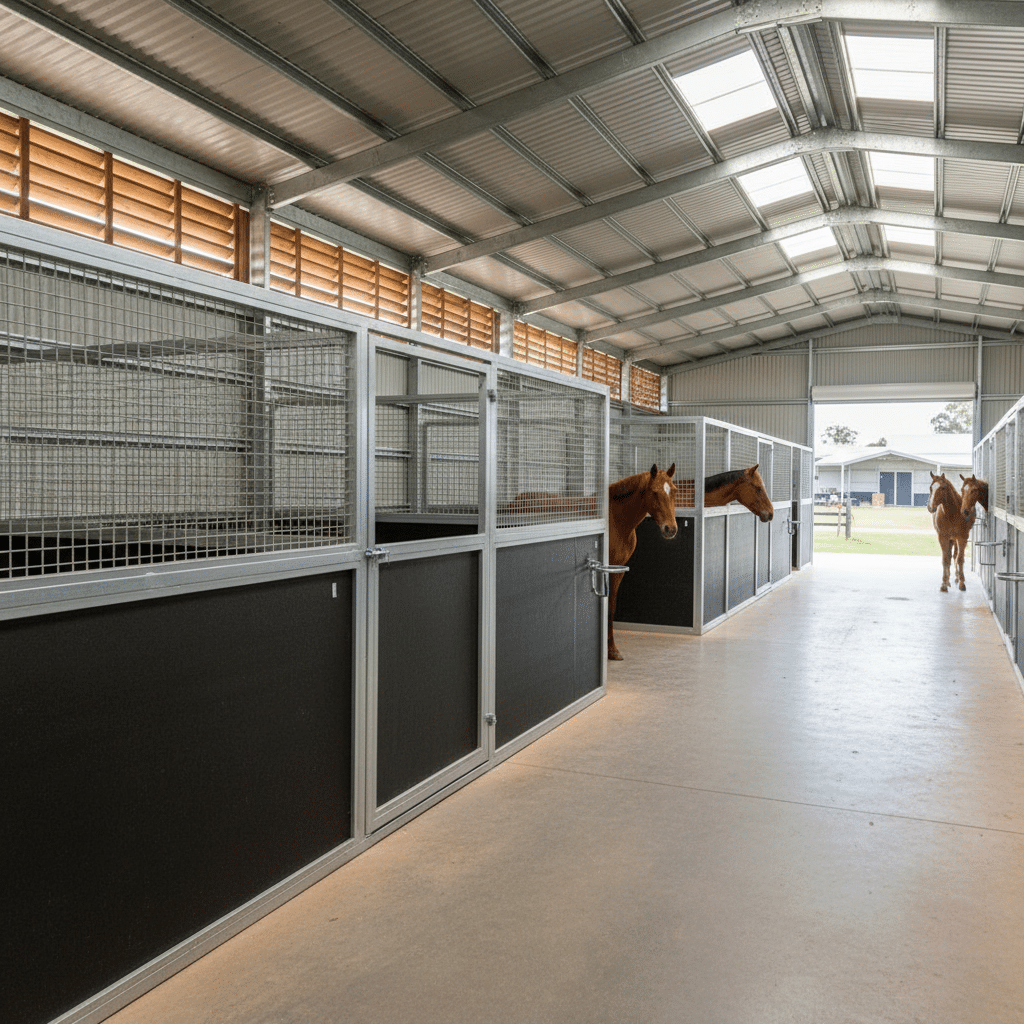
You might see lightweight aluminum tracks used for residential barn doors, but those specifications fail when applied to professional equestrian equipment. Our “Professional Series” partitions use heavy-duty Q345B structural steel framing, not the standard Q235B found in cheaper alternatives. When you combine that steel density with our High-Density Strand Woven Bamboo infills (rating over 3000 lbf on the Janka hardness scale), a single partition door often exceeds 400kg.
A standard round track will sag under this specific load, creating friction points that make the door difficult to open. The box track system serves as a structural beam. It handles the dead weight of the Q345B frame and dense bamboo without bowing. This rigidity ensures that even our heaviest “Royal Series” doors glide with minimal effort, maintaining the smooth operation expected in high-end equestrian centers.
- Critical for Professional Series: Specifically engineered to carry the extra mass of Q345B steel framing.
- Bamboo Compatibility: Supports High-Density Strand Woven Bamboo (3x harder than Oak) without track fatigue.
- Heavy Operation: Ensures 400kg+ partitions slide smoothly rather than grinding against a deflected rail.
- Integrated Design: Standard fit for the “Hidden Track System” used in upscale riding schools and clubs.
Why DB Chooses the Enclosed Box Track for Bamboo Doors
We use enclosed box tracks specifically for bamboo because they support the extreme density of strand-woven infills without sagging and shield the rollers from inevitable barn dust.
Managing the Weight of High-Density Bamboo
You cannot treat a bamboo stable door the same way you treat a pine door. Our strand woven bamboo is three times harder than Oak and significantly denser than standard softwood. This creates a massive vertical load that cheap, open-round track systems simply aren’t engineered to handle long-term.
When you hang this much weight on a standard open track, the rollers often suffer from fatigue, creating a “heavy push” feel that makes daily feeding chores a workout. We engineered our system to manage this density:
- Load Distribution: The box track captures the rollers internally, distributing the heavy load evenly across the track’s geometry rather than focusing it on a single point of contact.
- Sag Prevention: The structural rigidity of the box profile prevents the bowing often seen in flat-bar tracks under heavy load.
- The “Hidden Track” System: Superior Hygiene and Stability
We list this feature in our Professional Series specifications as the “Hidden Track System.” This isn’t just an aesthetic choice; it is a functional requirement for a working stable environment. Open tracks are magnets for dust, hay, and bird droppings. When that debris settles on an exposed rail, every slide grinds it into the roller bearings.
The enclosed box design solves the two biggest problems in stable hardware:
- Debris Shielding: The track acts as its own roof. Dust and hay settle on top of the box, not inside the roller path, ensuring the “Lifetime” operation standard we promise.
- Captive Safety: Horses kick. In an open system, a violent kick can lift a door off its rail. Our captive rollers are trapped inside the steel box, making it mechanically impossible for the door to jump the track during an impact.
Final Thoughts
Selecting the right track system is a risk management decision, not just a hardware purchase. While round tracks offer hygiene benefits, our enclosed box track system remains the only viable option for heavy-duty bamboo and steel partitions exceeding 400kg. By standardizing on ISO 1461 Hot-Dip Galvanized components, you eliminate the liability of derailed doors and rusted equipment that plague lesser-grade alternatives.
Do not leave your facility’s safety to speculation; validate our engineering firsthand. We invite you to request a specification sheet or a sample kit to experience the structural difference of our Professional Series hardware. Contact our engineering team today to configure a track solution that matches your project’s specific load requirements.

 English
  Spanish
  French
  Arabic
  German
0 Comments