


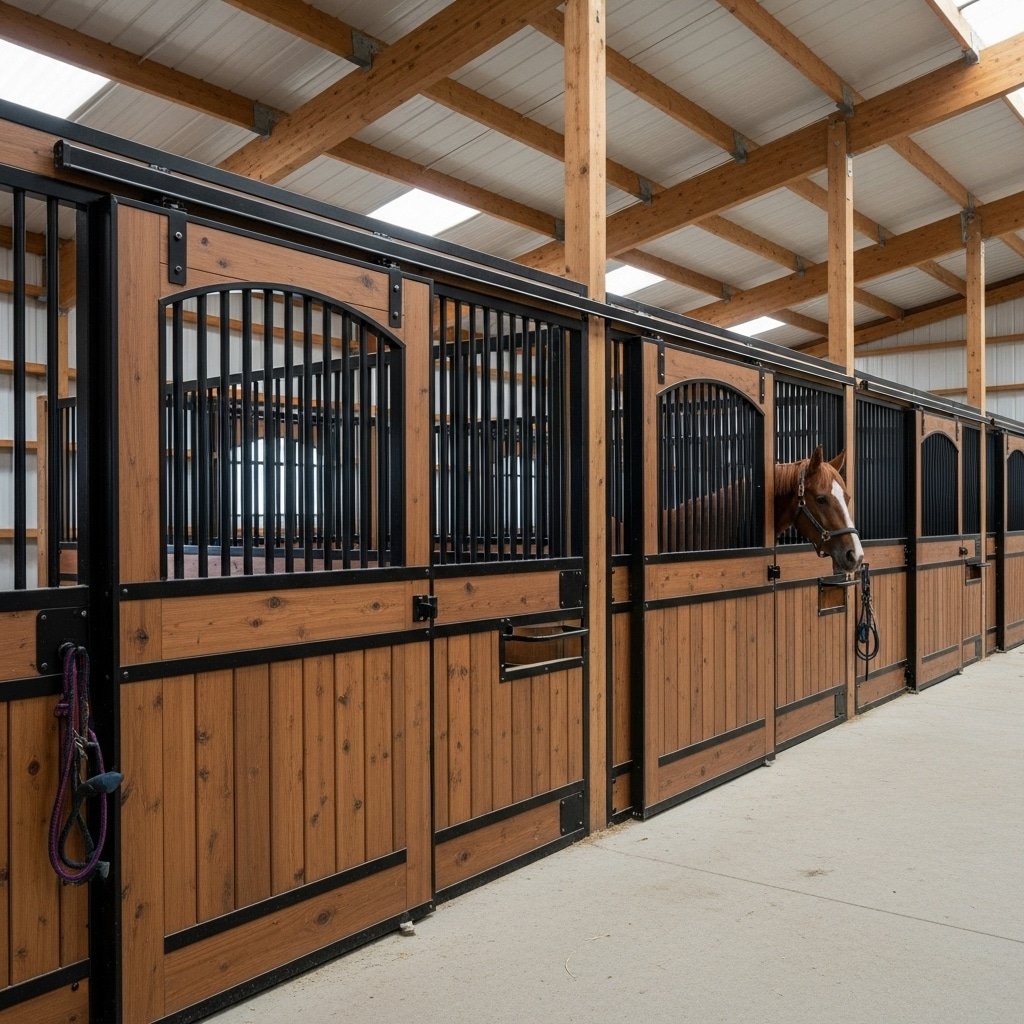
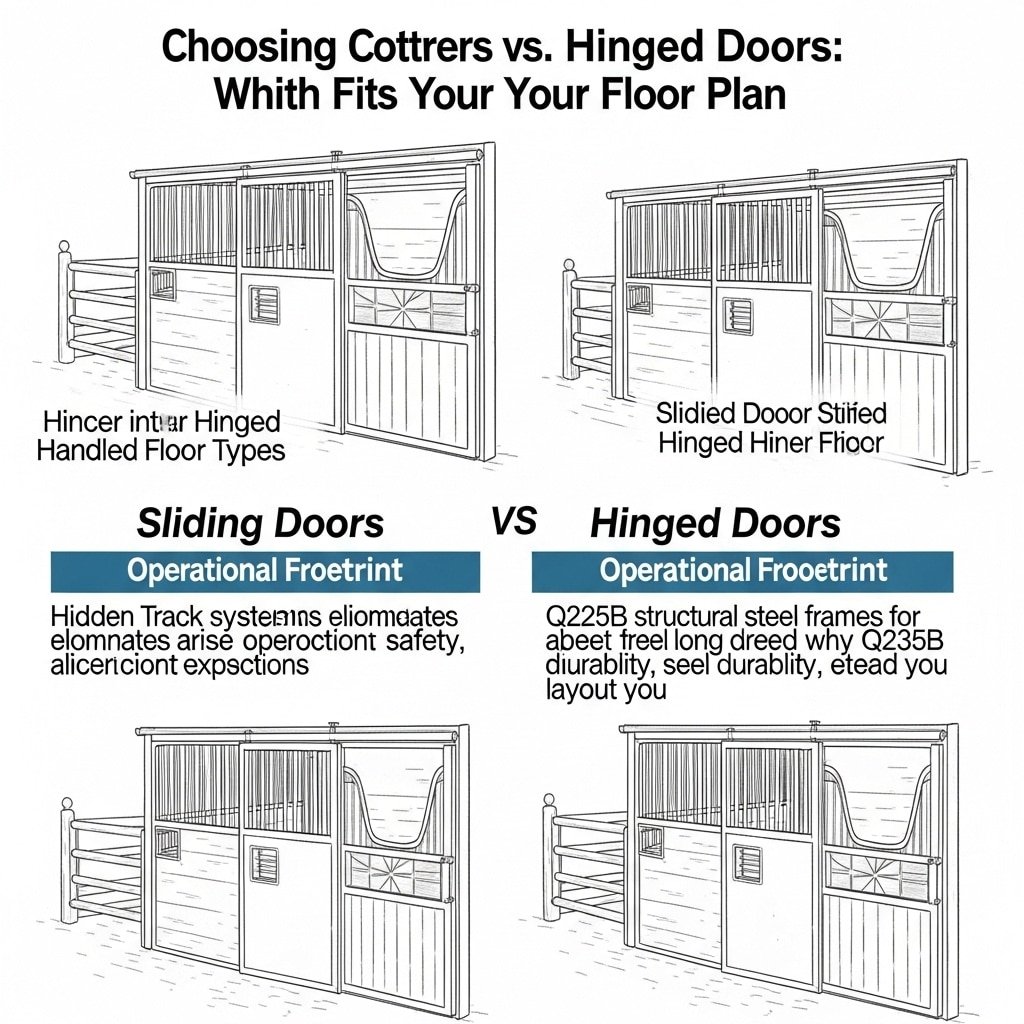
Choosing the correct horse stall door types is a critical decision that dictates a barn’s safety and workflow. A hinged door projects into the aisle, creating a collision risk and consuming valuable square footage. This fundamental design flaw compromises handler safety, reduces operational efficiency, and ultimately devalues the facility’s floor plan.
This analysis benchmarks sliding versus hinged systems based on their true operational footprint. We evaluate how hardware like hidden track systems eliminates aisle obstructions and why Q235B structural Stahlrahmen are essential for ensuring long-term durability, regardless of the layout you choose.
How to Maximize Space in a Compact Barn?
Maximize space in a compact barn with vertical storage, efficient task zones, and space-saving hardware like sliding stall doors that keep critical aisles completely clear.
Applying Vertical Storage and Efficient Zoning
Getting the most out of a small footprint starts with getting things off the floor. Use vertical space by installing shelving units, pegboards, and overhead racks for tools and supplies. After that, create dedicated zones for feed, tack, and equipment. A predictable workflow prevents clutter and keeps your main pathways clear, which is fundamental for safety and making the barn feel larger than it is.
Selecting Space-Saving Sliding Stall Doors
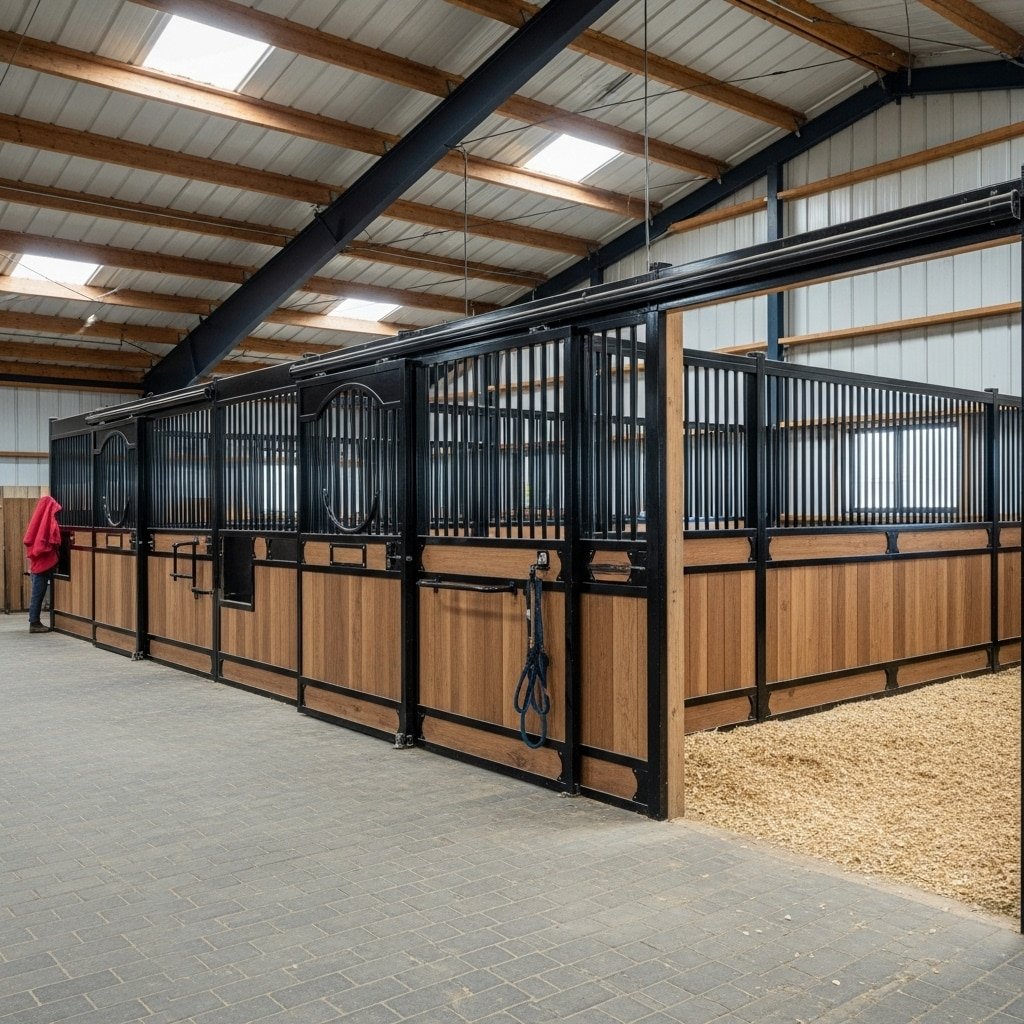
The hardware you choose has a huge impact on usable space. A swinging Stand door eats up valuable aisle real estate every time it opens. Sliding doors operate parallel to the stall front and don’t project into the walkway. Our Professional Series stable systems use smooth hidden track systems designed for this exact problem. This approach gives handlers and horses maximum clearance, a critical factor for safety and efficiency in narrow barn aisles.

Best 10 Design Features for Small Horse Barns
Wirksam Scheunendesign prioritizes horse safety and structural longevity. Focus on proper ventilation, langlebige Materialien, and smart space allocation for a functional, low-maintenance facility.
| Design Feature | Key Consideration |
|---|---|
| 1. Site Evaluation | Proper drainage, wind direction, and sun exposure. |
| 2. Stall Sizing | 12’x12′ minimum for average horses; larger for big breeds. |
| 3. Door Width | Minimum 4 feet wide to prevent hip injuries. |
| 4. Stall Partitions | Solid walls to prevent contact and injury. |
| 5. Ventilation | Ridge vents, cupolas, and open-front stalls for airflow. |
| 6. Barn Height | 10-12 feet minimum to prevent head strikes and aid air circulation. |
| 7. Aisle Width | 12 feet or wider for safe passage and equipment use. |
| 8. Durable Materials | Verzinkter Stahl and non-wood infills for longevity. |
| 9. Protected Windows | High placement with bars to Unfälle verhindern. |
| 10. Organized Storage | Dedicated, climate-controlled tack and feed rooms. |
1. Proper Site Evaluation
Before you build anything, analyze the site. Proper evaluation of drainage, prevailing winds, and sun exposure prevents future problems like muddy paddocks and foundation issues. Orienting the barn correctly maximizes natural ventilation and helps regulate temperature year-round.
2. Adequate Stall Sizing
The industry standard is a minimum stall size of 12’x12. For larger breeds, 14’x14′ is better. A horse needs enough room to lie down fully reclined and get up again without touching the walls. Anything smaller compromises welfare and safety.
3. Stall Door Width
Stall doors must be at least 4 feet wide to prevent hip injuries as horses enter and exit. Sliding doors are safer and more space-efficient in barn aisles than swinging doors, which can block traffic or startle other horses.
4. Solid Stall Partitions
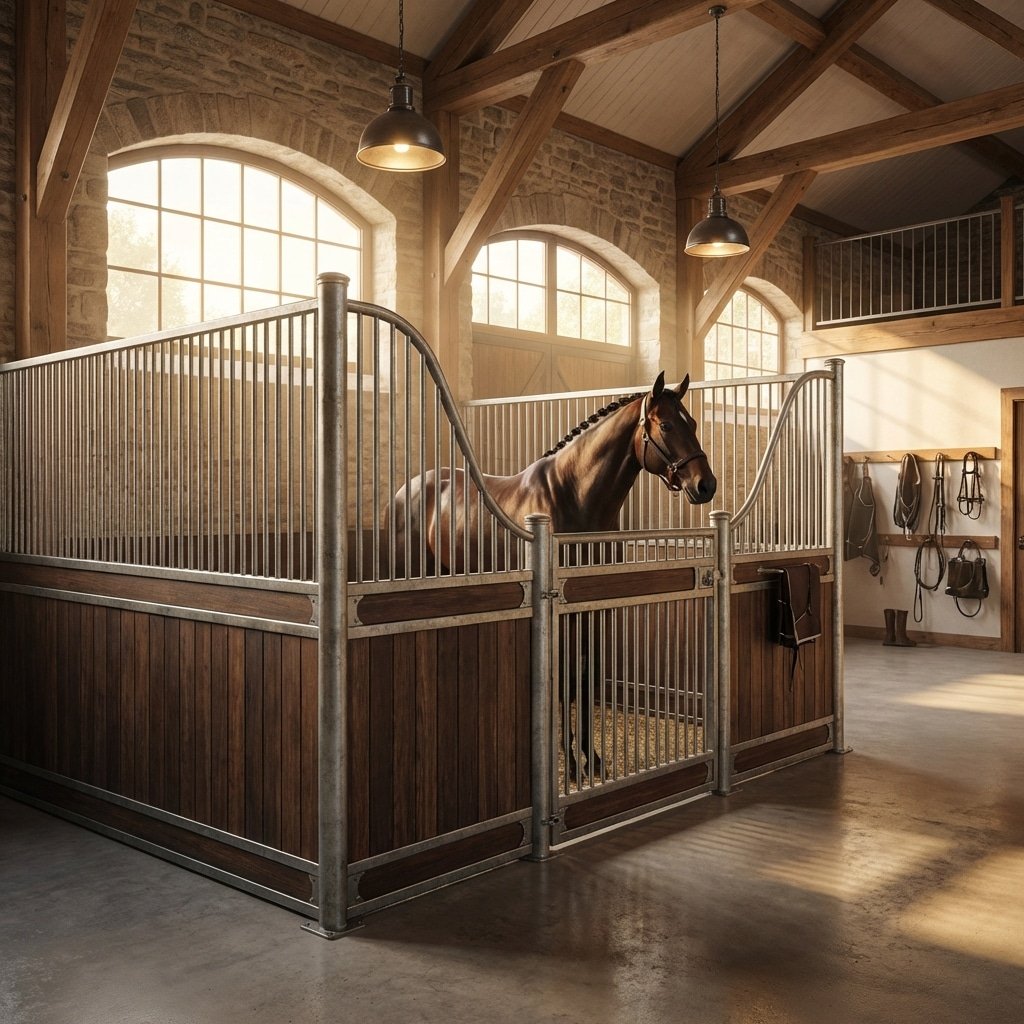
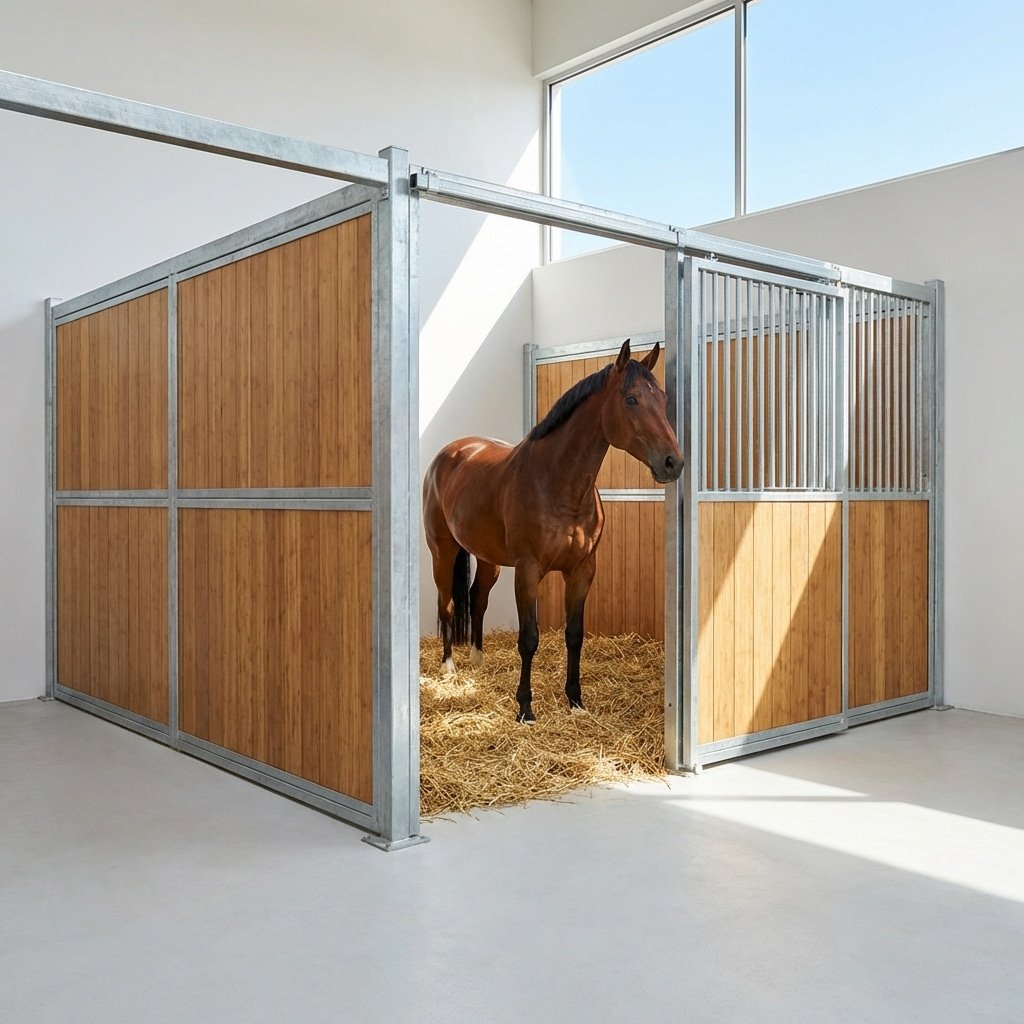
Solid partitions between stalls prevent biting, kicking, and the spread of respiratory issues. While wood is traditional, modern materials like high-density bamboo or impact-absorbing HDPE offer superior durability and a “zero maintenance” advantage. Good design also ensures minimal gaps at the bottom, creating a “cast-proof” stall that prevents a horse from getting a leg stuck.
5. Natural Ventilation Systems
Good airflow is non-negotiable for horse health. Design elements like ridge vents, cupolas, and Dutch doors promote cross-ventilation. Stall fronts with an open grill design also encourage vertical airflow through a “stack effect,” pulling stale air up and out of the stall.
6. Appropriate Barn Height
A minimum ceiling height of 10-12 feet is essential to prevent head strikes and improve air circulation. If you plan to ride inside the aisles, you need 12-14 feet. Low ceilings trap heat and moisture, increasing the risk of respiratory problems and injury.
7. Wide, Safe Aisles
Aisles should be 12 feet wide at a minimum. This allows two horses to pass safely and provides enough room for equipment like a small tractor for mucking out. The flooring must be non-slip; textured concrete or rubber pavers are common choices.
8. Durable, Horse-Safe Materials
The materials define the barn’s lifespan and safety. For steel components, insist on a “hot-dip after fabrication” galvanizing process that conforms to ISO 1461 standards. This ensures every cut and weld is coated. Competitors often use cheaper pre-galvanized tubes that rust at the welds. The frame should be built from Q235B structural steel, with a wall thickness of at least 2.0mm to withstand kicks.
9. Protected Windows and Openings
Windows provide natural light but can be a hazard. They should be placed high (over 5 feet), made of tempered glass, and protected with bars spaced 3 inches apart or less. This spacing prevents a horse from getting a hoof or head stuck.
10. Organized Storage and Feed Rooms
A well-run barn has dedicated rooms for tack and feed. These spaces need to be climate-controlled and rodent-proof to protect expensive equipment and maintain feed quality. Integrating storage efficiently streamlines daily chores and keeps the main barn aisles clear and safe.
Why Sliding Doors Are Mandatory for Small Aisles?
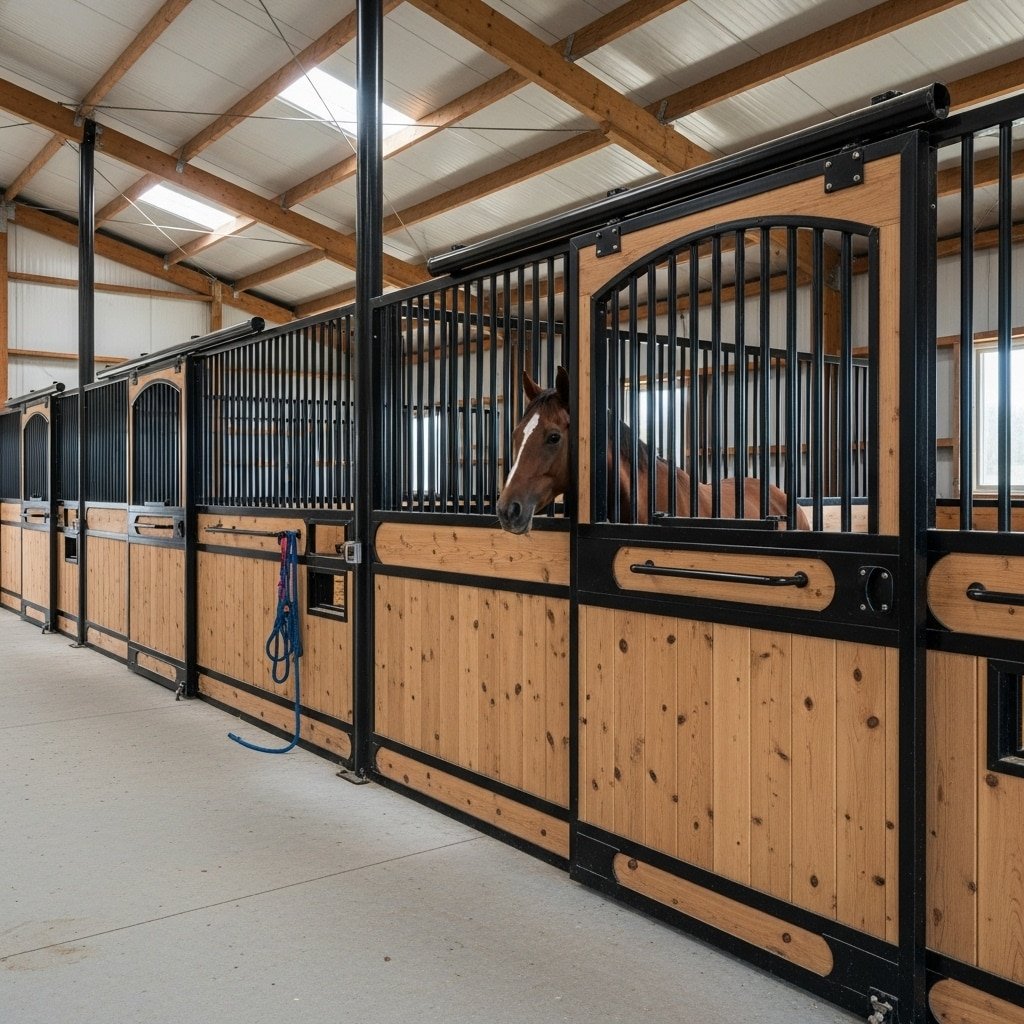
Schiebetüren are essential for narrow aisles because they have zero swing clearance. They move parallel to the wall, preserving the entire walkway for safe movement.
The Advantage of Zero Swing Clearance
A hinged door swings out, stealing valuable aisle width and creating a collision risk. A sliding door moves parallel to the stall front. This zero swing clearance keeps the entire walkway open for handlers, wheelbarrows, and other horses. It completely eliminates the safety hazard of a door swinging open unexpectedly into a narrow path.
Ensuring Smooth Flow with a Hidden Track System
Our Professional Series stables use a hidden track system to guarantee this smooth flow. The design protects the rolling mechanism from dust and debris, which ensures quiet, reliable operation for years. With no exposed track on the floor, it also removes a critical tripping hazard for both horses and handlers in a tight space.
Can Rotating Feeders Save You 5 Square Feet?
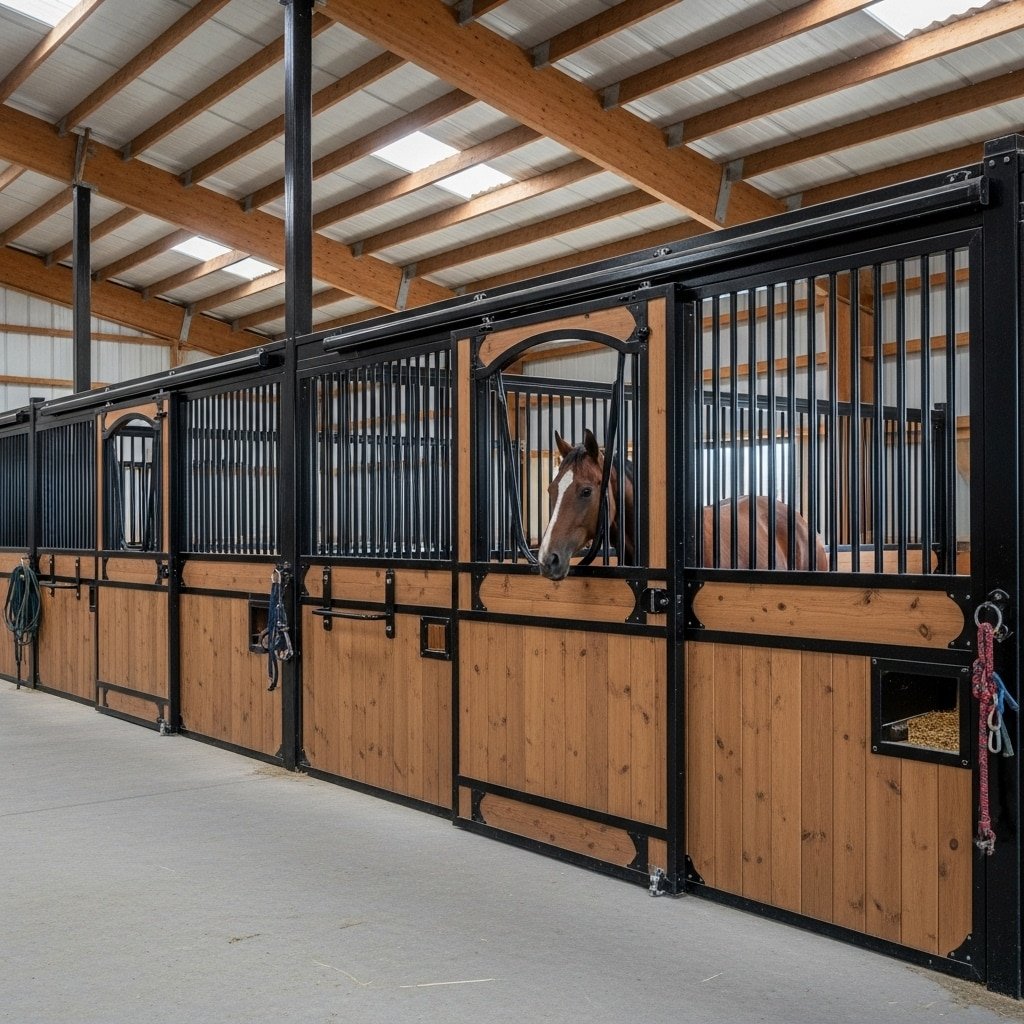
Yes. Swivel feeders rotate into the stall front, clearing the aisle of obstructions. This reclaims usable space, making workflow safer and more efficient in standard 12ft aisles.
How Fixed Feed Options Consume Aisle Space
Traditional feed doors or corner mangers permanently stick out into the barn aisle. This intrusion narrows the walkway, creating an obstruction for horses, carts, and equipment. The space they occupy is lost, shrinking the barn’s functional area.
The Design of the Aisle-Clearing Swivel Feeder
The swivel feeder solves this by design. Its mechanism allows the entire feed pan to rotate into the stall front, leaving a completely flush surface in the aisle. This eliminates any permanent protrusion, maximizing clear passage. It’s an engineered feature included in our Professional Series to improve barn workflow and space utilization without compromising feeding access.
How to Integrate a Tack Room in a 4-Stall Layout?
A tack room is typically a 12×12 space, equivalent to one stall, positioned off a center aisle or at a shed row’s end using standard partition Platten.
Positioning the Tack Room for Daily Workflow
A center aisle design lets you place the tack room right off the main walkway for central access to equipment. For a shed row barn, making the first or last stall a tack room creates a clear start and end point for daily work. Placing the tack room next to a wash rack combines two functions into one efficient zone for grooming and tacking up.
Using Modular Partitions to Build the Tack Room
The tack room walls are built using the same Hot-Dip Galvanized partition panels as the Pferdeboxen. This ensures a uniform look and maintains structural integrity. You can select either zero-maintenance HDPE or high-density Bamboo infill for the walls, matching the rest of the barn. Our flat-pack system allows for flexible placement and simple connection, making the integration straightforward.
Get Weatherproof Horse Stables Built to Last

Abschließende Überlegungen
While pre-galvanized stables offer a lower upfront cost, the Hot-Dip After Fabrication process (ISO 1461) is the only way to prevent rust at the welds. This specification protects your reputation from warranty claims. Selling durable systems builds the long-term trust that secures repeat business.
The next step is to verify our engineering for yourself. We recommend a trial order to confirm the material quality and flat-pack efficiency firsthand. Contact our team to get a detailed quote and discuss your project specifications.
Häufig gestellte Fragen
What kind of rust protection do your stables have?
Unser stables undergo a ‘Hot-Dip Galvanization After Fabrication’ process. This means the entire steel Panel is fully welded before being submerged in molten zinc, conforming to ISO 1461 standards. This provides a coating of over 70 microns, ensuring comprehensive Rostschutz, especially at the weld points.
What is the difference between your HDPE and Bamboo infill options?
HDPE is a UV-stabilized, impact-absorbing plastic that offers a zero-maintenance solution. High-density strand-woven bamboo is an eco-friendly option that is three times harder than oak, providing extreme durability and natural resistance to mold and decay.
How are the stables shipped to distributors?
We use a steel pallet flat-pack system for all shipments. This method protects the components during transit and allows for much denser loading, fitting 30-45 sets in a 40HQ container, which significantly reduces per-unit freight costs for our B2B clients.
Do you sell single stables to individual buyers?
As an OEM/ODM source factory, our business model is strictly B2B. We focus on serving distributors and contractors handling large projects. We do not retail single stable units directly to end-users.
Can you fit a wash rack in a 4-stall barn?
Yes, it is generally feasible with proper planning. A wash rack should be at least 8 feet wide by 12 feet long, with 10′ x 12′ being a common recommendation. This space can often be integrated into a well-designed 4-stall barn layout, either adjacent to the stall row or as part of a wide aisle system, provided there is adequate drainage.
Is a 36×24 foot barn big enough?
A 36×24 foot barn provides 864 square feet, a versatile medium size. It can comfortably hold up to two vehicles, house several animals with custom stalls, or serve as a workshop or storage area. Whether it is ‘big enough’ depends entirely on your specific needs, from simple storage to a small commercial operation.
How should I store hay in a small barn?
To store hay safely in a small barn, focus on elevation, ventilation, and proper stacking. Never store hay directly on the ground; use wooden pallets or a gravel base to prevent moisture absorption. Ensure good airflow by leaving at least 18-24 inches of space between the hay stacks and the barn walls and ceiling.
Do I need a dedicated feed room?
A dedicated feed room is highly recommended for horse safety and efficient barn management. It prevents horses from accidentally overeating, which can cause serious health issues like colic or laminitis. A secure, rodent-proof room ensures feed stays fresh, organized, and safely away from unintended access.
Can I use the barn aisle for grooming?
Using the main aisle for grooming is not recommended due to safety risks. An aisle is a high-traffic area, and having a horse on crossties can create a hazard for other horses and handlers passing through. The professional standard is a dedicated grooming stall, which provides a safer, more controlled environment.
What is the smallest safe size for a tack room?
The smallest recommended size for a functional tack room is about 10×10 feet. This size is typically adequate for a barn with 4 to 12 stalls, assuming you use vertical storage like wall-mounted saddle racks and cabinets to keep the floor clear. For larger barns or if the room will also store feed, a larger space is necessary.

 German
  English
  Spanish
  French
  Arabic
0 Kommentare