


Smart Escapers expose the critical liability hidden within standard agricultural hardware. Relying on simple gravity latches for dexterous horses invites veterinary costs and property damage that far exceed the price of engineered security. Facility managers cannot afford the risk of a loose animal navigating a high-traffic aisle.
This analysis benchmarks escape-proof mechanisms against the DB Stable Professional Series standard. We evaluate the mechanical necessity of 304 Edelstahl internal springs to prevent ammonia corrosion and the safety benefits of flush-mount designs that eliminate snag hazards.
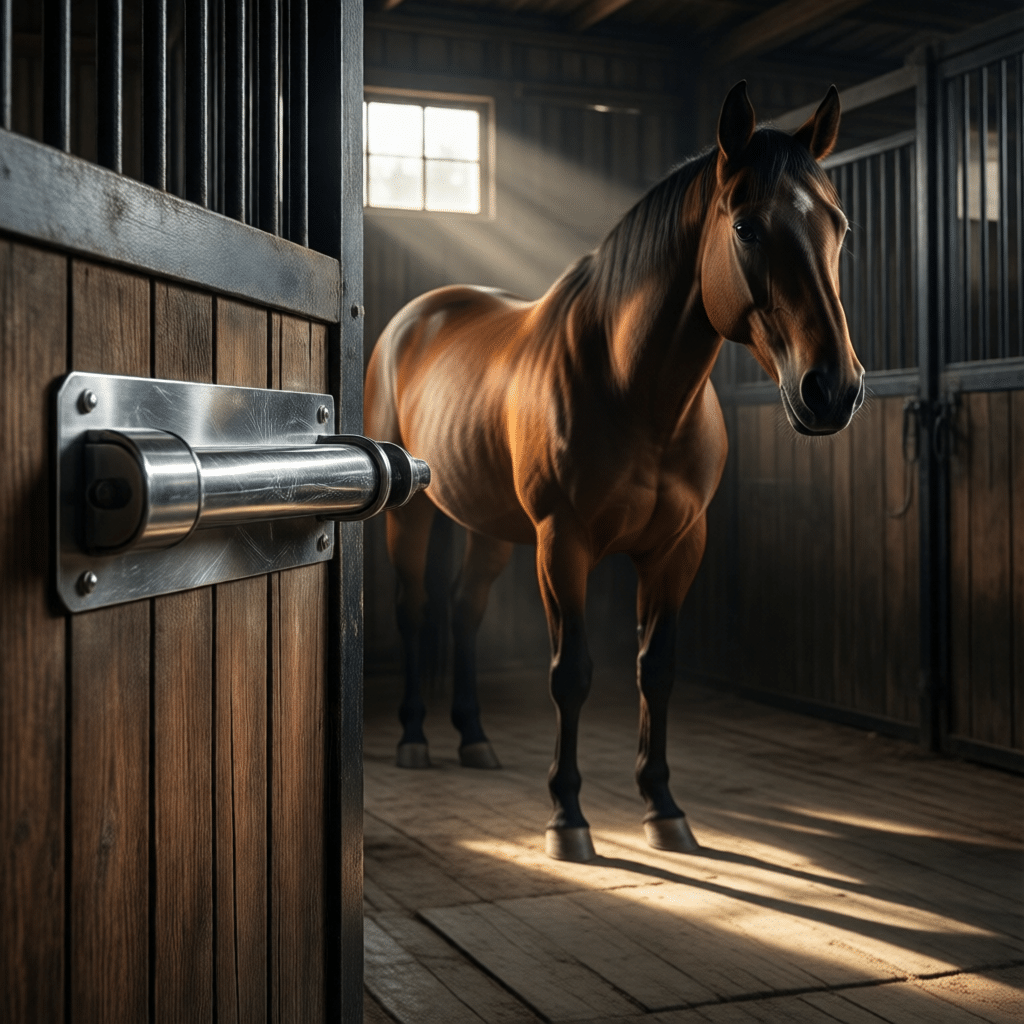
The “Houdini” Horse: How They Pick Simple Latches
Horses utilize dexterous prehensile upper lips to manipulate slide bolts like human fingers. Standard agricultural hardware cannot withstand this tactile curiosity, requiring complex, engineered locking mechanisms.
The Mechanics of Manipulation: Upper Lip Dexterity
Die meisten facility managers assume escape attempts result from brute force, but the most successful escapes come from finesse. Horses possess a prehensile upper lip capable of fine motor skills comparable to human fingers. This anatomical feature allows them to grasp, twist, and lift objects with surprising precision.
Research into equine behavior confirms that escape artists, such as the documented cases of “Kroni” and “Marisa,” do not open doors by accident. These horses deliberately manipulate sliding bolts and twist knobs, often waiting until they are unobserved to execute the maneuver. This behavior typically originates in foalhood as oral investigation and play. Over time, what starts as chewing or mouthing a latch evolves into a learned mechanical process.
Unlike a kick or a shove, this technique relies entirely on tactile sensitivity. The horse explores the mechanism, identifies the moving parts, and applies directed pressure to exploit the latch’s operation. If a mechanism can be defeated by a simple push, lift, or slide, a curious horse will eventually solve the puzzle.
Engineering Safety: Why Standard Hardware Fails
The primary failure point in many stables is the reliance on conventional agricultural latches. These generic fittings are designed for human convenience on garden gates, lacking the complexity required to baffle a determined 500kg animal. Simple slide bolts or gravity latches offer no resistance to the “lift and slide” motion of a horse’s lip.
This vulnerability drives DB Stable’s design philosophy: “Engineering Safety, Defining Standards.” We explicitly reject generic retail fittings because they address the wrong problem. A latch must do more than hold a door shut; it must present a cognitive barrier to the animal.
Standard hardware fails because it is linear. A horse pushes, and the bolt moves. To prevent “Houdini” escapes, the hardware requires complex locking systems—such as spring-loaded plungers or multi-step engagement mechanisms—that demand a level of simultaneous dexterity and force that a horse’s lip cannot replicate. Relying on simple physical barriers is a safety risk; professional facilities require engineered solutions.
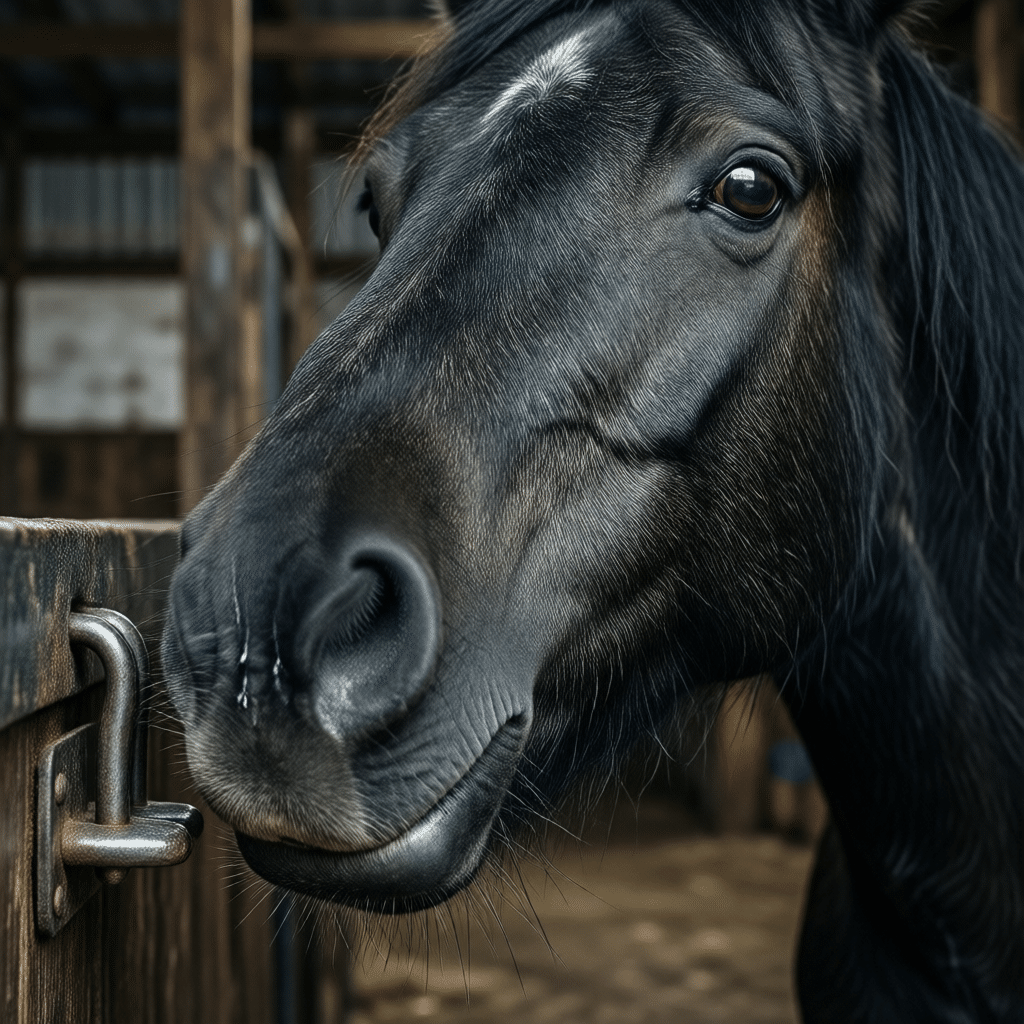
Gravity Latches vs. Spring-Loaded Plunger Latches
Gravity latches offer simplicity but fail if posts shift; spring-loaded plungers provide superior security against vibration but demand 304 Stainless Steel to prevent internal rust.
| Merkmal | Gravity Latch | Spring-Loaded Plunger |
|---|---|---|
| Mechanics | Passive pivot drop | Active kinetic tension |
| Security Profile | Vulnerable to “jiggling” | High vibration resistance |
| Maintenance Risk | Fails if posts settle/shift | Spring fatigue (if not 304 SS) |
| Primary Use | Low-traffic paddocks | Commercial high-traffic aisles |
Operational Mechanics: Gravity Drop vs. Spring-Loaded Tension
The choice between gravity and spring mechanisms often comes down to facility workflow and the specific “talent” of the horses housed. Gravity latches rely entirely on pivot physics. A latch arm drops into a catch plate as the door closes. This design is elegant in its simplicity but unforgiving in practice; it requires the gate post to be perfectly plumb. If the post shifts even a few degrees due to ground settling, the latch arm misses the catch, leaving the door unsecured.
Spring-loaded plunger latches utilize active kinetic energy to drive a steel bolt into a receiver. This creates positive engagement that resists vibration. In high-traffic commercial aisles, staff prefer this mechanism because it allows for quick, one-handed operation—a critical feature when leading a horse or carrying tack. Conversely, gravity latches often require two hands to align properly if the door has sagged.
- The “Houdini” Factor: Clever horses can manipulate gravity latches by jiggling the door until the arm bounces out of the catch. Plunger latches require a specific pullback motion that is mechanically difficult for a muzzle to replicate.
- Vibration Resistance: When a horse kicks a door, a gravity latch can bounce open. A spring-loaded bolt remains seated under impact pressure.
Material Resilience: Ensuring Longevity with 304 Stainless Steel
Critics of spring-loaded latches often point to “seized springs” as a major failure point. This criticism is valid only when manufacturers cut costs by using carbon steel internal springs. In a stable environment, ammonia fumes from urine rapidly corrode standard steel, causing the internal spring to rust, lose tension, or snap entirely.
To eliminate this risk, we standardize **304 Stainless Steel** for every component in the DB Stable Installation Kit. This includes the internal springs, the plunger bolt, and the housing casing. Unlike zinc-plated alternatives that eventually succumb to the corrosive barn atmosphere, 304 grade steel maintains its tensile strength and smooth operation indefinitely, regardless of humidity or ammonia levels.
- Structural Shift: Gravity latches are technically “maintenance-free,” but they suffer immediately if the barn structure settles. Re-aligning a gravity latch often requires re-hanging the entire door or post.
- Weather Adaptability: In freezing climates (common in EU/North American markets), gravity latches can freeze shut if moisture collects in the catch. Spring latches with proper tolerances and high-grade steel resist binding in sub-zero temperatures.
Precision-Engineered Stables With 20-Year Durability

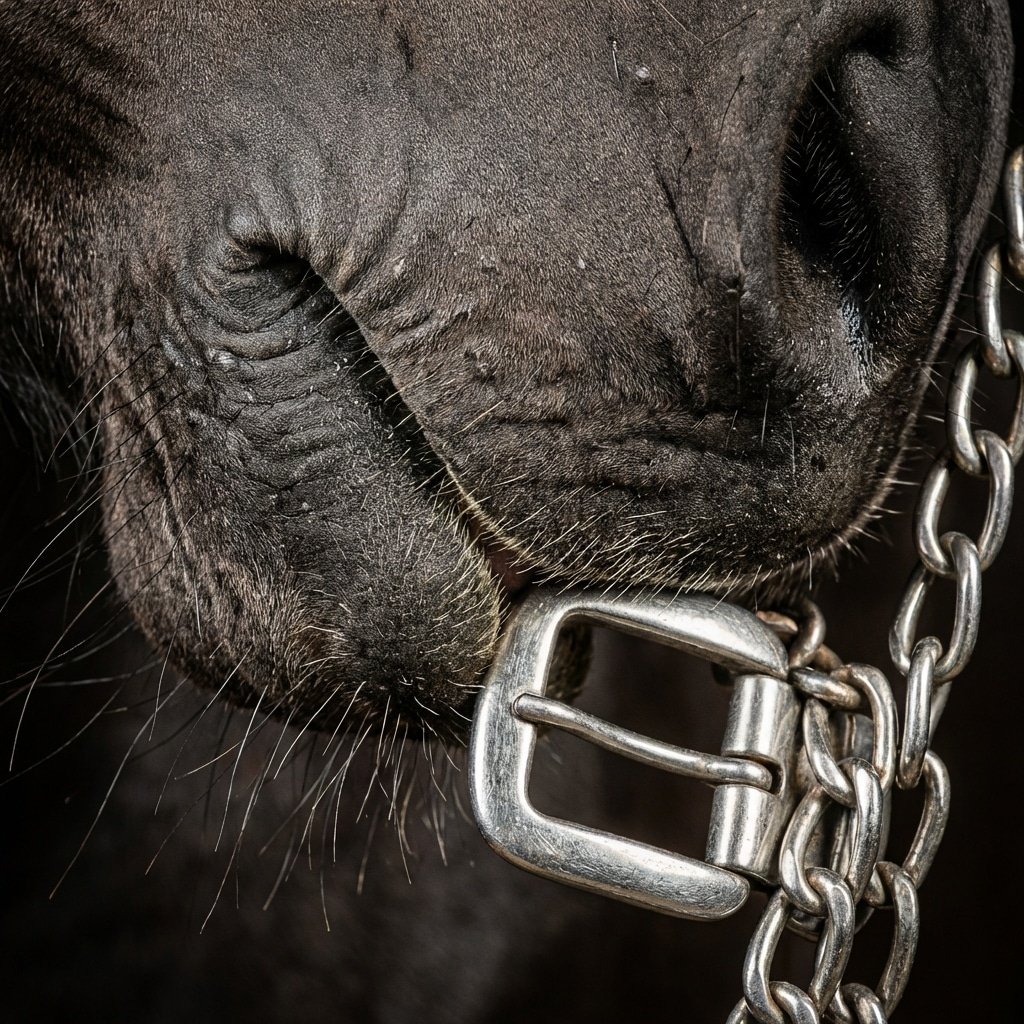
The Flush Mount Advantage: Preventing Aisle Lacerations
Flush mount latches eliminate protruding bolts and strike points, preventing costly shoulder lacerations and rug tears in high-traffic stable aisles.
Minimizing Snag Hazards in High-Traffic Zones
Traditional gravity latches typically protrude 3 to 5 inches into the aisleway. In a busy facility, this creates a static strike point. When a horse rushes out of a stall or turns sharply, that protruding metal acts like a hook. These impacts frequently result in shoulder lacerations or torn rugs, creating unnecessary veterinary costs and equipment damage.
We apply our “Engineering Safety” core principle to eliminate this risk. Flush-mounted designs recess the latch mechanism directly into the door profile. This removes the catch point entirely, ensuring the aisle width remains clear and safe for moving livestock. A smooth surface allows horses to brush against the frame without injury, a critical requirement for high-turnover barns.
Flush Integration within the Professional Series
The DB Stable Professional Series integrates this hardware as a standard specification rather than an aftermarket add-on. This series utilizes a Hidden Track System that necessitates flush components for proper mechanical operation.
- Recessed Profile: Hardware sits inside the frame, preventing the “hip-check” injuries common in economy stables with external bolt-on latches.
- Material Spec: We use 304 Edelstahl for all moving parts to resist corrosion while maintaining structural integrity under impact.
- System Logic: The flush design supports the Professional Series’ streamlined aesthetic and functional safety requirements.
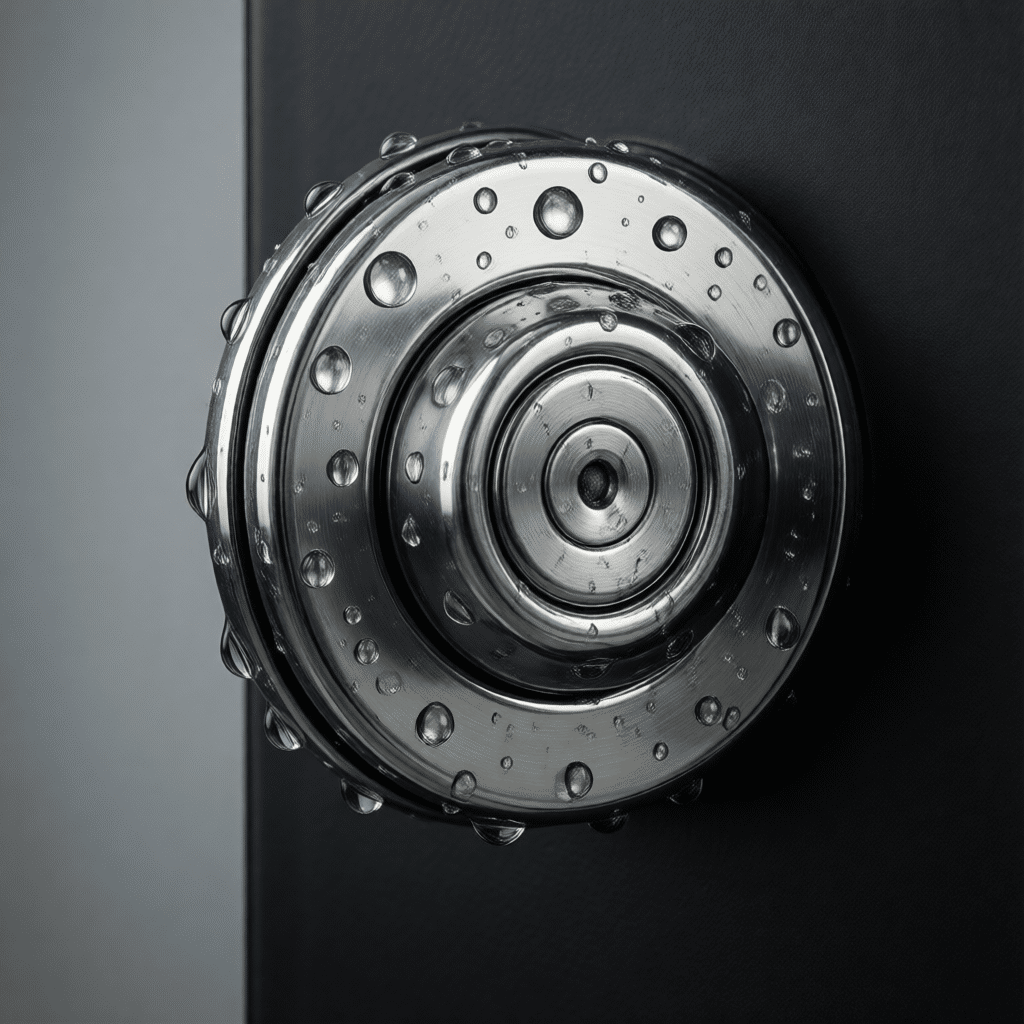
304 Stainless Steel: Springs that Never Rust
304 Stainless Steel prevents mechanical seizure in high-ammonia stable environments. Unlike galvanized steel, it maintains elasticity and tensile strength for the lifetime of the stall.
The Chemistry of Corrosion Resistance
Standard steel springs fail quickly in horse stables. The environment is naturally damp and rich in ammonia, a combination that accelerates corrosion on basic galvanized or carbon steel wire. We rely exclusively on 304 Stainless Steel because its metallurgy fundamentally rejects this corrosion. The alloy forms a passive oxide layer that repairs itself if scratched, acting as a permanent shield against barn acids.
- Composition: Contains 17-19% Chromium and 8-10% Nickel for maximum rust defense.
- Industry Standard: Meets ASTM A 313 specifications for cold-drawn spring wire.
- Ammonia Resistance: Outperforms standard carbon steel in urine-rich stable atmospheres.
Reliability in Spring-Loaded Plunger Latches
The internal spring is the most common failure point in plunger latches. Moisture often gets trapped inside the latch housing, turning it into a rust chamber for inferior materials. If a spring corrodes, it loses tension or snaps, leading to a “frozen latch.” This is a critical safety hazard during emergencies where a door must open instantly. 304 grade springs maintain their mechanical properties regardless of internal moisture.
- Consistent Tension: Maintains high tensile strength (125-325 psi) without fatigue.
- Fracture Resistance: Does not brittle-fracture over time like rusted carbon steel.
- Operational Safety: Ensures the plunger mechanism engages and releases smoothly for decades.
Abschließende Überlegungen
Relying on generic agricultural hardware invites liability for equine injuries and escape incidents that will damage your dealership’s reputation. By standardizing on our 304 Stainless Steel plunger mechanisms, you deliver the “escape-proof” reliability and corrosion resistance professional facilities require. This hardware transforms a commodity component into a high-value safety feature that justifies a premium margin.
Eliminate the risk of hardware failure in your supply chain by verifying our engineering standards directly. Request the Professional Series Specification Sheet today to review the flush-mount integration details for your upcoming bulk orders. Contact our team now to schedule a sample kit delivery and experience the difference in mechanical precision.



 German
  English
  Spanish
  French
  Arabic
0 Kommentare