


A stable floor gets inspected once, on the day it is laid. After that, nobody looks at the field until somebody stumbles in it. Rubber mat edges safety is the part that wears first and gets checked last: the border where the mat meets concrete, the seam where two mats shake hands, the threshold under every stall door that opens and closes many times a day.
For a dealer or a facility owner, the edge is also where warranty conversations start and end. A lifted lip or a spread seam is often the first thing photographed in a dispute, and the first thing a supplier will claim is misuse. The difference usually traces back to six spec lines that most purchase orders never contain.
Key Takeaways
- Most edge complaints are not material failures. They are transitions: mat-to-hardstanding, mat-to-mat, and mat-to-doorway each want a different answer.
- Straight-cut, beveled and ramped edges are three different products on a packing list. A ramped edge (a tapered border that lets hooves and wheels roll up onto the mat) still needs its taper length confirmed in writing, because this site publishes no edge dimensions.
- Interlocking teeth hide their problems until liquid finds the seam line. Sheet mats butt-joined on a flat base fail differently — a lone lifted corner is a base or trim issue, not a bad day.
- Drainage channels and floor falls cross mat borders in most aisles. The mat edge and the channel edge compete for the same few centimeters; the drawing has to decide who wins before the mats ship.
- Walk the perimeter with a straightedge and a wheelbarrow on delivery day, photograph what lifts, and tie the response to the 4-6 week global lead time. Replacing one mat on a complaint queue is not a plan.
Where Edge Problems Actually Start
Heavy rubber stays flat under load. That is the whole trick, and its limit. A mat behaves while something holds it down: a horse standing on it, a wall abutting it, or neighboring mats locked to it. Edge failures trace back to places where that holding force disappears — an open perimeter, a doorway, a joint.
Door thresholds are the worst case, not the rare case. A stall door swings across bare floor, then mat, then bare floor again, repeatedly through every feeding and mucking round. The crossing takes wheel loads from a muck barrow and casual hoof strikes. An untrimmed straight edge at that line curls eventually; a trimmed edge over a hollow base curls sooner.

Perimeter edges next to walls want the opposite treatment. Against a wall, the mat can run into a fixed stop; in a doorway, it must meet the floor gracefully with nothing to hold it. Ordering one profile for the whole building is how buyers end up with a curled lip at every stall front.
Edge Profiles: Straight-Cut, Beveled, Ramped
Three commercial edge styles cover nearly every stable application. The naming on quotations is loose — sellers call beveled pieces “ramped” and ship straight-cut stock against requests for either — so check the drawing, not the adjective.
| Edge profile | Where it belongs | What to confirm in writing |
|---|---|---|
| Straight-cut (square factory edge, no taper) | Walls, abutting stall fronts, seams between identical mats | Whether borders need separate trim pieces |
| Beveled (angled taper cut into the border) | Light-traffic borders, edges a person walks more than a barrow rolls over | Taper length and whether the bevel molds with the mat or is glued on |
| Ramped (long, shallow slope for hooves and wheels) | Doorways, thresholds, aisle crossings, trailer loading aprons | Slope run per mat thickness; load class under barrow wheels |
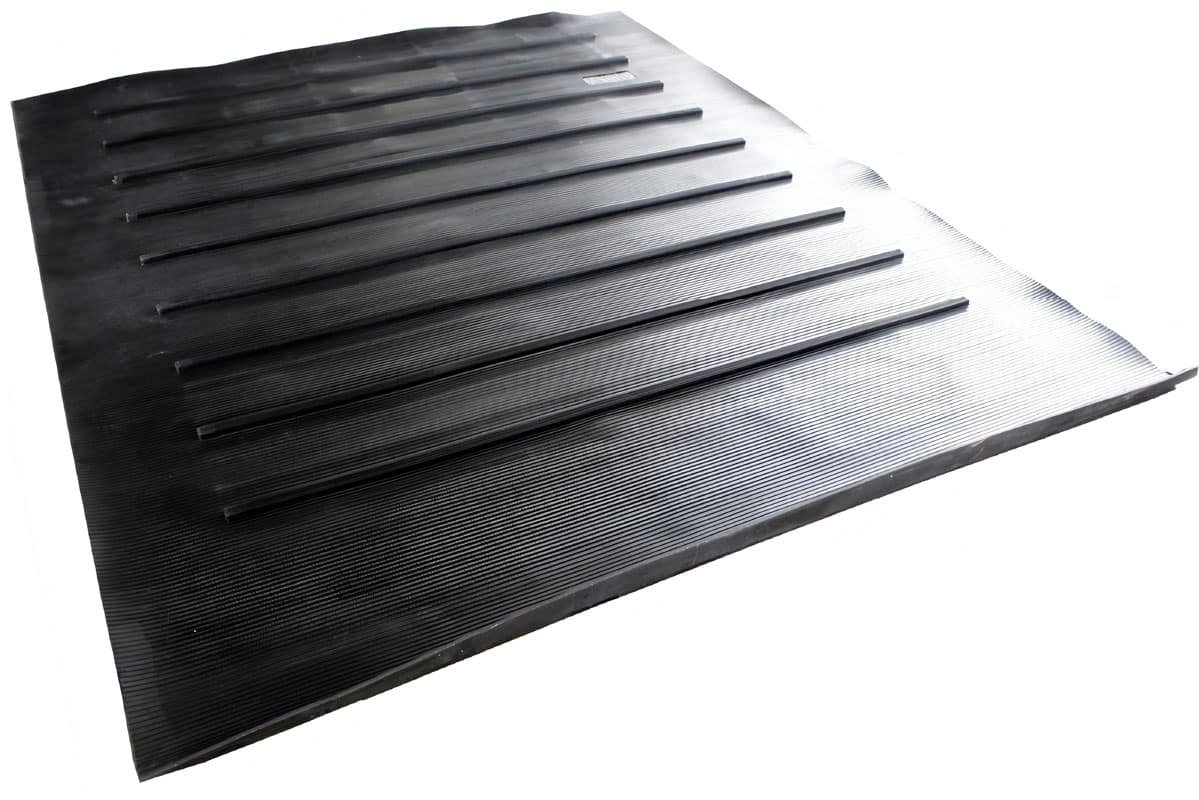
This site’s published flooring line describes heavy anti-slip rubber mats for stalls and arenas. It publishes no ramp lengths, bevel angles or mat thicknesses. Treat any such number quoted verbally as a draft until it appears on the order, because the trim geometry has to match the mat thickness it serves — a taper sized for a thin stable board goes to pieces under a barrow wheel on a thick arena mat.

Seams, Teeth and the Line Between Two Mats
The seam is an edge that nobody protects. Interlocking formats knit toothed borders together and resist spreading when the base is continuous and the mats came from one production run. Sheet formats butt two cut edges and rely on gravity and friction.
Three seam mechanisms deserve a named answer on the specification. First, debris: a toothed joint with a loose fit passes bedding down and packs it into the line, which holds moisture against the cut faces. Second, differential wear: two batches with slightly different surface texture or density wear at different rates, and the seam widens where they meet. Third, base flex: an interlock can only transfer load if both sides sit on the same support — a hollow spot under one tooth turns every step into a pry bar.
Our position: specify the edge per location instead of ordering one profile for the whole building, and let thresholds and drainage crossings have the longest, shallowest transition in the barn. It costs a line on the packing list and removes the two places edges most often fail.
Cut edges age differently from factory edges. A trimmed border exposes the mat body along its full height, so water and urine reach material that never saw the surface treatment. Ask how the supplier wants field cuts documented — sealed, painted, or accepted bare — before a fitter on site decides for you.
Six Lines the Order Must Contain
The format decision comes first. This site’s flooring guide walks interlocking versus sheet mats against different subfloors; teeth forgive an imperfect lay only when the base is sound. Whatever format you pick, the edge story is six written lines.
- Edge profile per location: straight-cut at walls, ramped or beveled at thresholds, named on the layout drawing.
- Transition geometry: taper or ramp run stated per mat thickness, since one trim cannot serve every board depth.
- Seam system: toothed interlock, butt joint with trim, or seam-welded; state which, and who supplies the closing strips.
- Subfloor handover: flatness and fall tolerance the mat contractor will accept, agreed between the concrete crew and the mat supplier before either mobilizes.
- Drainage crossings: which line the mat edge runs parallel to, and whether channel grates carry traffic at the seam.
- Batch single-sourcing: one production batch per room, so seams never join mats of different density or texture.
Receiving inspection takes an afternoon per barn. Run a straightedge along each threshold; push a loaded barrow over every crossing; press any perimeter corner that springs back. Photograph what lifts before signing. With a 4-6 week global lead time behind the order — and 1-2 weeks if Sydney or Warsaw regional stock covers the item — an undocumented complaint at month three becomes a purchase-order problem, not a warranty claim.
Cutting the mats is normal; improvising at the edges is not. Stable layouts never square up perfectly, and every installer trims borders to fit. The difference between a tidy barn and a trip-hazard inventory is whether those trimmed lines were planned on the drawing — and whether the trim pieces arrived in the same container as the field mats. The stall systems page shows what this factory builds around the flooring; the flooring itself is specified here: rubber stable mats, interlocking versus sheet.
Häufig gestellte Fragen
Do rubber stall mats need ramped edges everywhere?
No. Walls and fixed abutments suit straight-cut edges because something holds the mat down there. Ramped or beveled trim matters most where the mat meets open hardstanding: doorways, aisle crossings and drainage transitions.
Why does one corner of my mat keep lifting?
A single lifting corner usually means a hollow in the base under that corner, or a trim edge left unsupported at a crossing. Fix the support before blaming the mat; a new board over the same void repeats the story.
Are interlocking seams safer than butt joints?
On a continuous sound base, a tight toothed joint resists spreading better than two cut edges leaning on friction. On a poor base, the teeth concentrate movement at the joint and fail sooner. The base decides, not the keyword.
How do I order edge pieces from an overseas factory?
Put them on the same packing list as the field mats, with the layout drawing attached and quantities per room. A trim reorder follows the supplier’s standard production queue, so confirm the reorder lead time in writing and order spares at the start.
What minimum order applies to mats alone?
This site publishes minimums of 10 stall sets or 50 fence panels; a mats-only quantity is not published, so confirm it with the supplier in writing together with the edge profile lines above.
Schlussfolgerung
Edges and seams are where a stable floor is actually judged, because they are where load, moisture and traffic all concentrate on the few centimeters nobody specified. Profile per location, geometry in writing, one batch per room, and a straightedge on delivery day cover most of what goes wrong later.
Take the layout drawing to your supplier and make them answer the six lines before production starts — the rubber mats line and the stall systems page show what those details must match.



 German
 English
 Spanish
 French
 Arabic
0 Kommentare