


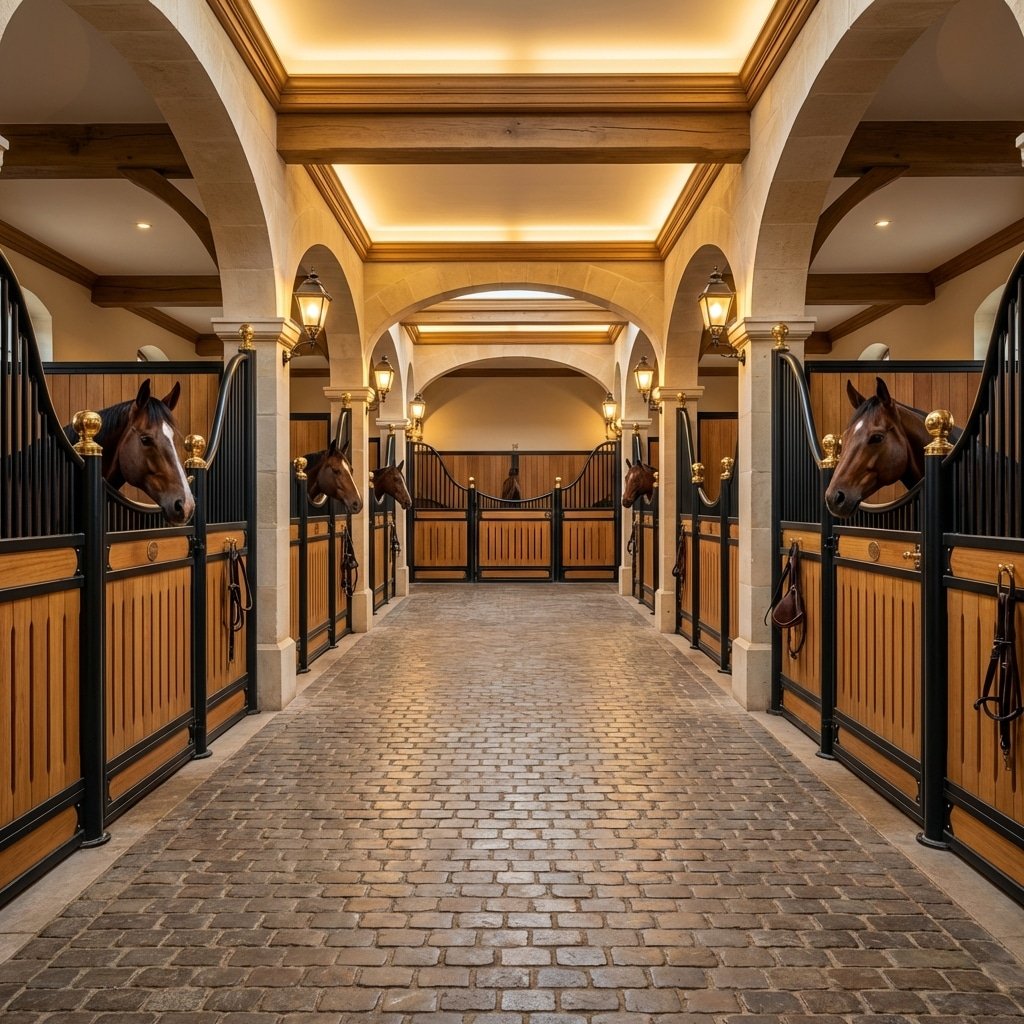
Bei der Beschaffung von Infrastrukturen für den Pferdesport in Frankreich muss das ästhetische Erbe des Ancien Régime mit der Langlebigkeit der modernen Industrie in Einklang gebracht werden. Die Verwendung von traditionellem Eichenholz oder standardmäßig lackiertem Stahl führt schnell zu Verformungen und Korrosion, was die Verwalter von Landgütern erhebliche Kosten für die regelmäßige Wartung und den Austausch von Arbeitskräften verursacht.
In diesem Bericht wird die Spezifikation der Royal Series im Vergleich zu traditionellem Holz bewertet, wobei der Schwerpunkt auf High-Density Strand Woven Bamboo mit einer Janka-Härte von über 3000 lbf liegt. Wir analysieren, wie Q345B-Stahl und die zweischichtige Verzinkung nach ISO 1461 das architektonische Prestige bewahren und gleichzeitig den in feuchtem europäischen Klima üblichen strukturellen Verfall verhindern.
Die Ästhetik des französischen Reiterhofs
Das französische Pferdedesign verwandelt Ställe durch strenge Symmetrie und monumentale Größe in architektonische Wahrzeichen. Die Royal-Serie modernisiert dieses Erbe durch die Kombination von hochbelastbarer Stahltechnik mit einer raffinierten “Dual Protection”-Oberfläche.
=”margin-top: 30px; margin-bottom: 15px; font-weight: 600; line-height: 1.3;”>Das Erbe von Versailles und Chantilly
Die Gestaltung von Ställen blieb bis zum 16. Jahrhundert rein zweckmäßig, bis François de Beauvau das Paradigma änderte. Inspiriert von der italienischen Architektur gab er die ersten Ställe in Auftrag, die Form und Funktionalität miteinander verbanden. Damit wurde das Pferd von einem einfachen Holzschuppen zu einer von Architekten entworfenen Struktur, die signalisierte, dass die Anlage selbst eine Machtdemonstration darstellte.
Die großen Ställe von Versailles und Château de Chantilly kodifizierten diesen Look. Diese “Paläste für Pferde” legten die Regeln fest, die wir auch heute noch in erstklassigen Gestüten sehen: monumentale Ausmaße und absolute Symmetrie. Architekten wie Jules Hardouin-Mansart legten den Schwerpunkt auf hohe Decken und verglaste Fenster, nicht nur aus Gründen der Pracht, sondern auch, um Licht und Belüftung zu maximieren - frühe historische Beispiele für die “Stack Effect Ventilation”, die wir in moderne Ställe einbauen.

Die Royal-Serie: Die Modernisierung des Estate Looks
Moderne Anwesen verlangen nach diesem historischen Prestige, ohne dass die Instandhaltung des Mauerwerks aus dem 18. Jahrhundert Probleme bereitet. Wir haben das Königliche Serie um diese Lücke zu schließen. Diese Linie greift die visuelle Sprache des Ancien Régime auf - europäische Bögen und dekorative Messingzierleisten - und nutzt gleichzeitig die strukturelle Integrität von Q235B- und Q345B-Stahl.
Das Hauptunterscheidungsmerkmal ist unsere “Dual Protection”-Beschichtung. Wir verwenden keine einfache Farbe. Wir verwenden eine hochwertige Pulverbeschichtung über unser Standardrahmen aus feuerverzinktem Stahl (ISO 1461). Dies sorgt für das elegante, raffinierte Finish, das für Privatanwesen erforderlich ist, und bietet gleichzeitig die für eine lange Lebensdauer erforderliche industrielle Korrosionsbeständigkeit.
- Struktureller Kern: 14-Gauge (2,0 mm - 2,5 mm) Stahlrohr, um eine “Kick-Proof-Garantie” zu gewährleisten.”
- Ästhetisches Detail: Integrierte Messing-/Goldknöpfe und geschwungene europäische Bögen.
- Infill-Optionen: 40 mm dickes High-Density Bamboo (Janka > 3000 lbf) für eine traditionelle Holzoptik, die verrottungsbeständig ist.
Europäische Bögen und Messingzierleisten an Pferdestallfronten
Das europäische Design verbindet ästhetische Messingzierleisten und gewölbte Bügel mit der Technik der Royal Series: hochbelastbarer Q345B-Stahl, geschützt durch eine zweischichtige Pulverbeschichtung über einer feuerverzinkten Oberfläche.
Die Architektur der europäischen Schleifen und Bögen
Das charakteristische Merkmal einer europäischen Stallfront ist die Abweichung von der geraden horizontalen Standardlinie. Wir verwenden hohe Bögen und “Swoop”-Designs - oft als “Low Euros” bezeichnet - um die visuelle Monotonie eines Stallganges zu durchbrechen. Diese Designwahl dient einem doppelten Zweck: Sie schafft eine offene, luftige Ästhetik, die die Anlage größer erscheinen lässt, und sie verwandelt den Stall von einem Käfig in ein architektonisches Möbelstück.
Funktional gesehen verbessert der gebogene Jochbereich die Sozialisierung. Durch das Absenken des Mittelpunkts der Tür oder der Frontplatte kann das Pferd seinen Kopf bequem heraushängen lassen, um den Gang zu beobachten und mit den Pflegern zu interagieren. Das Design schwingt jedoch nach oben zu den Pfosten (den Flügeln) hin, wobei eine hohe Barriere an den Seiten beibehalten wird, um die Pferde davon abzuhalten, herauszuspringen oder ihre Nachbarn zu beißen. Dieses Gleichgewicht zwischen Offenheit und Eingrenzung ist die zentrale technische Logik hinter der Kurve.
Royal Serie Spezifikationen: Messingzierleisten auf doppelt beschichtetem Stahl
Ästhetischer Luxus bedeutet nichts, wenn die darunter liegende Struktur innerhalb von fünf Jahren korrodiert. Die DB Stable Royal Series zeichnet sich durch die Anwendung eines “Dual Protection”-Systems aus, das viele Wettbewerber aus Kostengründen weglassen. Während Standard-Luxusboxen oft nur schwarz gestrichen sind, um gut auszusehen, werden unsere Boxen in einem speziellen mehrstufigen Prozess auf Langlebigkeit ausgelegt.
- Der Dual-Coat-Standard: Wir pulverbeschichten nicht direkt über rohem Stahl. Jedes Bauteil der Royal Series durchläuft Feuerverzinkung nach der Herstellung (BS EN ISO 1461). Erst nachdem die Zinkschicht ausgehärtet ist, tragen wir den architektonischen Pulverlack auf. Wenn die Farbe durch einen Huf zerkratzt wird, verhindert die darunter liegende Zinkschicht, dass sich Rost ausbreitet.
- Poliertes Messing Integration: Die dekorativen Endstücke sind solide Akzente, kein billiges Plastik. Diese Messingkappen sind in das Pfostendesign integriert und dienen als funktionale Verschlüsse für die hochbelastbaren Pfosten, während sie den charakteristischen goldfarbenen Kontrast zur schwarzen oder farbigen Pulverbeschichtung bilden.
- Hochbelastbarer Q345B-Stahl: Unter der luxuriösen Oberfläche verbirgt sich ein Rahmen aus hochfestem, niedrig legiertem Stahl Q345B. Dies ist der Standard für kalte Klimabedingungen und bietet eine höhere Schlagzähigkeit als der Standard Q235B. Wir verwenden ausschließlich Wandstärken der Stärke 14 (2,0 mm bis 2,5 mm), um sicherzustellen, dass die Box den Tritten eines Warmbluts standhält, ohne sich zu verbiegen.
Diese Kombination stellt sicher, dass die Stallfront nicht nur eine dekorative Fassade ist, sondern ein struktureller Wert, der der rauen, ammoniakreichen Umgebung eines Arbeitsstalls standhält.
Modulare Pferdeställe mit 20-Y

Die Holzdebatte: Warum sich Eichenholz in feuchten Regionen verzieht
Eichenholz verzieht sich, wenn die Feuchtigkeit unter den Sättigungspunkt der 25-30%-Fasern fällt, was zu einer ungleichmäßigen Schrumpfung führt. Litzengeflochtener Bambus eliminiert dieses Risiko durch hochverdichtete Kompression und Harzbindung.
Die Wissenschaft der Fasersättigung und des hygroskopischen Stresses
Holz wirkt im Wesentlichen wie ein Schwamm. Es nimmt Feuchtigkeit auf, wenn die Luft feucht ist, und gibt sie ab, wenn die Luft trocknet. Dieser hygroskopische Austausch bewirkt, dass sich die physikalischen Abmessungen des Holzes ständig ändern. Der kritische Versagenspunkt liegt beim Fasersättigungspunkt (FSP), der ungefähr zwischen 25% und 30% Feuchtigkeitsgehalt liegt.
Wenn die Umgebungsfeuchtigkeit das Holz zwingt, diese Schwelle zu überschreiten, schrumpfen und quellen die Fasern. Eiche stellt hier aufgrund ihrer breiten Faserstruktur eine besondere Herausforderung dar. Im Vergleich zu dichteren Hölzern nimmt sie Feuchtigkeit ungleichmäßig und schnell auf. Dadurch entstehen erhebliche innere Spannungen, die das Brett zwingen, sich zu wölben oder zu beugen, um den Druck abzubauen. In einer stabilen Umgebung führt dies zu klappernden Trennwänden und beeinträchtigt die strukturelle Integrität.
Warum stranggeflochtener Bambus besser ist als herkömmliches Eichenholz
Um Verformungen zu vermeiden, sind wir bei unserer Professional- und Royal-Serie von traditionellen Hölzern abgekommen. Wir verwenden High Density Strand Woven Bamboo. Dabei handelt es sich nicht um herkömmliches Holz, sondern um ein technisches Material, bei dem die Bambusfasern zerkleinert und unter extremem hydraulischem Druck zu einem einheitlichen Brett zusammengepresst werden.
- Janka-Härte > 3000 lbf: Dieses Material ist dreimal härter als Eichenholz und daher praktisch unempfindlich gegen Kratzer und direkte Tritte.
- Beseitigung der Leere: Durch die Hochdruckverdichtung werden die natürlichen mikroskopisch kleinen Hohlräume im Eichenholz beseitigt, so dass sich keine Feuchtigkeit ansammeln oder ein Aufquellen verursachen kann.
- Widerstandsfähigkeit gegen den Klimawandel: Die harzgebundene Struktur ist von Natur aus schimmel- und fäulnisbeständig und gewährleistet eine lange Lebensdauer, selbst in feuchten europäischen oder australischen Wintern.
Der geflochtene Bambus erreicht eine Janka-Einstufung von über 3000 lbf und bietet die dreifache Dichte von Red Oak, um schweren Stößen von Pferden standzuhalten, ohne abzusplittern.
| Material Spezifikation | Janka-Härte (lbf) | Leistungsprofil |
|---|---|---|
| Standard Nadelholz (Kiefer) | 380 - 690 | Hohes Bruchrisiko; gefährliche Splitter beim Aufprall. |
| Traditionelle Roteiche | ~1,290 | Mäßige Haltbarkeit; anfällig für Kauen. |
| Strand-Woven-Bambus | 3,000+ | Industrielle Dichte; tritt- und krippenfest. |

Die Bewertung des Janka 3000 verstehen
Die Janka-Skala ist der Industriestandard für die Messung der Holzdichte. Sie berechnet die Kraft, die erforderlich ist, um eine 0,444-Zoll-Stahlkugel halb in das Material einzubringen. Standard-Roteiche, oft der Maßstab für heimisches Laubholz, hat einen Wert von etwa 1.290 lbf. Unser stranggeflochtener Bambus erreicht durchweg Werte über 3.000 lbf. Damit liegt seine Dichte in der gleichen Kategorie wie die von Ipe und anderen exotischen Harthölzern und übertrifft bei weitem die strukturelle Kapazität von herkömmlichem stabilen Holz.
Wir erreichen diese Dichte durch ein spezielles Herstellungsverfahren. Anstatt feste Scheiben aus dem Bambushalm zu schneiden, wird das Material in Fasern zerkleinert. Die Hersteller komprimieren diese Fasern mit Harz unter extremem hydraulischem Druck. Durch diese Verschmelzung entsteht ein kompositartiges Material, das die Schwachstellen der natürlichen Holzmaserung beseitigt.
Schlagzähigkeit in der Professional Series
Unsere Professional Series integriert dieses Material, um spezifischen Sicherheitsrisiken in stark frequentierten Ställen zu begegnen. Wir spezifizieren Plattenstärken zwischen 28 mm und 38 mm, um die strukturelle Integrität von Trennwänden zu maximieren. Der Hauptvorteil ist hier die Sicherheit und nicht nur die Langlebigkeit.
- Splitterschutz: Wenn ein Pferd gegen weichere Hölzer wie Kiefer oder Eiche tritt, zersplittert das Holz oft in scharfe Geschosse. Die Dichte von litzengeflochtenem Bambus absorbiert die Aufprallenergie, ohne dass es zu einem katastrophalen Ausfall kommt.
- Krippenwiderstand: Pferde, die auf Holz kauen, können eine Boxenfront in wenigen Monaten zerstören. Dieser Bambus ist zu dicht, als dass die Zähne ihn durchdringen könnten, so dass keine unansehnlichen Kauleisten aus Metall erforderlich sind.
- Strukturelle Stabilität: Der Hochdruckverleimungsprozess verhindert das Verziehen und Verdrehen, das bei Massivholz, das stabiler Feuchtigkeit ausgesetzt ist, üblich ist.
Das Duplex-System verbindet eine feuerverzinkte Zinkbasis mit einer Polyester-Pulverdeckbeschichtung. Diese Kombination verhindert Unterschichtkorrosion und sorgt gleichzeitig für die für Luxusimmobilien erforderliche ästhetische Oberfläche.
Das Duplex-System: Die Kombination von Opferzink mit Polyesterpanzerung
Herkömmliche Pulverbeschichtungen, die direkt auf blanken Stahl aufgetragen werden, versagen häufig in Reitumgebungen. Sobald ein Pferd gegen die Tür tritt oder ein Werkzeug die Oberfläche zerkratzt, dringt Feuchtigkeit in den Riss ein, wodurch sich Rost unter der Farbe ausbreitet. Dies führt zu Blasenbildung und Abblättern, bekannt als Unterschichtkorrosion. Das Duplex-System beseitigt diese Fehlerquelle, indem zuerst eine Zinkschicht aufgetragen wird.
Dadurch entsteht ein Synergieeffekt, bei dem sich die beiden Schichten gegenseitig schützen. Die äußere Pulverbeschichtung wirkt wie eine Barriere, die das Zink vor atmosphärischer Oxidation und UV-Zersetzung schützt. Wenn die Pulverschicht beschädigt wird, fungiert das darunter liegende Zink als Opferanode, die langsam oxidiert, um das Stahlsubstrat zu schützen, anstatt die Bildung von Rotrost zu ermöglichen. Diese Wechselwirkung verlängert die Lebensdauer des Stahls im Vergleich zur isolierten Verwendung eines der beiden Materialien erheblich.
Royal Series Ausführung: Pulverbeschichtung über ISO 1461 Verzinkung
Bei unserer Royal-Serie verwenden wir keine vorverzinkten Rohre, bei denen die Schweißnähte offen liegen. Wir verwenden ein “Hot-Dip After Fabrication”-Verfahren, bei dem der vollständig geschweißte Stahlrahmen in geschmolzenes Zink getaucht wird. Dies gewährleistet eine innere und äußere Abdeckung, bevor eine kosmetische Beschichtung aufgebracht wird. Der Erfolg dieses Systems hängt von der strikten Einhaltung der Normen für die Oberflächenvorbereitung ab, um zu gewährleisten, dass das Pulver chemisch und mechanisch auf dem Zink haftet.
- Basisschicht Standard: Wir halten uns an BS EN ISO 1461, die eine durchschnittliche Zinkauflage von mehr als 85 Mikrometer für Strukturteile und 70 Mikrometer für Schläuche.
- Vorbereitung der Oberfläche: Die verzinkte Oberfläche wird feingestrahlt oder chemisch geätzt, um ein Profil zu erzeugen, das das Pulver verankert und eine Delamination verhindert.
- Leistung: Diese technische Schicht ist speziell auf die Beständigkeit gegen Ammoniak aus Urin und ständige Feuchtigkeit ausgerichtet und sorgt für ein luxuriöses Aussehen, ohne die strukturelle Integrität zu beeinträchtigen.
Häufig gestellte Fragen
Was macht den ‘französischen’ oder ‘europäischen’ Stil von Pferdeboxen aus?
Europäische Boxenfronten setzen auf eine offene, soziale Architektur statt auf die für Standard-Schiebetüren typische Isolation. Das Markenzeichen des Designs sind Flügeltüren mit einem ‘High-Low’-Profil - geschwungene Flügel, die nach unten fallen, um den Pferden den Kontakt zu ermöglichen - und mit Messing- oder Goldzierleisten versehen sind. Diese Konfiguration maximiert die Belüftung und die visuelle Eleganz und spiegelt die Ästhetik gehobener Anwesen wider, während sie gleichzeitig dafür sorgt, dass die Pferde sicher eingeschlossen und dennoch mit der Stallumgebung verbunden bleiben.
Warum empfehlen Sie Bambus gegenüber herkömmlicher Eiche für Stallausfachungen?
Eichenholz ist ein traditioneller Favorit, aber es ist hygroskopisch - es nimmt Feuchtigkeit auf, was bei feuchten Stallbedingungen zu Verzug und Fäulnis führt. Wir verwenden ausschließlich hochdicht gewebten Bambus, weil er eine Janka-Härte von über 3.000 lbf erreicht. Damit ist es dreimal härter als Eichenholz, unempfindlich gegen Tritte und resistent gegen Feuchtigkeit und Bakterien, die in Pferdeställen häufig vorkommen. Es bietet das Aussehen von Hartholz, ohne die Dimensionsstabilität.
Ist die Pulverbeschichtung haltbar genug für einen stark frequentierten Pferdestall?
Herkömmliche Pulverbeschichtungen, die direkt auf Metall aufgetragen werden, splittern und rosten schnell. Unsere ‘Royal Series’ löst dieses Problem durch den Einsatz eines Duplex-Systems. Zunächst wird der Stahlrahmen nach ISO 1461 feuerverzinkt, wobei eine dicke Zinkschicht innen und außen auf das Metall aufgebracht wird. Anschließend tragen wir die architektonische Pulverbeschichtung über dieser Zinkschicht auf. Wenn ein Pferd die Deckschicht zerkratzt, opfert sich die darunter liegende verzinkte Schicht, um die Ausbreitung von Rost zu verhindern, und sorgt so für eine Langlebigkeit, die eine einfache Farbe nicht erreichen kann.
Können diese Luxusboxen in bestehende Ställe eingebaut werden?
Ja. Unsere Systeme sind als modulare, flach verpackte Einheiten konzipiert, die speziell für die Nachrüstung entwickelt wurden. Wir verwenden eine 1:1-Passschablone und verstellbare Verbindungsstücke, so dass diese Fronten ohne Schweißarbeiten vor Ort in ältere Ställe oder neue Strukturen eingebaut werden können. Diese Methode des Zusammenschraubens gleicht leichte Unregelmäßigkeiten in bestehenden Wänden aus, was den Renovierungsprozess effizient macht und die Arbeitskosten für die Installation senkt.
Abschließende Überlegungen
Mit einer Investition in die Royal Series entfällt die chronische Wartungspflicht von herkömmlicher Eiche und einfach lackiertem Stahl. Unser High-Density Bamboo und das ISO 1461 Dual Protection System sorgen dafür, dass Ihre Anlage ihr Prestige ohne ständige Reparaturen bewahrt. Für Immobilienbesitzer hat die Langlebigkeit der Struktur Vorrang vor anfänglichen Einsparungen, und Ihre Lieferkette muss diesen Standard widerspiegeln.
Überzeugen Sie sich aus erster Hand von unserer “Kick-Proof”-Technik und Oberflächenqualität, bevor Sie sich für einen kompletten Container entscheiden. Wir laden Sie ein, ein Materialmusterset anzufordern oder ein Beratungsgespräch zu vereinbaren, um spezifische architektonische Anpassungen für Ihr Projekt zu besprechen. Sichern Sie sich einen Fertigungspartner, der den Ansprüchen Ihrer Kunden an Perfektion gerecht wird.

 German
  English
  Spanish
  French
  Arabic
0 Kommentare