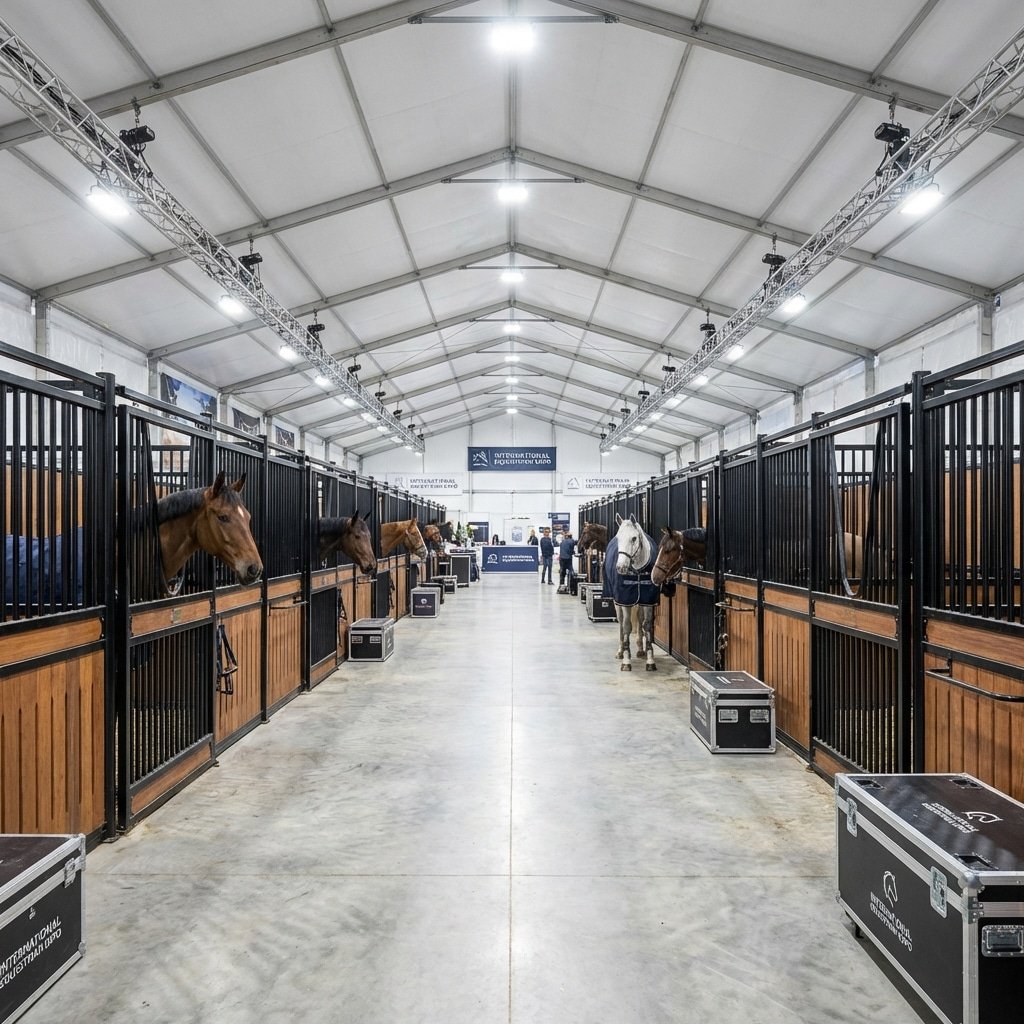
Efficient Tent Integration defines the margin between a profitable expo and a logistical disaster. Relying on incompatible, fully welded stabling units forces crews into excessive overtime and drives up transport costs due to wasted container space.
This analysis examines modular stabling solutions engineered for rapid deployment under clear-span structures. We benchmark the DB Stable flat-pack system, capable of loading 45 sets per 40HQ container, against traditional welded units to maximize freight efficiency and site safety.
Der Aufstieg von ESG (Environmental, Social, Governance) im Bauwesen
By 2026, ESG shifts from voluntary “green” badging to mandatory audit frameworks. Success now depends on documenting whole-life carbon costs and minimizing supply chain (Scope 3) emissions.
</bl
ockquote>
From Voluntary Standards to Regulatory Mandates
The days of vague “eco-friendly” marketing claims are over. Investors and regulators now demand hard data. In the past, energy efficiency (operational carbon) was enough. Now, the focus has shifted aggressively to embodied carbon—the emissions generated before the building even opens. For construction firms, this means every material choice is under the microscope for its total environmental cost over decades.
Mandatory Disclosure: You need audit-ready data on embodied carbon. It is no longer optional; it determines project viability and financing.
Whole-Life Assessment: A cheap product that requires replacement in five years is now a liability. The market incentivizes materials that last decades to avoid the carbon cost of manufacturing replacements.
Scope 3 Accountability: Your supplier’s emissions are your emissions. Logistics and manufacturing efficiency are now critical selection criteria for maintaining a compliant supply chain.
Optimizing Scope 3 Emissions via Flat-Pack Logistics and Galvanization
For equestrian infrastructure, the biggest carbon offenders are inefficient transport and premature rust. Shipping “air” inside fully welded frames ruins a project’s carbon footprint, while steel that rusts out in five years doubles the manufacturing impact. DB Stable addresses these Scope 3 issues through specific engineering decisions designed to protect both the environment and distributor margins.
Effizienz im Güterverkehr: We use a proprietary flat-pack design that fits 30-45 Sätze in a single 40HQ container. Competitors shipping welded units only fit 12-15 sets. This reduces transport emissions per unit by over 60%.
Extended Lifecycle: We strictly adhere to BS EN ISO 1461 for hot-dip galvanization after fabrication. This ensures the steel resists rust for decades, eliminating the “replacement carbon” footprint associated with painted or pre-galvanized alternatives.
Sustainable Material Choice: We utilize High-Density Bamboo infills. Bamboo matures in 3-5 years compared to decades for hardwoods, offering a renewable alternative that maintains the structural density required for horse safety.
Abkehr von Altholz (Eiche/Kiefer)
Traditional hardwoods suffer from slow regeneration and high maintenance needs. The industry is shifting to high-density bamboo and HDPE for superior durability, impact resistance, and zero maintenance requirements.
The Ecological and Practical Limits of Traditional Hardwoods
For decades, oak and pine were the default choices for stable infills, but they present significant operational liabilities for modern equestrian facilities. Beyond the environmental strain of harvesting trees that require 50 to 100 years to mature, natural timber reacts poorly to the aggressive environment of a working stable. The combination of moisture, ammonia, and physical impact exposes the functional limitations of these traditional materials.
Unsustainable Regeneration Cycles: Old-growth oak takes decades to replace, making it an increasingly scarce and expensive resource compared to rapidly renewable alternatives.
High Maintenance Burden: In a stable environment, timber requires constant staining and sealing to prevent rot. Without this labor-intensive upkeep, wood absorbs urine and moisture, becoming a breeding ground for bacteria.
Cribbing and Structural Damage: Horses naturally chew on softwoods like pine. This damages the facility’s structural integrity and poses health risks to the animal through splinter ingestion.
High-Density Bamboo and HDPE as Superior Alternatives
To eliminate the maintenance cycle and improve safety, DB Stable utilizes engineered materials that outperform natural wood in hardness and longevity. We have standardized our production on High-Density Strand Woven Bamboo and UV-Stabilized HDPE, ensuring our stalls withstand the impact of kicking horses while meeting modern sustainability standards.
Engineered Hardness: Our bamboo boards boast a Janka Hardness > 3000 lbf, making them over three times harder than oak. This density effectively prevents cribbing.
Schnelle Erneuerbarkeit: Unlike timber, our bamboo matures in just 3-5 years. The strand-woven process creates a board that is naturally mold and rot-resistant without requiring toxic pressure treatments.
The “Zero Maintenance” Solution: For high-traffic facilities, we use 28mm-32mm Recycled HDPE. This material is impact-absorbing, completely impervious to moisture, and requires no painting or sealing—ever.
Durable Wholesale Stables With 20-Year Lifespan
Maximize facility value with rust-resistant galvanized steel stables engineered for extreme global weather. Our modular designs cut installation time by 30%, ensuring rapid deployment and long-term durability.
Global leaders like Siemens and Tesla prove that carbon-neutral manufacturing enhances efficiency. We apply these same standards using high-density bamboo and ISO 1461 galvanized steel to maximize lifecycle durability.
Factory / Leader
Key Sustainability Milestone
Core Methodology
Siemens Electronics (Chengdu)
24% Energy Reduction
Digital Twins & Process Analytics
Lego Factory (Vietnam)
100% Carbon Neutral
12,400 Rooftop Solar Panels
Nestlé (Surčin)
Zero Waste to Landfill
Comprehensive Recovery Systems
Tesla Gigafactory (Shanghai)
92% Production Increase vs Waste
Advanced Waste Classification AI
Global Benchmarks in Green Manufacturing
The manufacturing sector is currently undergoing a definitive shift where sustainability is no longer just a compliance checklist but a core operational strategy. Major industrial players have set the standard for what modern production lines must achieve regarding waste and energy.
Siemens Electronics Works Chengdu (SEWC): This facility serves as a digital lighthouse, achieving a 24% reduction in energy consumption and a 48% drop in waste by utilizing digital twins to model production efficiency before physical execution.
Lego Factory Vietnam: Lego is constructing its first carbon-neutral run facility, powered by 12,400 rooftop solar panels and offset by extensive biodiversity planting on the surrounding land.
Nestlé Surčin Facility: This plant establishes the zero-waste-to-landfill benchmark, proving that even large-scale food processing can achieve total recycling and recovery of byproduct materials.
Sustainable Infill and Production Standards
Aligning with these global benchmarks requires selecting materials that balance environmental responsibility with industrial-grade durability. In the equestrian sector, this means moving away from slow-growing hardwoods and chemically treated softwoods toward high-yield renewables and fully recyclable metals. We adhere to strict material specifications to ensure our stables meet these modern standards.
High-Density Bamboo Infill: Unlike oak, which takes decades to mature, bamboo regenerates in 3-5 years. Our strand woven bamboo registers a Janka Hardness rating > 3000 lbf—three times harder than oak—providing a mold-resistant, kick-proof barrier without contributing to deforestation.
Hot-Dip Galvanization (ISO 1461): Sustainability includes longevity. We immerse our steel frames after fabrication to achieve a zinc coating average > 85 microns. This extends the product lifecycle by decades compared to pre-galvanized alternatives, significantly reducing scrap waste from premature replacement.
Recyclable Structural Steel: We utilize Q235B and Q345B steel grades. These materials are 100% recyclable at the end of their lifecycle, ensuring the primary structure of every stable can be melted down and repurposed without loss of material properties.
Stranggeflochtener Bambus: Eine ergiebige Kohlenstoffsenke
Strand-woven bamboo functions as a significant carbon sink, sequestering 50–60 kg of CO₂ per culm while delivering a density exceeding 3,000 lbf Janka—three times harder than oak.
Rapid Sequestration and Biomass Efficiency
Bamboo creates a biological advantage through speed. While traditional hardwood forests require decades to regenerate, bamboo reaches full maturity in just 4-6 years. This rapid cycle allows the plant to absorb up to 57 times more carbon per hectare than comparable tree species, making it an aggressive tool for atmospheric carbon reduction.
Total Fiber Utilization: The strand-woven manufacturing process shreds the entire culm, utilizing high-density fibers that traditional milling would discard as waste.
Vermeidete Emissionen: Substituting bamboo for energy-intensive materials like concrete or steel creates “avoided emissions” while actively storing biogenic carbon within the stable structure.
Janka Hardness and Extended Lifecycle
Carbon storage means nothing if the product fails after a few years. The environmental value of strand-woven bamboo is directly tied to its extreme density, which extends the product’s usable life far beyond softwoods. By preventing early replacement, we ensure the embedded carbon remains sequestered for decades.
Extreme Density: DB Stable utilizes 28mm-38mm High Density Strand Woven bamboo with a Janka Hardness exceeding 3000 lbf—effectively 3x harder than Oak.
Schlagzähigkeit: This density creates a “Kick-Proof” barrier that resists hoof impact and prevents horses from chewing the material, a common failure point in pine stables.
Carbon Lock: Longer product lifecycles keep carbon trapped in the physical structure rather than returning it to the atmosphere through rotting or incineration.
Q235B-Stahl: Der wiederverwertbare Rahmen 100%
Q235B steel offers ASTM A36 equivalent strength and acts as the ideal substrate for hot-dip galvanization, creating a framework that is structurally sound and fully recyclable.
The Metallurgy of Q235B Carbon Steel
Selecting the right grade of steel is the difference between a stable that bends under pressure and one that lasts decades. We standardize on Q235B Structural Steel because it balances high tensile strength with the ductility needed for custom fabrication. Unlike brittle high-carbon steels, Q235B allows for deep weld penetration without forming stress cracks, a critical factor when manufacturing safety-critical barriers for 500kg animals.
Streckgrenze: 235 MPa (Equivalent to ASTM A36), providing sufficient elasticity to absorb impact shocks.
Materialzusammensetzung: Controlled carbon content (<0.20%) ensures superior weldability for complex joinery.
Safety Standard: We strictly utilize 14-Spur (2.0mm – 2.5mm) wall thickness to prevent tube deformation from heavy kicks.
Optimizing for Hot-Dip Galvanization (ISO 1461)
Steel grade directly dictates the quality of the rust protection. Q235B chemistry is specifically optimized to react with molten zinc during the galvanizing process. This reaction creates a metallurgical bond—an iron-zinc alloy layer—that is far superior to surface-level paints or sprays. We employ a “Hot-Dip After Fabrication” method: we weld the raw black steel frames first, then dip the entire unit. This seals every joint and internal surface that pre-galvanized tubing leaves exposed.
Zink-Haftung: Q235B allows for average coating thicknesses >85 microns on structural parts.
Reihenfolge der Herstellung: Welding before dipping eliminates the risk of rust starting at the weld seams.
Lifecycle Economy: The resulting durability extends the facility’s replacement cycle, aligning with long-term sustainability goals.
Häufig gestellte Fragen
How do I ensure my equestrian center is ESG-compliant?
Compliance rests on three pillars: Environmental, Social, and Governance. For the Environmental pillar, shift procurement toward materials with long lifecycles rather than disposability. We recommend hot-dip galvanized steel (BS EN ISO 1461 standard) because it eliminates the need for replacement materials every few years, unlike untreated timber. Install solar panels and rainwater harvesting systems to handle operational loads.
Social compliance focuses on staff and animal safety. Use kick-proof materials like Q345B steel and high-density infills to prevent injury to grooms and horses. Governance requires transparent supply chains. Ensure your equipment suppliers provide valid mill certificates and fair labor documentation, rather than buying from opaque sources.
Is bamboo a durable option for stable infills?
Yes, if you select high-density strand woven bamboo. Standard bamboo can be hollow or weak, but the industrial-grade bamboo we specify has a Janka Hardness rating exceeding 3,000 lbf. This makes it approximately three times harder than Oak. It resists hoof impact and cribbing (biting) far better than traditional softwoods like Pine.
From a sustainability perspective, bamboo matures in 5 to 7 years, compared to 50+ years for hardwood trees. It regenerates naturally without replanting. Just ensure the boards are treated for mold and rot resistance to handle the moisture levels typical in a stable environment.
Which material has a lower environmental impact: Steel or Wood?
This depends on the timeline you analyze. Wood has a lower initial carbon footprint during the manufacturing phase. But in a high-traffic commercial stable, wood degrades. It rots, warps, and gets chewed, often requiring full replacement within 10 to 15 years.
Steel, specifically Hot-Dip Galvanized Q235B, is a “buy once” investment. It lasts decades without maintenance and is 100% recyclable at the end of its life. For B2B projects where long-term operational costs and waste reduction matter, steel offers superior lifecycle sustainability.
Are there specific green certifications for horse stables?
Widely recognized certifications like LEED are designed for urban commercial buildings and fit poorly with agricultural structures. While you can attempt to certify a large equestrian center under commercial standards, it is often an administrative burden with low ROI.
Instead of chasing a plaque, focus on measurable metrics: lowering kilowatt-hours per stall, reducing water usage, and sourcing verifiable sustainable materials. Some regional codes, like California’s CalGreen, do have specific mandates for agricultural structures regarding water and energy conservation.
What defines an eco-friendly horse barn?
An eco-friendly barn combines modular efficiency with passive design. We define this through three key features:
Stack Effect Ventilation: Open grill designs allow hot air to rise and escape naturally, reducing reliance on electric fans.
Prefabricated Modularity: Our flat-pack system allows a 40HQ container to hold 30-45 sets, drastically reducing shipping emissions compared to fully welded alternatives.
Material Longevity: Using hot-dip galvanized steel prevents the cycle of “rot and replace” common with wood, minimizing landfill waste over the facility’s life.
Abschließende Überlegungen
Ignoring Scope 3 emissions is no longer a commercial option for modern expo infrastructure. Selecting DB Stable’s ISO 1461 galvanized frames and high-density bamboo infills secures your regulatory compliance while eliminating the replacement costs associated with rotting timber. This strategic shift protects your rental inventory’s lifecycle value and safeguards your margins against rising logistics fees.
Stop estimating your carbon impact and start documenting it with our audit-ready supply chain data. We invite you to request a specific loading plan to see how our flat-pack system fits 30-45 sets per container, maximizing your freight efficiency. Contact our engineering team today to configure a high-yield, ESG-aligned infrastructure package for your next event.
Hallo, ich bin Frank Zhang, der Gründer von DB Stable, ein Familienunternehmen, ein Experte für Pferdeställe. In den letzten 15 Jahren haben wir 55 Ländern und mehr als 120 Kunden wie Ranch und Farm geholfen, ihre Pferde zu schützen. Der Zweck dieses Artikels ist es, mit dem Wissen im Zusammenhang mit Pferd Stall halten Sie Ihr Pferd sicher zu teilen.





 German
  English
  Spanish
  French
  Arabic
0 Kommentare